How to Short Crude Following Aggressive Rate Cuts
The FOMC’s 50 basis point cut won’t prop up crude oil prices for long and I'm taking advantage.
You've reached your free article limit
You've read 0 of 1 free Pro articles.
Were you surprised that the Federal Open Market Committee cut the Fed funds rate by 50 basis points on Wednesday? I was.
Not because it was the wrong move, but because it was the right move. The Fed is often late to the party. Consider the “inflation is transitory” fiasco, for starters.
This time, there was too much evidence to ignore. The Fed made the right call, and at least for now, the trading markets seem to agree.
Now, we’re getting bounces in copper and crude oil, two commodities that tend to fall in a recessionary environment. It’s the market’s way of saying that a recession just became a bit less likely.
However, both copper and crude are moving higher within the context of bearish downtrends. Crude oil in particular looks like an attractive short, if it would just bounce a bit higher.
I’m aiming to short West Texas Intermediate, which has been trending lower since early June (diagonal lines). I’m planning to enter near $74.75 (green), which is near the upper end of the bear channel.
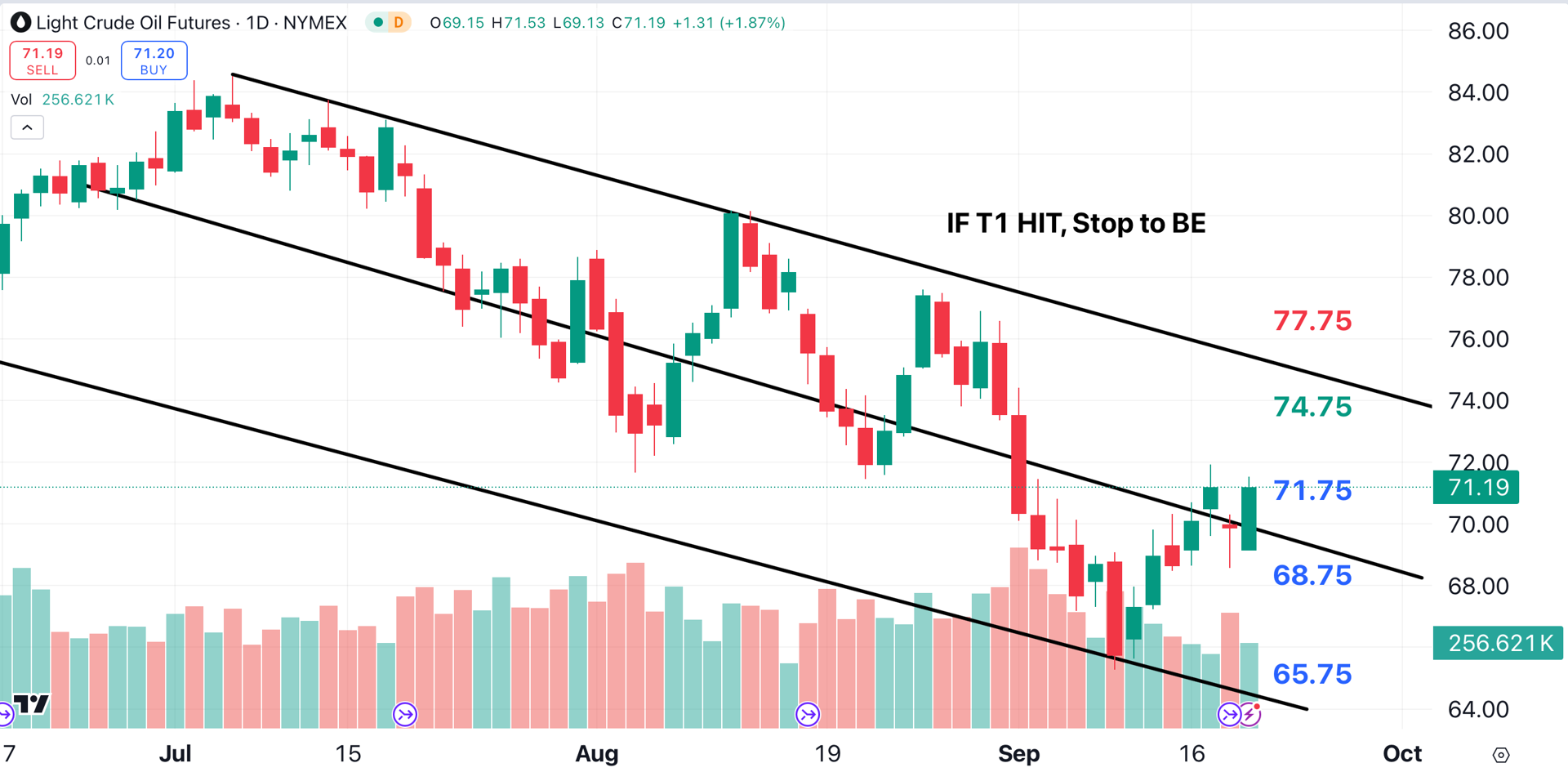
I’m placing a protective stop at $77.75 (red). My plan is to close one-third of the trade at each of three targets: $71.75, $68.75 and $65.75 (blue).
If and when the first target is hit (T1), I’ll lower my protective stop to breakeven ($74.75). If the second target is reached, I’ll lower the stop again, this time to the former location of the first target ($68.75).
Why did the Fed take the bold step of cutting rates by 50 basis points? In its statement, the FOMC said its concerns for inflation and employment were now in balance. Earlier, the central bank’s decision-making body had a strong bias toward taming inflation.
Did the FOMC notice something that was too bleak to ignore? I'm not referring to the usual suspects, like non-farm payrolls or weekly jobless claims data. Cracks are starting to form in less obvious places.
For example, the Institute for Supply Management (ISM) recently reported that the U.S. manufacturing sector has contracted for four consecutive months, and in 20 of the past 21 months.
ISM uses diffusion indexes. This means that any reading above 50 indicates growth, and a reading below 50 indicates contraction.
While the following applies only to the manufacturing sector, it's too bleak to ignore.
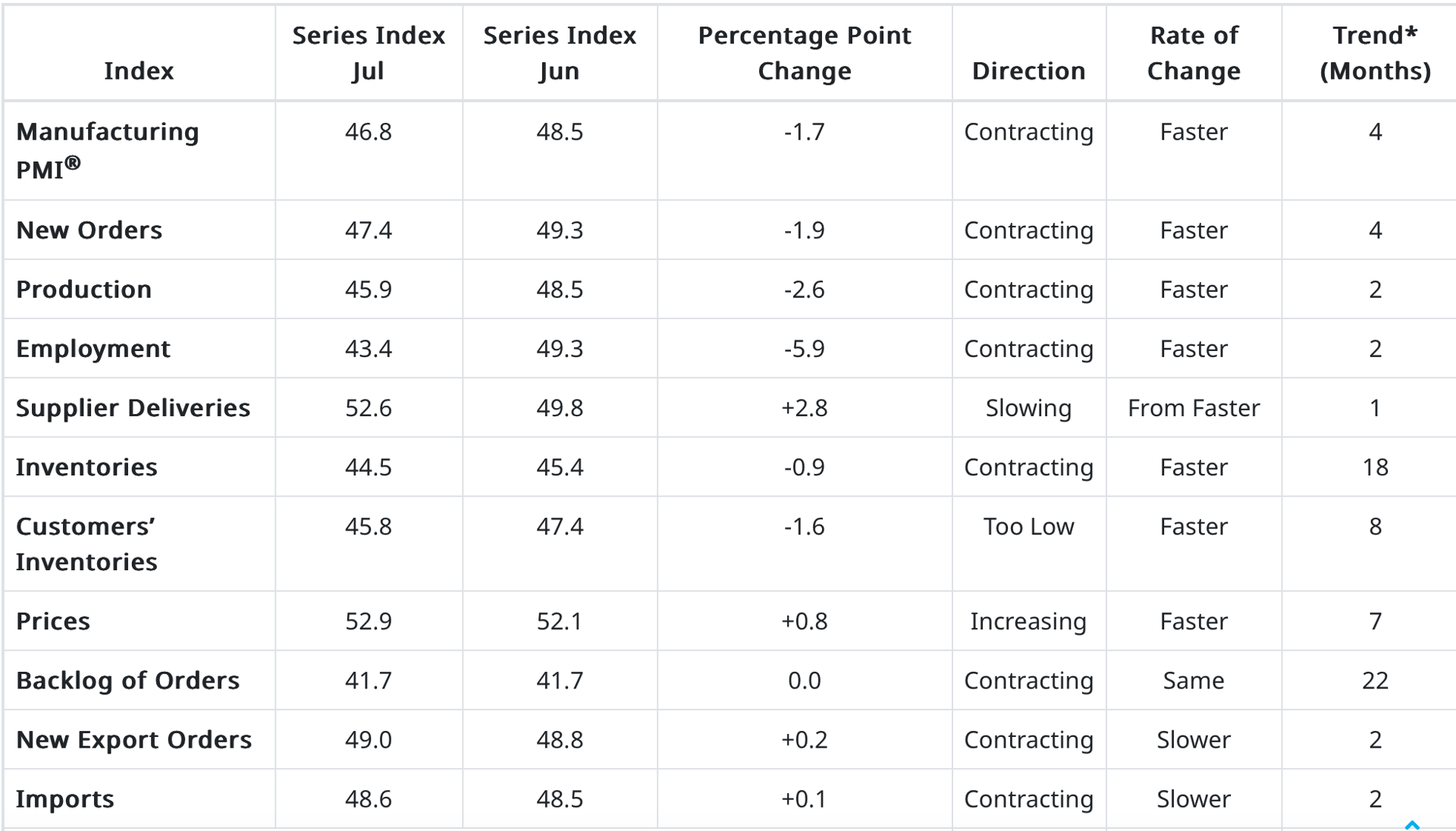
The headline number for the most recent ISM manufacturing report (July) came in at 46.8, below June’s figure of 48.5.
That’s bad, but what really caught my eye was the employment component of this figure, which registered a mere 43.4. This was a sharp decline from June’s 49.3.
Manufacturing employment isn't just weak — it’s falling off a cliff. That doesn’t bode well for the sector. Notice that nearly every data point on the above table is negative.
Now, consider that this weakness may not be unique to the manufacturing sector, and you can understand why a 50 basis point cut was the right move.
At the time of publication, Ponsi had no positions in any securities mentioned.