AeroVironment at a Crossroads After Impressive Earnings
The defense contractor turned some heads on Wall Street with surprising results.
You've reached your free article limit
You've read 0 of 1 free Pro articles.

Autonomous systems focused defense contractor AeroVironment (AVAV) released the firm’s fiscal first quarter financial results on Wednesday evening. The adjusted results were impressive, even if the sales growth was not exciting. There is a backlog to talk about, but the guidance did not floor anyone. The stock appears to this old dog to be at a crossroads. Let’s talk about it.
For the period ended August 1, AVAV posted an adjusted EPS of $0.59 (GAAP EPS: -$0.10) on revenue of $480.49 million. These top- and bottom-line numbers all beat Wall Street’s expectations, the bottom-line prints decisively so. That revenue print, while better than projected, was only good for sales growth of 5.7%. That said, the firm’s funded backlog has reached $1.5 billion, which is up 37% year over year. That, my friends, is impressive.
Wahid Nawabi, who is the firm’s chairman, president and CEO commented in the press release:
“AV’s fiscal year 2027 is off to a strong start, with record first-quarter revenue and funded backlog and landmark strategic wins. Our team is united in our mission to execute with discipline and capture demand for the key franchise programs that matter most to our customers, and that is exactly what we did in the first quarter.”
Nawabi added:
“Our customers are continuing to field autonomous capabilities at increasing scale, and our priority is expanding manufacturing capacity across our sites and strengthening our supply chain so we can deliver for our customers at the speed their missions require. We are excited for the opportunities ahead as we extend our track record of value creation for shareholders, customers and all stakeholders that rely on AV.”
Operations
Product sales were up 4.9%, and the sales of contracted services were up 7.1% as sales increased 5.7% to $480.49 million. The cost of those sales decreased 1.1% to $355.891 million, leaving a gross profit of $124.599 million (+31%) on a gross margin of 25.9% (up from 20.9%). After accounting for all operating expenses, GAAP operating income/loss printed at -$10.871 million, up sharply from -$69.272 million.
Once factoring for interest, other income and expenses as well as taxes, GAAP net income/loss ends up at -$5.066 million, up nicely from the year-ago comp of -$67.37 million. That works out to $0.10 per fully diluted share, up from -$1.44. After adjustments, primarily for the amortization of acquired intangible assets, that EPS print becomes $0.59, up from $0.32 for the year-ago period.
Guidance
For the full fiscal year, AVAV affirmed its expectation to drive revenue of $2.125 billion to $2.225 billion, which keeps the midpoint below the $2.19 billion that Wall Street was looking for. Revenue is expected to accelerate during the second half of the fiscal year as the timing of the final U.S. budget remains uncertain. Full year adjusted EPS is projected at $3.01 to $3.34. That, too, brings the midpoint below the $3.22 expected by the community of analysts.
Fundamentals
For the quarter reported, AVAV generated operating cash flow of $13.496 million, up from -$123.726 million a year ago. Out of that number came traditional capex spending of $44.033 million and $5.417 million in capitalized software. That left “free” cash flow of -$35.954 million. The firm obviously does not return capital to shareholders.
Turning to the balance sheet, AVAV ended the period with a cash position of $589.227 million and inventories of $410.773 million. That left current assets at $1.882 billion. Current liabilities add up to $441.73 million, including $87.546 million in “customer advances.” I call those deferred revenues. The firm’s current ratio stands at a very muscular 4.26. Adjusted for those advances, this ratio rises to an incredible 5.32. There is no short-term debt on the books. To say that AeroVironment is in “solid” shape fiscally would be the understatement of the year.
Total assets amount to $5.731 billion. About 59% of that total is labeled as either goodwill or other intangibles, which I do not love very much. Total liabilities less equity comes to $1.335 billion, so there was no need to claim so much in the way of intangibles. There is an entry for long-term debt of $730.057 million. While the number is eye-opening, it still stands at far less than the cash position and receivable combined. I am not overly concerned about this balance sheet.
Opinion
I think it is obvious that AeroVironment’s business model is becoming more and more efficient all the time. The potential for growth is obvious as the funded order backlog is there, and unmanned warfare only becomes more and more prevalent. Cash flows are not where I’d like to see them yet but are improving dramatically. The balance sheet is in good shape. The current position is in better than excellent shape. The guidance was not spectacular. I think the street liked the fact that the firm did not cut guidance. There were some whispers that it might.
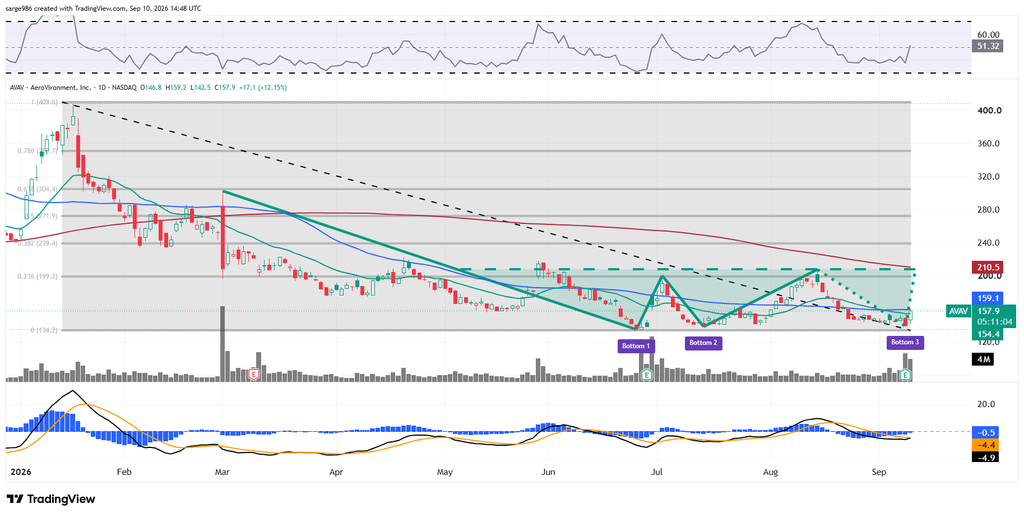
AVAV has developed a very interesting daily chart. Optimists will see a developing triple-bottom pattern of bullish reversal. Pessimists will note that every recent rally in this name has failed at the 23.6% Fibonacci retracement level of the January into June sell-off. This also just happens to be very close to the pivot point created by the Triple Bottom. Neither Relative strength nor the daily MACD offer a lot in the way of clues.
What traders need to see is the battle at the stock’s 21-day EMA at $158 and the battle right behind it at the 50-day SMA ($159). Should the stock retake these two lines, that would likely force both swing trades and professionals to get behind the stock. My idea? Wait. This is not the spot. Playing catch up won’t be an issue once those lines are retaken. However, failure this close to the nadir of the triple bottom carries substantial risk.
At the time of publication, Guilfoyle had no positions in any securities mentioned.