In Scott Bessent vs. The World, Can ‘The House’ Ever Win?
The Treasury secretary is fighting rising rates across the G7. But there’s a battle he can win, and it could create a win-win scenario for investors too.
You've reached your free article limit
You've read 0 of 1 free Pro articles.

So much for Treasury Secretary Scott Bessent’s status as “The House.” When it comes to controlling Treasury yields, Bessent is struggling because the rise in yields is a global phenomenon.
This isn’t Scott Pilgrim vs. the World. This is Scott Bessent vs. the World. Instead of battling seven evil exes, Bessent is fighting rising rates across the G7.
In Japan, the central bank policy rate is at a multi-decade high. The yield on a 10-year JBG is over 3%, a 30-year high.
In Europe, German Bund yields have reached a 15-year high, as the European Central Bank is expected to raise its main refinancing rate by another 25 basis points.
Global yields are rising, and there is little the Treasury Secretary can do about it. However, there is a battle Bessent can win, and it could create a win-win scenario for investors as well.
Suspension of Disbelief
Try to imagine the following scenario. This will require some suspension of disbelief.
In this scenario, Warren Buffett is still running Berkshire Hathaway (BRK.A, BRK.B). During an appearance on CNBC’s Squawk Box, Mr. Buffett discusses a new position he’s planning to initiate in stock XYZ:
“Over the next few months, we’re going to put billions of dollars to work in this stock. It’ll probably go much higher, simply due to the fact that I’ll be buying with both hands, so you folks at home might want to buy it too. In fact, if you’re a hedge fund trader, I dare you to short it.”
Of course, the above scenario is absurd. No fund manager would ever reveal his intentions in this manner, any more than a professional poker player would reveal his cards to his opponents at the table.
Easy vs. Difficult
A scenario does exist where telegraphing one’s intentions in this manner could be advantageous, but it won’t be found in the stock market.
For a hedge fund manager, moving a stock is easy. It’s so easy that institutional investors carefully enter and exit positions over weeks and months, to avoid unintentionally creating excessive volatility.
What if the stock in question had, say, 110 trillion shares in circulation? That stock would be much harder to move.
The House of the Falling Yen
When U.S. Treasury Secretary Scott Bessent refers to himself as “The House,” he’s warning investors not to bet against him. He’s not afraid to telegraph his intentions because there are about 110 trillion Japanese yen in circulation.
He wants to move the yen higher. Why does he care about Japan’s currency?
Here is the long-term chart of the Japanese yen. The yen is in a brutal downtrend, and has lost about one-third of its value since early 2021 (point A).
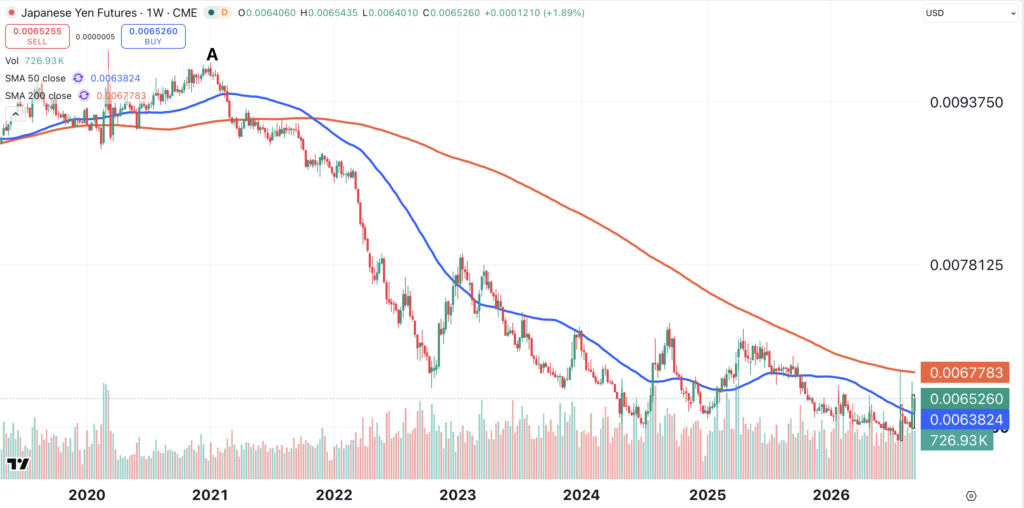
As the yen loses value, more yen are needed to purchase goods that are imported from outside Japan. Since Japan imports most of the crude oil it consumes, the rising price of oil combined with the falling yen creates a double-whammy of inflation.
That inflation is threatening to derail Japan’s economy, one of the five biggest in the world. By making the yen stronger, Japanese officials, with the help of Bessent, are fighting inflation.
Intervention Could Be the Key
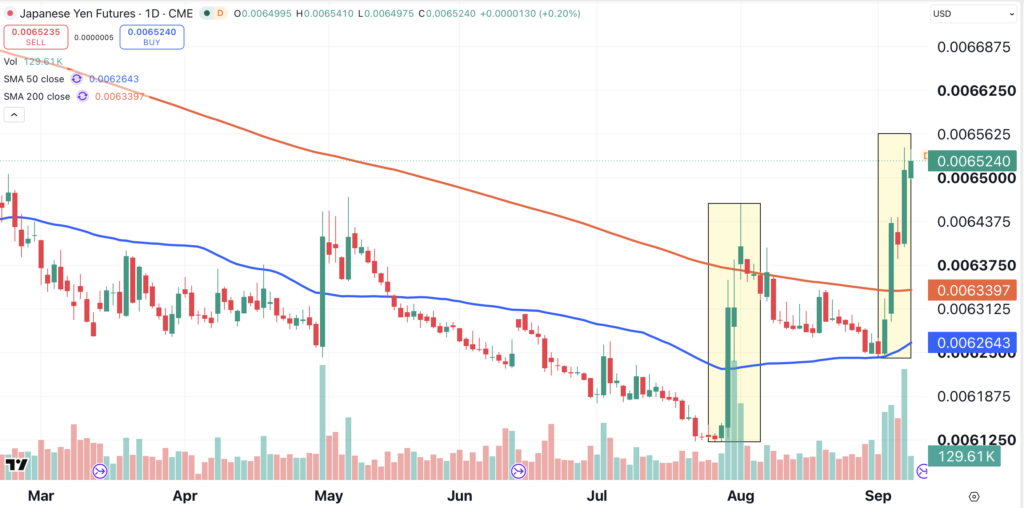
Bessent and Japanese officials are making a coordinated effort to fight the above trend. This is done through intervention, which occurs when a central bank or other government entity trades in the open market in an attempt to reverse the direction of the currency’s prevailing trend.
Zooming in on the yen’s daily chart, two recent interventions are clearly visible (shaded yellow).
Is intervention a form of manipulation? Sure, but it’s not illegal. This isn’t the stock market. Countries are free to do whatever they please with their own currencies.
A Win-Win Situation
Scott Bessent and Japanese officials are planning to drive the yen higher. They don’t mind if you come along for the ride. In fact, they’d appreciate your help, since there are so many yen in circulation.
If you turn a profit in the process, it doesn’t come out of their pockets. It’s a win-win scenario.
How to Trade It
There are numerous ways to trade the Japanese yen. Investors can use the Invesco CurrencyShares Japanese Yen Trust (FXY), shown on the left below, or the ProShares Ultra Yen 2X (YCL), a leveraged ETF designed to move twice as much as the yen, presented on the right.
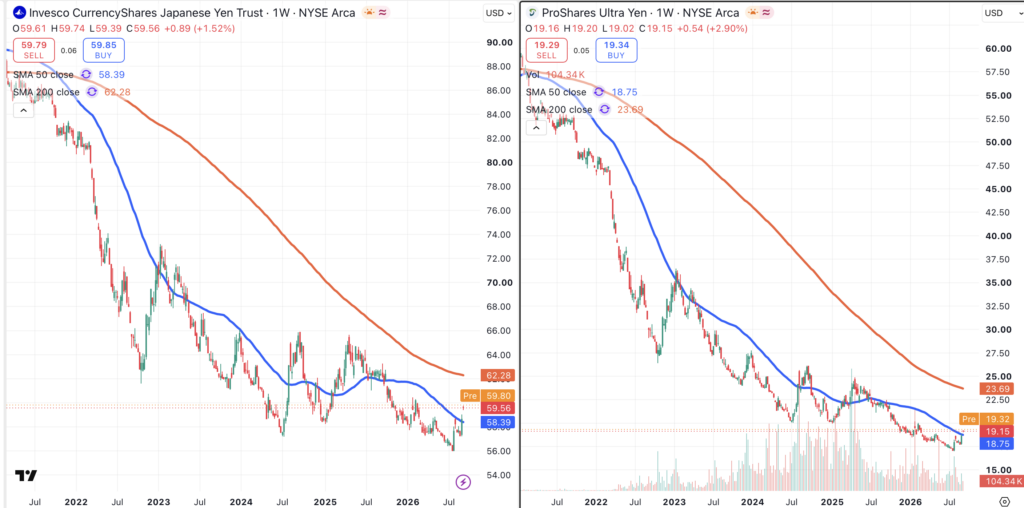
The yen can also be traded via futures and options.
No Guarantees
There is no guarantee that Bessent and company will succeed in changing the direction of the Japanese yen. Interventions sometimes fail, because they are often at odds with the underlying fundamentals.
Bessent formerly worked for George Soros, the trader who made a fortune betting against an intervention in the British pound in 1992. Soros, realizing that the intervention was doomed, shorted roughly $10 billion worth of British pounds. The pound subsequently crashed on September 16, 1992, a day known as Black Wednesday.
At the time of publication, Ponsi was long FXY, YCL, and Japanese yen futures.