Market updates and conversation from TheStreet Pro team. Follow the latest and join the conversation below.
Stock Market Today: October 21, 2026
Newest first · All times Eastern · 12 updates
DATE:
By Neil Sethi
Will Meta Break Hyperscaler Bond Drought?
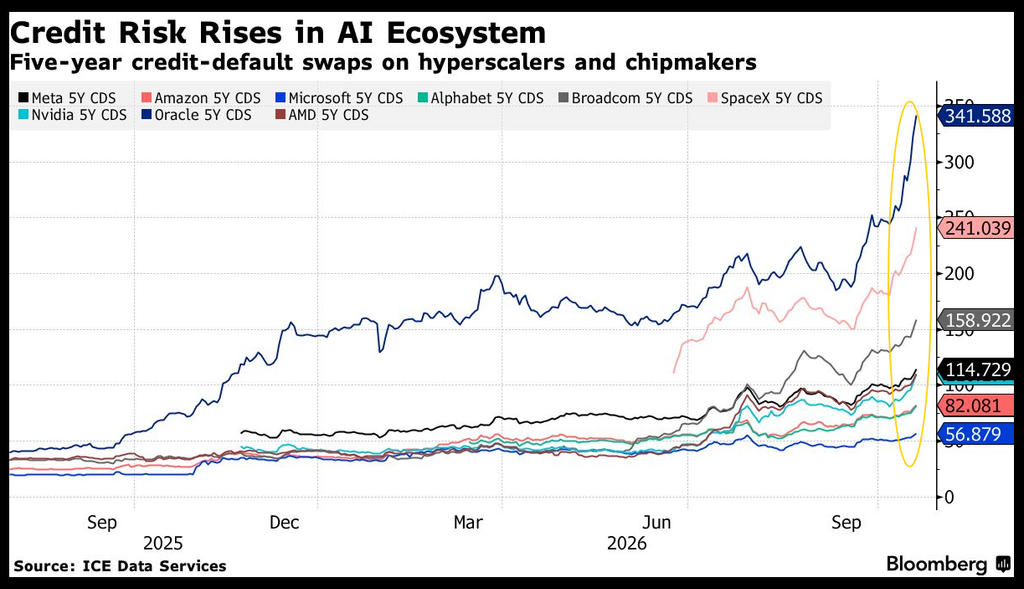
Ahead of Meta’s (META) earnings, 5-year credit default swaps hit new record highs on Tuesday across a range of the largest Tech companies.
“Credit default swaps tied to Oracle Corp. (ORCL), broadly seen as a barometer for AI debt risk, traded as high as a record 343 basis points, ICE Data Services data shows. A gauge of Meta’s credit risk has also touched an all-time high, soaring as much as 6.3 basis points to 114.8 basis points ahead of its earnings report Wednesday, the data shows.”
“We have yet to find some kind of a landing zone for the level of debt issuance that the market needs to absorb,” said Lotfi Karoui, multi-asset credit strategist at Pacific Investment Management Co in an interview Tuesday. “There’s still a wide range of estimates as how much debt capital this build out will end up consuming in general.”
That comes after $451 million of hyperscaler bonds were bought on Monday, the highest net buying since mid-September — likely a result of investors selling hyperscaler debt due to supply and demand concerns, according to Bank of America.
With the rise in funding costs there hasn’t been a hyperscaler bond deal in two months. We’ll see if we get news of one from Meta who previously said in April they would not issue again until the fourth quarter. Notably, Meta has moved up its normal last Wednesday of October reporting date a week, many think to do just that.
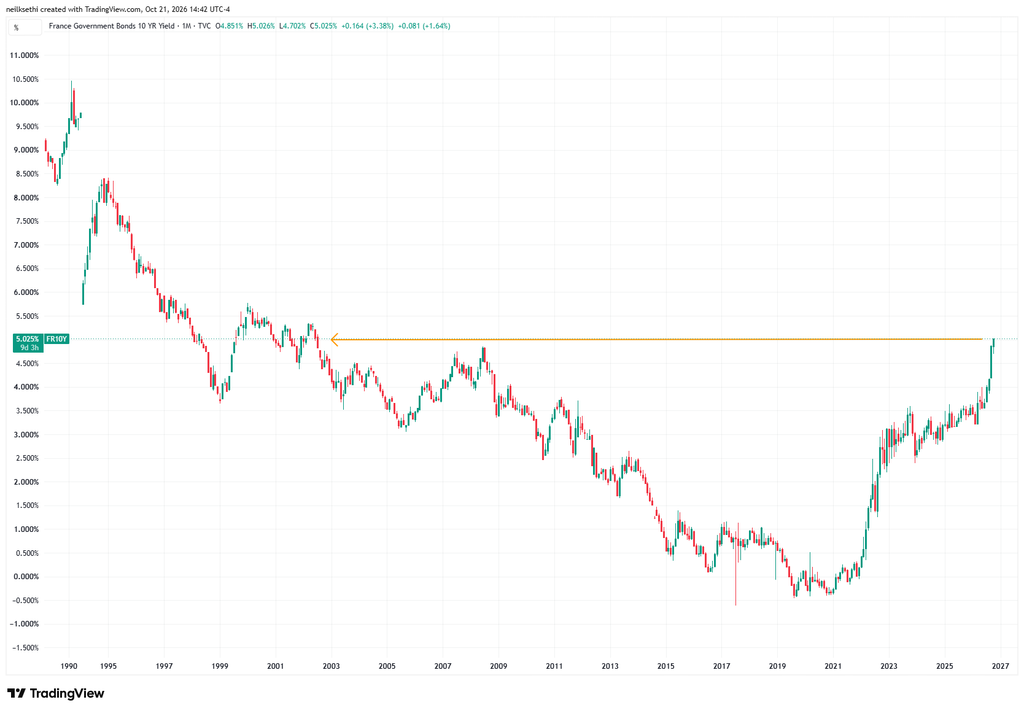
French 10-year bond yields join the U.S. in the 5% club, hitting that mark for the first time since July 2002.
While bond yields are rising globally, France has been hit especially hard by concerns over its precarious fiscal position, made worse by higher energy prices. Leadership there faces growing discontent over cost-of-living issues that have sparked violent protests, with similar unrest flaring in Italy, Belgium and Portugal. But its options are limited with the debt ratio already near 120% of GDP, almost twice Germany’s. Some investors are going so far as to draw parallels with Greece, the epicenter of the crisis that nearly splintered the euro zone early last decade.
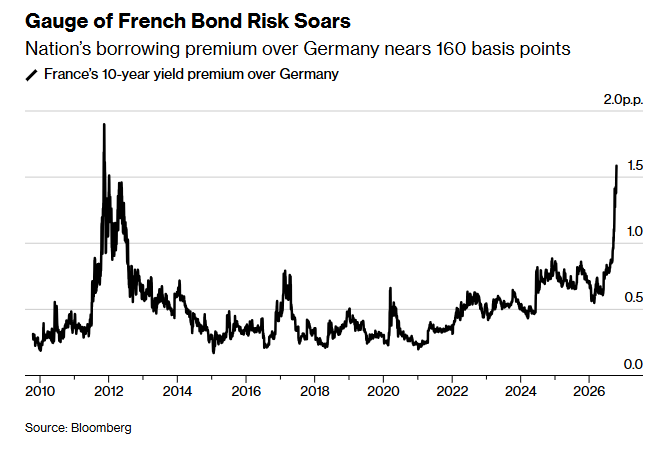
Those worries have pushed the gap between French and German yields to nearly 160 basis points, the most in 15 years (chart via Bloomberg). That has forced policymakers to more seriously consider a proposed 2027 budget with about €43 billion ($48 billion) in deficit-cutting measures, but Prime Minister Sébastien Lecornu still lacks a majority to pass it. Moody’s is also due to rule on France’s credit rating Friday, with most economists expecting a downgrade. Oh, and presidential elections are just six months away.
Axios is reporting Russian President Vladimir Putin told White House envoy Steve Witkoff on Wednesday that he “agrees in principle” resuming trilateral peace talks between Russia, Ukraine and the U.S. to end the war, according to Russian and U.S. officials.
The homebuilding sector, or the (XHB) ETF, has been mired in a massive slump this year. We can directly see the cause as being high interest rates, mortgages are comfortably above 7%. That is a huge difference from just five years ago when a new housing boom and refinancings took place (started when Covid was the issue). Many of those refinancers have very low interest rates and not only won’t pay off their mortgage but they won’t sell their house, either. The conundrum is about supply — is there too much or too little? It seems buyers are out there but maybe credit is an issue, or job security. Demand for housing is weak, this week saw housing starts and permits in negative territory.
Whatever the case, homebuilders are not in the best shape. Every chart looks the same, lower highs and lower lows, our textbook definition of a downtrend. The XHB has been fighting the 20-day moving average and losing, but eventually we’ll see it base and then move above there with some strong volume, it is just not happening now.
When might the homebuilders start to shine? It may not be in 2027, when Fannie Mae predicts mortgage rates will average 7.5%, far above its previous forecast of 6.75%. Not good times for the homebuilders, but maybe this is the down cycle for the group. Keep an eye on long-term rates.
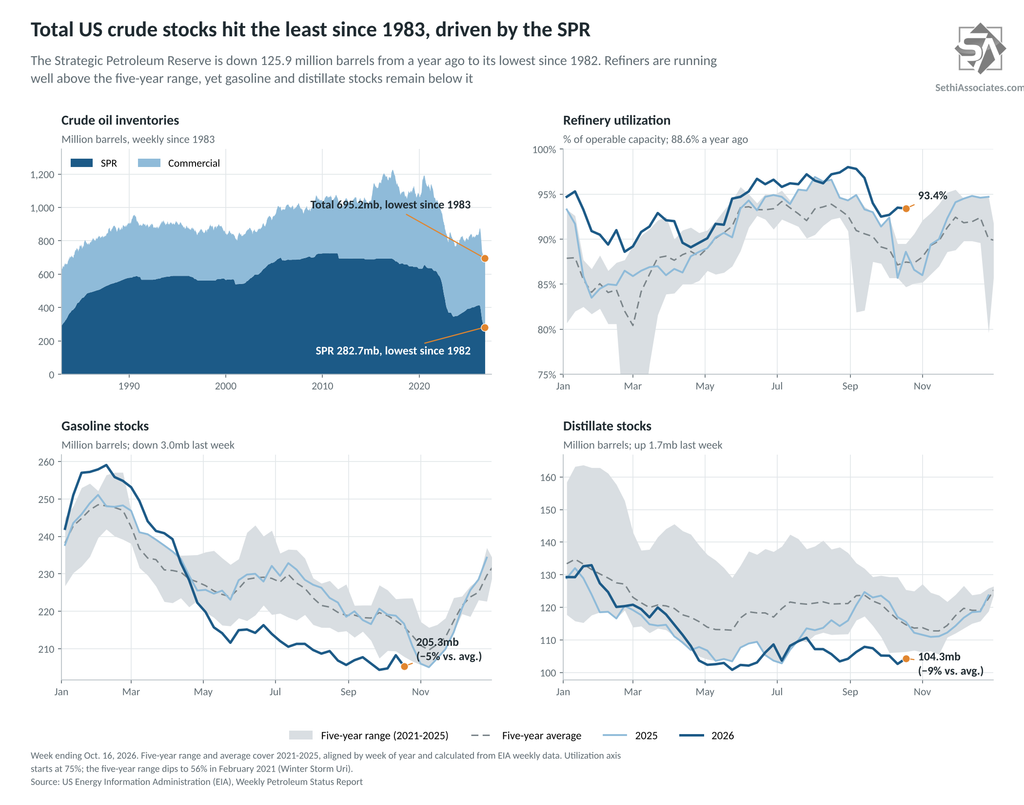
U.S. Crude Inventories Extend Slide to Lowest Since October 1983
Total U.S. crude oil inventories (commercial plus the Strategic Petroleum Reserve) extended their slide to 695.2 million barrels last week, the least since October 1983, per the EIA. The SPR is driving it, accounting for 125.9 million of the 136.2 million barrel drop in total inventories from a year ago.
The SPR slipped another 0.3 million barrels to 282.7 million in the week ending October 16, its lowest since 1982 and down 30.8% from a year ago. But commercial crude drew 3.1 million barrels to 412.5 million, the third straight draw (14.8 million barrels over those three weeks). That left it 3% below the five-year average and the lowest for this time of year since 2014.
Turning to products, those also remain historically low even as refiners are running hard: ▪️ Refinery utilization was 93.4%, versus 88.6% this week last year and well above the five-year range. ▪️ Gasoline fell 3.0 million barrels, the biggest draw since early May, to 205.3 million, 5% below the five-year average. Gasoline demand rose 575,000 barrels a day to 8.98 million. ▪️ Distillates rose 1.7 million barrels, the first build in five weeks, but are still 9% below the five-year average. ▪️ Products are also being drawn down by exports which are up 6.8% from a year ago on a four-week average.
One other notable: crude production fell 410,000 barrels a day to 13.27 million, the lowest since late January, as Hurricane Isaias kept Gulf of Mexico output offline (57% was still shut in as of October 12, per BSEE). Expect a rebound as platforms restart.
Mortgage Applications Drop for 7th Straight Week Despite Easing Rates
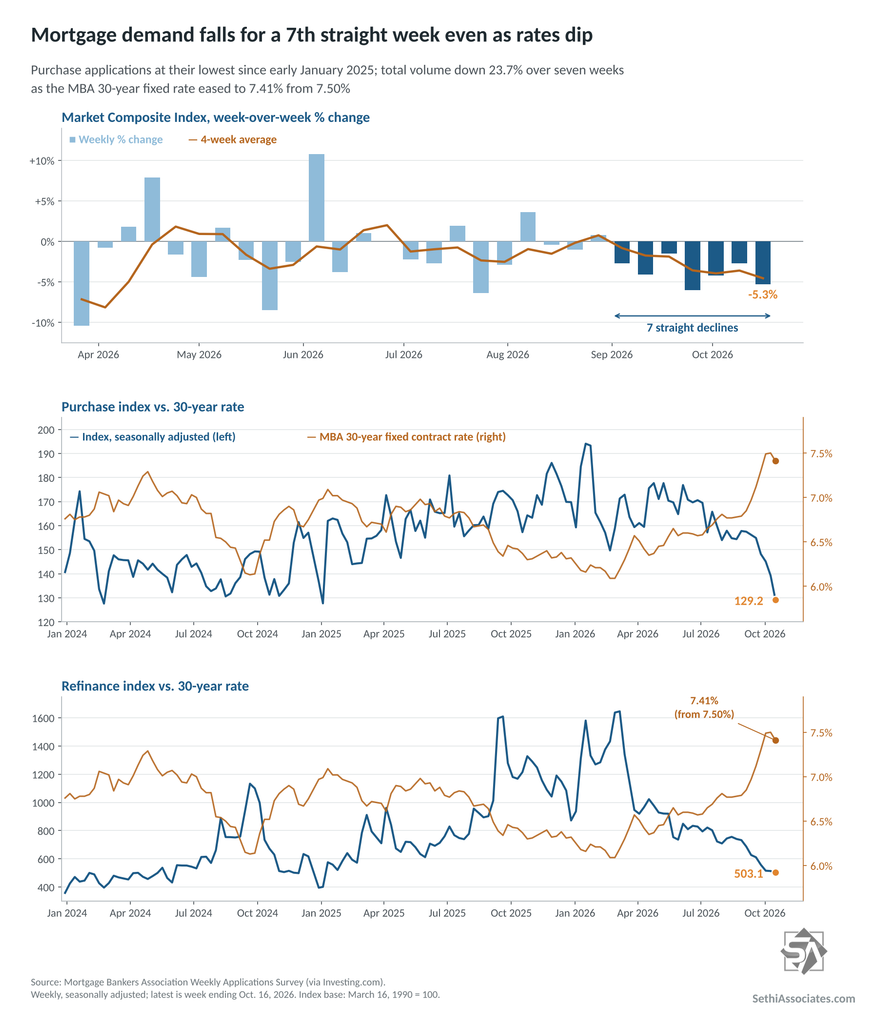
Mortgage applications fell 5.3% last week, according to the Mortgage Bankers Association (MBA), the seventh straight weekly decline, even as the 30-year fixed rate eased to 7.41% from 7.50%, its first drop in over two months. Total volume is now down 23.7% over those seven weeks.
▪️ Purchase applications fell 7% to their lowest level since early January 2025 and were 18% below a year ago. ▪️ Refinance applications fell 2% and were 59% lower than a year ago, with rates more than a full percentage point above where they were then.
MBA’s Joel Kan: “Lower rates were not enough to boost application activity, as both purchase and refinance applications continued to decline.”
CNBC’s housing reporter Diana Olick said buyers are reacting less to the weekly move in rates than to the overall higher level. The MBA’s 30-year rate has gone from 6.09% in February to 7.41% now.
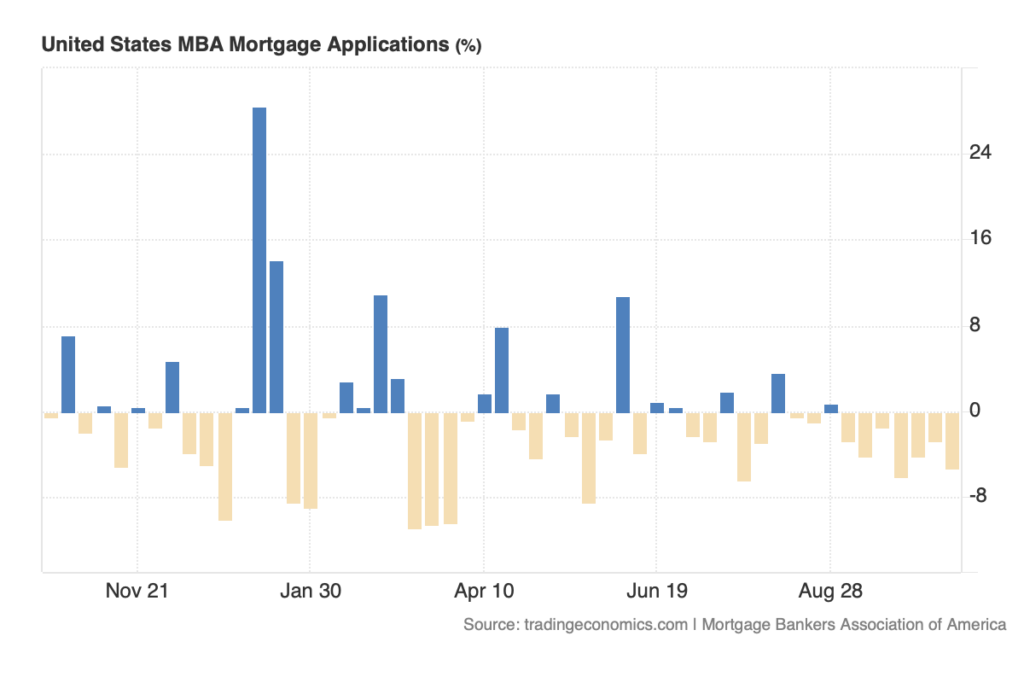
Per the Mortgage Bankers Association, U.S. mortgage applications fell 5.3% for the week ending October 16, marking a seventh consecutive weekly decline and reaching their lowest level since January 2025.
In other words, as we can see in the chart below, the slide continues.
The Informationis reporting that hackers used Claude and Grok to fully automate attacks on banks, supporting our view that AI adoption and usage by bad actors would accelerate the pace of cyber attacks and be a catalyst for incremental cybersecurity spending.
Here’s the gist:
A hacking group called CyberCartel used a network of AI agents running on models from Anthropic, SpaceX (SPCX) and the Chinese lab Moonshot AI to automate cyberattacks against more than 400 Latin American financial targets, according to an investigation by the cybersecurity startup Straiker.
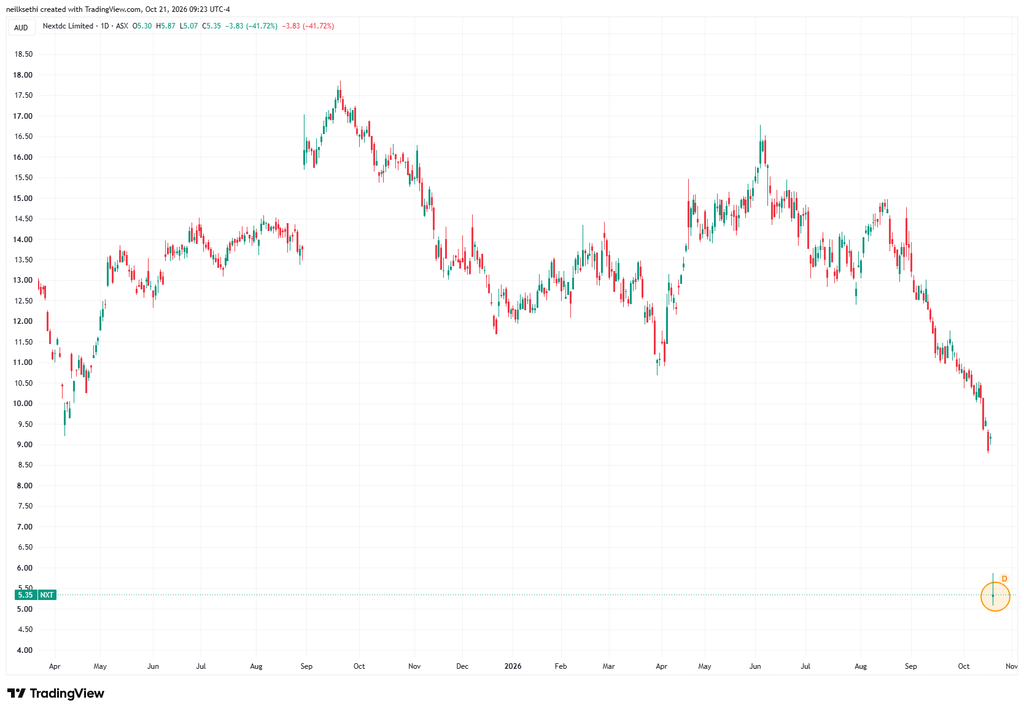
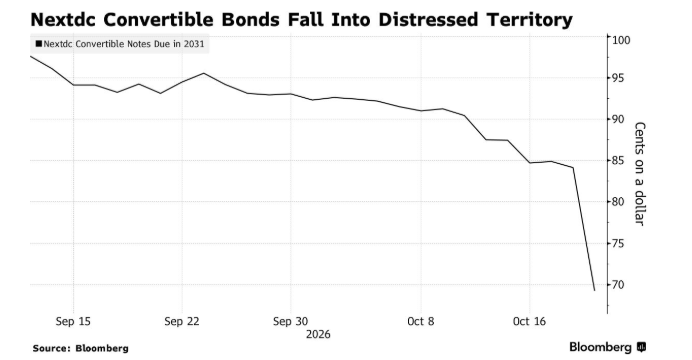
It’s not all positive in tech-land though as Australian data center firm Nextdc (NXT) slashed its full-year earnings guidance by a third and placed development plans on hold after protests delayed power supply to one of its major projects in Melbourne that saw the firm pause all new development work, a caution sign for other global projects that have run into opposition.
Its shares plunged almost 42% in Sydney — the most since listing in 2010 — cutting its value to about A$4 billion ($2.8 billion) while its bonds fell into distressed territory.
The delay forces the company to defer roughly A$140 million of contracted customer revenue in this financial year. Management has announced it will pause all new development projects. It has 17 in operation and 11 in development or planning.
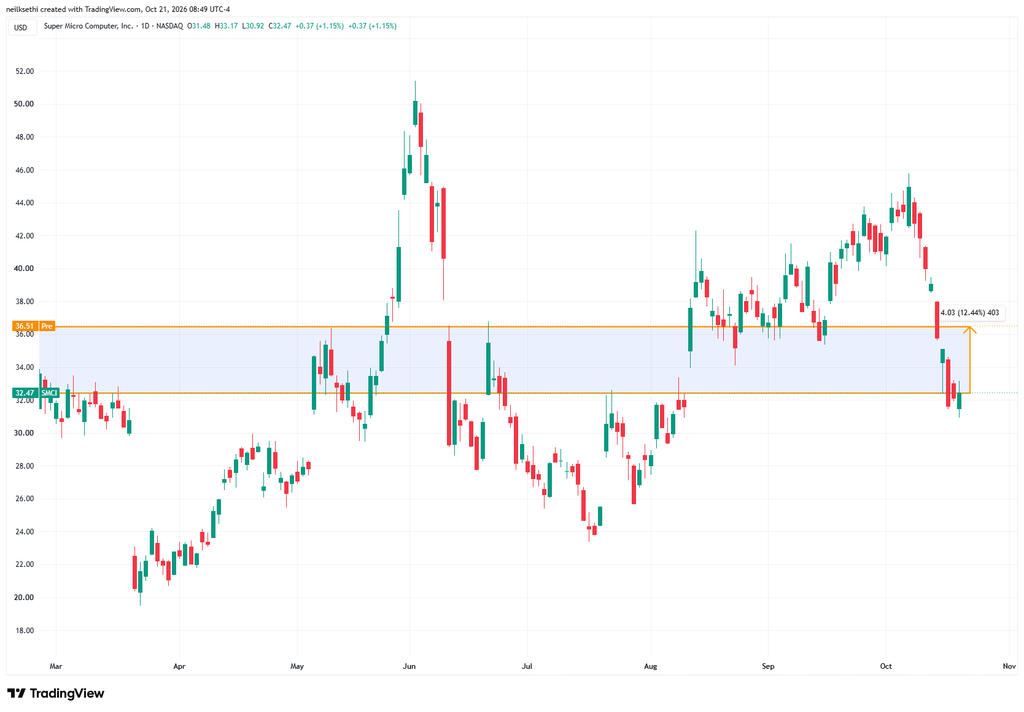
Shares of server maker Super Micro Computer (SMCI) are up over 12% premarket after the firm released preliminary quarterly numbers for the period ending September 30, saying it expects revenue of $18.5 billion to $19.5 billion for the quarter. That compares with its earlier forecast of $14.5 billion to $15.5 billion and an average analyst estimate of about $15 billion. The company also raised its gross margin forecast to 12% to 12.5%, from 10.4% to 10.8%
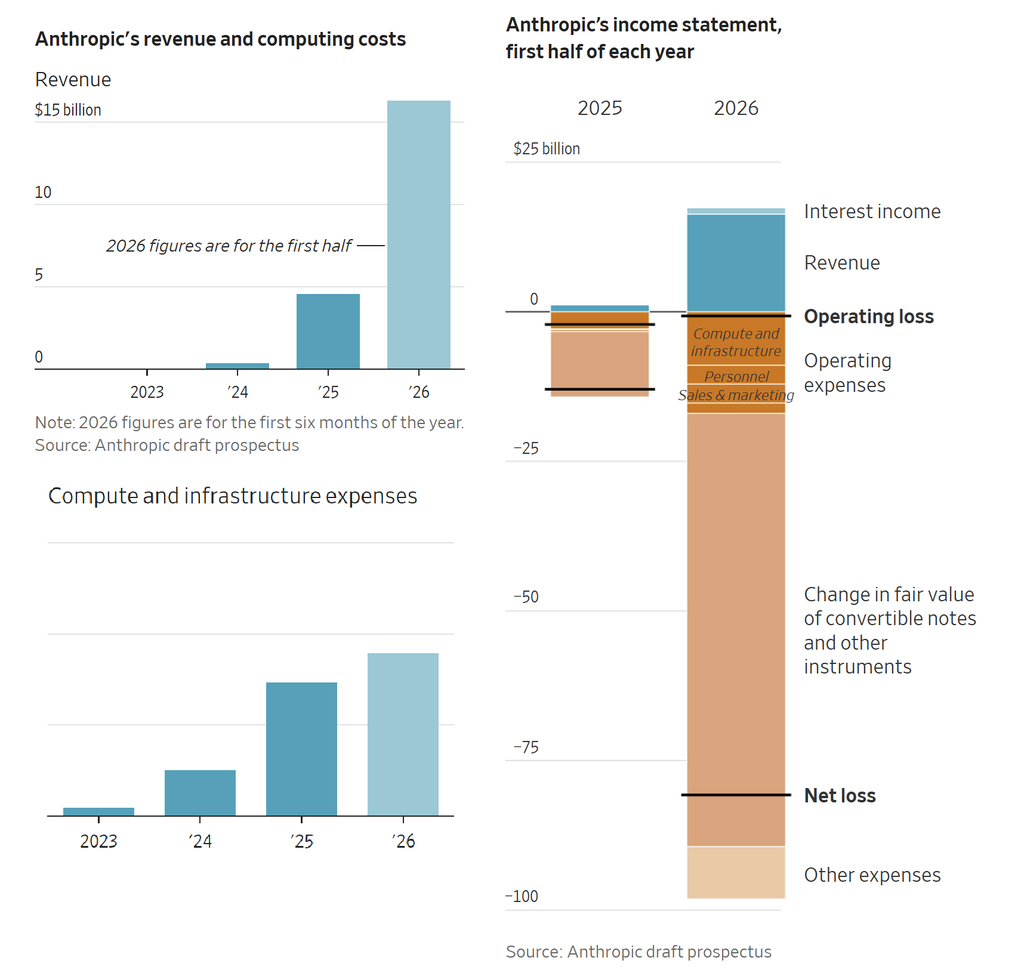
In addition, the Wall Street Journal is reporting that Anthropic’s draft prospectus signals coming spending on computer and power of as much as $750 billion in coming years, with $111 billion on contracts with Alphabet’s Google Cloud (GOOGL), $110 billion with Amazon Web Services (AMZN) and $31 billion with Microsoft (MSFT) “regardless of actual usage.”
Anthropic also agreed to spend up to $86 billion renting Nvidia (NVDA) chips from smaller AI cloud providers Nscale and Lambda.
And sales are growing at a blistering pace. The Journal reported revenues had grown to $16.3 billion in the six months ended June 30, up from $1.1 billion in the year-earlier period. That outpaced the nearly $9 billion on computing capacity and infrastructure, up from $2.3 billion.
Still it recorded a net loss of $80.7 billion, the vast majority ($72 billion) “tied to changes in the value of convertible notes and other instruments the company issued to raise funding.”
Wall Street Journal
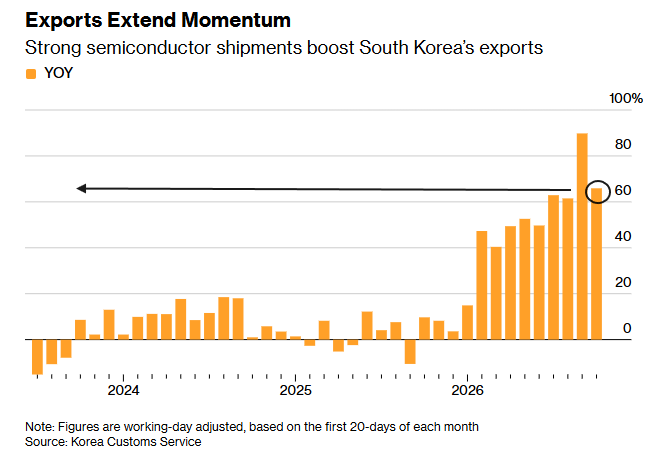
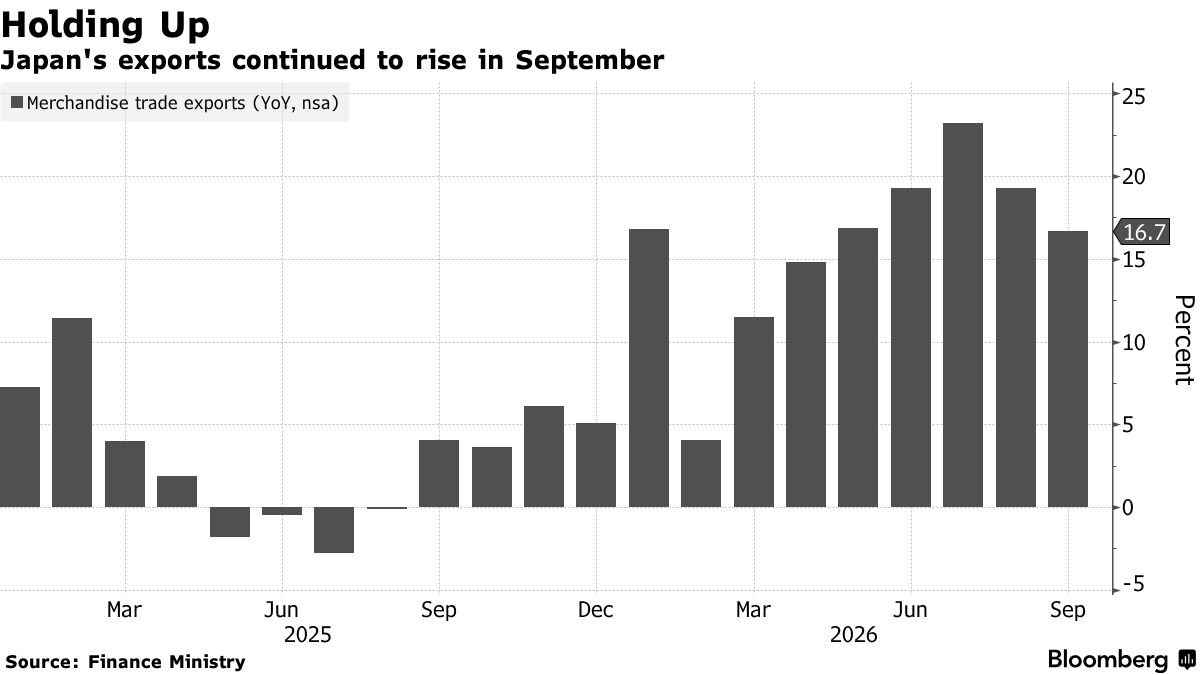
And finally, several Asian countries with large tech exposure (South Korea, Japan, Taiwan, etc.) are reporting strong export numbers led by semiconductor and other Tech shipments.
Bloomberg reports that South Korea’s exports the first 20 days of October, adjusted for working-day differences, rose 65.9% from a year earlier. While down from the 89.8% increase during the same period in September, it is otherwise a record. Semiconductors surged 222.5% from a year, while products increased 68.3%, and automobile exports almost 41%.
Bloomberg
Also from Bloomberg, Japan’s September export growth rose 16.7% from a year earlier. While it missed expectations for a 21.2% increase, shipments of semiconductors and chip-making equipment surged 49.4% and 43.9% respectively (autos were +15.1%). Shipments to the US gained 22.9%. Those to China and the European Union advanced 8.6% and 10.5%, respectively.
Reuters reports that Taiwan’s export orders jumped 62.4% in September to a record $114.21 billion “credited to strong demand for AI, high-performance computing and cloud services applications.” The Ministry of Economic Affairs forecast October as rising between 62% and 67%. “Taiwan’s orders in September for telecoms products were up 87.3% from a year earlier, while those for electronic products jumped 71.0%.”
Conversation 0 Comments
One ongoing discussion across all days. Everyone can read; sign in to take part.
Your voice matters. Discussions are moderated for civility. Read our guidelines .
Log in to join the conversation