Monthly Roundup: Let's Review All Portfolio Holdings as We Near Year-End
Our repositioning of the portfolio continued this week with seven buys and one exit.
You've reached your free article limit
You've read 0 of 1 free Pro articles.
We entered this week with the market short-term overbought, and despite Friday’s rebound, unexpected developments led all the major market averages to lose ground over the five trading days. Those developments included the reaction to the Fed’s December policy action and updated set of projections, which brought renewed uncertainty about the timing for future rate cuts.
Thursday added fresh drama from Washington, D.C. over a potential government shutdown in the early hours of December 21. If a deal to avoid that is not reached Friday, we will follow developments that could include a weekend agreement to fund the government into 2025. Should we start the holiday week with such a deal in hand, we could very well see Friday’s market rally continue, giving us a potentially early jump on a Santa Claus rally.
The glass half-empty view for this week is that the move lower in the market and the portfolio erased some of their gains. While we can’t argue with that math, we would argue the pullback took some of the froth out of a market that was until recently trading at extremely stretched valuations and robust investor sentiment. We saw that reflected in strong equity inflows since early November, which should lend a helping hand to our positions in Bank of America BAC and Morgan Stanley MS. Hopefully, you remember our discussions about the Citibank Panic/Euphoria model that was flashing “Euphoria” and other sentiment indicators in recent days.
The glass-half-full view is that we were able to put some capital to work at better share price levels. All told, we added to seven holdings this week and exited one as well. Part of that effort allowed us to build up positions that so far have been on the smaller size in the portfolio, but to be fair they have also performed very well for us. We see it as opportunity knocking, and we took advantage of that. As we continue to position the portfolio for the coming quarters, we’ll look for similar door knocks, and subject to what happens regarding the debt ceiling we may get one sooner than later.
Next week starts what tends to be two of the slowest market weeks of the year and that means trading volumes tend to be low as well. While things will move at a slower pace next week, in part because of the market’s early closing on December 24 and being closed on December 25 for Christmas, we’ll use the time to discuss S&P 500 earnings expectations for 2025 and the market's valuation while also continuing our work to freshen up the Bullpen. Should there be another bout of unexpected market happenings, we’ll be there to guide you through it.
Catching Up on the Portfolio This Week
While the market rebounded on Friday, as we discussed above, both the S&P 500 and the Nasdaq Composite moved lower compared to last week and that weighed on the portfolio. We have eight trading days left in the year, and accounting for the S&P 500’s still positive move quarter to date, it is up more than 24% year-to-date. While the portfolio’s outperformance relative to the S&P 500 lessened this week, as we move into the last two weeks of the year, our quarter-to-date and year-to-date returns remain nicely above those for the S&P 500.
Following Monday’s December Flash PMI report from S&P Global that revealed the service economy ticked higher, employment improved, and inflation abated during the month. On the back of that data, we used the short-term oversold nature of the market to pick up additional shares of Builder’s First Source BLDR, United Rentals URI, and Waste Management WM.
Those shares moved lower as did the rest of the portfolio on Wednesday afternoon following the Fed’s fresh injection of uncertainty about the timing for its next rate cut. We discussed what that timing is likely to look like as we dissected Friday’s November PCE Price Index results.
We used Wednesday’s market retrenchment to pick up more shares of Eaton ETN and ServiceNow NOW for the portfolio. We also pulled the plug on the portfolio’s Four-rated position in PepsiCo PEP. That exit built our cash levels back up, and on Friday we used some of that returned cash to scoop up more shares of Meta META and Elastic ESTC. As we made that trade, we upgraded our rating on ESTC shares to One from Two.
During the week we also lifted our price target for Amazon AMZN shares to $260 from $240, and used the latest dividend increase from Mastercard MA to reset that price target at $570. Following a primer on the difference between subscription and membership business models, we added American Express AXP to the Bullpen.
We now have just over 10% of the portfolio’s assets in cash. We will continue to look for fresh ideas for the Bullpen as we get ready to close out the year.
This Week's Portfolio Videos
We cover a lot of ground during the week in our Daily Rundowns. If you happened to miss one or more of them, here are some helpful links:
Monday, December 16: Our Road Map for the Year's Final Full Week of Trading
Tuesday, December 17: How Today's Data Will Shape Tomorrow's Monetary Policy
Wednesday, December 18: Here's a Bullpen Name We Intend to Revisit
Thursday, December 19: What Happens if Inflation Data Gets Back on Track Sooner Than Expected?
Friday, December 20: Our Take on PCE, What to Watch in DC, and Putting More Capital to Work
Key Global Economic Readings
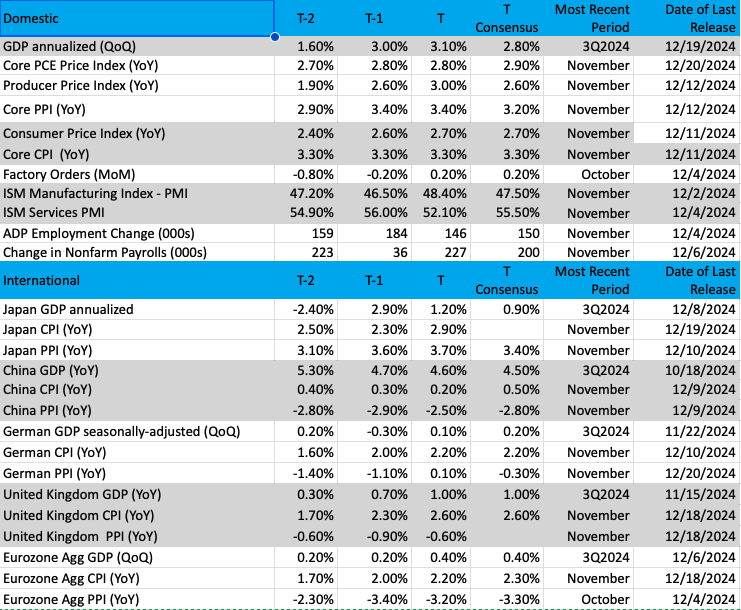
(Note: T is the most recent period, T-1 is the prior period's reading and T-2 is two periods back, the intent being to illustrate any trends)
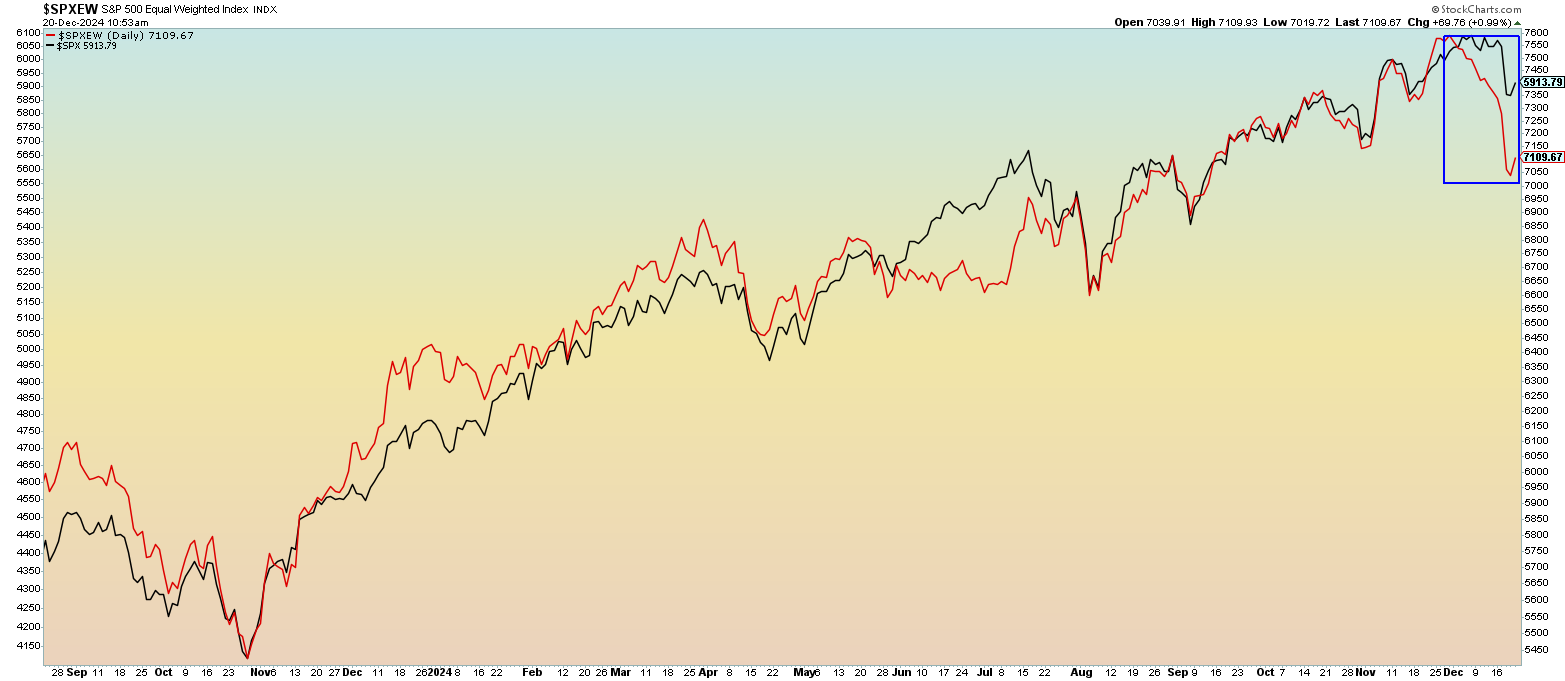
Chart of the Week: S&P 500 Equal Weight vs. the S&P 500
We often look for divergences in charts and try to point them out when relevant and important. In past instances, we’ve noticed discrepancies between small-caps and large-caps, and those would eventually be corrected and re-aligned. More interesting of late is the misalignment of the S&P 500 (SPX) and the equal-weighted S&P 500 (SPXEW).
The difference between these two indexes is simple — the SPX is priced based on a market-cap weighting of stocks, while the SPXEW is equally weighted. Hence, the SPXEW counts each member of the "500" with one vote, while the SPX is skewed heavily towards the so-called Magnificent Seven names, which have trillion-dollar market-caps. This index is heavily influenced by names such as Apple (AAPL), Tesla (TSLA), Meta (META), and Nvidia (NVDA), among others.
Currently, there is a major divergence between the SPX and SPXEW. The divide is huge, and that means there is an opportunity for mean reversion. What does that mean? Basically, when prices stray too far from the mean, such as what we have here with the wide differential between SPX and SPXEW, then prices tend to come together. There is no timeline for this to occur, nobody rings a bell for that "closure" of difference to happen, but it will.
Look back on previous divergences such as the box to the right in the chart below, and you’ll see this condition corrects itself eventually. The current situation has the SPX outperforming the SPXEW (lower line). In our view, healthy market conditions are the opposite condition, when more stocks are participating during market rallies.
If the SPXEW starts performing better than the SPX then a broadening out of the rally is surely going to happen, leading the markets to move higher.
Other charts we shared with you this week were:
Monday, December 16: S&P 500 - Year-End Run Past 6,000 a 'Huge Possibility' for S&P 500
Monday, December 16: United Rentals (URI) - United Rentals 'Moving' in the Wrong Direction
Tuesday, December 17: First Trust Nasdaq Cybersecurity ETF (CIBR) - A Portfolio Holding Gets a Lift From an Unlikely Source
Wednesday, December 18: Applied Materials (AMAT) - This Tech Position Is in the Basing Process
Thursday, December 19: Apple (AAPL) – Apple Remains the “Go To” Name
The Week Ahead
With the Christmas holiday next week and New Year’s the following that, year-end vacations will see trading desks thin out and investors take time off as we sunset 2024 and prepare for 2025. Folks will be looking to see if a Santa Claus rally, which spans the last five trading days in December and the first two trading days of January, emerges starting on Tuesday, December 24.
We will have little in the way of market moving data next week, but we will be keeping tabs on November New Home Sales figures as we track homebuilder delivery forecasts for the current quarter.
Here's a closer look at the economic data coming at us next week:
U.S.
Tuesday, December 24
· Durable Orders – November (8:30 AM ET)
· New Home Sales – November (10:00 AM ET)
Thursday, December 26
· Initial & Continuing Jobless Claims – Weekly (8:30 AM ET)
· EIA Crude Oil Inventories – Weekly (11:00 AM ET)
Friday, December 27
· EIA Natural Gas Inventories – Weekly (10:30 AM ET)
International
Monday, December 23
· UK: GDP, Business Investment (Final) – 3Q 2024
Friday, December 27
· Japan: Retail Sales, Industrial Production – November
· China: Industrial Profits – November
Similar to the light economic calendar next week, earnings be even more sparse. As of now, the only company expected to report its quarterly results next week is BlackBerry (BB) on Thursday, December 26. Given our positions in the First Trust Nasdaq Cybersecurity ETF (CIBR) and Qualcomm (QCOM), we’ll be interested in BlackBerry’s forward-looking comments about cybersecurity demand and its outlook for the IoT market.
Because next week and the following ones will be among the quietest of the year, we will be watching out for companies that try to slip in negative December-quarter pre-announcements when investing and trading teams are staffed thinner than usual.
Portfolio Investor Resource Guide
· Economic Data: Here's a List of Links to the Key Economic Data We Closely Watch
· Investing Terminology: 16 Key Terms Club Members Should Know
· 10-Ks: Want to Know About a Stock? Read the Company's Reports
· 10-Qs: Unlock the Numbers and Key Information Behind Your Stock With the 10-Q
· Income Statement: Our Cheat Sheet to Understanding This Financial Document
· Balance Sheet, Cash Flow Statements, and Dividends: How to Know If a Company Is Off-Kilter? Read Its Balance Sheet
· Valuation Metrics: Everyone Wants a Value. Here's How Investors Can Find
· Thematic Investing 101 Webinar
The Portfolio Ratings System
1 - Buy Now (BN): Stocks that look compelling to buy right now.
2 - Stockpile (SP): Positions we would add to on pullbacks or a successful test of technical support levels.
3 - Holding Pattern (HP): Stocks we are holding as we wait for a fresh catalyst to make our next move.
4 - Sell (S): Positions we intend to exit.
ONES
Alphabet GOOGL; $191.41; 1,035 shares; 3.98%; Sector: Communication Services
UPDATE: Shares of Alphabet (GOOGL) came roaring back this month, bringing their quarter-to-date move higher firmly into double-digits. Fueling that ascent over the last few weeks, Google’s global search engine market share rebounded in November, the positive outlook for digital advertising, and the unveiling of its quantum computing chip Willow. Those developments led us to reiterate our $210 price target even as others like Jefferies and Baird lifted theirs to $205. Shortly after that, November data from Nielsen pointed to year-over-year share gains by YouTube in the streaming market. To that we can add a recent Pew Research Center study found that 54% of U.S. adults now get at least some of their information from YouTube. Those data points reaffirm its growing position with consumers, something that makes it increasingly attractive to advertisers. General Motors (GM) announcement that it will shutter its Cruise autonomous-car division improves the competitive landscape for Alphabet’s Waymo just as it plans to bring that offering to Miami in early 2025. Looking ahead, we are reading Google is looking to bring conversational answers into its search engine with the option to switch to an AI Mode that looks nearly identical to its Gemini AI chatbot. We suspect the effort is designed to shore up its competitive position against a Microsoft-Bing-ChatGPT relationship and reports ChatGPT will enter the search engine market on its own.Because we are still in the relatively early innings when it comes to AI revenue generation, we will be patient with Alphabet and GOOGL shares. We continue to see the company well positioned, given its treasure trove of data across its search, advertising, and YouTube businesses, which should benefit it in the coming months with an upswing in digital advertising. As AI matures, we see that resulting in further lift to Google Cloud’s revenue and profit generation. During the September quarter, Alphabet repurchased $15.3 billion in stock, bringing its year-to-date total to $47 billion, and leaving nearly $60 billion under its current buyback program. We’ll continue to evaluate our price target and rating as necessary. We’ll also be watching developments on the FTC front and what that could mean for Alphabet in the coming quarters. Should TikTok be banned in the U.S. that would be a positive for YouTube’s Shorts products and related monetization efforts.
1-Wk. Price Change: 0.8%; Yield: 0.4%
INVESTMENT THESIS: We believe that while search and digital ad dominance are what will carry shares in the near- to mid-term, longer-term it is the company's artificial intelligence "moat" that will provide for new avenues of growth. AI is what has made the company's search, video, and targeted ad capabilities best-in-class and is the driving force behind the company's success in voice (Google Home) and autonomous driving (Waymo). Furthermore, we believe it is this AI expertise that will also make the company more prevalent in other industries, including healthcare via its subsidiary Verily, as AI and machine learning continue to disrupt operations across industries. Adding to our positive view of the company's future opportunities, we believe that Alphabet's free cash flow generation and solid balance sheet set it apart and are what will allow the company to continue taking chances on far-out ground-breaking and potentially world-changing projects. The company is also preparing to roll out Gemini Subscription with enterprise plans for workspace, according to a report. All good news for Alphabet.
Target Price: Reiterate $210; Rating: One
Panic Point: $145
RISKS: Regulatory risk (data privacy), competition, and macroeconomic slowdown impacting consumers and therefore ad buyer activity.
Amazon AMZN; $224.92; 946 shares; 4.28%; Sector: Consumer Discretionary
UPDATE: After rising in November, shares of Amazon (AMZN) entered December on the back of a record-setting Cyber Monday, which capped the company’s week-long Black Friday sales event. Per Adobe Analytics, Cyber Monday sales reached $13.3 billion, a 7.3% increase from last year’s event, making this year’s event the biggest online shopping day in history. For the five-day holiday shopping event between Thanksgiving and Cyber Monday, sales totaled $41.1 billion, up 8.2% year over year. For the full holiday season, Adobe expects sales to reach $240.8 billion, an 8.4% improvement from last year with sales already at $131.5 billion for the period from November 1 to December 2. That strength was confirmed in the November Retail Sales report. That strength led us to raise our AMZN price target to $260 from $240 on December 17. Also early this month, at its re:Invent event, Amazon Web Services’ annual all things cloud-related conference, it announced new AI partnerships with GitLab (GTLB) and PagerDuty (PD) and revealed its in-house Tranium3 AI chips that will be available in late 2025. Those and related announcements led UBS to name AMZN to its top 25 stocks for 2025, joining JPMorgan, Jefferies, and Mizuho in doing so, primarily given the company’s cloud business and its role in AI. December also brought another round of clarity on Amazon’s multi-year capital spending plans with Ohio Governor Mike DeWine saying the company would invest $23 billion in the state by 2030, including an additional $10 billion in data center infrastructure. Amazon Auto officially launched in 48 U.S. cities this month, initially offering online automotive shopping from Hyundai (HYMTF) dealers across major metropolitan areas nationwide. In 2025, Amazon plans to roll out additional manufacturers, brands, cities, and new functionality for the online car buying program. We see that as Amazon doing what it does best, removing transactional friction. Amazon shares have been a strong performer for the portfolio given the gains they have recorded so far this year, and we see that continuing as consumers combat higher price levels due to multi-year inflation pressures while companies continue to embrace cloud and adopt AI. Because AMZN is one of the largest position sizes in the portfolio, we’re not inclined to add more shares. However, for members that are light on AMZN, support near $205 offers a potential pick-up point.
1-Wk. Price Change: -1.1%; Yield: 0.0%
INVESTMENT THESIS: We believe the upside will result from Amazon's continued eCommerce dominance, AWS's continued leadership in the public cloud space, and ongoing growth of the company's advertising revenue stream, which feeds off Amazon's eCommerce business. Additionally, we think profitability will continue to improve as AWS and advertising account for a larger portion of total sales as both these segments sport higher margins than the eCommerce operation. While we believe the increasing share of the revenue from these higher margin businesses will be key to driving profitability longer-term, we think margins on eCommerce stand to improve as the company's infrastructure is further built out and economies of scale further kick in. The embedded call option is that management is always looking to enter a new space and generate new revenue streams.
Target Price: Reiterate $260; Rating: One
Panic Point: $180
RISKS: High valuation exposes the stock to volatile swings, eCommerce has exposure to slower consumer spending and competition, management is not afraid to invest heavily, potential headwinds resulting from new eCommerce regulation in India, and management is not scared to invest aggressively for growth, which can at times cause volatile reactions as near-term concerns arise relating to the impact on margins.
Bank of America Corp. BAC; $44.17; 4,410 shares; 3.90%; Sector: Financial Services
UPDATE: After climbing in October and November, Bank of America (BAC) shares have given back a portion of those gains so far in December. Some of that can be traced to stickier inflation that fueled the prospect of the Fed trimming the number of expected rate cuts in 2025. That unfolded as expected, but the renewed uncertainty around the timing of those cuts weighed on the market and BAC shares. While we have a sizable position in BAC, should we see the shares erode further and land in oversold territory, we may have the ability to pick up a few more for the portfolio. We are inclined to do that given the improving outlook for investment banking activity in the coming year. Goldman Sachs CEO David Solomon called for a pick-up in both equity capital raising and M&A activity under the Trump administration. The market is cautiously optimistic heading into 2025 about the IPO market strengthening given further rate cuts, deregulation, and a stable macroeconomic environment. There is also a health backlog of offerings, including high-profile companies like CoreWeave, Medline Industries, and Genesys Cloud Services. We continue to see Bank of America’s investment banking and asset/wealth management businesses well positioned for the road ahead and that led us to increase our BAC price target to $53 on December 9. BofA’s efforts to expand its commercial banking footprint should pay dividends as lower rates boost lending activity. BofA is expected to give initial 2025 net interest income (NII) guidance when it reports December-quarter results in January. Should we see a meaningful pickup in investment banking activity, stock market inflows, or loan activity, we will revisit our BAC price target as needed. If we saw BAC shares retreat to support near $41-$42, it would be a very favorable place for members to add BAC shares.
1-Wk. Price Change: -3.3%; Yield: 2.4%
INVESTMENT THESIS: Bank of America is one of the world's leading financial institutions, serving individual consumers, small and middle-market businesses, and large corporations with a full range of banking, investing, asset management, and other financial and risk management products and services. The company provides unmatched convenience in the United States, serving approximately 67 million consumer and small business clients with approximately 3,900 retail financial centers, approximately 16,000 ATMs, and award-winning digital banking with approximately 56 million verified digital users. Bank of America is a global leader in wealth management, corporate and investment banking, and trading across a broad range of asset classes, serving corporations, governments, institutions, and individuals around the world. Bank of America offers industry-leading support to approximately 3 million small business households through a suite of innovative, easy-to-use online products and services. The company serves clients through operations across the United States, its territories, and approximately 35 countries. From a reporting perspective, the company's business breaks down as follows: Net Interest Income breakdown: Consumer Banking 57%, Global Banking 23%, Global Wealth & Investment Management 14%, and Global Markets 6%; Income Before Tax breakdown: Consumer Banking 42%, Global Banking 27%, Global Wealth & Investment Management 16%, and Global Markets 15%. Bank of America pays a quarterly dividend of $0.22 per share.
Target Price: $53; Rating: One
Panic Point: $39
RISKS: Financial markets, fiscal, monetary, and regulatory policies, economic conditions, and credit ratings.
Builders FirstSource BLDR; $150.50; 1,055 shares; 3.17%; Sector: Industrials
UPDATE: After logging a gain of more than 40% in Q3 2024, Builders FirstSource (BLDR) has given back a good chunk of that move as mortgage rates rebounded. That led us to pick up more shares for the portfolio earlier this week. The Fed’s expected decision to take a more measured and cautious approach to future rate cuts weighed further on the shares this week as did Lennar’s (LEN) expected decline in home deliveries for the current quarter. In Thursday’s video, we shared our view that margin pressure for homebuilders should be a positive for Builders' value-added products, helping it grow its dollar content per home. In the same video, we discussed that because of the aggregate position size for our construction-related holdings, we’re inclined to be patient investors with BLDR. However, the oversold status of the shares offers members a nice opportunity to up their position size relative to the portfolio. Our take is that as the cumulative impact of rate cuts this year and next year are felt, 2026 is a potential peak year for construction activity. With the current share price way below that average after having corrected over the last several weeks, we suspect Builders is putting the remainder of its current authorization to good work. Upcoming catalysts for the shares include the soon-to-be-published November Construction Spending report and formal policy announcements as President-elect Trump and his administration take the reins in January. Should inflation get back on track sooner than expected, the market may need to revisit rate-cut expectations, and that is a potential catalyst for the housing market and our BLDR shares. With that in mind, we will continue to monitor weekly and monthly data for new mortgage originations and housing starts. Recent data for both were encouraging with the Mortgage Bankers Association (MBA) Builder Application Survey (BAS) data for November 2024 showing mortgage applications for new home purchases increased by 7.2%. Single-family housing starts, which account for the bulk of homebuilding, jumped 6.4% to a seasonally adjusted annual rate of 1.011 million units in November. We’d also remind members that during the first nine months of 2024, Builder repurchased 6.8 million shares at an average price of $171.37.
1-Wk. Price Change: -9.6%; Yield: 0.0%
INVESTMENT THESIS: Builders FirstSource is a supplier and manufacturer of building materials, manufactured components, and construction services to professional homebuilders, sub-contractors, remodelers, and consumers. The company’s top 10 customers account for 15% of net sales and are comprised primarily of the largest national production homebuilders, including publicly traded companies such as D.R. Horton, Dream Finders Homes, Lennar Corp., Pulte, Taylor Morrison Home, and Toll Brothers. The company is leveraging its national manufacturing footprint to grow its higher-margin value-added products as homebuilders look for more efficient ways to construct homes. We see this driving faster revenue and earnings growth in the coming quarters as the eventual rate-cutting cycle by the Fed lifts the demand for housing.
Target Price: $235; Rating: One
Panic Point: $145
RISKS: Economy, interest rates, commodity pricing, and supply chain risks.
Elastic N.V. ESTC; $103.63; 1,712 shares; 3.57%; Sector: Consumer Cyclical
UPDATE: Following the strong reaction to Elastic’s (ESTC) October-quarter earnings report that led the shares to close November up more than 36%, we prudently locked in a 39% gain on a slice of shares in early December. Subsequent weeks have brought more confirming data points for AI adoption across an expanding array of industries, which bodes well for Elastic. We suspect management’s operating margin outlook is conservative even though it reflects ongoing investments in AI to drive future growth. Morgan Stanley backed that view when it initiated coverage on Elastic shares this week with an "Overweight rating" and a $130 price target. We have seen some insider selling, but we would argue the 7,017 shares sold by CEO Ashutosh Kulkarni was a small fraction compared to the 395,326 shares owned following that trade. And let’s remember, we took some shares off the table as well, and at a better price than the $108.12 Ashutosh received. With ESTC shares tending lower, we have room to add back some shares, and should they get closer to the $99 support level we may opt to do so. Given our $135 price target and the recent share price following the recent market selloff, on Friday we picked up more shares for the portfolio and lifted our rating to a One from Two.
1-Wk. Price Change: -0.4%; Yield: 0.0%
INVESTMENT THESIS: As digital transformation drives mission-critical business functions to the cloud, Elastic N.V. brings the portfolio exposure to search AI adoption across IT and enterprise business lines as companies look to drive productivity. Elastic bills itself as the Search AI company and its Elastic Search AI Platform as a hosted, managed service across major cloud providers, including Amazon Web Services (AWS), Google Cloud, and Microsoft’s Azure in more than 55 public cloud regions globally. Customers can also deploy Elastic’s platform across hybrid clouds, public or private clouds, and multi-cloud environments. What we like even more about this is Elastic’s subscription-based business model, which accounts for just over 93% of its total revenue stream. As we’ve discussed before with other companies, this affords not only good visibility but also predictable cash flow and earnings. Moreover, the gross margins associated with the subscription business are above 80%, which helps explain the rising margin profile and EPS as that business has come to account for a greater percentage of overall revenue. When it comes to potential risks, one sign that would lead us to reconsider owning the shares would be if either Elastic’s customer count or its subscription revenue per customer stalled. Another item we’ll be watching because of Elastic’s geographic mix, with 40% of its revenue outside of the U.S., is the dollar and its corresponding foreign exchange impact.
Target Price: Reiterate $135; Rating: One
Panic Point: $82
RISKS: Enterprise software spending, AI adoption, competitive dynamics, foreign exchange risk.
Lockheed Martin Corp. LMT; $489.02; 370 shares; 3.61%; Sector: Aerospace & Defense
UPDATE: Headline concerns over the potential impact of the Department of Government Efficiency (DOGE) intensified in December following some tweets by Elon Musk targeting the F-35, while touting drones. While we won’t shy away from agreeing there is likely spending inside the defense budget that can be trimmed, DOGE is expected to focus on areas not covered by Congressional approval. Also, during his first term, President Trump increased the defense budget. For now, Lockheed shares will likely be rangebound until we have greater clarity on these issues. However, defense spending outside the U.S. continues to rise and Bloomberg Intelligence finds the 15 largest European members of NATO will need to nearly double their annual military investment to $720 billion to bolster capacity against Russia. That prospect as well as continued program wins and ramping F-35 production keep us bullish on LMT shares, especially following their 20% correction over the last several weeks that has landed them deeply in oversold territory. We used that move lower to pick up more LMT shares for the portfolio on December 11, bringing our position size to ~3.6% of the portfolio. We have room to nibble further but recognize a strong rebound in the shares could trigger some prudent portfolio management. Catalysts for such a move higher include Lockheed sharing its multi-year delivery schedule when it reports its December-quarter results. Next week, Lockheed will pay its next quarterly dividend of $3.30 per share on December 27 to shareholders of record on December 2.
1-Wk. Price Change: -1.1%; Yield: 2.7%
INVESTMENT THESIS: Lockheed Martin is the largest defense contractor globally and has dominated the Western market for high-end fighter aircraft since the F-35 program was awarded in 2001. Lockheed's largest segment is aeronautics, which is dominated by the massive F-35 program. Lockheed's remaining segments are rotary and mission systems, which is mainly the Sikorsky helicopter business; missiles and fire control, which creates missiles and missile defense systems; and space systems, which produces satellites and receives equity income from the United Launch Alliance joint venture. Historically, the stability of defense spending has been a haven during periods of economic uncertainty, and we see that repeating once again even as geopolitical conflicts are likely to lead to incremental demand for Lockheed's products. The company has increased its dividend consistently over the last 19 years and is widely expected to boost it again in the coming days. In October 2022, Lockheed announced its board authorized the purchase of up to an additional $14.0 billion of LMT stock under its share-repurchase program.
Target Price: $650; Rating: One
Panic Point: $470
RISKS: Contracts and budget risk with the U.S. government and the Department of Defense, F-35 program funding and renewal, competition, and subcontractor issues.
Nvidia Corp. NVDA; $134.70; 1,510 shares; 4.07%; Sector: Technology
UPDATE: Following a string of strong monthly performances through November, Nvidia shares have been giving back a portion of those gains. Even so, our position in NVDA is up more than 58% since being added to the portfolio earlier this year. Nvidia delivered stellar October-quarter results and impressive guidance, but as we suspected, as strong as its outlook was for the current quarter, it fell short of more aggressive Wall Street expectations. In our note to members, we explained why we maintained our $175 price target even as others across Wall Street were lifting their targets in and around ours. Findings from Menlo Ventures show enterprise spending on AI increased sixfold in 2024 as companies began implementing AI after first experimenting with it. More telling is that 72% of enterprise IT decision-makers from companies with 50 or more employees expect to see broader adoption of AI “in the near term.” That supports comments from Cisco and others that we are still in the relatively early innings of AI adoption. Meanwhile, monthly revenue reports from Taiwan Semi and Foxconn as well as Micron’s November earnings report all confirm the robust demand for AI and data center. We see that playing into Nvidia’s strength, which keeps us patient with NVDA shares. The next catalysts for us to watch for Nvidia will be December revenue reports from Taiwan Semi and Foxconn in early January and Nvidia CEO Jensen Huang’s keynote at 2025 CES on January 6. As we digest those events, we’ll revisit our $175 price target as needed. Given the current upside to our price target, we reiterate our One rating on NVDA.
1-Wk. Price Change: 0.3%; Yield: 0.0%
INVESTMENT THESIS: Nvidia is well positioned to benefit from ramping AI and data center spending. The company pioneered accelerated computing to help solve the most challenging computational problems. Nvidia is now a full-stack computing infrastructure company with data-center-scale offerings that are reshaping the industry. The company's full stack includes the foundational CUDA programming model that runs on all Nvidia GPUs, as well as hundreds of domain-specific software libraries, software development kits, or SDKs, and Application Programming Interfaces, or APIs. This deep and broad software stack accelerates the performance and eases the deployment of Nvidia accelerated computing for computationally intensive workloads such as artificial intelligence, or AI, model training and inference, data analytics, scientific computing, and 3D graphics, with vertical-specific optimizations to address industries ranging from healthcare and telecom to automotive and manufacturing. Nvidia reports in two business segments: Compute & Networking and Graphics. The Compute & Networking segment (78% of revenue, 85% of operating income) is comprised of Data Center accelerated computing platforms and end-to-end networking platforms, including Quantum for InfiniBand and Spectrum for Ethernet; NVIDIA DRIVE automated-driving platform and automotive development agreements; Jetson robotics and other embedded platforms; Nvidia AI Enterprise and other software; and DGX Cloud software and services. The Graphics segment (22% of revenue, 15% of operating income) includes GeForce GPUs for gaming and PCs, the GeForce NOW game streaming service and related infrastructure; Quadro/NVIDIA RTX GPUs for enterprise workstation graphics; virtual GPU, or vGPU, software for cloud-based visual and virtual computing; automotive platforms for infotainment systems; and Omniverse Enterprise software for building and operating metaverse and 3D internet applications.
Target Price: $175; Rating One
Panic Point: $112
RISKS: Market and interest rate risk, credit risk, country risk, and operational risk, including cybersecurity.
Qualcomm Inc. QCOM; $152.89; 1,135 shares; 3.49%; Sector: Technology
UPDATE: In late November we trimmed our price target for Qualcomm (QCOM) to $200, taking a more conservative view on the company’s multi-year diversification plan it shared during its November 19 Investor Day. Following the market’s “wait and see” view, we’ve seen Qualcomm's November drag on the portfolio continue despite favorable data points for the smartphone market this year and next year. The latest on that came from Micron (MU) this week when it reiterated its view smartphone industry shipments should rise in the mid-single digits this year and grow further in 2025. Micron also sees PC shipments rising 5% next year as the replacement cycle catches wind, which in our view bodes well for Qualcomm and the 58 AI PC programs discussed at its November Investor Day. As we see it there are two overhangs on QCOM shares – the ability of Qualcomm to offset the expected revenue loss as Apple introduces its own Apple Silicon-based modem into the iPhone and the current licensing case with Arm Holdings (ARM). Apple is expected to migrate to its own modem over the next few years starting with lower volume entry models. As we move through the coming quarters, we will monitor the migration of Qualcomm’s AI PC, automotive, and other IoT from program wins to shipping product. Progress on that front should lead Wall Street to revisit how it values the shares, and that is what we are aiming to capture by owning QCOM. As it relates to Qualcomm-Arm, both companies made final arguments on Friday and we should have a ruling before too long. We continue to suspect we will see a new licensing agreement emerge, which subject to its terms, should lift that overhang on QCOM shares. Upcoming catalysts we’ll be watching include December and January monthly revenue reports from Taiwan Semi and Foxconn as well as 2025 shipment forecasts from IDC and other research firms. On a risk-adjusted basis, we see the current share price offering members underweight QCOM a nice level to add the shares.
1-Wk. Price Change: -3.6%; Yield: 2.2%
INVESTMENT THESIS: Qualcomm focuses on foundational technologies for the wireless industry, including 3G (third generation), 4G (fourth generation), and 5G (fifth generation) wireless technologies and processor technologies including high-performance, low-power computing, and on-device artificial intelligence technologies. As a connected processor company, its technology roadmap aims to enable the connected intelligent edge (the next generation of smart devices) across industries and applications beyond handsets, including automotive and the Internet of Things (IoT). Qualcomm has three reportable segments: QCT (Qualcomm CDMA Technologies) semiconductor business, which develops and supplies integrated circuits and system software based on 3G/4G/5G and other technologies for use in mobile devices; automotive systems for connectivity, digital cockpit, and ADAS/AD; and IoT including consumer electronic devices; industrial devices; and edge networking products. QCT accounts for 80%-85% of revenue. QTL (Qualcomm Technology Licensing) licensing business grants licenses or otherwise provides rights to use portions of the company's intellectual property portfolio, which includes certain patent rights essential to and/or useful in the manufacture and sale of certain wireless products. QTL accounts for ~15% of Qualcomm's revenue but contributes a greater portion of the company's operating income.
Target Price: $200; Rating: One
Panic Point: $140
RISKS: Customer risk, technology advancement, competition risk, third-party supplier, and manufacturing partner risk.
Universal Display OLED; $149.53; 1,225 shares; 3.68%; Sector: Technology
UPDATE: After climbing earlier this year, shares of Universal Display (OLED) peaked in late October and embarked on a several-week slide lower. The drivers behind that slide include the company’s own potentially overly conservative guidance for the current quarter and similar iPhone guidance from Apple. More recent data from Taiwan Semi, Foxconn, and Micron back a more favorable outlook for the smartphone market. In addition, we are continuing to see more robust demand for premium smartphone models that have larger display sizes, a positive for Universal’s business. We are also seeing more flip smartphone models come to market, and rumblings point to more on the way before too long, including ones from Apple. That mix shift in the industry will be another favorable driver for Universal’s business as will the continued shift in the remaining 40%+ of the smartphone market not yet using organic light-emitting diode display technology. We see the upcoming 2025 CES conference and the prospect of supporting announcements for organic light-emitting diode display technology across TV, PC monitors, tablets, auto, and other applications as potential catalysts for OLED shares. We welcome the revenue diversification adoption in those markets will bring, in part because it supports our view that the organic light-emitting diode will follow the one for light-emitting diodes, culminating with the general illumination market. On December 11, following the "sigh of relief" November CPI report, we once again added to our OLED holdings. At 3.75% of the portfolio’s assets, we have a sizable position in OLED shares, but we see the current share price as a compelling level for members to pick up shares given their long-term potential, hence our One rating.
1-Wk. Price Change: -8.2%; Yield: 1.1%
INVESTMENT THESIS: Universal Display focuses on the development and commercialization of organic light-emitting diode (OLED) technologies and materials for use in display and solid-state lighting applications. OLED displays are capturing a growing share of the display market, especially in the mobile phone, television, monitor, wearable, tablet, notebook, personal computer, augmented reality (AR), virtual reality (VR), and automotive markets. This adoption reflects advantages over competing display technologies concerning power efficiency, contrast ratio, viewing angle, video response time, form factor, and manufacturing cost. Universal's business strategy is to develop new OLED materials and sell existing and new materials to product manufacturers for display applications, such as mobile phones, televisions, monitors, wearables, tablets, portable media devices, notebook computers, personal computers, and automotive applications, and specialty and general lighting products. The company also looks to license its OLED material, device design, and manufacturing technologies to those manufacturers. As such, Universal has a significant portfolio of proprietary OLED technologies and materials with more than 5,500 patents issued and pending worldwide.
Target Price: Reiterate $250; Rating: One
Panic Point: $140
RISKS: Patent and Intellectual property protection; maintaining OLED manufacturing and customer relationships; technology risk; market risk.
Vulcan Materials Company VMC ; $263.13; 613 shares; 3.23%; Sector: Building Materials
UPDATE: While shares of Vulcan Materials (VMC) have traded off in December, they are still in positive territory on a quarter-to-date basis. In the face of that move lower, JPMorgan lifted its VMC target to $290 and Argus Research increased its target to $315. Both see favorable aggregate volumes and pricing driving revenues, margin, and EPS at Vulcan as the company benefits from ongoing infrastructure spending programs. Our view has been that demand for Vulcan’s aggregates continues to benefit from non-residential construction and multiple new projects across data centers, airports, healthcare, and battery manufacturing. That demand bodes well for further price realization in 2025 and margin improvement at Vulcan. We continue to think 2026 is a potential peak year for construction activity as the Fed delivers additional rate cuts in 2025, which should benefit residential and non-residential construction activity. In Thursday’s video, we discussed that because of the aggregate position size for our construction-related holdings, we’re inclined to be patient investors with VMC shares. However, with VMC shares on the cusp of being oversold, the current risk-reward in the shares skews favorable offering members a nice opportunity to true up their position size relative to the portfolio.
1-Wk. Price Change: -4.6%; Yield: 0.7%
INVESTMENT THESIS: Vulcan Materials operates primarily in the U.S. and is the nation's largest supplier of construction aggregates (primarily crushed stone, sand, and gravel), a major producer of asphalt mix and ready-mixed concrete, and a supplier of construction paving services. Its products are the indispensable materials used in building homes, offices, places of worship, schools, hospitals, and factories, as well as vital infrastructure including highways, bridges, roads, ports and harbors, water systems, campuses, dams, airports, and rail networks. Ramping spending associated with the Biden Infrastructure Law should drive demand for Vulcan's products over the coming years. Vulcan has historically complemented its organic growth prospects by acquiring businesses to expand its geographic reach and product scope. Since 2014, the company has acquired more than two dozen companies, including the 2021 acquisition of U.S. Concrete. That combination has allowed the company to deliver steady top and bottom-line growth over the last decade, with only a modest decline when the pandemic hit in 2020.
Target Price: Reiterate $300; Rating: One
Panic Point: $225
RISKS: General economic and business conditions; dependence on the construction industry; timing of federal, state, and local funding for infrastructure; changes in the level of spending for private residential and private nonresidential construction.
TWOS
Apple AAPL ; $254.49; 790 shares; 4.03%; Sector: Technology
UPDATE: Apple shares have moved steadily higher so far this month, building on its November gains, leaving them up in the high-single digits quarter to date. That move also has AAPL shares flirting with our $250 target. That move was partly stimulated by the latest wave of price target increases for the shares and Morgan Stanle naming them a top pick for 2025. We continue to expect a more protracted upgrade cycle is likely now that Apple has shared iOS 18.2, which includes more robust Apple Intelligence features including ChatGPT integration. That release and subsequent others are behind our thinking the iPhone upgrade cycle will be a stronger factor in 2025. With more Apple Intelligence features targeted for not only iPhone but Apple’s other product categories including Mac, iPad, and Wearables, we see a similar cadence unfolding for them as well as other software update releases. As that happens, we should see further lift in the Services business, driving overall profits and EPS higher. With Apple poised to migrate to its proprietary Apple Silicon-based modems and Bluetooth-WiFi chipsets inside its products, we see that helping margins starting late this year and more so in 2026. We will stick with our $250 price target for now but intend on revisiting it as fresh data becomes available. Those data points include December revenue data from Taiwan Semi and Foxconn.
1-Wk. Price Change: 2.6%; Yield: 0.4%
INVESTMENT THESIS: While we acknowledge that near-to-midterm performance remains heavily influenced by iPhone sales, the dynamic is shifting as investors finally place greater emphasis on Services growth. We are bullish on the 5G upgrade cycle and believe longer-term upside will continue to come as Services revenue grows its share of overall sales. Services provide for a recurring revenue stream at higher margins, a factor that serves to reduce earnings volatility while allowing for a higher percentage of sales to fall to the bottom line; as a result, we believe that Services growth and the installed base, are much more important than how many devices the company can sell in each 90-day period. In addition to improved profitability, we also believe the transparent nature of this revenue stream will demand an expanded price-to-earnings multiple as segment sales grow. Furthermore, we believe that Apple's desire to push deeper into the healthcare arena will help make its devices invaluable as more life-changing features are added and the company works to democratize health records. Lastly, also see upside resulting from increased adoption of wearables (think the Apple Watch) and potential new product announcements such as an AR/VR headset or an update on Project Titan, the company's secretive autonomous driving program.
Target Price: Reiterate $250; Rating: Two
Panic Point: Reiterate $185
RISKS: Slowdown in consumer spending, competition, lack of new product innovation, elongated replacement cycles, failure to execute on Services growth initiative.
Applied Materials Inc. AMAT; $163.59; 970 shares; 3.19%; Sector: Semiconductor Manufacturing
UPDATE: Shares of Applied Materials (AMAT) have been reaching down for lower levels since peaking back in July, making them a drag on the portfolio’s performance. By our count, the stock has been hit with a nasty cold brought on by some of its competitors like ASML (ASML) and Lam Research (LRCX). These capital equipment companies often move in tandem, which can be a double-edged sword. The stock is up about 4% on the year, a far cry from where it was in July, but as you know we focus on the developing landscape and what that means for the coming quarters. We took advantage of some recent selling and added some shares recently. We added another slug of shares just last week, tempted by the price as AMAT has been working on a nice base. Technically, the stock is very overbought and due for a bounce. Money flow has improved but the MACD is on a sell signal. We look for the stock to hold some support at the $160 level. From a fundamental perspective, Micron (MU) telegraphed its capital spending levels will move higher in the coming quarters, and given strong chip demand we suspect Taiwan Semi (TSM) will make similar comments when it reports in January. Continued strength in AI and data center chips and the improving outlook for smartphones and PCs in 2025 likely means Taiwan Semi will also be spending more on equipment next year compared to this year. We see that supporting Semi’s semiconductor capital equipment sales forecast of $121 billion in 2025 and $139 billion in 2026 compared to $113 billion this year, which marked a new industry record. If we were not seeing rising demand for semi-cap equipment, that would give us a reason to question owning shares of Applied Materials in the Portfolio. Whether it's formal forecasts or rising chip industry capacity levels, that’s not what we’re seeing and that means we will stay the course with AMAT shares.
1-Wk. Price Change: -3.4%; Yield: 1.0%
INVESTMENT THESIS: Applied provides manufacturing equipment, services, and software to the semiconductor, display, and related industries. With its diverse technology capabilities, Applied delivers products and services that improve device performance, power, yield, and cost. Applied's customers include manufacturers of semiconductor chips, liquid crystal, and organic light-emitting diode displays, and other electronic devices. Applied operates in three reportable segments: Semiconductor Systems (73% of 2022 revenue, 78% of 2022 operating income), Applied Global Services (22%, 19%), and Display and Adjacent Markets (5%, 2%). Key customers include Samsung (12% of 2022 sales), Taiwan Semiconductor (20%), and Intel (10%).
Target Price: Reiterate $210; Rating: Two
Panic Point: $155
RISKS: Manufacturing and Supply Chain, Competitive Factors, Government Regulation, Technology Change.
Costco Wholesale COST; $954.07; 210 shares; 4.02%; Sector: Consumer Staples
UPDATE: Quarter to date, Costco shares have meaningfully outperformed the S&P 500, and with eight trading days left in the year, the stock is up more than 40% year-to-date, substantially ahead of the index. Our thesis behind the position, which has been confirmed time and time again through its monthly sales reports, has been Costco taking wallet share as consumers contend with higher price levels and sticky inflation. A recent Bank of America survey found that nearly half of Americans at least somewhat agree with the statement, “I am living paycheck to paycheck” and we see that powering further share gains as Costo continues to expand its warehouse footprint and flex its digital commerce platforms. Heading into Costco’s November quarter earnings report we boosted our COST price target to $1,050 and what we saw in that earnings report confirmed that decision. The coming quarters should bring more greater realization of Costco’s September membership fee price increase as it continues to expand its warehouse footprint. In terms of digital advertising, Costco is still in the early innings of leveraging its online and app base, but management shared that it is working with over 25 suppliers interested in its digital advertising efforts. The way we see it, those companies want to tap into Costco’s growing digital membership base much the way its suppliers want to reach its membership when they visit Costco’s warehouses. As that digital effort matures, if it repeats what we’ve seen with Amazon and others, it should have a very nice impact on Costco’s margins in the quarters ahead. TD Cowen boosted its target to $1,090 from $975 and Deutsche Bank went to $1,096, but the big bull on the shares, BMO Capital Markets, hoisted its target to $1,175. Our next catalyst for COST shares will be on January 8 when Costco reports its December sales results.
1-Wk. Price Change: -3.6%; Yield: 0.5%
INVESTMENT THESIS: We like Costco's long-term prospects, driven by a club-based operating model that focuses on volumes, not margins, and therefore offers its customers a value proposition of everyday low prices. The strength of this model has created an incredibly loyal customer base with low churn and continued share gains in both bricks-and-mortar and e-commerce. This is a global concept, evidenced by the strength of sales both in the U.S. and abroad, which includes an emerging China opportunity. We see the company's membership model as a key differentiator vs. other retailers and its plans to open additional warehouse locations in the coming quarters should drive retail volumes and the higher-margin membership fee income as well. We also appreciate management's approach to capital returns and their willingness to return cash when it is in excess on the balance sheet.
Target Price: Reiterate $1,050. Rating: Two
Panic Point: $800
RISKS: Inability to pass through higher costs, fuel prices, weaker consumer, and membership churn.
Dutch Bros BROS; $54.06; 2,850 shares; 3.08%; Sector: Consumer Cyclical
UPDATE: After coming off an amazing month of November where the stock hit all-time highs, Dutch Bros (BROS) is settling in and building a nice base at a higher level. That process could take some time but as long as the low end of the gap holds then the basing process continues. The stock was severely overbought on several metrics at the start of December, so a little selling was not all that surprising. On December 2 we locked in some gains following that stellar move. Since then, we’ve seen some folks raise their price targets for BROS shares with UBS taking its to $65, while Jefferies lifted its to $60 and JPMorgan reset its at $58. This week, the company rolled out mobile ordering into 90% of hits franchisee locations, which has driven traffic up significantly in the morning. Early learnings on that and more insight into the company’s plan to expand its food offering are potential catalysts for us to revisit our price target in the coming weeks. When that happens, we’ll plot our next move with BROS shares.
1-Wk. Price Change: 3.8%; Yield: 0.0%
INVESTMENT THESIS: Dutch Bros is an operator and franchisor of drive-thru shops that focus on serving high-quality, hand-crafted beverages with unparalleled speed and superior service. As of June 30, 2024, there were 912 shops in operation in 18 U.S. states, of which 612 were company-operated and 300 were franchised. Coffee-based beverages make up ~50% of the menu mix, and ~25% of the menu mix is based upon the company’s proprietary Blue Rebel energy drink, which is highly customizable with flavors and modifiers and can be served blended or over ice. The energy platform helps unlock the afternoon daypart and broadens the company’s appeal. The remaining 25% of the menu mix is a wide variety of teas, lemonades, sodas, and smoothies. Through the first half of 2024, Dutch Bros opened 81 shops and targets 150-165 new ones for all of 2024. The company’s west-to-east expansion is a time-tested strategy that should drive revenue and EPS growth over the next several years. Over the last week, Citi and Jefferies boosted their ETN price targets to $440.
Target Price: Reiterate $50; Rating: Two
Panic Point: $42
RISKS: Commodity risks, labor costs, interest rate risk, inflation.
Eaton Corp. ETN; $338.12; 435 shares; 2.96%; Sector: Industrials
UPDATE: After trucking higher in November, Eaton (ETN) shares, along with others touching the AI and data center market, trended lower this month. The pace of their decline accelerated this week following the market’s reaction to the Fed’s December policy meeting and renewed uncertainty over the timing of the next rate cut. We used that overall move lower in recent weeks from $375 to around $335, to pick up some additional ETN shares this week. CarbonCredits.com says that data center power use in the U.S. could double in the coming years, but because AI consumes more computing power and more electricity, the Electric Power Research Institute (EPRI) estimates data centers could consume up to 9% of U.S. electricity generation by 2030, up from 2%. While that forecast could skew somewhat aggressive, the bottom line is ramping data center capacity will give rise to greater electrical power demands. That keeps us bullish on Eaton longer term. As the Fed ultimately gets monetary policy back to neutral footing from still restrictive levels, we see that helping foster construction project activity, a positive for Eaton. Entering 2025, we’ll look for updated data center construction forecasts as well as those for electricity supply vs. demand expectations. The greater the supply-demand imbalance, the better for Eaton’s business and our shares.
1-Wk. Price Change: -5.0%; Yield: 1.1%
INVESTMENT THESIS: Eaton is an intelligent power management company that makes products for data center, utility, industrial, commercial, machine building, residential, aerospace, and mobility markets. That business is positioned to capitalize on the megatrends of electrification, energy transition, and digitalization. We see Eaton helping address the power pain point created by data center, EV charging infrastructure, and other drivers of electricity demand. Research estimates that data center power demand will grow 160% by 2030, accounting for 3%-4% of global power up from 1%-2% today. Data centers will use 8% of U.S. power by 2030, compared with 3% in 2022.
Target Price: Reiterate $400; Rating: Two
Panic Point: $285
RISKS: Raw material costs, labor costs, end market volatility, government legislation.
First Trust Nasdaq Cybersecurity ETF CIBR; $64.04; 2,530 shares; 3.25%; Sector: Cybersecurity
UPDATE: Each time we note ripped-from-the-headlines confirmation points for the portfolio and its underlying strategy, one constant is the signals for cybersecurity demand. While our shares of the First Trust Nasdaq Cybersecurity ETF (CIBR) have had a strong showing quarter to date, this week’s market selloff knocked CIBR back to a level near the 50-day moving average that offers members with smaller position sizes an opportunity to scoop up some shares. According to Gartner, cybersecurity spending in 2025 is projected to reach $212 billion, representing a 15% increase from 2024. We continue to favor the diversified exposure CIBR brings to the portfolio, which compliments the cybersecurity efforts at Elastic, Microsoft, and Alphabet.
1-Wk. Price Change: -2.3%; Yield: 0.0%
INVESTMENT THESIS: The First Trust Nasdaq Cybersecurity ETF seeks investment results that correspond generally to the price and yield (before the fund's fees and expenses) of an equity index called the Nasdaq CTA Cybersecurity Index. The Nasdaq CTA Cybersecurity Index is designed to track the performance of companies engaged in the cybersecurity segment of the technology and industrial sectors. It includes companies primarily involved in the building, implementation, and management of security protocols applied to private and public networks, computers, and mobile devices to protect the integrity of data and network operations. To be included in the index, a security must be listed on an index-eligible global stock exchange and classified as a cybersecurity company as determined by the Consumer Technology Association. Each security must have a worldwide market capitalization of $250 million, have a minimum three-month average daily dollar trading volume of $1 million, and have a minimum free float of 20%.
Target Price: Reiterate $68; Rating: Two
Panic Point: Reiterate $55
RISKS: Cybersecurity spending, technology, and product development, the timing of product sales cycle, new products, and services in response to rapid technological changes and market developments as well as evolving security threats.
Labcorp Holdings Inc. LH; $228.61; 610 shares; 2.80%; Sector: Healthcare
UPDATE: Following a market-beating performance in October and November, shares of Labcorp (LH) have given back some of those gains so far this month. With our position size less than 3%, we are interested in expanding LH's role in the portfolio as it continues to widen its test offering, benefits from its increasing relationships with hospitals and regional labs, and integrates its Invitae acquisition. To that end, Labcorp recently announced the commercial availability of its new H5 bird flu molecular test to aid in the diagnosis of human infection with H5 bird flu. Over the last few weeks, LH shares have received multiple price target increases from the likes of Morgan Stanley and Bank of America to $270 as well as a fresh Buy rating from Baird that came with a $275 target. Labcorp continues to see acquisitions being accretive next year, which bodes well for incremental profit dollars falling to the bottom line. Management has the capacity, and the company has the balance sheet for other nip-and-tuck acquisitions in this still-fragmented medical testing and diagnostics business. As we move into 2025, we will monitor the regulatory environment and the Trump administration’s healthcare and government efficiency moves.
1-Wk. Price Change: -1.5%; Yield: 1.3%
INVESTMENT THESIS: Labcorp is a global leader in innovative and comprehensive laboratory services that provides vital information to help doctors, hospitals, pharmaceutical companies, researchers, and patients make clear and confident decisions. By leveraging its diagnostics and drug development capabilities, the company provides insights and accelerates innovations to improve health and improve lives. The company is organized under two segments, consisting of Diagnostics Laboratories (Dx), which includes routine testing and specialty/esoteric testing, and Biopharma Laboratory Services (BLS), consisting of Early Development Research Laboratories and Central Laboratory Services. Our attraction to LH shares stems from the combination of the aging population driving diagnostic testing growth and the increasing array of diagnostic testing as well. That combination is expected to drive the healthcare testing services market to $12.6 billion by 2029, from $7.4 billion in 2024, according to Markets and Markets. To augment its position in oncology, women's health, autoimmune diseases, and neurology, the company has been expanding through acquisitions and partnerships with health systems and regional local labs.
Target Price: Reiterate $260; Rating: Two
Panic Point: Reiterate $190
RISKS: Macroeconomic factors, changes in healthcare reimbursement models and products, government regulations, product discontinuations or recalls.
Marvell Technology MRVL; $111.90; 1,895 shares; 4.26%; Sector: Technology
UPDATE: Building on their strong performance in October and November, Marvell (MRVL) shares surged following the company’s early December beat-and-raise earnings report prompting multiple price target increases across Wall Street. In response, we lifted our MRVL target to $130 but also downgraded the shares to a Two rating. As we made that move, we prudently locked in a massive gain of more than 195% on a portion of our Marvell position. After that trade, the Portfolio continued to hold a significant position in MRVL shares. The logic behind that decision is we are still in the early stages of AI adoption and the rollout of Marvell’s proprietary chips with Amazon, Meta, Microsoft, and Alphabet. The ramp in those efforts should bring incremental margin leverage while overall AI adoption drives a demand rebound for Marvell’s Enterprise Networking and Carrier Infrastructure businesses. Management sees the pace of recovery accelerating in the current quarter with aggregate revenue expected to climb mid-teens on a quarter-over-quarter basis. Supporting that perspective, during Oracle’s (ORCL) November-quarter earnings call on December 10, Chairman and CTO Larry Ellison supported our thought that AI adoption will translate into greater investment in digital infrastructure: “… as we make our networks faster, the AI training will get faster. If we don't — if no one makes the networking faster, then I think there's a potential bottleneck. But we're trying to avoid that bottleneck by speeding up our networking.” With a position size of 4.2%, we will be patient investors with our MRVL position but should market strength or other forces boost that position size to 4.5% or higher, we’d be inclined to lock in another slice of profits associated with this holding.
1-Wk. Price Change: -7.3%; Yield: 0.2%
INVESTMENT THESIS: Marvell is a fabless supplier of high-performance standard and semi-custom infrastructure semiconductor solutions. These solutions power the data economy, enabling the data center, carrier infrastructure, enterprise networking, consumer, and automotive/industrial end markets. With roughly 75%-80% of Marvell's revenue stream tied to digital infrastructure, we see it continuing to benefit from rising content consumption and creation. Pointing to that rising demand that necessitates network densification and the build of digital infrastructure, Ericsson sees global monthly average usage per smartphone reach 46 gigabytes (GB) by the end of 2028 vs. 19 GB in 2023 and 15 GB in 2022.
Target Price: Reiterate $130; Rating: One
Panic Point: $90
RISKS: Technology risk, customer risk, competition risk, reliance on manufacturing partners, and supply chain constraints.
Mastercard MA; $528.03; 275 shares; 2.92%; Sector: Info. Tech
UPDATE: Mastercard (MA) shares have been a solid performer for the portfolio quarter to date. Data pointing to rising wages and real wage growth bode well for continued spending, especially during the holiday season. In November we boosted our price target to $540 but this week we upped it to $570 following the announcement of a 15% dividend boost. In tandem with that announcement, Mastercard also unveiled a fresh $12 billion buyback program that will commence once it has utilized the remaining $3.9 billion under its current authorization. As we explained in our Alert, given the potential impact of that effort on Mastercard’s bottom line, we’ll focus our valuation analysis on the company’s operating profit and net income growth prospects to sidestep the cosmetic effect on its bottom line. With the upside to our new price target, our Two rating remains. We’ll look to revisit the rating when Mastercard delivers its annual outlook during the December quarter earnings season, one we’ll match up against GDP, job creation, and wage gain expectations. We’ll also keep an eye on technical support levels that could bring a more favorable pick-up point for members should we see the shares pull back. Currently, that looks like the 100-day moving average, which is just below $500, but as we know these levels of support can change.
1-Wk. Price Change: -0.2%; Yield: 0.6%
INVESTMENT THESIS: Mastercard is a card network company that benefits from the secular shift away from cash transactions and toward card-based and electronic payments. On Covid-19 dynamics, we view MA as a "reopening" play and an economic recovery play within technology because its cross-border volumes fell sharply during the pandemic but will rebound as mobility increases and travel restrictions ease. Mastercard has more international exposure relative to Visa (V), making its growth outlook more susceptible to new travel restrictions. However, we view MA as the better long-term play as we are betting on that inevitable recovery.
Target Price: $570; Rating: Two
Panic Point: $450
RISKS: The recovery in cross-border transactions, regulation in the payments market, competition from other fintechs, and pricing pressures.
Meta Platforms META; $585.25; 240 shares; 2.82%; Sector: Communication Services
UPDATE: The upward climb in shares of Meta Platforms (META) has accelerated as we’ve moved through the current quarter. We attribute that to the favorable outlook for digital advertising, which plays into the strength of the company’s various platforms. Data from Group M, WPP’s media investment group, sees pure-play digital advertising remaining as the strongest channel, estimated to grow 12.4% globally this year and rise another 10% next year to account for 72.9% of total advertising in 2025. At the same time, we are seeing AI adoption accelerate and that bodes well for Meta’s AI efforts in the enterprise and elsewhere. That includes Meta’s decision to make its Llama AI models available to the U.S. government, a move that could court success with military contractors. Monetizing those models as well as Meta’s own internal use of them to improve monetization efforts should help fuel additional margin improvement in the coming quarters even as the company ramps capital spending levels. We see that as the company aiming to more than hold its own in the AI arms race, but so long as it can deliver flat to higher margins compared to the September 2024 quarter, Meta should be able to manage that investment. Earlier this month, we received some insight as to those spending plans when Meta shared plans to spend $10 billion to build a four million-square-foot AI data center in Louisiana. During the month, Mizuho called out Meta as being well-positioned to monetize AI, and UBS added them to its global equity focus list because of continued share gains in digital advertising across its platforms. We agree with that assessment and would note if TikTok is banned in the US that would be a positive for Meta’s Reels product and related monetization efforts. During the week, we used the pullback toward support levels to increase the portfolio’s META exposure. Next week, Meta will pay its next $0.50 per share quarterly dividend on December 27 to shareholders of record on December 16.
1-Wk. Price Change: -5.7%; Yield: 0.3%
INVESTMENT THESIS: Meta segments its business between Family of App Products, which includes Facebook, Instagram, Messenger, Threads, and WhatsApp, and Reality Labs Products, which includes its metaverse and investments and future product R&D. Family of Apps accounts for ~99% of company revenue and 100% of company operating profit. Substantially all of Meta’s revenue is currently generated from advertising on Facebook and Instagram. Family daily active people (DAP) was 3.27 billion on average for June 2024, an increase of 7% year-over-year. Meta forecasts capital expenditures of approximately $37 billion to $40 billion in 2024 and expects its capital expenditures to grow significantly in 2025 to support our AI research and product development efforts. Meta is positioned to benefit from the ongoing shift toward digital advertising and the adoption of AI across its product offerings. We recognize Meta is ramping up capital spending as part of the current AI arms race, but we see that as an investment that should drive productivity in its core advertising business. As the company harvests that investment, we could see a step up in margins much like we saw in 2023.
Target Price: Reiterate $675; Rating: Two
Panic Point: $475
RISKS: Ability to add and retain users and user engagement; marketing spend; new products or changes to existing ones; competitive risk, geopolitical risk.
Microsoft Corp. MSFT; $436.60; 425 shares; 3.72%; Sector: Technology
UPDATE: Early in the month we talked about how Microsoft was getting ready to power up, and it sure did, rising nearly 10% but this week’s post-Fed meeting market reaction knocked the shares back. The company is in a transition period this quarter and next based on management’s September-quarter guidance that called for slightly slower revenue growth this quarter and next at Azure as it brings needed capacity online to meet demand. To be clear, “slightly slower” means around 31%-32% instead of the 34% growth posted by Azure in the September quarter. We continue to see signs of greater AI adoption in the coming quarters, which should benefit Microsoft’s cloud business as well as its subscription revenue streams in the coming quarters. Ahead of that re-ramp in Azure, we’ve seen ample price target hikes across Wall Street for MSFT shares of late. One notable standout is the increase from UBS to $525 even though it sees that re-ramp in Azure more back-end loaded next year. This past Wednesday it was discovered that Microsoft had bought 485,000 Nvidia chips, more than double that of rival Meta Platforms (META), which suggests Microsoft is heavy in its Azure investment phase. For now, we’ll stick with our current price target but should Microsoft re-affirm its Azure timetable we’d be inclined to re-assess that target. Between now and then, with strong technical support between $423-$426, should we see the shares pull back near those levels it would be an opportunity worth exploring.
1-Wk. Price Change: -2.4%; Yield: 0.8%
INVESTMENT THESIS: We believe the cloud to be a secular growth trend and that upside to the shares will result from Microsoft's hybrid cloud leadership as the company grabs market share in this expanding industry. While companies may look to build out multi-cloud environments, Microsoft's Azure offering will be a prime choice thanks to its decision to provide the same "stack" used in the public cloud, to companies for their on-premises data centers. Additionally, we would note that hybrid environments are currently the preference for most companies because they allow them to maintain critical data in-house while taking advantage of the agility and scalability provided by public clouds. Outside of the cloud opportunity, we maintain a positive view on the company's growing gaming business, which we believe is becoming an increasingly prominent factor in the Microsoft growth story as gaming becomes more mainstream, management works to convert its gaming revenue from one-time license purchase to a recurring subscription model and as technologies like augmented/virtual reality evolve. Finally, as it relates to LinkedIn and other subscription-based services such as O365 and various Dynamics products, we continue to value them highly for their recurring revenue streams, which, we remind members, provide for greater transparency of future earnings.
Target Price: $480; Rating: Two
Panic Point: Reiterate $350
RISKS: Slowdown in IT spending, competition, cannibalization of on-premises business by the cloud.
Morgan Stanley MS; $123.44; 1,535 shares; 3.80%; Sector: Financial Services
UPDATE: Following strong price movement in October and November, shares of Morgan Stanley gave back a fraction of those gains so far in December, but are still up more than 20% quarter to date. Continued M&A activity, a burgeoning IPO market, and continued strong stock market inflows led us to boost our MS price target to $140 from $130 on December 9. Should we see signs of investment banking activity rev up as we head into 2025, given the favorable operating leverage on Morgan’s business model, it would provide a reason for us to revisit our MS price target yet again. As we do that, we will assess entry points for members as well as our current rating on the shares. As a precursor to that ramp, we will be monitoring Trump White House efforts on tax cuts and reducing regulatory red tape as well as the prospect for the Fed to move monetary policy closer to a neutral level. Each of those are factors that could help jumpstart not only M&A activity but lead private companies to tap the IPO market as well. Early in December, Keefe Bruyette lifted its MS target to $138 from $121.
1-Wk. Price Change: -3.1%; Yield: 3.0%
INVESTMENT THESIS: Morgan Stanley reports in three business segments: Institutional Securities (42% of trailing 12-month revenue, 38% of trailing 12-month Income Before Tax), Wealth Management (48%, 55%) and Investment Management (10%, 6%). While the IPO window has yet to reopen, the potential IPO class for 2024 continues to build with recent additions including Panera Bread, Reddit, Fanatics, and Skims, which is backed by Kim Kardashian. This along with the Fed increasingly likely to start cutting rates in H2 2024, suggests we are far closer to the IPO window opening on a sustained basis than we have been in some time. That would be a boon to private equity firms and others that have been nursing IPO candidates during the dark period and a positive for Morgan's investment banking business. Marginally lower rates could also generate a pick-up in M&A activity as the cost of capital with rates improving. As the Fed continues its cutting cycle to get rates back to normalized levels, that effort would also reduce rates for stock market alternatives, ones that quashed the "there is no alternative" trade earlier this year. That along with folks continuing to be behind in retirement savings bodes well for Morgan's wealth management business in the coming quarters.
Target Price: $140; Rating Two
Panic Point: $110
RISKS: Market and interest rate risk, credit risk, country risk, and operational risk, including cybersecurity.
ServiceNow NOW; $1,091.25; 97 shares; 2.12%; Sector: Technology
UPDATE: Following the double-digit gain in Q3 2024 for the portfolio’s position in ServiceNow (NOW), the shares have powered ahead by more than 20% quarter to date. Higher highs, and higher lows in the chart are our textbook definition of an uptrend. Money flow has been robust since the summer, while RSI had been showing good readings until this week. Failing to hold the 20-day moving average though is short-term problematic, but this is some light here, with higher lows still in place after that December 18 low. Mizuho this month raised its target on NOW to a healthy $1,210, and this week UBS raised its target to $1,300 while Wolfe Research boosted its to $1,225. On December 9 we boosted our NOW price target to $1,200 from $1,100 following favorable AI adoption findings, which were supported the following day by Oracle (ORCL). That led us to take advantage of the pullback in the shares this week, something we’ve been itching to do when the right opportunity presented itself. Following that move, the portfolio’s position in NOW is larger, but at 2.1%, it remains one of the smaller ones. Because we are still in the early innings of AI adoption, we will continue to look for prudent opportunities to pick up additional NOW shares.
1-Wk. Price Change: -2.7%; Yield: 0.0%
INVESTMENT THESIS: The addition of ServiceNow adds exposure to the enterprise as it deploys AI-enabled solutions across its enterprise workflow platform. The company’s “Now Platform” is a cloud-based solution with embedded AI and machine learning (ML) capabilities that help unify and digitize workflows, driving productivity. At the heart of it, the company’s platform automates workflows across an entire enterprise by connecting disparate departments, systems, and silos in a seamless way to unlock productivity. ServiceNow counts more than 8,100 global customers, including 85% of the Fortune 500, with 97% of its revenue from subscriptions that have notched a 98% renewal rate.
Target Price: Reiterate $1,200; Rating: Two
Panic Point: $900
The Trade Desk TTD; $125.01; 1,485 shares; 3.72%; Sector: Technology
UPDATE: Shares of The Trade Desk (TTD) have been a big contributor to the portfolio early in the current quarter and that continued in December. Quarter to date, TTD shares are up double digits compared to a low single-digit gain for the S&P 500. We attribute that to the accelerating shift to digital advertising at streaming video services as well as retailers looking to monetize their digital platforms. Data from Group M, WPP’s media investment group, see pure-play digital advertising remaining as the strongest channel, estimated to grow 12.4% globally this year and rise another 10% next year to account for 72.9% of total advertising in 2025. Stepping back, Group M sees the global advertising market reaching $1.04 trillion this year, excluding the impact of U.S. political advertising, and growing 7.7% next year to hit $1.1 trillion. That implies a pure-play digital advertising market of more than $800 billion. Measured against the $2.96 billion consensus revenue forecast for 2025, that suggests Trade Desk has ample market share opportunities. We’ll look to revisit our $140 price target based on 2025 outlooks from Netflix, Amazon, and other CTV platforms as well as overall advertising spending forecasts from consumer product and other companies.
1-Wk. Price Change: -5.6%; Yield: 0.0%
INVESTMENT THESIS: The Trade Desk offers a cloud-based ad-buying platform that empowers its clients to plan and manage data-driven digital advertising campaigns across ad formats and channels, including video, display, audio, digital-out-of-home, and social. Modalities for those campaigns span a multitude of devices, such as computers, mobile devices, televisions, and streaming devices. This positions the Trade Desk to benefit from an accelerating shift toward digital advertising. That shift is expected to see digital advertising account for more than 70% of total ad spending in 2025 rising to ~74% by 2027. We also see the company benefiting from the use of digital advertising in the 2024 presidential campaign, which is expected to grow more than 150% compared to 2024, putting it around $3.5 billion.
Target Price: Reiterate $140; Rating: Two
Panic Point: $105
RISKS: Advertising spending; customer risk and loss; evolving market dynamics and competitive landscape; platform disruptions and outages.
United Rentals URI; $722.64; 215 shares; 3.10%; Sector: Industrials
UPDATE: After climbing in October and November, shares of United Rentals (URI) tumbled hard in December amid renewed concerns for the housing market and the Fed taking a more measured approach to rate cuts. Ahead of the Fed meeting, we took advantage of the recent weakness to pick up more shares of this rental equipment company. Following the Fed’s meeting, URI shares moved into oversold territory. As we discussed in Thursday’s video given the aggregate position size for our construction-related holdings, we’re inclined to be patient investors with URI. However, the oversold status of the shares offers members a nice opportunity to true up their position size relative to the portfolio. Our take is we’re a few years into multi-year infrastructure stimulus but as the cumulative impact of rate cuts this year and next year are felt, 2026 is a potential peak year for construction activity. Upcoming catalysts for the shares include the soon-to-be-published November Construction Spending report and formal policy announcements as President-elect Trump and his administration take the reins in January. Should inflation get back on track sooner than expected, the market may need to revisit rate-cut expectations and that could be another catalyst for URI shares.
1-Wk. Price Change: -7.2%; Yield: 0.9%
INVESTMENT THESIS: United Rentals, the largest equipment rental company in the world, operates throughout the United States and Canada, and has a limited presence in Europe, Australia, and New Zealand. It serves industrial and other non-construction; commercial (or private non-residential) construction; and residential construction. Industrial and other non-construction rentals represented approximately 50% of rental revenue, primarily reflecting rentals to manufacturers, energy companies, chemical companies, paper mills, railroads, shipbuilders, utilities, retailers, and infrastructure entities; commercial construction rentals represented approximately 46% of rental revenue, primarily reflecting rentals related to the construction and remodeling of facilities for office space, lodging, healthcare, entertainment, and other commercial purposes; and residential rentals around 4% of revenue. We see the company benefiting on three fronts — the seasonal uptick in construction spending; the release of funds and projects associated with the five-year Biden Infrastructure bill; and the company's nip-and-tuck acquisition strategy that should further enhance its geographic footprint.
Target Price: Reiterate $875; Rating: Two
Panic Point: $675
RISKS: Industry and economic risk, competition and competitive pressures, and acquisition risk.
Waste Management WM; $205.83; 760 shares; 3.14%; Sector: Industrials
UPDATE: After being a solid contributor in October and November, Waste Management (WM) slumped in December but that also brought the opportunity for us to pick up more shares for the portfolio on December 16. We continue to favor the company’s residential-facing business especially given further margin improvement prospects in the coming quarters at the core Collection and Disposal business. When WM closed its pending acquisition of Stericycle in early November we made a preliminary adjustment to our price target, lifting it to $245 alongside picking up more WM shares for the portfolio. We like that move by the company in part because it expands Waste’s reach into the medical waste market, but it also brings opportunities for Waste to wring costs out of the business. We see that as a nice complement to our position in Labcorp, and one that should grow nicely alongside the medical test market. We also suspect it will follow the same path as WM's solid waste business, meaning nip-and-tuck acquisition opportunities. Once WM discusses expected synergies and longer-term cost savings opportunities, we’ll factor that into our price target. Outside the residential business, we see WM benefiting from improving construction activity as the Fed moves monetary policy to a more neutral level in the coming quarters. Subsequent to our December addition of more WM shares, the company announced a 10% hike to its quarterly dividend to $0.825 per share, which puts its annual dividend payment to shareholders like us at $3.30 per share. In recent weeks, Stifel upped its WM target to $252 from $243, Deutsche Bank lifted its to $238 from $234 and CIBC raised its to $235 from $228. We have room to round out the portfolio’s WM position, and with the shares falling into oversold territory, we may be inclined to do so.
1-Wk. Price Change: -3.5%; Yield: 1.6%
INVESTMENT THESIS: 2024 will see more nonresidential construction activity because of the Biden Infrastructure Law, but now we can finally factor in activity for the CHIPs Act, which saw its first award this week. Other potential drivers include spending associated with the Inflation Reduction Act, including the much-awaited start of building out a nationwide network of EV charging stations. Recently President Biden announced an $8.2 billion passenger rail project, which will likely take several quarters to come onstream, leading us to think it's more of a 2025 catalyst. Alongside that bright outlook for WM's commercial business, automation efforts and pricing power in its sticky residential business should drive margins and EPS generation higher in the coming quarters.
Target Price: $245; Rating: Two
Panic Point: $185
RISKS: Industry and economic risk, competition and competitive pressures, and acquisition risk.