With Situational Awareness the Key to This Market, Here Are 5 Trends to Watch
From staggering market cap changes to the AI trade, here is the latest for investors to know.
You've reached your free article limit
You've read 0 of 1 free Pro articles.
With so much going on, we have to at least briefly address other topics, but I think spending some time on “situational awareness” is important:
- Federal Reserve chair Kevin Warsh isn’t as hawkish as some believed — we’ve been arguing that he keeps pointing to inflation, with every intention of using data that shows lower inflation, and hoping that inflation comes down. The ongoing escalation in Iran is not helping on the inflation front. I’m fully in favor of less info from the Fed. It can step back and let the market try and guess where rates should go, rather than the marketing guessing where the Fed intends to move rates to.
- Staggering market cap gains and losses: There were $1.3 trillion of market cap changes just for (AAPL), (MSFT) and (AMZN) in less than 48 hours, which seems insane. I think this had far more to do with situational awareness portfolio management post sale, than it did with earnings!
- Iran: This situation seems to have “devolved” into an effort to get ships moving through the Strait of Hormuz. The Gulf Countries want that, as does the U.S. Apparently, Iran is content to keep it from happening (except on its terms). Some of the best pressure the U.S. can use — blockades, as an example — have the problem that they cause energy prices to rise. The big question mark for markets, as we see it, is: How much more can we release from the strategic petroleum reserve (SPR)?
- I was fortunate to discuss the AI trade and Iran on Friday’s CBNC’s Morning Call.
- Japanese yen: I’m not a big believer in the “carry trade” and so many were expecting intervention that the move from 164 to 157 should not be too problematic, but keep an eye out on it!
Situational Unawareness
Literally, every conversation I’m having boils down to situational awareness:
- The argument that this should be a temporary bottom makes some sense and we will examine why.
- The concerns that this is just the first “thing” (or second, if you want to include structured notes in South Korea) in what may be a string of “things” (frequent discussions around the Bear Stearns hedge funds that were forced to liquidate, relatively early in the (ABX) calamity — the “Big Short” covers this).
I suspect that this fund made a lot of mistakes on the way to getting their fund bought last week.
Did they keep information about their losses and positions to a small, trusted group? Did they trade smartly and aggressively to de-risk?
Maybe they did, but my assumption is they made some “naïve” mistakes in the past month or so, leading up to this forced sale.
If I am correct:
- Much of the recent weakness and “peculiar” relative value reversals can be attributed to them trying to hedge or unwind.
- We should see more “normal” behavior as I suspect some of the large moves were a result of the purchaser closing out positions relentlessly (using the discount they purchased the portfolio at to prioritize speed over execution price).
That would “support” the bottom thesis, but it doesn’t spend enough time questioning the valuations we got to leading up to the sell off.
How much of the parabolic move higher from March to June in semis (for example) came from a leveraged fund betting aggressively? Forcing stops? Whether directly or indirectly, seeing its moves amplified by the narrow ETFs (semis and individual stocks), especially the leveraged ETFs!
I want to bring up Archegos as an example:
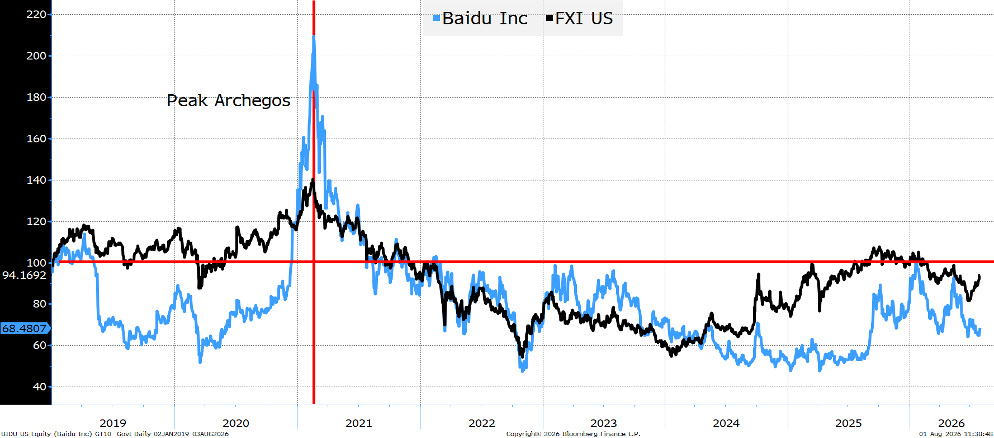
Did Archegos really drive the price of a big, well-followed company, to levels that haven’t been even close to being replicated five years later? (is it just coincidence that several of their largest holdings back in their heyday have similar patterns?)
Should we be spending less time wondering if the bottom is in, and more time wondering if the top is in?
Bottom Line
I suspect that performance for the coming days and maybe weeks, or longer, will come down to understanding what role situational awareness has played in this market. Not just in the last few weeks of volatility, but to the start of the year (or earlier), when we saw some parabolic moves higher develop. You will hear a lot about how earnings drove stocks, but I don’t think that is the case!
Maybe August will be a bit calmer? Most people in the industry could use a breather — it has been a long, volatile and stressful stretch!