Who Wants to Believe in Iran Talks? (The Markets Do); Big Earnings; Yen Plan
Let’s look at how Trump holds off big attack on Iran and the markets look optimistic, a joint plan for the yen, and earnings on tap for this week.
You've reached your free article limit
You've read 0 of 1 free Pro articles.

After the Fire
After the fire the fire still burns
The heart grows older but never ever learns
The memories smolder and the soul always yearns
After the fire the fire still burns
I heard a voice asking what happens after the fire
And then the sound of a breaking window and the scream of a tire
And then the sound of a distant gun and the cry of a hungry child
The night is hot
But nothing’s gonna stop
This gang going wild
– Peter Townshend (Roger Daltrey – solo), 1985
Iran Attack Off … Again?
On Sunday, U.S. Pres. Donald Trump spoke to the media. The president said that the U.S. had been prepared to launch the “biggest attack since World War II” on Saturday, but he had at least postponed those strikes. Pres. Trump was quoted, “We were all set to go, but when the allies asked to call it off, you have got to sort of say, well, let’s see.” The U.S. president says that he was told that U.S. partners (to include Saudi Crown Prince Mohammed bin Salman) in the region believed that a deal to completely reopen the Strait of Hormuz while Iran wound down its nuclear weapons program was close.
Iran, for its part, in what might simply be an attempt to keep its own people in the dark as to the extent of that nation’s military defeat, sent mixed messages. Iranian foreign minister Abbas Araghchi on Sunday, said that negotiations (supposedly with Oman, a nation that shares the Strait with Iran) “were in the final stages.” Esmail Baghaei (spokesperson for the Iranian foreign minister), however, said that “the ongoing negotiations between two coastal states and others can play a constructive or a destructive role in the process.”
Baghaei added this (Monday) morning that an agreement with Oman would not be “sufficient” to ensure safe passage for civilian merchant vessels through the Strait “as long as the U.S. naval blockade against Iran remains in place and its military aggression continues.” The bottom line? Pres.Trump said on Sunday that new peace talks with Iran were set to kick off on Monday afternoon. The president appeared to say (rather reluctantly), “We’re just going to see whether or not we can make a deal.” The president added, “I’m not looking to kill people.”
Iran, as far as we can tell, publicly, has not acknowledged that such talks with the U.S. are ongoing or imminent. That said, financial markets seem to at least want to believe that something positive is happening. Though the opening bells in New York City are still a number of hours away, equity index futures a bid, potentially building on Friday’s gains made when the idea of possible peace talks were more rumor than news. Overnight, traders have also been selling crude oil futures and buying U.S. Treasury debt securities.
Proverbs 8:5
You who are simple,
acquire prudence;
you who are foolish,
acquire understanding
Yen Action?
Over the weekend, the U.S. and Japan acknowledged having taken their first joint action since 1998 to bolster the yen as that reserve currency approached a 40-year low versus the U.S. dollar. Aboard Air Force One, Pres. Trump told the media, “They (Japan) wanted a little bit of help and we’re always there for Japan.”
Treasury Sec. Scott Bessent was a little more (not much more) specific in a social media post: “Friday’s coordinated foreign-exchange actions countered disorderly yen movements.”
This (Monday) morning, Japanese Finance Minister Satsuki Katayama confirmed the joint intervention to support the Japanese currency. Bessent and Katayama both said there would be no hesitation to intervene again if necessary.
Expectations of a potential interest rate differential, with a possibly more hawkish Fed and a seemingly dovish Bank of Japan, have served to exacerbate the trajectory of a weakening yen against the dollar. The yen’s weakness has also been caused by increased spending on energy imports, lackluster foreign investment and concern over Japan’s exceedingly sloppy fiscal policy trends (which are decades in the making).
The Week That Was
Last week, the S&P 500 ended a two-week losing streak, while posting a third winning week in five. The Nasdaq Composite did the same. This is how the past week went across the market…
- The S&P 500 gained 0.7% on Friday and 1.05% for the week.
- The Nasdaq Composite added an even 1% on Friday and 1.59% for the week.
- The Nasdaq 100 tacked on 0.6% on Friday but just 0.52% for the week.
- The Russell 2000 lost 0.5% on Friday but still gained 0.05% on the week.
- The S&P Small Cap 600 gave back just 0.09% on Friday but gained 0.4% for the week.
- The S&P Midcap 400 lost 0.15% on Friday and 0.67% for the week.
- The Dow Transports gave up 0.24% on Friday and a very nasty 6.39% for the week.
- The Philly Semis gained 0.07% on Friday but lost a gnarly 4.3% for the week.
- The KBW Bank Index stacked on just 0.13% on Friday but lost 0.66% for the week.
On Friday, perhaps counter to what readers might have expected on an “up” day, just four of the eleven S&P sector SPDR ETFs closed out the session in the green. Overall, though, the cyclicals clearly outperformed the defensive sectors for the day. The discretionaries (XLY) led for the day, while the materials (XLB) lagged badly.
For the week, again, just four of the 11 S&P sector SPDR ETFs finished the period in the green. Yes, despite the headline indexes having posted winning weeks. Performance was more scattered, but in general, cyclicals beat defensives over the five days.
For the month of July, six of the 11 sector SPDR ETFs posted winning months. Energy (XLE) easily led with the Financials (XLF) finishing comfortably in second place. Technology (XLK) placed a distant last place for July. The XLK gave up 7.96% for the month while the Dow Jones U.S. Semiconductor Index lost 12.04%. Within that index, SanDisk (SNDK) was hit for a loss of 46.6% while KLA Corp (KLAC) and Marvell Technology (MRVL) gave back 39.4% and 37% respectively.
Week Ahead
After yet another weekend pause in U.S. military operations inside Iran, the markets, or at least the algorithms that control the markets, appear to be making an attempt to believe the headlines for now.
- The Geopolitical: We’ve discussed this inside and out for months. This probably is the top market driver in terms of direction for now. This is also probably the leading economic determinant here in the U.S. and elsewhere as far as the pace of both producer-level and consumer-level inflation is concerned.
- Macro: This will be a huge macroeconomic week for economists, investors and traders. This is “July” Jobs Week. Friday obviously is the big day, and the macro will build up to Friday morning throughout the week. The ISM Manufacturing PMI will hit the tape later today while its Service sector counterpart will cross the tape on Wednesday morning. Then Friday is the big day, when the Bureau of Labor Statistics will release the results of its two monthly labor market surveys for July while revising the results from both May and June. This will surely impact our financial marketplace going into the weekend.
- The Federal Reserve: With the Federal Open Market Committee policy meeting offering little in the way of forward guidance last week and July jobs data due this week, there are not a lot of Fed officials on my public speaking radar for this week. We do expect to hear from Fed Gov Lisa Cook on Wednesday afternoon, from St. Louis Fed Pres. Alberto Musalem on Thursday evening and from Richmond Fed Tom Barkin on Friday morning. Of those speakers, only Cook holds 2026 policy voting rights.
Earnings
Second-quarter earnings season got over the bulk of the “Mag 7” hump last week but will continue to stay active this week. Palantir (PLTR) and maritime shipper Mattson (MATX) will report this evening. On Tuesday morning, Caterpillar (CAT) will post results to be followed by Advanced Micro Devices (AMD) and SpaceX (SPCX) that afternoon. Wednesday’s results include those from Eli Lilly (LLY), Walt Disney (DIS). SanDisk (SNDK) and Western Digital (WDC). On Thursday, investors will hear from Airbnb (ABNB), and then on Friday, Oklo (OKLO) will post results.
Charts
Readers will see that the S&P 500, despite posting four green candle sessions last week, more or less, spoiled our “Ascending Triangle” theory on Wednesday.
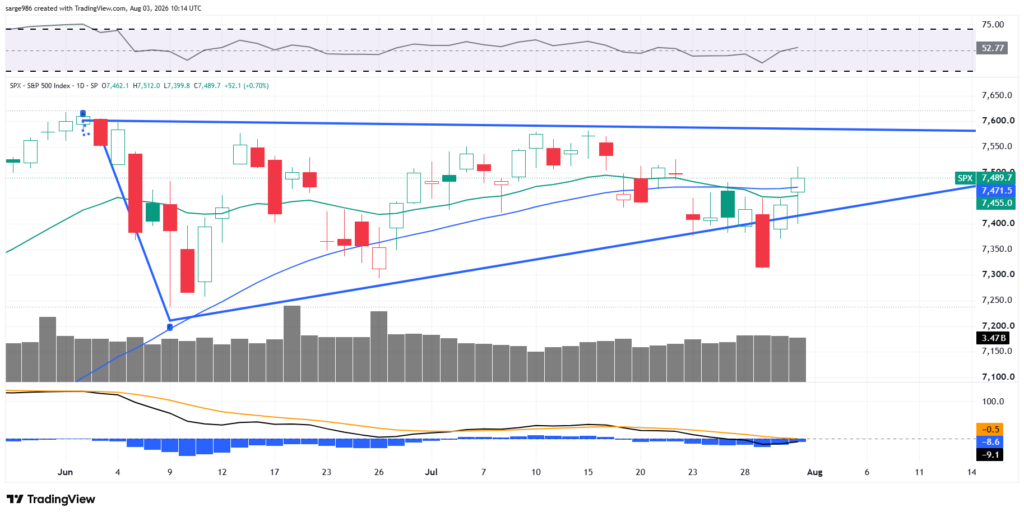
On Friday, the S&P 500 gained both its 21-day exponential moving average and 50-day simple moving average.
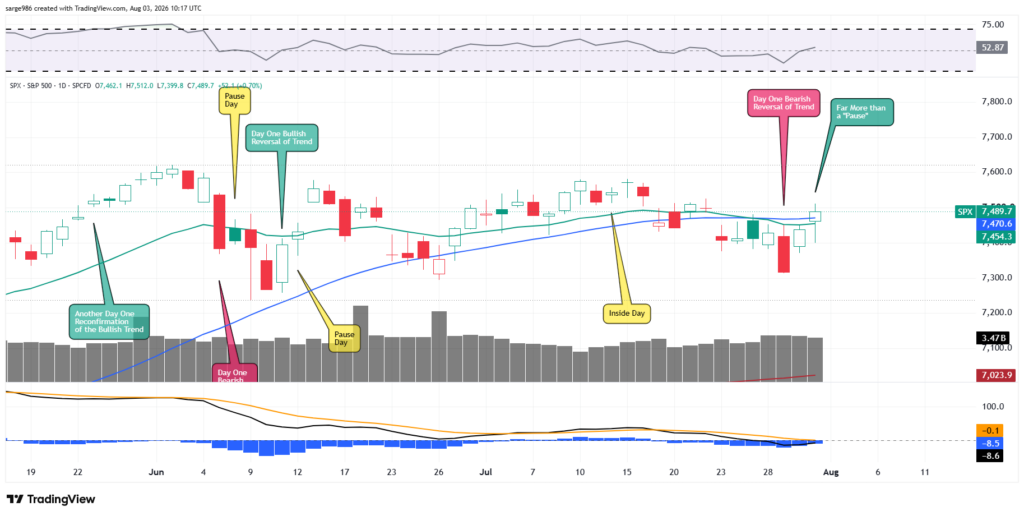
We spoke last Monday morning on such a move being necessary to keep the bull market alive technically. This happened. Though trading volumes were lighter, the price levels achieved by this index on Friday mean that the Bearish Day of Reversal on Wednesday cannot and will not be confirmed.
The bears will need a new Day One to get anything going in that direction. The bulls still need to see support at that 50-day simple moving average as a test from above is extremely likely. Both Relative Strength and the daily moving average convergence divergence for this index offer us very little in the way of directional signaling.
Earnings
As of July 31, according to FactSet, for the second quarter, Wall Street now sees blended (results and expectations) at an incredible year-over-year earnings growth rate for the S&P 500 of 47.4%, up more than “just” sharply from 37.9% last week, ion part, thanks to Amazon (AMZN). Wall Street also sees revenue growth of 14.1%, up significantly from 13.2% one week ago. With 61% of S&P 500 companies having already reported for the season, 86% have beaten earnings expectations, while 77% have beaten revenue expectations.
For the full year of 2026, the Wall Street now looks for earnings growth of 29.1%, up from 27.3% last week (again, thank you Amazon), and up from 14.7% about a month ago. This would come on revenue growth of 11.1%, up from 11% last week and up from 7.7% a month ago. The outlook for the third quarter is also very positive. Third quarter S&P 500 earnings growth is now estimated at 27.4% year over year, up from 27.3% last week.
At the moment, the energy, communication services, consumer discretionaries and technology sectors are projected to have grown Q2 earnings by an absolutely jaw-dropping 135.3, 109.8%, 90.7% and 69.4% respectively. Just one sector, health care (at an ugly -14%) is currently projected to have suffered a Q2 earnings contraction.
Valuation
Still using data provided by FactSet, the S&P 500 ended last week trading at 19.6-times 12 months’ forward-looking earnings, down from 20.1 times last week and down from 21.6 times a rough month ago. This is still below the five-year average of 19.9 times for the index as well as being well above its ten-year average of 19 times. This is also as much due to strong forward guidance as it is anything else.
The S&P 500 also ended last week trading at 27.2 times trailing 12 months’ earnings, down from 27.5 times just one week ago, and also above levels that the index reached more than two months back. This also stands well above the five-year (24.4 times) and ten-year (23.5 times) averages for the index.
Now five (up from three) of the 11 sectors are trading below their five-year average valuations. Six sectors, led by the Industrials (24.7 times) are trading at a premium to their five-year average valuation. The five “undervalued” sectors according to their historical averages over five years are the discretionaries, technology, the otilities, materials and communication services.
Fed Funds Futures
Fed Funds futures trading in Chicago are currently pricing in a 37% probability for no change to be made to the current target range (3.5% to 3.75) for the Fed Funds Rate at the culmination of the next FOMC policy meeting on Sept. 16. There is now a 63% likelihood priced in for that date for a quarter-point rate hike.
There are no rate cuts fully priced in at any point in the future looking out toward year’s end 2027, though there is now a minority probability being priced in as early as July of 2027. There is now a second 25-basis point rate hike priced in (62% probability) for March of 2027.
Economics (All Times Eastern)
09:45 – S&P Global Manufacturing PMI (July-F): Flashed 53.8.
10:00 – ISM Manufacturing Index (July): Expecting 54.0, Last 53.3.
10:00 – Construction Spending (June):
Expecting 0.2% m/m
, Last 0.1% m/m.
The Fed (All Times Eastern)
No public appearances scheduled.
Today’s Earnings Highlights (Consensus EPS Expectations)
Before the Open: TSN (.99)
After the Close: CLX (1.65), MATX (3.82), PLTR (.35)
At the time of publication, Guilfoyle was long PLTR, SNDK, AMD, AMZN equity.
Note: A correction was made to the paragraph about for the forward 12-month P/E ratio for the S&P 500.