What Every Investor Needs to Know About an Alarming Increase in Margin Borrowing
With AI hedge fund Situational Awareness at the forefront, margin debt is rapidly accumulating.
You've reached your free article limit
You've read 0 of 1 free Pro articles.

When markets rally like they have the past few years, investors get sloppy. We sometimes make poor decisions and, because the market is forgiving, we get away with them.
For example, the use of leverage, a means of buying stocks on borrowed funds, can get out of control.
Situational Awareness
The S&P 500 is trading near all-time highs. Despite this, several hedge funds have gotten into trouble due to heavy leverage and/or concentrated positions.
Most notable of these is Situational Awareness LP, an AI-focused hedge fund out of San Francisco. Run by Leopold Aschenbrenner, a 20-something former OpenAI employee, Situational Awareness reportedly used leverage equal to 400% of its capital.
Aschenbrenner’s fund gained 439% during the first half of this year. Undoubtedly, leverage played a key role in those gains, but how quickly the sweet turned sour. Situational Awareness has seen its assets drop from $45 billion to just $10 billion over the past month.
Heavy Leverage Means a Heavy Foot
Is leverage dangerous? It depends.
An automobile can be dangerous or not, depending on who is driving. There is an expectation that the individual behind the wheel has passed a driving test, is insured and understands the rules of the road.
Trading with high leverage is akin to driving F1 or Nascar. It can be done with a degree of safety, but the danger is high, so risk management rules are in place. The user needs special safeguards, just like a race car requires a roll cage or a HANS device.
A Different Kind of All-Time High
I’m not worried about Aschenbrenner. I’m concerned about average investors. As a group, retail investors are rapidly accumulating margin debt — money that is borrowed from a broker to buy stocks.
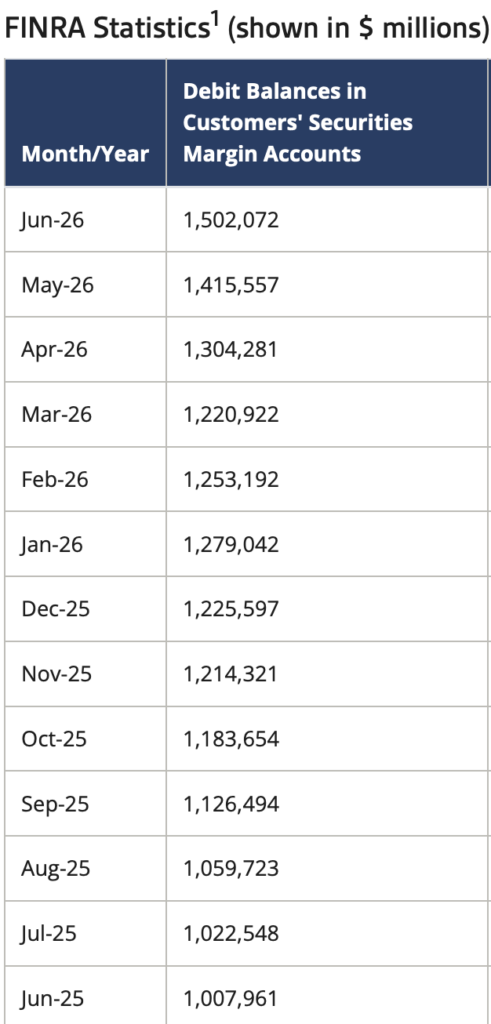
Over the 12 months from June 2025 through June 2026, the Financial Industry Regulatory Authority (FINRA) has recorded a concerning increase in margin debt, from $1 trillion to over $1.5 trillion, an all-time high.
The acceleration of this phenomenon is also concerning, with an increase of nearly $300 billion over the three most recently recorded months. Total margin debt rose from $1.22 trillion in March of 2026 to $1.50 trillion in June.
How This Affects Every Investor
You may believe that the recent sharp increase in leverage doesn’t concern you. But even if you never use leverage, I can assure you that it can affect your portfolio.
There was a sharp increase in margin debt usage starting in late 1999. That usage peaked in March 2000, just as the dot-com bubble began to pop.
Another, less dramatic surge occurred in mid-2007, just months before the S&P 500’s peak prior to the 2008 stock market crash.
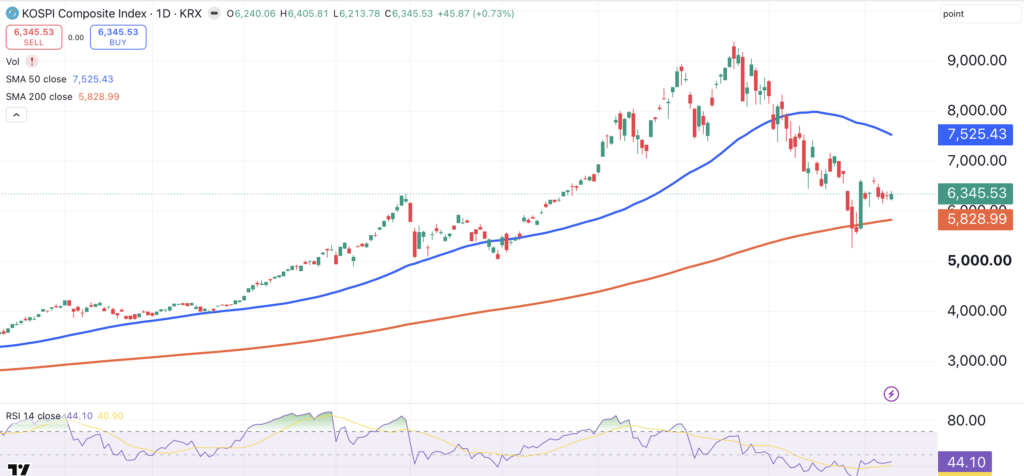
This doesn’t mean that every surge in margin interest usage precedes a market downturn. However, many market downturns are preceded by a surge in margin interest usage, as seen currently in Korea.
Korea
If stocks begin to fall, and many participants are heavily leveraged on the long side, some participants will be forced out of their positions due to margin calls. This forced selling can drive markets lower, creating additional margin calls.
This cascade effect was seen just weeks ago in the Korean stock market, when the KOSPI index nearly broke through its 200-day moving average (red).
Time for a Reset
Individuals are more susceptible to over-leveraging and concentrated positions than institutions, which have guardrails in place. Now that the market is trading near all-time highs, those among us who are over-leveraged and/or holding concentrated positions have an opportunity. We can use the current rally as a reset by selling into strength and reducing or eliminating our dependence on leverage.