Wall Street Looks a Bit Too Much Like Las Vegas for My Taste
The wild AI trade and crazy moves in the semiconductors — along with the action in the credit markets — make me ask, is this investing or gambling?
You've reached your free article limit
You've read 0 of 1 free Pro articles.

Even with Thursday’s over 8% rally in the Philadelphia Semiconductor Index (SOX), the semiconductor sector had its worse month in July since 2008. A breather before the next leg forward or an omen of things to come? As my late father would quip, “Only the Shadow Knows.”
Something happened last week that I think perfectly demonstrates some of the outright gambling going on in these markets. A hedge fund blew up, and tens of billions of dollars of assets were mostly liquidated with Citadel buying a huge chunk of the fund’s $16 billion public equity book. The fund was run by a 24-year-old who was allowed to leverage his first fund up to four times. Ironically the fund’s name was “Situational Awareness,” based on a treatise the manager had written in 2024. In a testament to how intertwined and borderline incestuous the AI ecosystem has become, the fund manager is an ex-OpenAI researcher who got married this weekend in tony Carmel, Calif., to the chief of staff to the CEO of Anthropic. The manager also previously worked at FTX Future Fund before its infamous collapse as did his bride. Sometimes the truth is indeed stranger than fiction.
Meanwhile, the credit default swap prices on Nvidia Corp. (NVDA) surged last week when it became known that the chipmaker was in discussions with OpenAI to potentially backstop up to $250 billion to aid in financing a 10-gigawatt data complex planned for Ohio. The same company that is on the hook to pay Oracle (ORCL) $60 billion annually starting next year for the compute capacity Oracle has gone deeply in debt to construct. Since that five-year $300 billion deal was announced last summer, the stock of Oracle has fallen some 70% from its post agreement highs.
In the first few years of the AI infrastructure build-out, capital spending was largely funded by free cash flow and cash on the balance sheets of the major hyperscalers. As spending has soared, previously asset-lite names like Meta Platforms (META) have seen their fixed assets in the form of huge AI data centers boom while free cash flow has plunged. Debt and off-balance sheet liabilities are increasingly being used to meet burgeoning capital budgets.
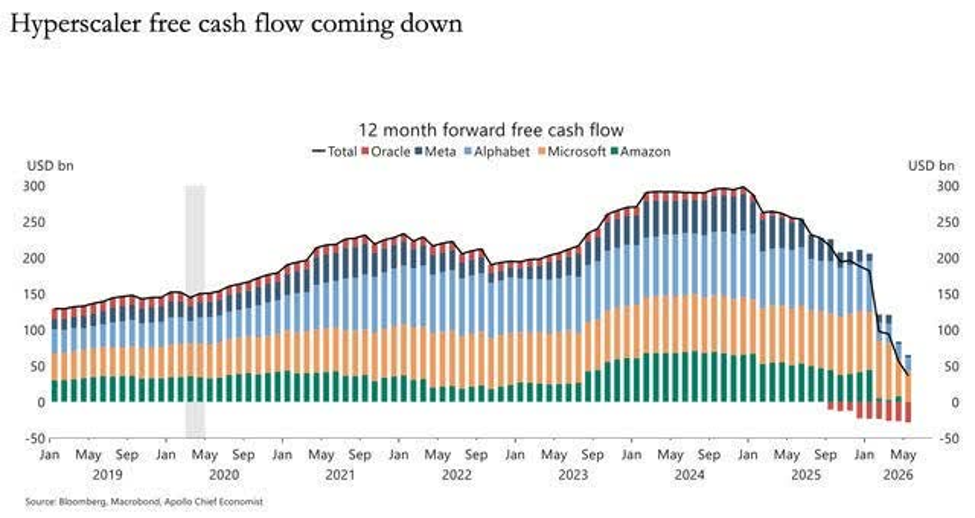
Debt issuance by the large hyperscalers in 2026 has already surpassed all of 2025. The credit markets are starting to choke on the amount of debt. CoreWeave (CRWV) just paid 5.5% above SOFR on a $2.6 billion leveraged loan. Initial discussions reportedly started at 4.25% to 4.5% above SOFR.
And Ed Yardeni’s famous “bond vigilantes” seem to be returning to the treasury markets as well with the 30-Year treasury yield closing last week at 5.28%. Ominously, that is its highest level since mid-2007, in front of the Great Financial Crisis. What possibly could go wrong? Not much according to a good chunk or the retail investor community judging by the record $1.5 trillion in stock margin debt outstanding.
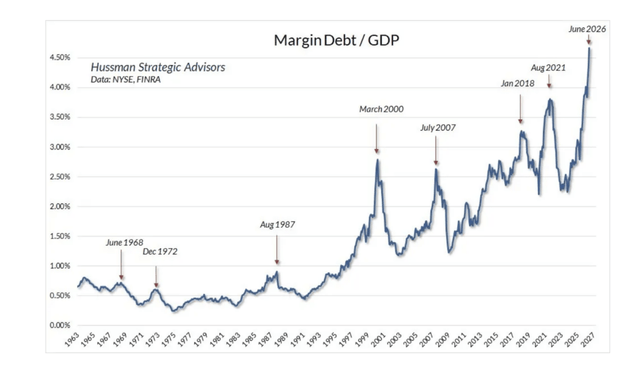
In summary, there is more gambling going on in parts of these markets than at Draft Kings in the lead up to NFL week 1. In addition, the credit markets are pointing to a different path forward than the major indexes. Therefore, as Sergeant Phil Esterhaus of Hill Street Blues would famously warn, “Be careful out there” as trading in August commences.
At the time of publication, Jensen had no position in any security mentioned.