Pack Your (Money) Bags. It’s Time to Hit the Road to Greener Markets.
Here’s why you should use this Vanguard ETF to move some of your money outside of the U.S.
You've reached your free article limit
You've read 0 of 1 free Pro articles.

If you love your money, you’ll treat it to a trip outside of the U.S. And I’m not being political. The fact is that money is being treated better in the rest of the world than it is here.
The Vanguard Total International Stock Index Fund (VXUS) invests globally, minus the U.S., and tracks the FTSE Global All Cap ex-US Index. It’s up around 42% since January 2025. During the same time, the S&P 500 (SPY) is up 25%. And I think the trend will continue.
The Global Market Ex-US Is Beating the S&P 500
Again, this isn’t political, as the chart below shows clearly. It’s simply based on price performance. The U.S. is losing to global markets. Since January 2025, the relationship has changed; money used to pour into the U.S., but now, it’s finding a home abroad, too.
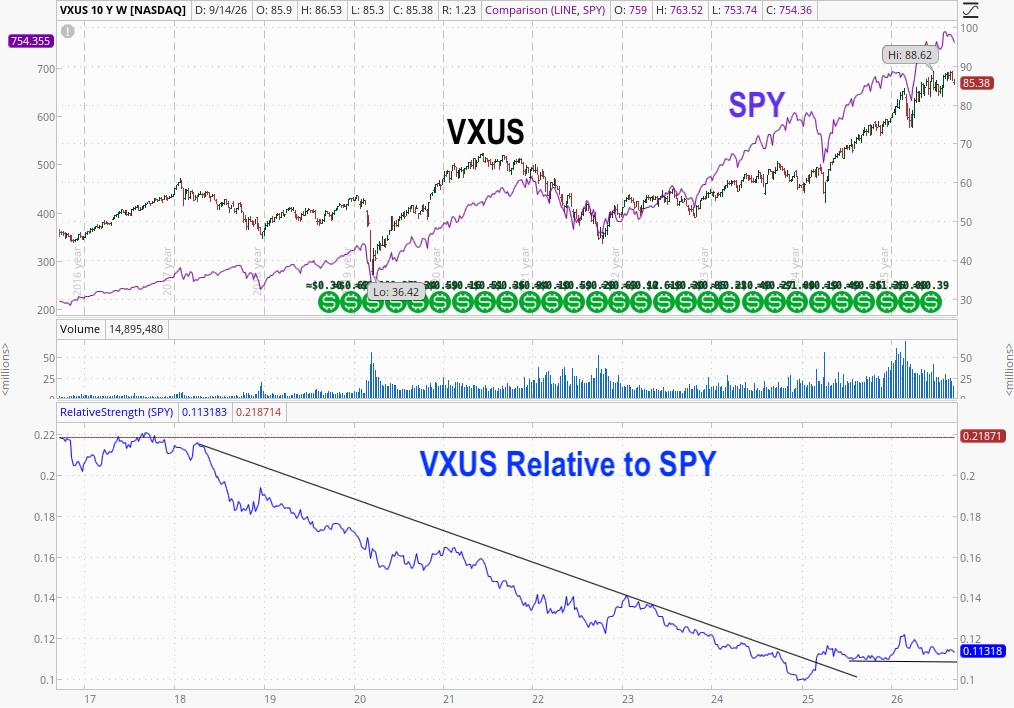
In the top clip, we’ve got VXUS and SPY price charts. Over the last 10 years, SPY is up more. But since the beginning of 2025, VXUS initially outperformed and is now performing in line with SPY. Will that continue? I don’t know, but I don’t see why it shouldn’t.
Here’s Why VXUS Is a Better Bet Than the S&P 500
The performance aspect is important, but it’s not the whole reason. What scares me about the U.S. markets is the concentration risk. It’s hard to say that investments in the S&P 500 or many other domestic market indices are truly diversified anymore. In the past, you could buy one index fund and gain reasonable exposure to all 11 sectors. These days, according to Morningstar, 35% of your money goes into tech. Just 2% goes to basic materials or utilities. Something around 40% is allocated to just the top 10 companies. That’s not diversification.
I know, I could just buy an equal-weight ETF, rather than a market-cap-weighted index like the S&P 500. The thing is, the equal-weighted indexes have generally underperformed the S&P 500, and since 2025, VXUS has beaten RSP, even more consistently than it’s beaten SPY. They say that money flows where it’s treated best, and that appears to be anywhere but here right now.
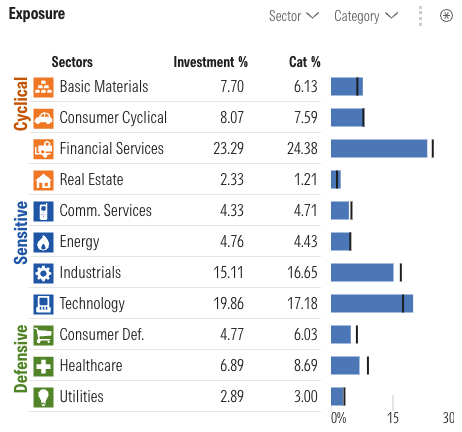
If you love tech, no worries. VXUS has you covered. Taiwan Semi (TSM) is its largest holding at 4% of the portfolio. Samsung (SSNLF), SK Hynix (SKHY), and ASML (ASML) each have between 1-2% of each dollar invested. However, where the S&P 500 is 35% tech, VXUS is a more rational 17%.
Compare the following two tables from Morningstar.
This is the overall sector exposure for VXUS:
This is the overall sector exposure for SPY:
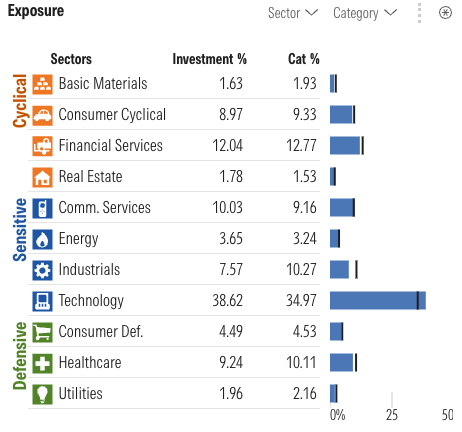
In fact, VXUS has just 13% of its assets in the top-10 holdings, whereas SPY has 38%, again, according to Morningstar. If you believe in the value of diversification, VXUS is the better fund.
It’s also got a better distribution yield: around 2.5% vs. just over 1% for SPY. Did I mention the expense ratio is about half of what SPY charges? 0.050% compared to 0.0945% (Vanguard’s VOO is just 0.03%, if you’re looking for a straight-up SPY replacement).
Risk Profile and Valuation
Investing is a game of risk. You want the best reward you can get for the level of risk you’re taking. Here, too, VXUS is the better bet. It’s annualized standard deviation, according to Morningstar, is 12.46 vs. 12.92 for SPY. Not a huge difference, but it’s something.
Did I mention valuation? Morningstar quotes the P/E for the holdings in VXUS as just under 14, vs. 20 for SPY, so in a market downturn, VXUS could hold up better.
Final Thoughts
In the long run, my guess is that the U.S. remains the better buy. We’ve always led when it comes to innovation. But the chart shows that something has changed, and it’s not just a temporary blip. Plus, diversification is important, and with VXUS, you get sector diversification as well as global diversification. Not to mention better valuation and slightly lower historical risk. So, until the chart shows a shift back to SPY dominance, it pays to send at least some of your money where it will be treated best.
I’ll end by saying that this isn’t a trade; it’s an investment, and I’m not trying to time this one. Rather, for the equity part of my portfolio allocation, I think it makes sense to rotate some of my U.S. holdings into VXUS or other similar funds.
Disclosure: Jason Meshnick does not currently hold shares of VXUS but will be placing a bid after this article is published.