Trump's India Trade Deal TACO Should Underpin Mumbai Markets
What does it mean to see U.S. tariffs on Indian goods slashed to 18%?
You've reached your free article limit
You've read 0 of 1 free Pro articles.
The United States has reached a deal on trade with India, lowering tariffs on U.S. imports of Indian goods from 50% to 18%.
That knocks what had been one of the highest tariff-tax rates in the world to a level where it’s one percentage point lower than key factory-output rivals in Southeast Asia.
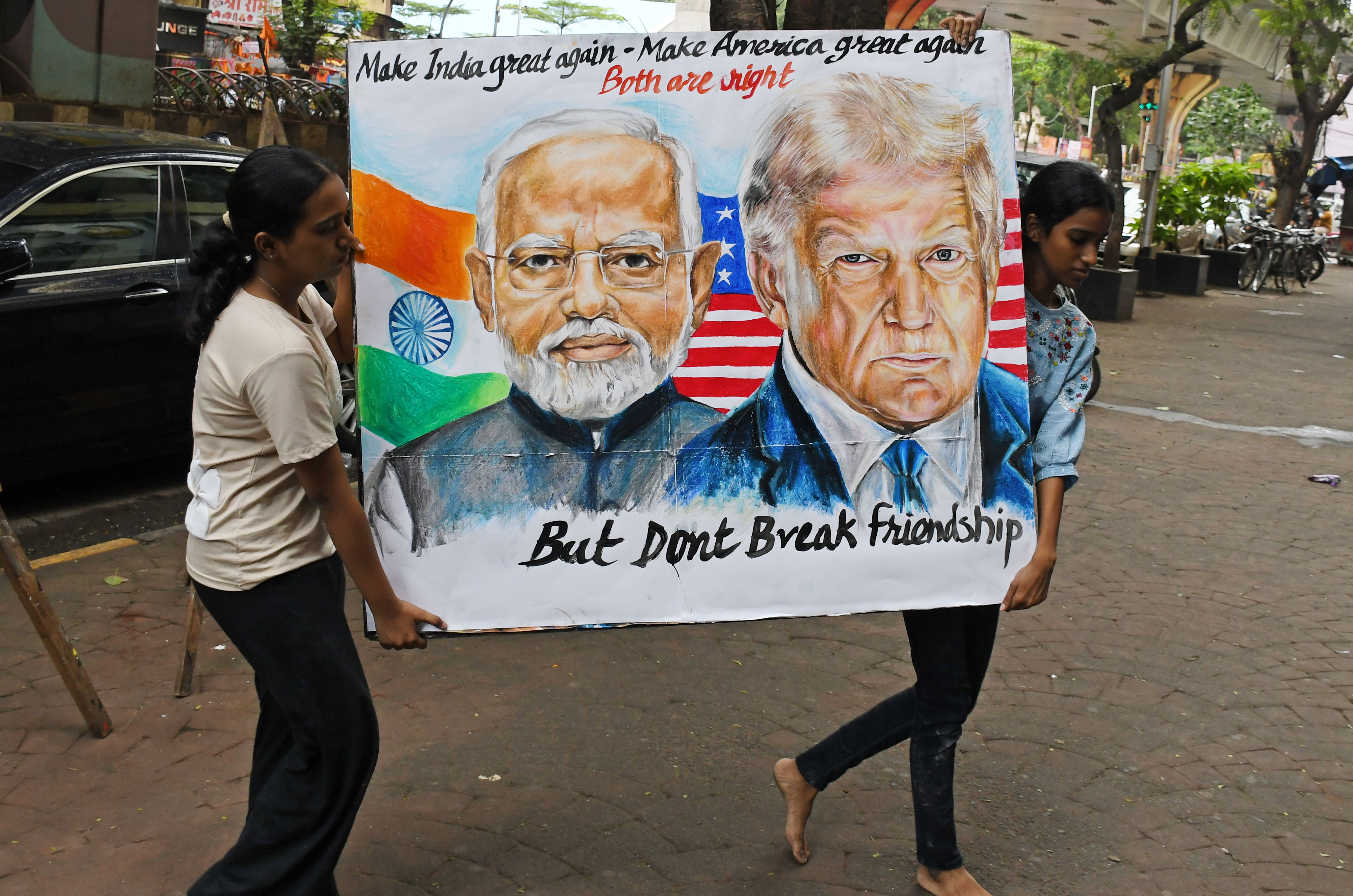
Whereas India will see a punitive 25% tariff removed entirely, and the remaining U.S. import tax cut to 18%, other Asian nations such as Thailand, Indonesia, Malaysia, the Philippines and Pakistan all face a U.S. trade duty of 19%.
The details, as usual, are very broad-brush and lack any of the nitty-gritty detail found in the trade agreement signed by the European Union and India on January 27.
Indian Prime Minister Narendra Modi confirmed the deal on social media.
“Wonderful to speak with my dear friend President Trump today,” the Indian leader
Made in India is a signature trade initiative launched by the Indian government in 2014, to boost Indian manufacturing and create jobs.
Modi 'One of my Greatest Friends'
President Trump, meanwhile, called it an “honor” to speak with Modi, “one of my greatest friends and, a Powerful and Respected Leader of his Country,” Trump stated, with his usual odd use of CapiTal LeTteRs and, punctuation.
Thank you for your attention to this matter!
Trump signed off with that typical turn of phrase, too.
Modi’s English may be perfect, while Trump’s use of language adheres to his very own stylebook, but the only surprise to see this deal struck is that it took so long to arrive.
It’s another TACO trade moment, where Trump backs off the big stick and plays nice again. It should also provide an underpinning for Indian stocks, which have underperformed over the course of the last 18 months.
Mumbai Market to Retest 2024 Highs?
The Mumbai markets should now have the underpinning to push back toward their September 2024 all-time highs.
The Sensex tracking 30 major companies on the Bombay Stock Exchange rose 2.5% on Tuesday, a day of recovery for most Asian markets. The Nifty 50 tracking large companies on the National Stock Exchange rose 2.6%.
But Indian equities are still in the red so far this year, and around 2% lower than those September 2024 highs. The Mumbai markets did lock in gains of around 10% last year, a recovery from a torrid start that saw them slip to lows last April. It was a recovery, but an underperformance compared with the 28.6% rise last year in the MSCI All Countries Asia Index.
It was already a shock to see India, a key U.S. ally in Asia and the world’s largest democracy, hit with 25% tariffs as part of the “reciprocal” U.S. trade taxes that Trump unveiled last April. But that was doubled last August when Trump cited Indian purchases of Russian oil — something the United States had
According to Trump, Modi has now “agreed to stop buying Russian oil,” substituting with oil from the United States and “potentially” Venezuela, although it appears more likely that India will continue to scale Russian purchases back, rather than eliminate them altogether.
Russia has already slipped from serving as India’s top source of oil into third place, behind Iraq and Saudi Arabia. Russian imports into India dropped by one-third in December alone.
A Key U.S. Ally
India has not quite had the same economic self-reliance as China has in standing up to these provocations. But Modi has quietly played a savvy game, standing tough in a way that appeals to his domestic voter base, while Indian negotiators worked in the background to achieve this outcome.
Modi is exactly the kind of nationalist, populist strongman leader that Trump admires. Modi was one of the very first leaders to meet personally with Trump in his second term, when an Indian delegation visited Washington in February 2025. India is also part of the “Quad” alliance of Asia Pacific democracies, alongside the United States, Japan and Australia.
That’s why it was a shock to see trade talks break down so badly. But the Trump administration grew frustrated with the slow pace of negotiations by the Delhi trade delegation. Months of talks led to an impasse, just as a hoped-for Indian trade deal during Trump’s first term cameo to nothing.
India has historically had a highly protectionist import regime, and made both investing and operating in India for foreign investors and companies so inconvenient that, until recent changes under Modi, most would walk away.
A $500 Billion Commitment for What?
That’s changing — as illustrated by recent trade deals with not only Europe but also Britain, signed in May 2025. Modi has also carefully embraced — literally — the leaders of geopolitical rivals such as Russia and China, a way to hedge his bets if his warm personal relationship with Trump was not enough to avoid an Indian hit from the big stick.
Trump said in his social-media post that India has now committed to “BUY AMERICAN” at a much higher level, including purchases worth “over $500 BILLION DOLLARS of U.S. Energy, Technology, Agricultural, Coal, and many other products.”
“Prime Minister Modi and I are two people that GET THINGS DONE, something that cannot be said for most,” Trump added.
India is now on a level playing field with the rest of Asia. Nevertheless, it faces far higher duties on exports to the United States than at the start of 2025, when the average effective rate of U.S. import taxes on Indian goods was 2.4% to 2.5%.
So Trump is claiming a “win” for relief from a self-imposed trade emergency. India says the $500 billion figure will include an existing pipeline of projects that have already been agreed upon, on industries such as infrastructure construction, defense and data centers.
Economic Growth Is Best in World
With details beyond that scant, what we can say for sure is that this new “deal” does represent a dramatic de-escalation of India-U.S. tensions. It should provide a solid underpinning for Indian stocks, and remove the overhang of trade uncertainty from the Mumbai markets.
Other economic conditions remain solid for India, with gross domestic product forecast to rise 6.9% in 2026. That’s the highest rate of growth in the world among major economies, well above the still-strong Asia average of 4.5%.
The central Reserve Bank of India has also been cutting interest rates since January 2025, from 6.5% at the start of last year to 5.25% now. Inflation, frequently sky-high and a major problem for the central bank, is under control, up slightly from a low of 0.25% last October but still a very manageable 1.33% as of the last reading, for December. That’s down from 5.2% in December 2024, and well below the RBI’s target of 2% to 6%.
Wait and See on Details
We will have to wait to see further details on the India-U.S. pact. Recent “deals” with Japan and South Korea have included similar broad-brush strokes and big figures on purchases, but including existing investments. However, a reduction on tariffs for U.S. exports on the likes of farm goods would be a major change.
The Trump administration had already granted tariff exemptions to key Indian industries such as pharmaceuticals. Low-cost India dominates the market for generic drugs as well as vaccines, accounting for 40% of the generics sold in the United States, and 60% of the world’s vaccine output.
The EU-India deal is the product of two decades of talks, and includes highly specific wording on each category of goods and services. It should lower tariffs on 96.6% of European shipments into India and 99.5% of Indian exports into Europe, covering the bulk of the €180 billion ($213 billion) in two-way trade.
It’s notable that the European deal includes an agreement on services, a sector that Trump’s trade policy — seemingly stuck, ideologically, in the assembly-line heyday of Henry Ford — has tended to totally ignore. The talks with Europe began in 2007, and it could still take a year for this deal to be implemented. But it’s far more likely to last.