Think the Yen Doesn’t Matter to U.S. Investors? Think Again.
A stronger yen would threaten the earnings of major exporters, but a strengthening yen would also be a boon to domestic Japanese companies. Let me explain.
You've reached your free article limit
You've read 0 of 1 free Pro articles.
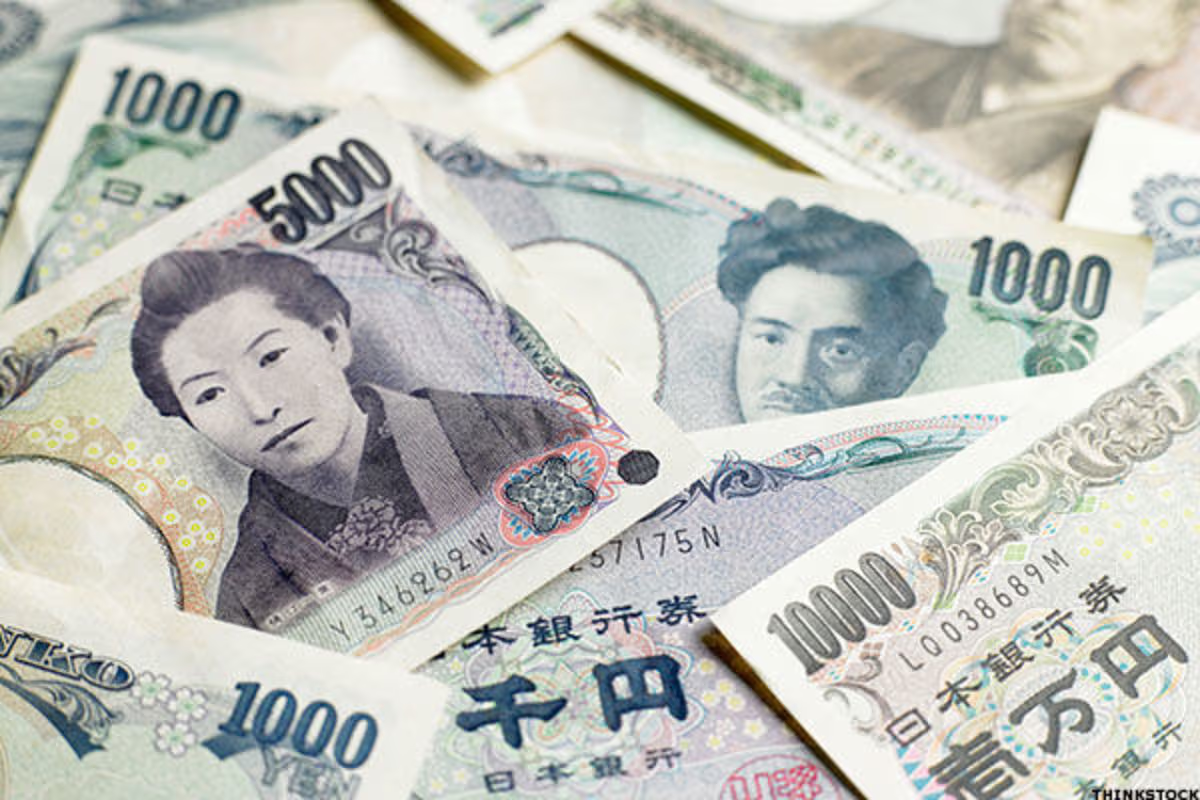
The United States and Japan both agree that the Japanese yen should be stronger. But they differ sharply on the necessary direction to take.
The dispute has undone around half of the gains in the Japanese currency since the joint U.S.-Japan intervention into currency markets on July 31. That pushed the yen from its high just shy of ¥164 to the U.S. dollar down to a strong point of ¥156.15.
The yen is now set to re-test the ¥160 “red line” that was breached in March. It remains at levels last seen in 1986. Do currency traders believe Japan will continue to support the yen?
Bessent blames crisis on weak yen
A rapid and sustained strengthening of the yen could threaten capital markets globally. Institutional investors from Japan in particular have for the last decade been able to borrow in yen at extremely low interest rates and buy overseas assets. An unwinding of this “carry trade” could cause forced selling by institutional investors and a rapid repatriation of capital into yen, which would only reinforce the yen’s value gains.
U.S. Treasury Sec. Scott Bessent has for the last year been insisting that Japanese interest rates are too low. And he’s likely right. Even after five rate hikes since March 2024, they remain at 1.0%, the second-lowest among G20 economies, the other outlier being Switzerland at 0.0%.
Bessent experienced chaos in Asian currencies during the Asian financial crisis of 1997-98, when he was working at Soros Fund Management. He said earlier this month on CNBC that the Asian financial crisis was in part triggered by an overly weak yen. “So I think a stable yen is not only important for the U.S., but it’s very important for the entire region.”
Exerting pressure on Tokyo
He is now urging Japan to sustain the intervention effect. “We can give the market signals, but at the end of the day, it’s going to be policy and fundamentals,” he added, stating that the U.S. Treasury intervened only “because we are very optimistic on their policy path.”
Bessent, though, finds himself at odds with Japanese Prime Minister Sanae Takaichi. He is subtly applying pressure for her to avoid undoing the effects of intervention.
A disciple of the late Shinzo Abe, Japan’s longest-serving prime minister, Takaichi is a proponent of his reflationary “Abenomics” policies. She advocates higher government spending and low interest rates to push Japan’s economy far out of the devastating deflationary spiral that occurred in the “lost years” after Japan’s bubble burst in the early ’90s.
Tax cut – with no way to pay it
Takaichi would prefer to keep borrowing costs low. She insists she will leave rate decisions to the central Bank of Japan (BOJ). She is also, though, pushing inflationary policies such as a dramatic cut in the sales tax on food. Her cabinet has approved a reduction to 1.0% from the current 8.0% for two years starting April 2027 – without her government indicating exactly how it will pay for that reduction in tax income.
It sounds a lot like a return to voodoo economics. “We will conduct a zero-based review of all special accounts, government funds and the like,” Takaichi told reporters as her cabinet approved the sales-tax reduction on Aug. 6. “I am confident that we can secure the necessary funding through these reforms.”
The BOJ meanwhile, would love to raise rates to combat inflation – still below the central bank’s 2.0% target but rising 50 basis points from a February low to 1.7% for June – and so long as wages continue to rise.
Inflation had been above 2.0% for almost four years, since April 2022, before dipping in January. It would likely have remained higher than 2.0% if the government had not introduced fuel subsidies during the disruption in oil supply from the Middle East. It has capped the price of fuel at the pump at ¥170 ($1.07) per liter, subsidizing wholesalers where necessary. Japan imports all its oil, some 90% flowing through the Strait of Hormuz under normal conditions.
Pricing in a rate hike in Tokyo
It is likely that the BOJ will raise rates at its meeting either in September or October, with another chance to come in December. Takaichi and her team would likely tolerate a quarter-percentage-point rise, having already overseen two such moves since she took office in October 2025.
Markets are currently pricing in a 75% likelihood of a rate rise in September. That could eat into the interest-rate differential with the United States, with markets now pricing in a 39% chance of a U.S. rate rise in September. Even at 1.25%, though, Japanese rates would be well below the 3.50% to 3.75% band at the U.S. Federal Reserve.
The pro-growth policies of the Takaichi administration have fed into the prospects of an improving Japanese economy to drive stocks higher this year.
Topix ends today at record
The Topix, a broad-market index encapsulating around 1,700 Tokyo-listed companies, closed at a record high today, up 0.9% to 4,176.04. It is now up 20.1% so far in 2026, and 4.3% in August alone.
The blue-chip-heavy Nikkei 225, tracking 225 of the largest-capitalization companies in Japan, closed up 1.2% at 68,308.59. It is 5.6% off its record closing high of 72,354 set on June 22. It is nevertheless up 35.7% year to date.
Both Japanese benchmarks are well ahead of the 13.0% advance for the S&P 500 so far this year, with Nasdaq not much further ahead on a 14.4% gain in 2026.
Tech stocks lead the way
Among the biggest gainers are Japanese chip stocks such as Kioxia Holdings (KXIAY) (T:285A), the former memory-chip unit spun out of Toshiba by Bain Capital in 2018, and Tokyo Electron (TOELY) (T:8035). Kioxia is leading the charge, up 356.4% this year, although it has lagged alongside other semiconductor stocks since mid-June. Tokyo Electron, which makes equipment to make chips, has had a little less fervor but is still up an extremely solid 61.0% year to date, having hit a high on July 1.
Advantest (T:6857), my pick for a stock in Asia for this year, is up 69.7% year to date. Like Tokyo Electron, it is a picks-and-shovels play in the semiconductor sector, making testing equipment to evaluate the performance of chips and memory devices along the various stages of production.
Those stocks see their fortunes rise and fall alongside the broader semiconductor sector. Such trades are driven by the profitability outlook for artificial intelligence rather than any inherent economic drivers within Japan.
Value stocks also rising
Encouragingly, while tech stocks tend to lead the charge higher, investors are currently buying both value and growth stocks in Japan.
For instance, the banks Mitsubishi UFJ Financial (MUFG) (T:8306), up 45.7% year to date, and Mizuho Financial Group (MFG) (T:8411), up 49.4%, have both charged ahead in 2026. They are already posting record profits while the slightly higher interest rates in Japan are goosing net-interest margins.
Investors are enthused that Japanese companies are starting to reap the rewards of a reflationary spiral, with consumers able to tolerate slightly higher prices thanks to rising wages. For decades, as prices got cheaper in Japan, it paid to wait to make major purchases, whether for a household or for a company seeking to expand.
A stronger yen would threaten the earnings of major exporters by reducing the currency-conversion effect when repatriated back into Japanese yen. But a strengthening yen would be a boon to domestic Japanese companies by reducing import costs and operating expenses.
For now, yen trading indicates prospects for very gradual interest-rate rises in Japan. Should the BOJ become more hawkish or inflation spike, we could however see faster rate rises, and an unwinding of the yen carry trade, threatening asset prices on Wall Street as well as in Japan.
At the time of publication, Frew McMillan had no position in any security mentioned.