Think Friday Was Bad? Get Used to It
Let’s unpack what happened and why I expect more such days over the coming months.
You've reached your free article limit
You've read 0 of 1 free Pro articles.
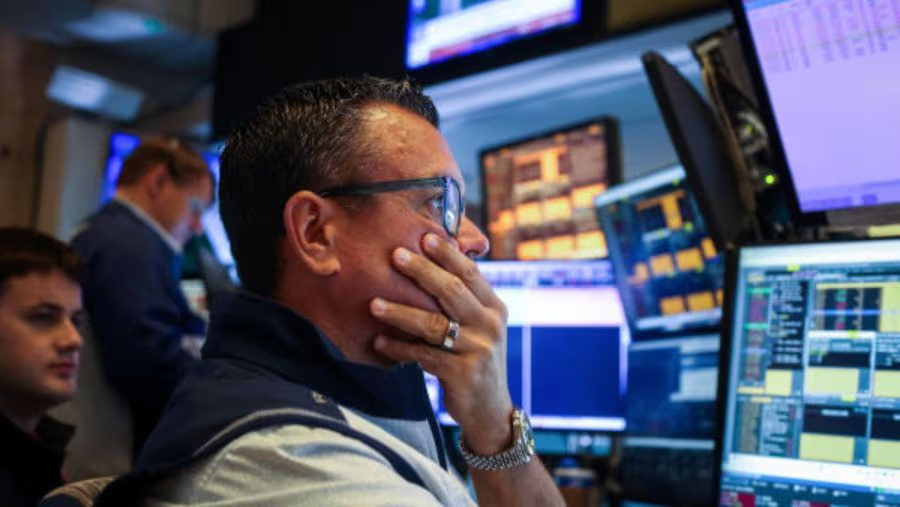
The market had a truly widespread selloff Friday — one of the few over the past several quarters — as the Nasdaq fell by over 4% on the day. That was the biggest one-day decline since the markets’ tariff tantrum at the beginning of April of last year. It was a true “risk off” day as small caps were off 3.5%. Bitcoin briefly went under the $60,000 threshold on Friday before rebounding sharply. The cryptocurrency is down more than half since its record highs in October. A testament on how fast things can go sideways once a bubble pops.
Friday’s jobs report contained both good news and bad news. Job creation last month was double the consensus and March and April had their job estimates revised upward. Job openings also surged in April. But a lot of job growth came from the low-paying hospitality industry. Most of the rest came from local government and health care, not exactly the most productive parts of the economy.
Yield on the 10-year treasury moved back over the 4.5% level. Any hopes for a rate reduction in 2026 now seem like a pipe dream. Mortgage rates are significantly higher than they were earlier in the year which has put the kibosh on any chances of a solid spring selling season for the moribund housing market. Wages rose 3.4% over the past 12 months. But that is less than the current rate of inflation, which has moved higher thanks to the conflict with Iran.
Speaking of which, there was no clear progress in negotiations last week on an agreement to reopen the Strait of Hormuz. One could make an argument that things went south over the weekend. Polymarket now sees just over 20% chance that a permanent peace agreement happens before the end of June. That could prove very problematic for the global economy and markets. Executives at Exxon Mobil (XOM) and leaders at other energy firms recently projected that if that scenario plays out, we could be looking at oil at $150/barrel as inventories and reserves get depleted. Equities are obviously not pricing another spike in energy prices.
This week will be dominated by news around the biggest IPO in history, Space Exploration Technologies Corp (SPCX). Elon Musk will try to become the globe’s first trillionaire as the company tries to raise $75 billion at a $1.8 billion valuation, or roughly 90 times last year’s revenues.
It is critical that this IPO succeeds. If it flops, the chances of OpenAI and Anthropic coming public in 2026 decrease notably. This would greatly undermine the AI narrative that has driven most of the market gains since ChatGPT debuted in November 2022. On that topic, Microsoft (MSFT) just joined OpenAI and Anthropic in moving their AI model customers from subscription-based pricing to usage-based pricing. This is a story that has gotten too little coverage from the financial press. The change could help understand what the “true” corporate demand for AI really is. I fear the markets might like that answer.
Given this view of the overall market, I would not be surprised if we see more days like Friday in the months ahead. I continue to hold a good chunk of dry powder within my portfolio to deploy incrementally into the market on days like Friday via covered call orders. I highlighted the trade I made on Friday’s selloff over the weekend. Wednesday, I will profile a few more growth at a reasonable price plays I have on my shopping list to act upon any further dips in equities.
At the time of publication, Jensen had no position in any security mentioned.