The Looming Debt Threat
While most investors are focusing on the Q2 earnings reports and Iran, I am watching the credit markets closely. Here’s why.
You've reached your free article limit
You've read 0 of 1 free Pro articles.

After two weeks of daily bombing in Iran, triggering retaliatory strikes throughout the Gulf region, it looks like an off ramp is again being bandied about, even as Ukraine apparently has targeted Iranian vessels in the Caspian Sea. I continue to see no good way out of this situation and these impacts will continue to accumulate for the global economy.
The surge in energy and commodity prices also exacerbates what I consider by far the biggest issue for the economy and equity markets. And that is the massive amount of debt being piled up throughout the credit markets. Any hopes that the Federal Reserve would lower the Fed Funds rate in 2026 have fully dissipated and the futures are increasingly pricing in a rate hike at the September Federal Open Market Committee meeting.
Not that another quarter-percentage point reduction to the Fed Funds rate would do anything for the economy. This is a story I have touched on frequently, but is close to criminally underreported in the financial press. The Fed has cut its primary interest rate by a cumulative 1.75 percentage points since September 2024. Treasury yields over that time have gone in the complete opposite direction. The yield on 10-Year treasury is nearly one full percentage point higher over that time. The 30-Year treasury yield has shot up to nearly 5.2% to its highest level since 2007.
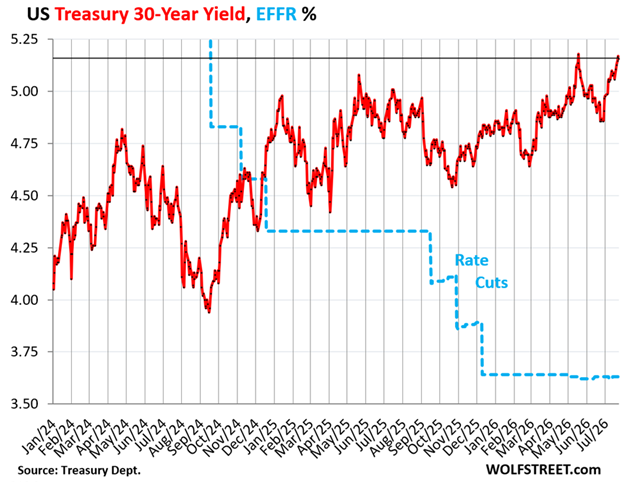
Neither political party has any inclination to cut spending on the federal level to address the yawning fiscal deficit. And the credit markets are starting to choke on the amount of debt issuance and bond investors are demanding higher yields to buy that debt. What is the new Fed Chairman going to do other than offering up less forward guidance than his predecessors? Well, besides tweaking some inflation models, even as the bureau of labor statistics already almost comically underestimates the true inflation rate for the average American household.
And AI-related debt has exploded this year with nearly $500 billion in this type of issuance already executed in 2026. Free cash flow has dropped dramatically at the hyperscalers this year, which have steadily boosted their capital budgets throughout this year. But this is not because demand for AI is exploding outside the unprofitable OpenAI and Anthropic. Capital spending is primarily moving up due to higher costs for the components that go into these huge data center facilities. Space Exploration Technologies Corp. (SPCX) and Meta Platforms (META) are now renting out a significant chunk of the compute capacity the companies originally built for their own needs.
So, while most investors are focusing on the Q2 earnings reports pouring across the wires, I am watching the credit markets closely. If the 10-Year treasury yield hits five percent, that easily could send shutters across the equity markets. The recent bonds issued by SpaceX in late June have traded quite poorly and credit default swap prices against Oracle’s (ORCL) burgeoning debt load are already troubling after the company posted nearly $24 billion in negative free cash flow in its recently concluded fiscal year. And the company has guided to a roughly $40 billion increase to its capital budget in its current fiscal year.
I am sure this week will be dominated by headlines around Iran and instant analysis on the stream of second-quarter results. I am going to keep my eye on the growing stress in the credit markets.
At the time of publication, Jensen had no position in any security mentioned.