The AI End Game Appears to Be Growing Near
Unfortunately, it is hard to see the AI infrastructure buildout maintaining this pace.
You've reached your free article limit
You've read 0 of 1 free Pro articles.

Markets ended the trading week Friday with all the major indexes posting modest gains as oil fell on the latest hopes that an agreement will be reached to reopen the Strait of Hormuz.
Both the S&P 500 and NASDAQ climbed 0.5%. It was not a broad-based rally, with the small-cap Russell barely ending in the back. Given the news on the week, the markets were quite resilient. Diesel prices seem to be making all-time highs almost on a daily basis and sovereign bond yields continue to surge globally.
That said, market breadth has become dismal. Last Monday, the S&P 500 rallied 1.5% on the day. It was the index’s best daily performance since early August, which put S&P 500 near its all-time high. However, there were many more stocks in the index sitting at 52-week lows than 52-week highs. Over the past century, this has only come close to happening in November 1999 and January 1973. Bear markets soon followed.
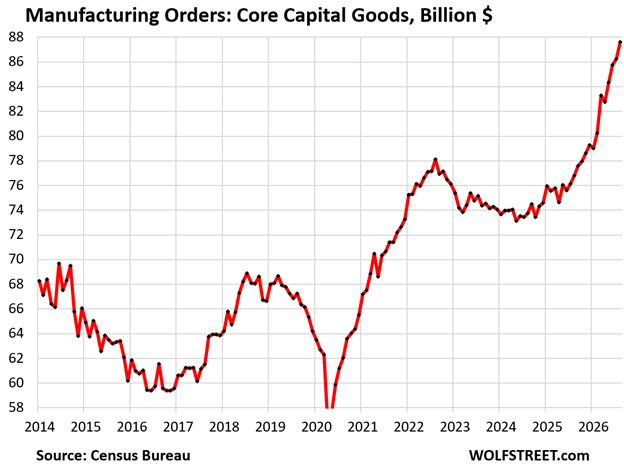
The primary driver of the U.S. economy and equity markets remains the AI revolution. Investors continue to see consistent signs of this. Late last week, durable good orders for August received by manufacturers, outside defense and aircraft, was posted. The report showed a 14.1% increase to $88 billion for the month. And that is within an economy that has averaged 1.2% GDP growth over the past three quarters.
Unfortunately, it is hard to see the AI infrastructure buildout maintaining this pace. The five major hyper scalers have now racked up a combined $3 trillion in off-balance sheet liabilities in addition to the nearly $1.4 trillion of on balance sheet obligations. And the credit markets are starting to choke on this debt issuance as interest rates continue to rise.
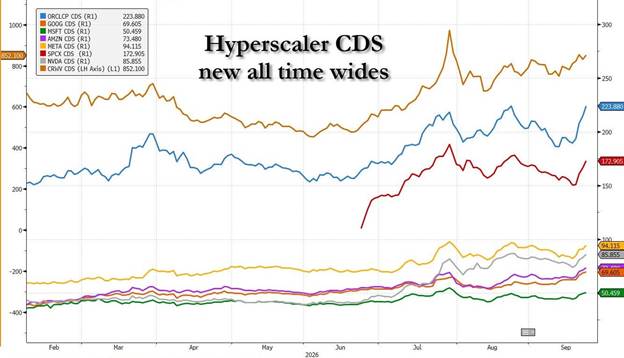
The AI narrative is starting to take on some water. Last week, Oracle (ORCL) triggered a hiccup in the markets when it sent out a force majeure notice around the huge data center complex being built for the company in New Mexico. Some bonds that were sold to finance the buildout of that massive facility were already trading in stressed territory at some 90 cents on the dollar. The project is facing some potential schedule challenges due to natural gas pipeline regulatory delays. Credit default swap prices against Oracle’s debt hit all time highs last week and are moving up against most of the hyperscalers and neocloud providers.
And this problem is hardly confined to the Land of Enchantment. The governor of Texas last week halted all permits for new data centers until a full and complete audit of the current requests in queue could be completed to assess what the impacts will be to the state’s electrical grid. Approximately, one-fifth of the U.S. data centers in the “pipeline,” roughly 50 gigawatts, are planned in the Lone Star state.
As the midterms rapidly approach, local opposition to new data centers is one of the few things that has large bipartisan support as data centers are perceived to push electricity costs higher. Goldman Sachs now believes that a quarter of data centers by 2030 will have to supply their own onsite power generation. This will increase the cost and complexity of these already challenging and massive buildouts.
Paraphrasing economist Herb Stein, all things that cannot go on forever will eventually stop. Now, I don’t know if that happens next month, next quarter or next year. That said, the cracks around the AI narrative are clearly growing.
At the time of publication, Jensen had no positions in any securities mentioned.