Outsmart the IRS With This Simple Investment Trick
Smart account placement means more tax-free growth. Here’s how.
You've reached your free article limit
You've read 0 of 1 free Pro articles.

Most advice on tax-advantaged investing stops at the account level: Max out your 401(k), fund a Roth IRA if you’re eligible and maybe also a health savings account.
Those are all great starting points, which any financial planner would applaud. But if you stop there, you miss some of the bigger strategies you can put to work. Those have to do with where your assets go, beyond just luxuriating in that 401(k), left alone to grow without the tax collector asking for a piece.
The 3 Tax Buckets
Before getting into strategy, it helps to think of your accounts in three categories:
- Taxable accounts: This is that regular brokerage account you’re holding somewhere like Schwab, Fidelity or Vanguard. You funded it with that bonus you got last year, or maybe a gift from your grandmother. In other words, not from a retirement account. It’s a great savings vehicle, but you pay tax on dividends and interest each year, and on capital gains when you sell.
- Tax-deferred accounts: This is your traditional 401(k) or IRA. Contributions may be deductible, growth is tax-deferred and withdrawals in retirement are taxed as ordinary income.
- Tax-free accounts: These are Roth 401(k)s and Roth IRAs. Contributions are made with after-tax dollars, but qualified withdrawals, including all the growth, are tax-free.
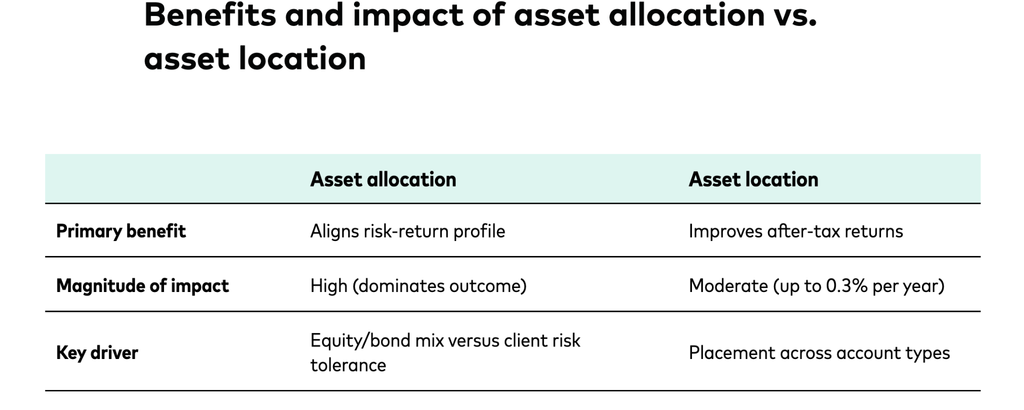
As you might guess, it matters where any given asset goes. Let’s dig into that next.
What Goes Where
Taxable Accounts
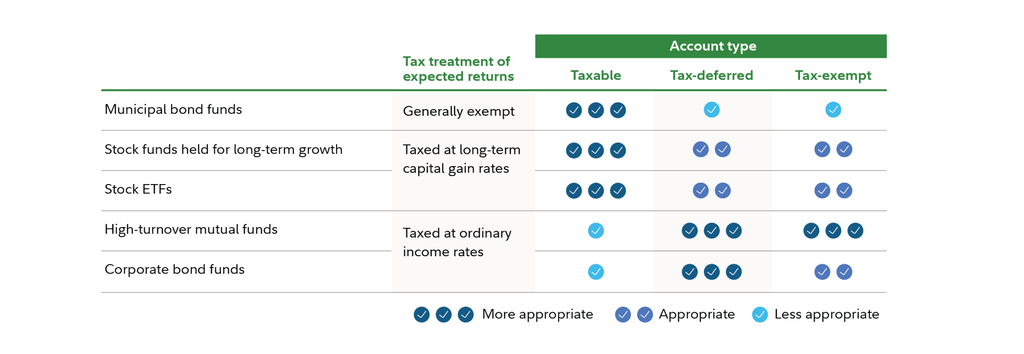
This can get tricky. Because Uncle Sam has his grubby paws out for a slice of your dividend and interest income, you want to minimize the taxable distributions here. Broad-market index funds and factor-based ETFs that are bought and held typically distribute less in taxable gains than more esoteric investments.
- Vanguard Total Stock Market ETF (VTI): Yields 1.03%
- iShares Core S&P Total US Stock Market (ITOT): Yields 0.97%
- Vanguard S&P 500 ETF (VOO): Yields: 1.04%
If you plan to hold an investment for years without much trading, a taxable account isn’t a big drag on overall portfolio performance, and you retain the flexibility to harvest tax losses or donate appreciated shares.
Tax-Deferred Accounts
This is the home for tax-inefficient investments, such as bonds, real estate investment trusts and actively managed funds that generate a lot of taxable income or short-term capital gains distributions. These create a tax drag in a regular brokerage account, so they’re better held in a traditional 401(k) or IRA that defers the tax bill until you sell.
- Vanguard Total Bond Market ETF (BND): Yield 4.04%
- Vanguard Real Estate ETF (VNQ): Yield 3.52%
- Fidelity Contrafund (FCNTX): Yield 4.40%
Roth Accounts
Your highest-growth-potential assets are great candidates to be housed in a Roth 401(k) or IRA. Those high-ordinary-income assets like REITs and bonds can also go in a Roth account. Also, because growth inside a Roth is never taxed, it makes sense to place the assets you expect to compound the most in one of these accounts. For example, a small-cap value tilt or a concentrated growth position benefits more from tax-free compounding than a stable, low-return holding does.
Here are some examples of securities that would be suitable for Roth accounts, along with their three-year total returns. With these, it’s not so much about the yield as the high annualized return. These can also be volatile investments.
- Avantis U.S. Small Cap Value ETF (AVUV): +67.27% cumulative; +18.71% annualized
- NVIDIA Corporation (NVDA): +356.49% cumulative; +65.89% annualized
- ARK Innovation ETF (ARKK): +109.37% cumulative; +27.93% annualized
High-Income Strategies Like Covered-Call ETFs or Master Limited Partnerships
These need special attention. Funds or other securities that generate a lot of ordinary income are a growing category on brokerage platforms. These are tax-inefficient in a taxable account, since their income is taxed at ordinary rates in the year it’s received. These are usually better held in a tax-deferred or Roth account.
Examples of high-income strategies include
- JPMorgan Equity Premium Income ETF (JEPI): Yields 7.91%
- Alerian MLP ETF (AMLP): Yields 7.36%
- Enterprise Products Partners (EPD): Yields 5.76%
What’s This Got to Do With Retirement Planning?
Asset location decisions don’t end when your accumulation years stop.
An investor who directs most of their savings into a traditional 401(k) for decades may end up with an oversized tax-deferred balance at 73, when required minimum distributions begin, even if those assets are rolled into a traditional IRA. That can push taxable income, and Medicare premiums, higher than expected. That can be a particular problem for single filers, who hit the same IRMAA thresholds as married couples but with half the income room. Ouch!
Balancing contributions across taxable, tax-deferred and Roth accounts during the accumulation years gives you more flexibility to manage your tax bracket later, rather than being forced into a bracket by RMDs you can’t avoid, or having to sell assets to get things properly balanced.
Common Mistakes
- Holding identical funds in every account. I see this more often than I should. If your Roth IRA and your taxable account both hold the same total-market fund, you’re missing the chance to be strategic about which one holds your highest-growth assets.
- Ignoring tax-loss harvesting opportunities. These only exist in taxable accounts, so it matters what’s there. I know some people hate selling losers (“It’ll come back!!”) but this is an opportunity to think more strategically about things.
- Setting it and forgetting it. Yeah, I see this a lot too. As account balances grow at different rates, your asset location can drift out of alignment. It’s worth revisiting periodically, meaning at least once a year.
Asset location won’t replace the basics of contributing enough to your accounts and choosing an allocation that makes sense (in other words, not all Nvidia, all the time). But for investors already doing those things, knowing which accounts hold which assets is one of the most overlooked ways to keep more of what you earn.