Make or Break Day for Brokers, Danger on Chart, Mag 7 Down
Here’s why good economic data is weighing down stocks, Russell’s rebalancing will make winners and losers and the chart looks … perilous.
You've reached your free article limit
You've read 0 of 1 free Pro articles.

Equity markets remained heavy on Thursday despite the euphoria created around the memory and storage trade by the Micron (MU) earnings release on Wednesday evening. That’s right. The word is “heavy.” There were a number of factors that worked against the U.S. stock market on Thursday, and it appears to have worsened overnight. On Thursday, as traders such as myself celebrated a narrow victory, Apple (AAPL), which is much more widely held than Micron or SanDisk (SNDK) will ever be, announced price hikes for MacBook and iPad.
Why? The very prices for memory and storage that have been pushing that specific trade higher are also pushing the cost of goods sold higher broadly for companies with huge consumer and business or business contacts. In other words, while the demand for AI-capable chips, memory specifically has soared and scarcity has forced margins much higher for those few businesses, a much wider swath of the economy is being negatively impacted. Apple (AAPL), by the way, lost 6.1% on Thursday. Amazon (AMZN), Alphabet (GOOGL) and Microsoft (MSFT) all closed lower as well.
As strange as it is, the economy also hurt the stock market on Thursday. The day was laden with the release of a number of economic data-points and generally speaking, the U.S. economy continues to outperform expectations. First, Q1 gross domestic product was revised from growth of 1.6% q/q (SAAR) to growth of 2.1%. That’s a huge increase for a final estimate. A stronger economy, in theory, creates an environment where the central bank is more apt to prepare to fight inflation through the use of increased short-term interest rates than it might have otherwise been. That’s why this is a market negative.
My problem with the data is this and we have now seen this divergence in the data provided by the Bureau of Economic Analysis under administration run by both major political parties, so please spare me the politically inspired emails. I try to just be a numbers guy. As Q1 gross domestic product grew 2.1%, gross domestic income grew 1.2%.
Mind you, in economics, product and income measure the same data, but from different angles. In simplified form, its goods and services sold vs. goods and services purchased. The two numbers should equal out and in fact, the Federal Reserve sees one as a check on the other. When they diverge like this, the Fed suggests averaging the two when discussing growth in economic activity, or the lack thereof. Hence, 2.1% + 1.2% = 3.3% and 3.3% / 2 = 1.65%. The economy, for economic purposes, grew an annualized, seasonally adjusted 1.65% for the first quarter, which is just about where GDP was before it was revised higher on Thursday morning. Things that make you go “hmmm.”
Then, There’s Hormuz…
The Wall Street Journal reported last night that according to two senior U.S. officials, a Singapore-flagged cargo ship sailing through the Strait of Hormuz, had been hit by a one-way attack drone launched by Iran’s Islamic Revolutionary Guard. The attack damaged the ship’s bridge but fortunately caused no casualties. The attack came just hours after the IRGC’s naval arm had warned civilian vessels trying to traverse the passage not to use routes that the regime in Iran had not sanctioned.
As part of the 60-day deal that the U.S. and Iran have both signed on to, Iran is required to make a best effort to ensure safe passage for civilian, commercial craft through the Strait. In return, the U.S. waived existing sanctions on Iranian oil and allowed that crude to be sold for U.S. dollars for the first time in many decades. Transit of oil through the Strait of Hormuz had nearly returned to pre-war levels this week as global prices for oil dropped precipitously. Oil prices spiked overnight on this news, but have since come back in.
The Busiest Day of the Year
Hold on to your hats. It’s about to get a little wild. Oh, and technically, what happens today is even less valid on the charts that are the four “triple witching” expiration events that we enjoy every year. Today is the day of the semi-annual or “June” Russell rebalancing or what FTSE Russell refers to as its “reconstitution.” This rebalancing or reconstitution will take place after tonight’s closing bell and will impact prices for a rough $12 trillion in risk assets.
For brokers and sales traders working on commission agreements, this day will make not only their month, but perhaps their summers. For some, today’s activities will be the difference between remaining in business and looking for work as a school bus driver by September. Not kidding. Early tabulations have 62 companies moving in and out of the Russell 1000 and 237 companies being added to and removed from the Russell 2000. Other indexes are seeing changes as well.
In addition, from top to bottom, weightings are being adjusted. That means that even for stocks remaining in these indexes, trading volume will likely increase as funds tracking these investment vehicles must, by mandate, adjust and reweight their holdings as well. This activity will increase as we move into the final hour of regular trade this afternoon and then hit “frenzy-mode” as the final five to 10 minutes tick off. As a former NYSE floor trader, I loved this day, because it kept you employed or got you paid. As a former NYSE floor trader, I hated this day, because of the stress created by the need to multitask at a level most folks could never imagine.
Marketplace
Asian markets are being slapped around again on Friday. I see South Korea’s Kospi Index down 5.8%. I see Japan’s Nikkei 225 Index down 4.2% led by a brutal sell-off impacting Softbank Group. SoftBank gave up a rough 12% on Friday after reports emerged that OpenAI may delay its IPO until 2027, as that would push back the timeline for any potential returns for SoftBank as the Japanese conglomerate is a major investor. Chinese stocks traded lower as well, both in Shanghai and Hong Kong as Alibaba (BABA) was hit hard on consecutive days.
Here in the U.S., equity markets were mixed on Thursday. While the S&P 500 essentially closed flat (-0.01%), the Nasdaq Composite gave back 0.46%. Interestingly, the Nasdaq 100 gained 0.75% for the session. Several parts of the U.S. market did well on Thursday despite a Mag 7 beat-down. The Dow Transports popped for a gain of 1.5%, as the KBW Banks (KBWB) added 1.02%. While the semiconductors did well in response to those Micron (MU) earnings, all of our small- to mid-cap indexes added between 0.71% and 1.3%. Mind you some of that activity was likely traders getting ahead of today’s Russell rebalancing.
Breadth
Seven of the 11 S&P sector SPDR ETFs closed in the green on Thursday, led by the industrials (XLI). The ciscretionaries (XLY) rode out the day in a distant 11th place as the retailers were hit hard. On the day, cyclicals did outperform defensives, which would be an overall positive for the U.S. economy.
Winners beat losers by a five-to-four margin at the NYSE, while losers beat winners by just a smidgen at the Nasdaq. Advancing volume took a 54.7% share of composite NYSE-listed trade, but just a 42.7% share of composite Nasdaq-listed activity. In a sign that traders were a bit cautious going into the Russell rebalancing, aggregate trade dropped 7.2% on a day-over-day basis across NYSE-listings and dropped an absolutely stunning 33.9% across Nasdaq-listings. The trading environment was undeniably quiet on Thursday.
Danger on the Chart?
Check out this chart:
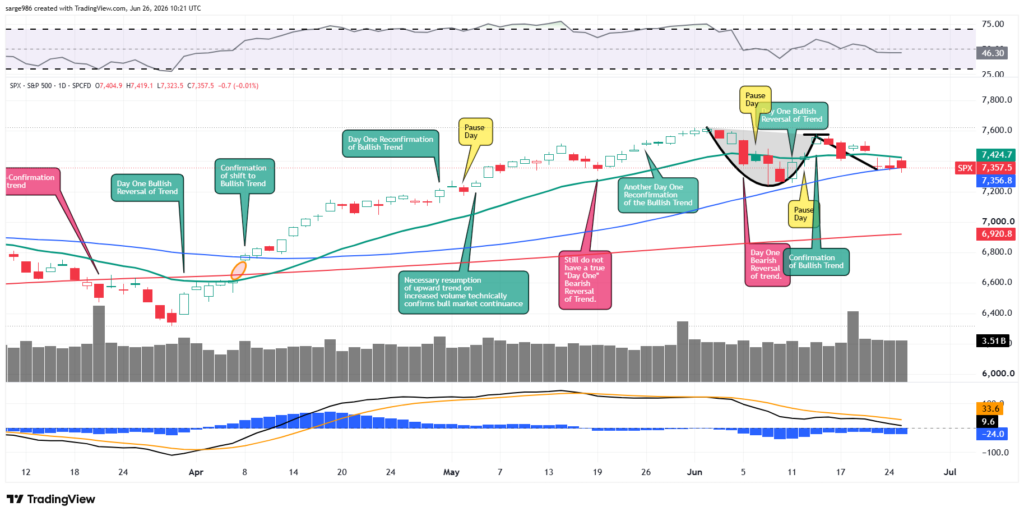
While the reader will see that the 50-day simple moving average has provided support to the S&P 500 for three successive trading sessions…
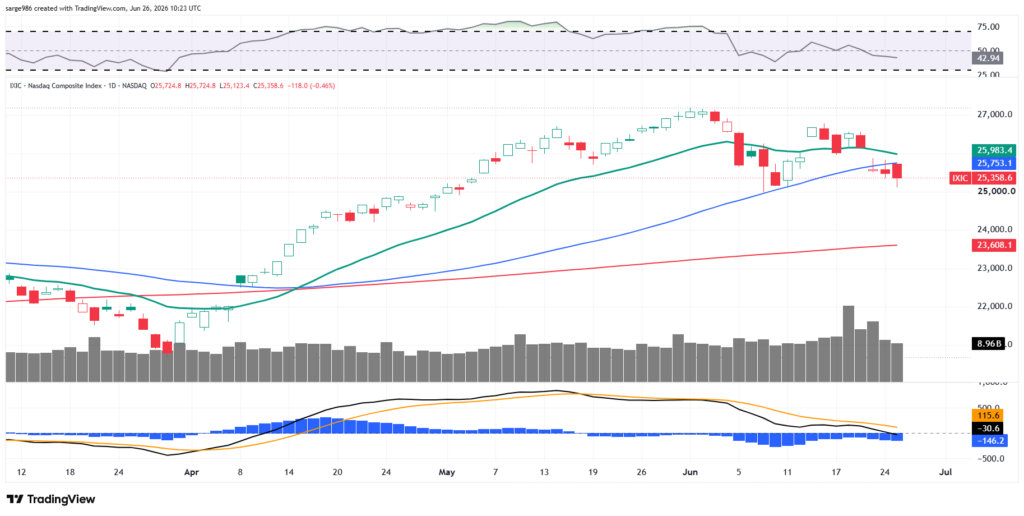
That reader will also note that the Nasdaq Composite has hit resistance at its 50-day line for those same three days. Yes, danger lurks.
Economics (All Times Eastern)
08:30 – Goods Trade Balance (May-adv): Last $-83B.
08:30 – Wholesale Inventories (May-adv): Expecting 0.2% m/m, Last 0.6% m/m.
10:00 – U of M Consumer Sentiment (June-F): Flashed 48.9.
10:00 – U of M One-Year Inflation Expectations (June-F): Flashed 4.6%.
10:00 – U of M Five-Year Inflation Expectations (June-F): Flashed 3.4%.
1:00 p.m. – Baker Hughes Total Rig Count (Weekly): Last 563.
1:00 – Baker Hughes Oil Rig Count (Weekly): Last 433.
The Fed (All Times Eastern)
No public appearances scheduled.
Today’s Earnings Highlights (Consensus EPS Expectations)
No significant quarterly earnings scheduled.
At the time of publication, Guilfoyle was long MU, SNDK, MSFT equity.