Keep Your Eye on the Ball Today
Just because today’s a half day doesn’t mean you can go on cruise control. Also, two things to understand about today and a look at that reversal.
You've reached your free article limit
You've read 0 of 1 free Pro articles.

Good morning. Half-day, Black Friday. I’d like to tell readers that due to the early close today across both equity and debt securities markets that trading will be light today, and that maybe participation will be less than complete. While that much is true, this by no way means that one can take their eyes off of the ball and ease through the day on “cruise-control.”
Two things need to be understood: First, trading volumes can be light this week because of the holiday and especially on this half-day Friday that comes after a bank holiday and before a weekend. Because attendance can be less than complete and because of the increased potential for volatility, this is the day where industry leaders often give their subordinates the day off rather than take an extra day for themselves.
In short, unlike Labor Day week when the decision makers might hit the beach and allow junior traders and managers to run the show, the big dogs will be at their desks today. If the boss gave you off today, there’s a chance that he or she does not see you as essential. Sorry. That’s the way it is and has been for decades. There is too much potential for opportunity on a day like this for the people in charge to be asleep at the switch.
Secondly, almost all institutional trading is now done electronically, and by high-speed, keyword reading algorithms that by design, seek price overshoot. I am not all that sure that a lack of human participation or thin markets matter like they used to. I mean, markets are always thin now, even under normal conditions. It’s not like algorithms line “the book” with large orders above or below the last sale of security in an attempt to stir interest at competing investment banks or broker-dealers.
A human trader might have shopped a million-share order to those funds or accounts that had shown interest in that particular stock in the recent past and broken the order up into 100,000 share pieces. Algorithms? Break the order into much smaller pieces, even odd lots (less than 100 shares) and systemically move those orders toward several points of sale sporadically under pre-programmed conditions. You don’t need decision makers or junior traders to do something like that. Just feed the order into the wood-chipper and go back to reading the sports pages.
You may have noticed that my colleagues and I, if still in the industry, had to evolve. We don’t litter trading floors with scraps of paper anymore while wearing different colored jackets so that our assistants could pick us out of the crowd and see our hand signals. There really is no central point of sale in 2026 as the primary function of any exchange, which was to act as a location where buyers and sellers could find one another and negotiate price through an auction process has changed. Changed to what? Good question. Every town in your county used to have at least one blacksmith.
Turkey Traders…
I had to laugh. I was watching financial television on Wednesday after the close. More than one pundit (I don’t call them traders like the media does if I don’t think they really trade) when asked about the day’s sharp reversal off of the lows, credited light trade ahead of the Thanksgiving holiday. Really?
Talk about rehearsing answers to questions requested ahead of time. By the way, I have never asked the questions before an appearance. If the person on the tube represents a large investment bank, there is almost a certainty that they have demanded the questions ahead of time, had legal scrub their answers and then memorized those answers.
Well, the light trading volume answer did not wash. All these clowns had to do was the least amount of homework prior to going on. Aggregate trade was up a whopping 23.2% on a day over day basis across Nasdaq-listings on Wednesday. Aggregate trade was also up 5.3% across NYSE-listings. Activity was also higher on Wednesday than it was on Tuesday across the membership of the S&P 500. As a matter of fact, Wednesday was the eighth most active day for U.S. equities of November out of eighteen trading sessions, so just about above average, volume-wise.
Was That Reversal Real?
Sure felt like it. While last Friday felt like a potential bottom, but we could not be sure and Monday’s rally felt like a short squeeze for sure, Wednesday had a different feel. The headline-level indexes still struggled, but the stock market, more broadly, did not. Additionally, the short sellers were largely out of the way. This reversal, which was titanic if you lived it and didn’t just read about it, had more of a feel of authenticity than did Monday’s Jensen Huang-inspired run.
On Wednesday, the Nasdaq Composite closed down 0.62% after having been down 4.6% early in the session. The S&P 500 closed down 0.25% after having been down 3.2%. It was ugly. It felt like the market could actually crash. Then the “take ’em” boys showed up. or maybe it was the “take ’em” algorithms. That seems far more likely. Whomever it was, the Sarge-folio was sure glad to see those guys show up. Sort of like a Huey throwing a crate of oranges overboard as it passes your position, after you’ve run out of water. That’s how nice it was.
This is an intraday chart of the S&P 500 on Wednesday. It all happened from a little before noon on the East Coast and lasted into about 2 p.m. Then markets stabilized. What happened? The White House put some pressure on markets with the unveiling of a new slate of ill-timed and probably ill-advised tariffs on U.S. trading partners. That said, what was announced was slightly less extensive than what was expected.
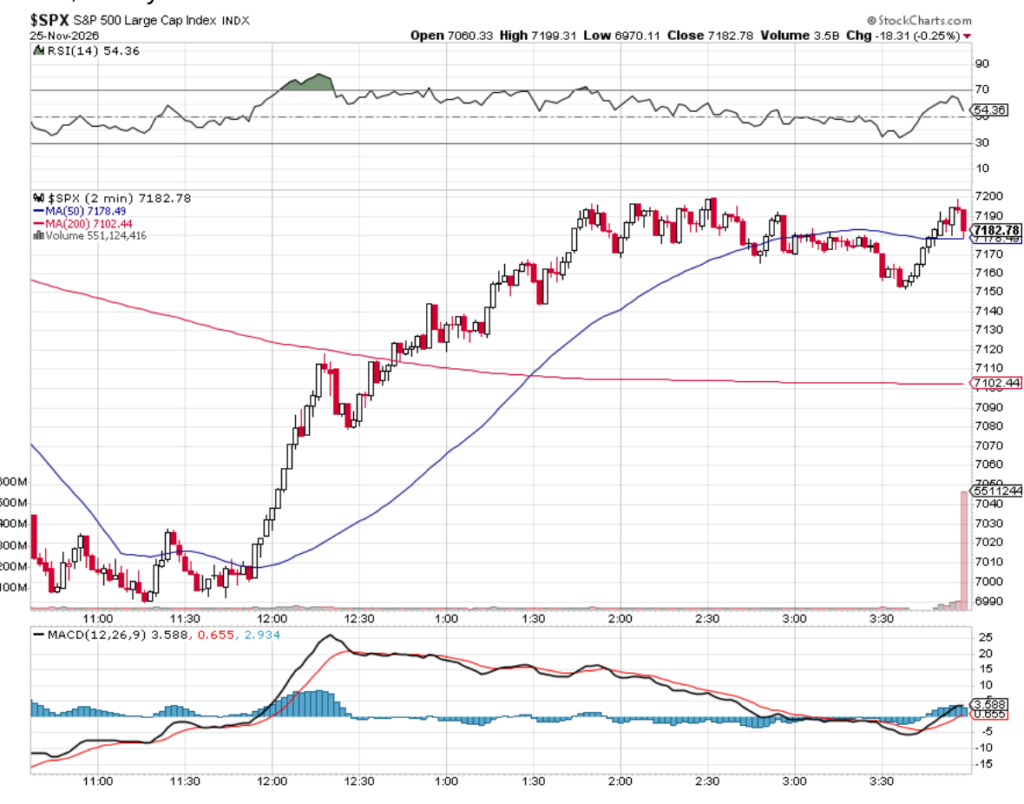
In addition, The Bureau of Economic Analysis revised its estimate for Q3 gross domestic product up from an initial 3.4% to growth of 4.3% (q/q, SAAR). That’s nothing to sneeze at. The U.S. economy was much, much stronger than the public was led to believe in Q3 2026. While investment in AI was good for a chunk of that growth, it was still the U.S. consumer that drove the print. Personal consumption expenditures grew 4.2% by itself and alone contributed 2.78% of the 4.3%. Q3 was the strongest quarter for the US consumer since Q4 2024.
On top of that, for October, Personal Income shocked to the upside, while personal consumption expenditure price inflation printed as expected, reinforcing the now widely accepted (except by the numbskulls at the Fed) idea that inflation is rapidly receding. That’s where the tariff threat is real. Could be a progress killer as far as inflation is concerned.
Futures Markets…
Appear to see things my way as we work though the wee hours on Friday morning. Enjoy your Black Friday. Prep for Cyber Monday. Rock on. Sarge out.
Economics (All Times Eastern)
08:30 – Goods Trade Balance (Oct): Last $-135.1B.
08:30 – Wholesale Inventories (Oct-adv): Expecting 0.7% m/m, Last 0.7% m/m.
The Fed (All Times Eastern)
No public appearances scheduled.
Today’s Earnings Highlights (Consensus EPS Expectations)
No significant quarterly earnings scheduled.
At the time of publication, Guilfoyle had no position in any security mentioned.