ISM Manufacturing Accelerates, Production Hits Highest Since 2021
ISM’s factory index rose to 55.5 in October, a tenth straight month of expansion.
You've reached your free article limit
You've read 0 of 1 free Pro articles.

- US ISM Manufacturing Oct: 55.5 (est 54.7; prev 54.5)
- Prices Paid: 75.2 (est 77.5; prev 77.9)
- New Orders: 55.5 (est 55.0; prev 55.3)
- Employment: 52.4 (est 52.4; prev 52.7)
Executive Summary
- The Institute for Supply Management (ISM) manufacturing index rose 1.0 point to 55.5 in October, the highest since July, beating expectations and marking a 10th straight month of growth, the longest run since 2022.
- All five components of the index were in expansion, one more than in September. Production jumped to 59.0, the highest since November 2021, new orders edged up and inventories returned to growth, while employment slipped slightly but has now expanded for four months in a row.
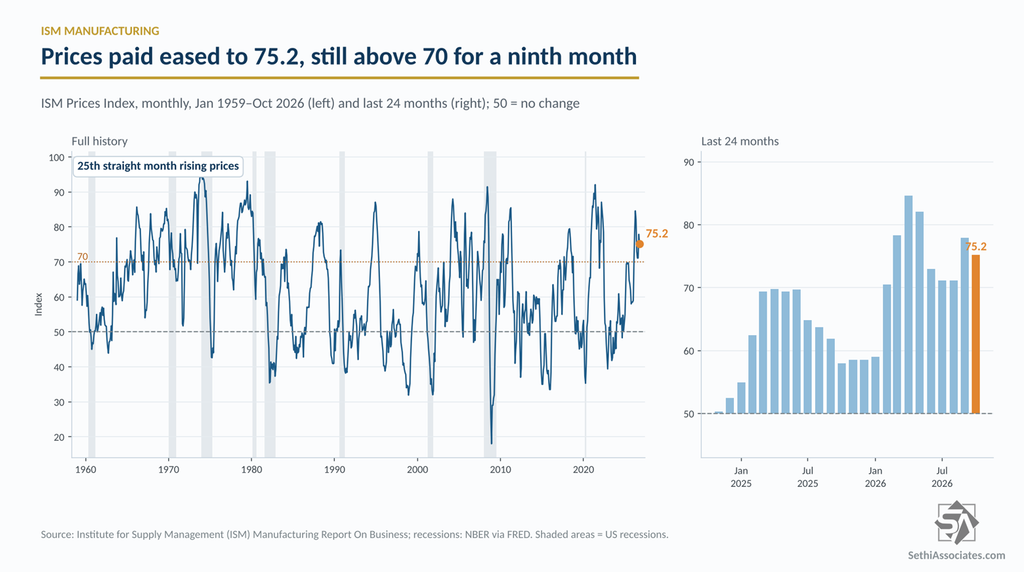
- Prices paid eased 2.7 points to 75.2 but have now risen for 25 straight months and been above 70 for nine.
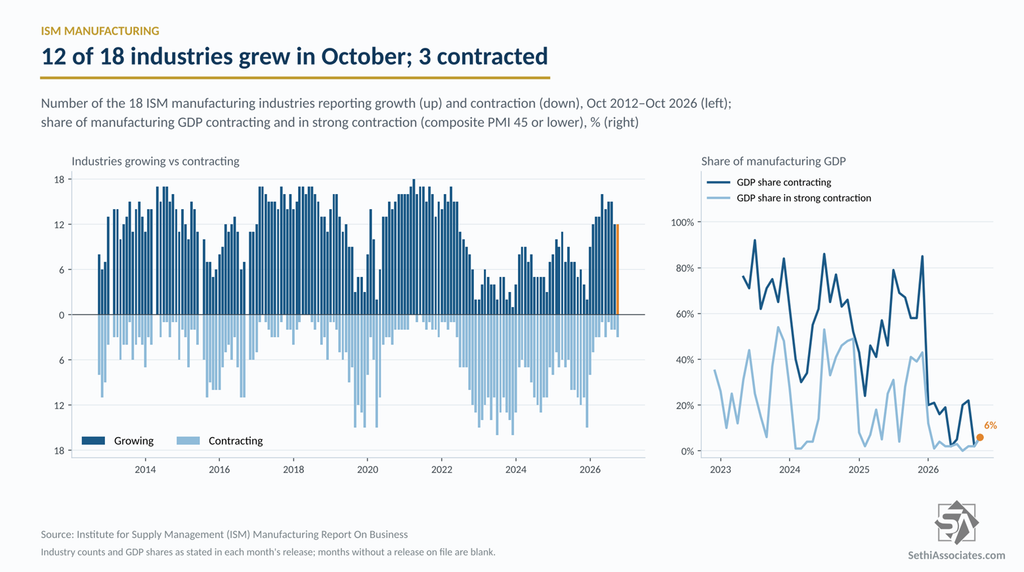
- The share of manufacturing GDP in strong contraction, which ISM calls “a good metric to gauge overall manufacturing weakness,” rose to 6% from 2%, the highest since January but low historically (it was 43% in December). Twelve of 18 industries expanded, the same as September.
- Respondents’ sentiment worsened for a third month, with negative comments outnumbering positive 2-to-1. Demand is booming in AI, data centers, semiconductors and defense, but others described customers in “wait-and-see mode,” and costs, lead times and policy uncertainty dominated.
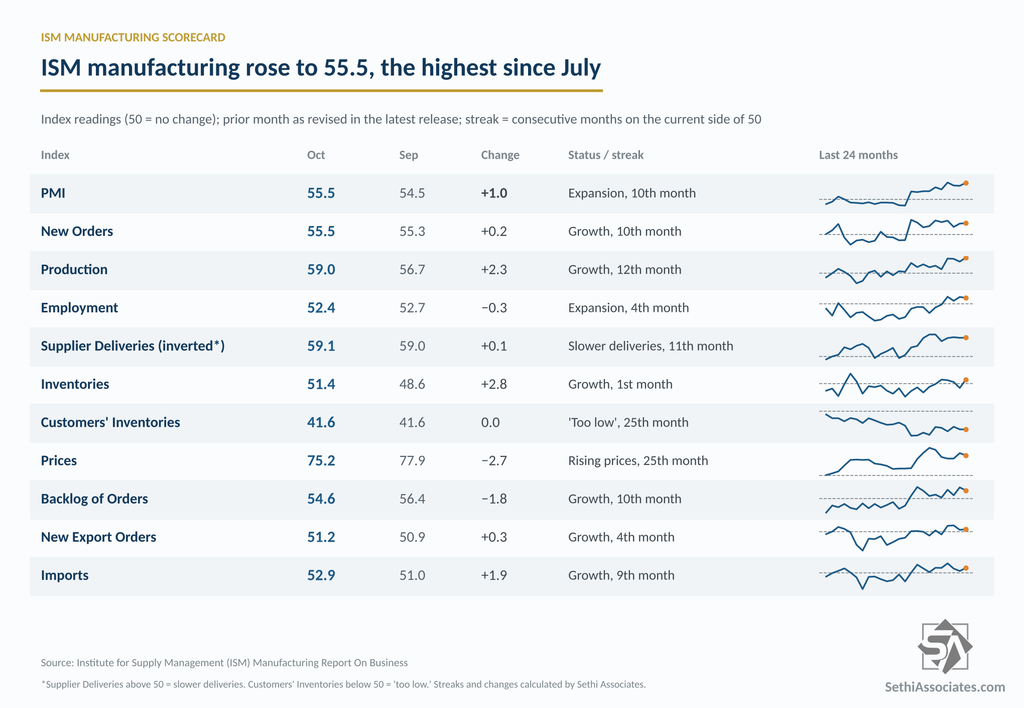
October ISM Manufacturing
The ISM manufacturing index rose 1.0 point to 55.5 in October, the highest since July, beating expectations of 54.7 and marking the 10th month in a row of expansion, the longest stretch since 2022. The reading is above the 12-month average of 52.8 (up from 52.3 in September). According to the report, it corresponds to 2.7% annualized growth in real gross domestic product (GDP) and marks the 24th straight month of overall economic expansion.
It’s also roughly consistent with S&P Global’s survey, which covers generally smaller and more domestically focused companies. That eased to 54.9 but remained well in expansion territory (see: S&P Manufacturing PMI Eases from 52-Month High but Prices Rise the Most Since 2022).
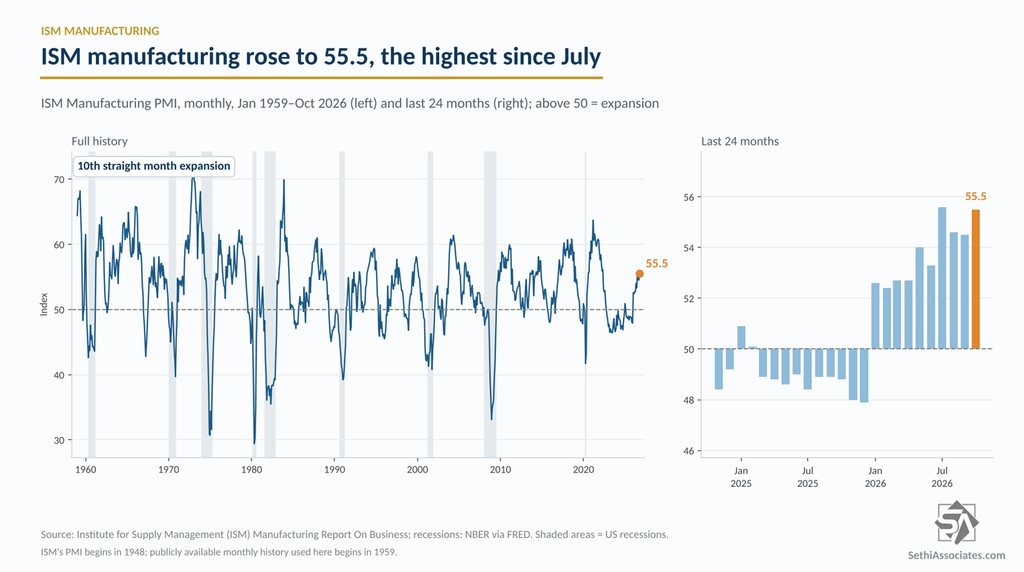
The Components
All five components behind the headline were in expansion, one more than in September, and four of them (new orders, production, supplier deliveries and inventories) grew faster.
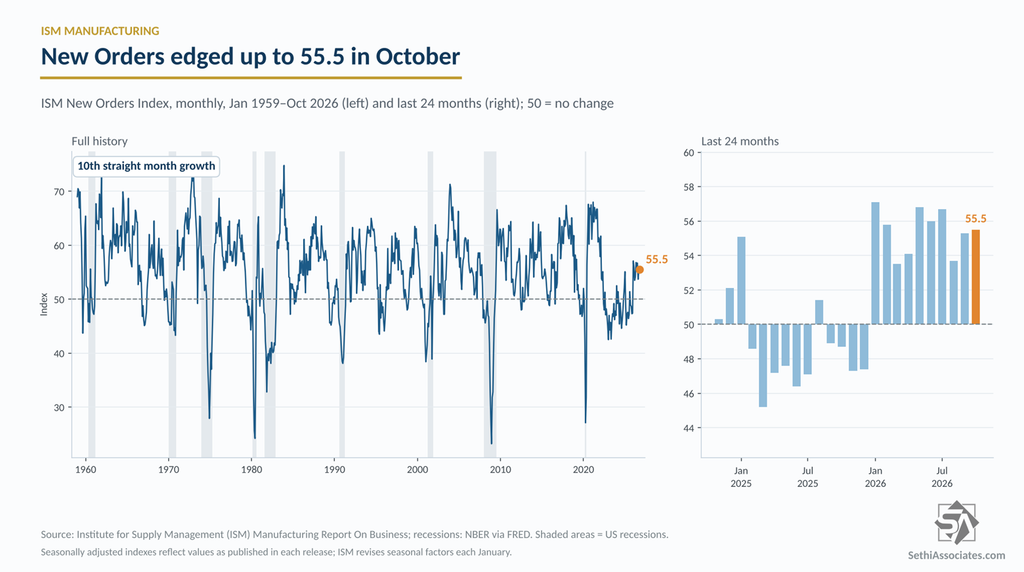
New Orders rose 0.2 point to 55.5, a 10th straight month of expansion. Four of the six largest industries reported more orders (five in September). Eleven industries reported growth (up from 10) and four reported declines (unchanged). Demand sentiment was “1.8 positive comments for every negative comment, a very slight improvement from last month’s 1.7-to-1 ratio,” said Susan Spence, chair of ISM’s Manufacturing Business Survey Committee.
S&P Global in contrast showed new orders rising at the slowest rate since March, though “growth was still solid,” with “some reports of clients seeking to secure orders and lock in prices given widespread inflationary pressures.”
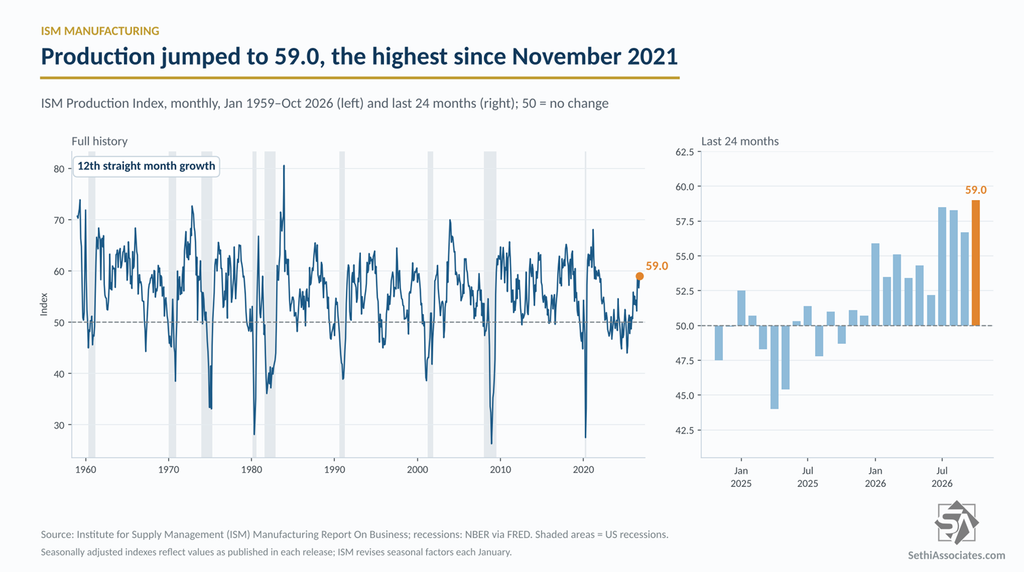
Production jumped 2.3 points to 59.0, the highest since November 2021, and has now expanded for 12 straight months. Eleven industries reported growth (up from 10) and three reported declines (unchanged), and four of the six largest reported higher output. The ratio of positive to negative comments on output improved to 2-to-1, “up from September’s 1.6-to-1 ratio.”
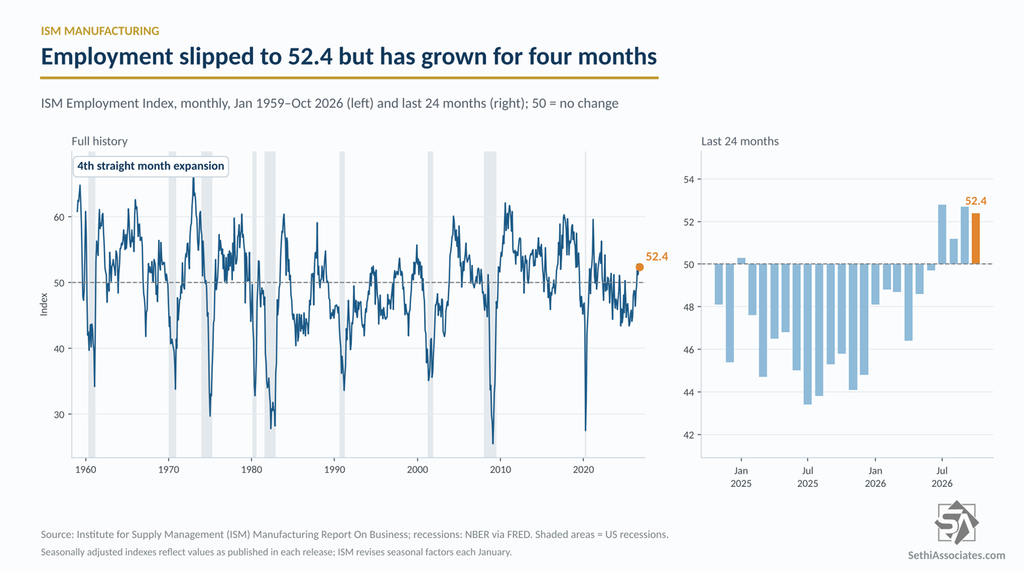
Employment slipped 0.3 point to 52.4 but has now expanded for four straight months, extending the longest run of factory job gains since 2022. Eight industries added workers (unchanged) and five cut (down from six). Four of the six largest industries reported higher employment. Comments on hiring outnumbered comments on reducing head counts by 1.8-to-1, up from 1.5-to-1.
S&P Global’s employment measure showed the steepest growth in five-and-a-half years, with manufacturers adding “to their staffing levels at a historically strong pace.”
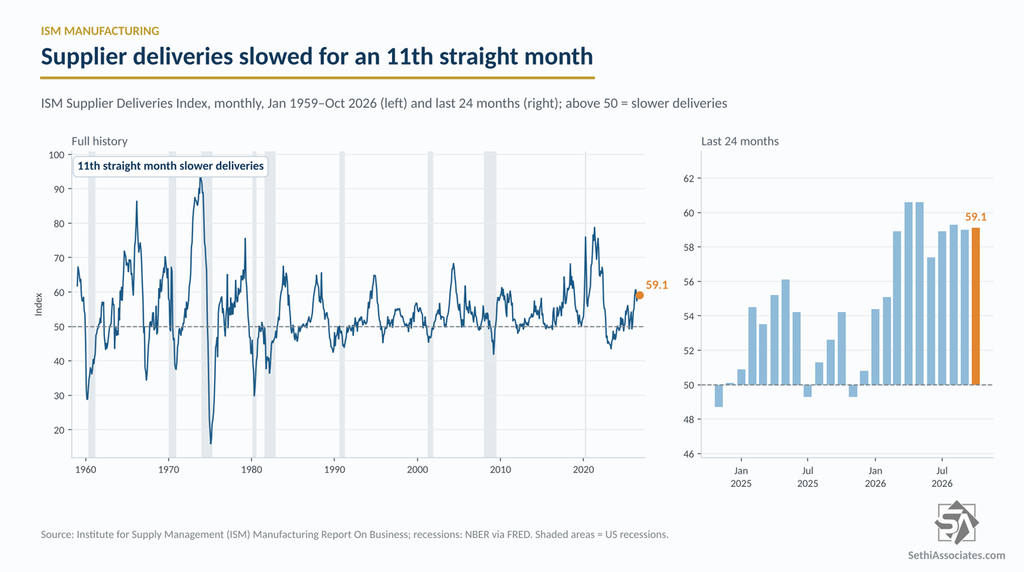
Supplier Deliveries edged up 0.1 point to 59.1. A reading above 50 means deliveries are taking longer, and they have now slowed for 11 straight months. Twelve industries reported slower deliveries, including five of the six largest, while two (textile mills and paper products) reported faster deliveries, the same number as September. Electronic components have now been listed in short supply for 20 straight months, electrical components for 16 and memory for 10.
S&P Global said delivery times lengthened the most since August 2022, with vendors “struggling to keep up with demand, especially for any products related to AI data center build outs, whilst simultaneously dealing with tariffs and the disruption caused to supply chains by the conflict in the Middle East.”
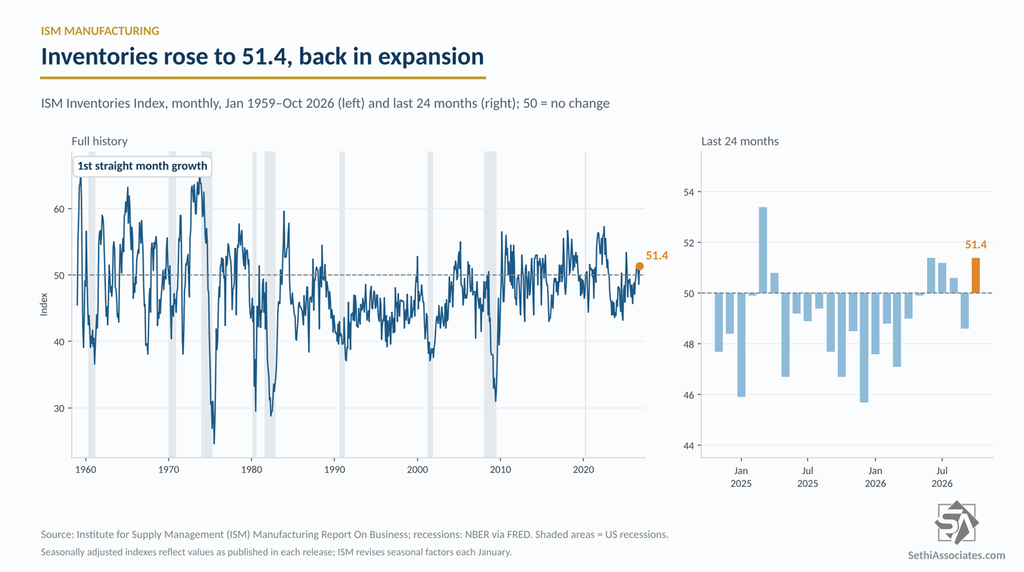
Inventories rose 2.8 points to 51.4, returning to expansion after one month of contraction. Seven industries reported higher inventories and six reported lower.
Prices
Prices paid eased 2.7 points to 75.2 but have now risen for 25 straight months, and the index has been above 70 for nine months in a row. While below September’s 77.9 and the year’s high of 84.6 in April, it was above July and August’s 71.1.
Spence said the reading “is still being driven by (1) increases in steel and aluminum prices that impact the entire value chain, (2) tariffs applied to many imported goods and (3) increases in petroleum-based products as a result of the Middle East conflict.” The share of respondents reporting higher prices was 53.1%, down 5.5 percentage points from 58.6% in September. Five of the six largest industries reported paying more (all six did in September). Overall, 16 of 18 industries paid more (unchanged) and none paid less, though two commodities were reported down in price (aluminum, which was also reported up, and polypropylene resin) after none in September. Aluminum has now been listed as up in price for 35 straight months, copper for 16 and steel for 12.
S&P Global showed input costs rising at the fastest rate since May and selling prices rising the most since September 2022, with “energy, fuel and transportation expenses” key drivers and “metals like aluminum and steel” again up. “Many manufacturers saw little choice but to increase their own charges in October,” S&P said.
Other Indexes
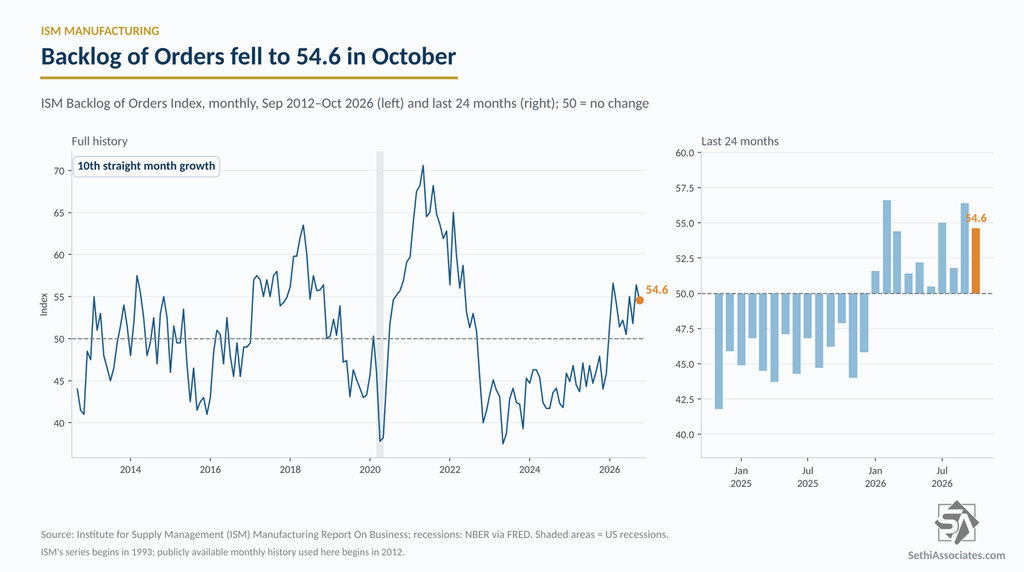
Backlogs fell 1.8 points to 54.6 but have now grown for a 10th straight month (a positive indicator for continued growth). Four of the six largest industries reported higher backlogs (unchanged). Eleven industries reported higher backlogs and three reported lower.
S&P Global also showed backlogs rising for an eighth month, at “the steepest since April’s near four-year peak.”
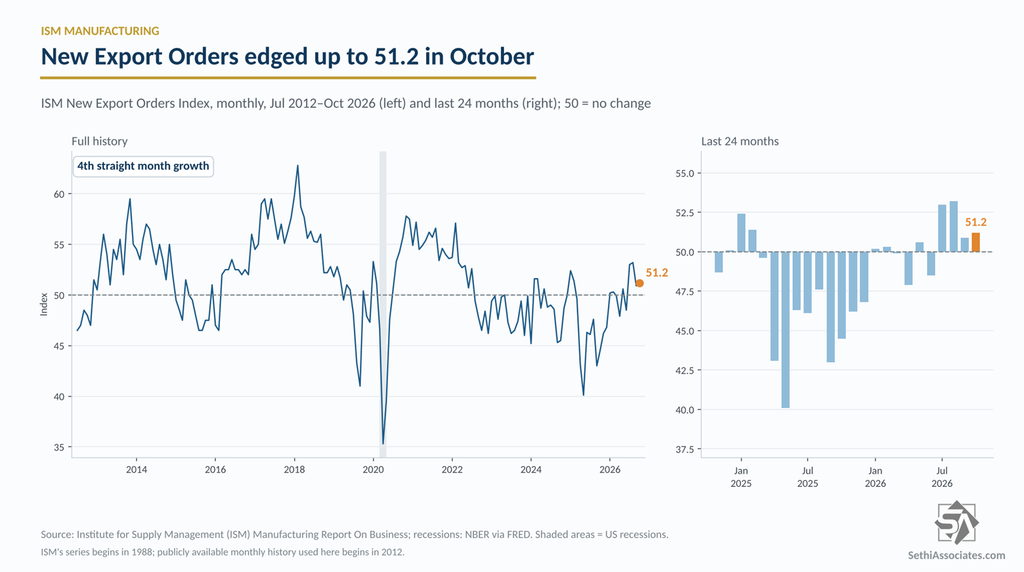
New Export Orders rose 0.3 point to 51.2, a fourth straight month of expansion, though just two industries reported growth (down from four) and nine reported declines (up from eight). Export comments ran negative, at “1-to-1.3” positive to negative.
S&P Global said new export business “rose fractionally for the first time since June 2025 although tariffs limited gains.”
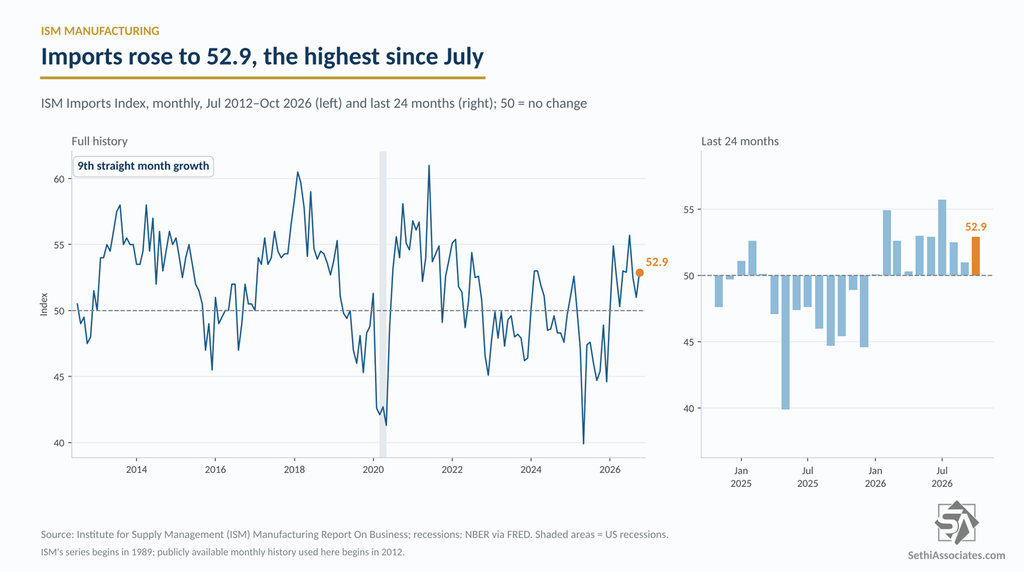
Imports rose 1.9 points to 52.9, the highest since July, and have now expanded for nine months. Seven industries reported higher imports (up from four) and three reported lower (down from seven).
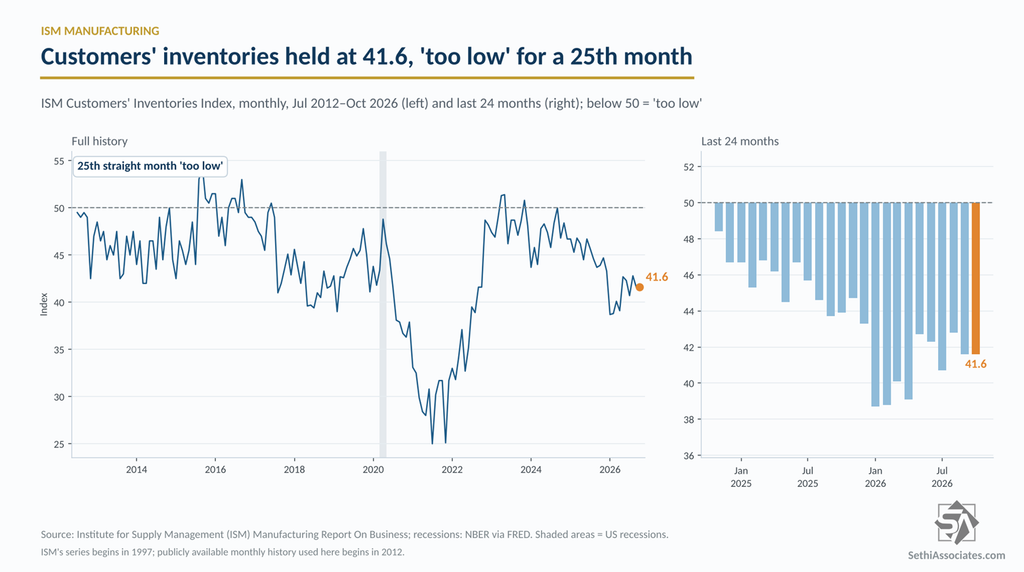
Customers’ Inventories held at 41.6. Customers have now been carrying “too low” stock for 25 straight months, which ISM notes “is usually considered positive for future production.” No industry reported customers’ inventories as too high.
Breadth
Six percent of manufacturing GDP was in contraction in October, up from 2% in September, which had matched May as the lowest reading this year. For comparison, the share was 85% last December, the highest since July 2024.
ISM defines “strong contraction” as a composite reading of 45 or lower and calls it “a good metric to gauge overall manufacturing weakness.” The share of manufacturing GDP in strong contraction also rose to 6%, the highest since January (12%), from 2% in September. That’s up from 0% in July, the low for the year, but well below 43% in December and 39% in November.
Twelve of 18 industries expanded, the same as September, led by plastics and rubber, electrical equipment and machinery. That’s down though from 15 in August and July and 16 in May. Three contracted (printing, paper and nonmetallic minerals), up from two. Last December the picture was very different: 15 industries contracted, the most since 2022. Five of the six largest industries expanded, the same as September, with Petroleum & Coal Products the only one that didn’t.
What Respondents Are Saying
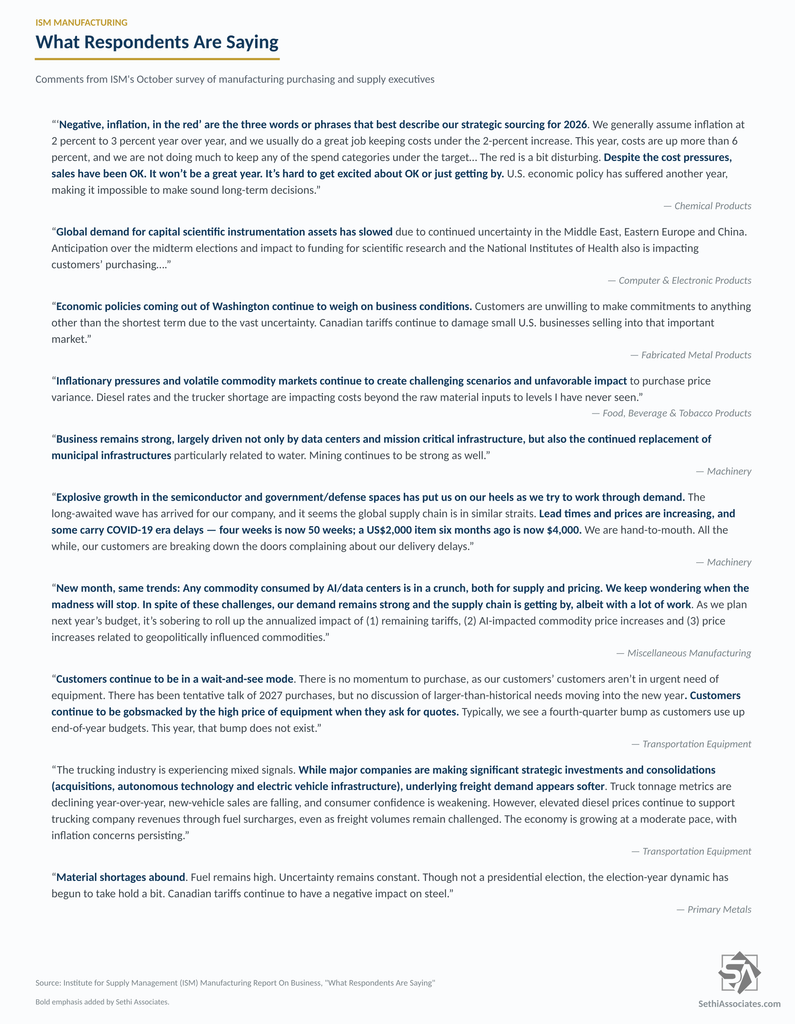
Sentiment worsened for a third straight month, to 34% positive and 66% negative, a 1-to-2 ratio (versus 40% and 60%, or 1-to-1.6, in September). Among negative comments, pricing volatility was cited in 62% (up from 46%), longer lead times in 41% (up from 21%), tariffs in 25% (down from 34%) and the Iran war in 21% (down from 30%).
Looking first at demand, comments split between booming AI, data center, semiconductor and defense work and customers holding back.
One Machinery respondent described “explosive growth in the semiconductor and government/defense spaces,” saying “the long-awaited wave has arrived for our company,” while another said business “remains strong, largely driven not only by data centers and mission critical infrastructure, but also the continued replacement of municipal infrastructures particularly related to water.” Miscellaneous Manufacturing said “our demand remains strong and the supply chain is getting by, albeit with a lot of work.”
On the other side, Transportation Equipment said “customers continue to be in a wait-and-see mode,” adding that the usual fourth-quarter budget bump “does not exist” this year. A second Transportation Equipment respondent said “underlying freight demand appears softer” despite major companies’ strategic investments. Computer & Electronic Products said “global demand for capital scientific instrumentation assets has slowed,” citing the Middle East, Eastern Europe, China and the midterm elections’ impact on research funding. Chemical Products summed it up: “Despite the cost pressures, sales have been OK. It won’t be a great year. It’s hard to get excited about OK or just getting by.”
The strong demand in certain sectors, along with fuel and trade issues, is pushing up costs and stretching lead times. The first Machinery respondent said “lead times and prices are increasing, and some carry COVID-19 era delays — four weeks is now 50 weeks; a US$2,000 item six months ago is now $4,000. We are hand-to-mouth.”
Miscellaneous Manufacturing said “any commodity consumed by AI/data centers is in a crunch, both for supply and pricing. We keep wondering when the madness will stop.” It added that budgeting for next year means rolling up “(1) remaining tariffs, (2) AI-impacted commodity price increases and (3) price increases related to geopolitically influenced commodities.”
The Transportation Equipment respondent who noted customers delaying purchasers said it was in part as they “continue to be gobsmacked by the high price of equipment when they ask for quotes.” Chemical Products said “costs are up more than 6 percent” against its usual 2% to 3% assumption. Food, Beverage & Tobacco Products cited “inflationary pressures and volatile commodity markets,” adding that “diesel rates and the trucker shortage are impacting costs beyond the raw material inputs to levels I have never seen.” Primary Metals put it more simply: “Material shortages abound.”
Washington and Canada remained flashpoints. Fabricated Metal Products said “economic policies coming out of Washington continue to weigh on business conditions,” with customers “unwilling to make commitments to anything other than the shortest term due to the vast uncertainty,” and “Canadian tariffs continue to damage small U.S. businesses selling into that important market.” Primary Metals said “Canadian tariffs continue to have a negative impact on steel” and that “the election-year dynamic has begun to take hold a bit.” Chemical Products said “U.S. economic policy has suffered another year, making it impossible to make sound long-term decisions.”
Other Commentary
“US manufacturing entered the fourth quarter with surprising momentum and inflationary pressures in the sector eased slightly. The October ISM report offered no indication that the recent wobble in AI-linked stocks has been driven by weaker underlying activity.” — Bloomberg’s Andrew Sacher
“It’s really all about the inflationary pressures and the constraint in availability of raw materials, made worse by the ongoing Iran war and the tariff trade wars,” Susan Spence, chair of ISM’s Manufacturing Business Survey Committee, said in a call with reporters.