Interest Rates Set to Move Higher for Longer as Inflation Persists
With the AI bubble looking to “jump the shark” and conflict in the Middle East ongoing, the Federal Reserve has little choice.
You've reached your free article limit
You've read 0 of 1 free Pro articles.
Wednesday will be a big day for financial news junkies.
New Federal Reserve chairman Kevin Warsh will be providing commentary after the conclusion of the FOMC meeting. Investors, based on futures, believe the federal funds rate will remain unchanged this month. However, futures are pointing to a high likelihood of a 25 BPS rate hike at the end of the September Fed confab. Equity markets will probably move in the afternoon following remarks from Warsh.
The markets are already starting to price in a bump in rates as the yield on 10-year treasury has moved up by one-half of 1% in 2026 to date. With inflation above the central bank’s official 2% target now for nearly five-and-a-half years, higher rates are appropriate, albeit will not be well-received by the administration before the upcoming midterms.
I expect interest rates to remain higher for longer than most were penciling in at the start of this year, the last thing most of the K-shaped economy needs. Meta Platforms (META) and Microsoft (MSFT) are also scheduled to report quarterly results on Wednesday. Investors will be intently focused on whether these hyperscalers lift their capex guidance again and what impacts all this spending is having on free cash flow. The stocks of Alphabet (GOOG) and Tesla, Inc. (TSLA) sold off last week following their quarterly numbers. Capex targets were raised for the fiscal year and both companies had negative free cash flow for the quarter. It was the first time Alphabet had delivered free cash flow in the red for a quarter since the stock’s debut on the markets more than two decades ago.
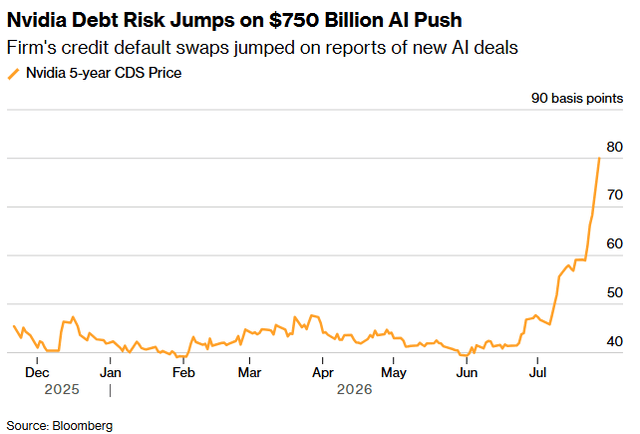
Investors are starting to get increasingly concerned around the amount of debt and equity issuance the AI revolution is generating and whether it is sustainable. This week, the credit default swap prices around NVIDIA’s (NVDA) have jumped. The giant chipmaker is reportedly deep in talks with OpenAI to potentially backstop some $250 billion to help finance a giant 10-gigawatt data center complex in Ohio. If that deal happens, if well could be the “jump the shark: moment for the AI bubble in my view.
The chipmakers have gotten hit hard over the past five weeks. After pushing forward by more than 90% in the first half of 2026, the Philadelphia Semiconductor Index (SOX) is off nearly a quarter from its all-time high on June 22. Micron Technology (MU) was down 9% in trading on Tuesday, highlighting how volatile these names have become.
Then, we have the situation in the Middle East, which was again boosting oil prices before the bell. My regular readers know that I don’t see any permanent solution on the near-term horizon, meaning that, in addition to interest rates remaining higher for longer, I expect the same for critical items like gasoline and diesel fuel. Maritime vessels have now been hit in the Red, Black and Caspian seas as well as the Strait of Hormuz. Escalation of this conflict is the last headwind global supply chains want to navigate.
Ending on a brighter note, outside AI-related names, most of the market is holding up quite well given the major challenges equities and the economy faced right.
There is not a lot of panic in the markets despite the news. The VIX is just over 18, compared to the over 30 level it broached at the beginning of the hostilities with Iran. There has also been a considerable amount of sector rotation in recent weeks. I have noticed some defensive sectors in the market have behaved quite well recently. Two of the most defensive names in my portfolio, Kimberly-Clark Corporation (KMB) and PepsiCo, Inc. (PEP), are up just over 5% in the last week. Both stocks still sport dividend yields just north of four percent as well.
At the time of publication, Jensen was long KMB and PEP.