How to Allocate a Safe Portfolio as Indices Mask Broad Weakness
Passive investors continue to be too complacent about economic and geopolitical risks.
You've reached your free article limit
You've read 0 of 1 free Pro articles.

The three major indexes all advanced last week with the S&P 500 being in the vanguard of the rally with a rise with a gain of 1.2%.
It was not a broad-based rebound, with the small-cap Russell 2000 sinking roughly 1% on the week. And the headline numbers from the market indexes are hiding a lot of damage under the surface. Market breadth remains putrid, which has been a consistent theme on the Daily Diary in recent weeks.
Passive investors continue to be too complacent around a plethora of economic and geopolitical risks, in my opinion. Over the weekend, Ukraine once again attacked energy facilities deep inside of Russia. This came just after the president of Russia and President Donald Trump came to an agreement around the export of some diesel supplies from the country. In addition, the Houthis hit the Riyadh airport, which resulted in a mass casualty event.
On the economic front, record high diesel prices have not fully made their way across the economy, which will boost inflation. The average 30-year mortgage rate is approaching 7.5%, which has kiboshed any hopes for a rebound in the moribund housing market. Next year could be an inflection point for the struggling commercial real estate sector as roughly a quarter of $5 trillion of CRE debt outstanding matures.
Massive capex spending on AI infrastructure has sustained the rally in the market and has been the main driver of the U.S. economy. However, the days of the hyperscalers being money printing machines are over. Stock buybacks have all but ceased and there has been a massive surge in debt and equity issuance to fund all of this AI buildout.
And the needs are voracious. Take Space Exploration Technologies Corp. (SPCX). The company raised just over $85 billion via the largest IPO in U.S. history in June. It immediately came back to the markets to do a $25 billion debt deal. Those bonds have rapidly traded down to 85 cents on the dollar. Now SpaceX is putting together a $40 billion financing deal for GPU chips.
Oracle (ORCL) got downgraded to one level above junk early this summer by S&P Global after the company bled nearly $24 billion in negative free cash flow in its most recently completed fiscal year. The credit markets already believe the company’s debt should be marked into junk status given credit default swaps are already pricing in a roughly one in five chance that Oracle will default on that debt over the next five years. If Oracle’s debt does get downgraded again, it could be quite problematic as pension and insurance funds would have to jettison any debt they hold once it is no longer deemed investment grade.
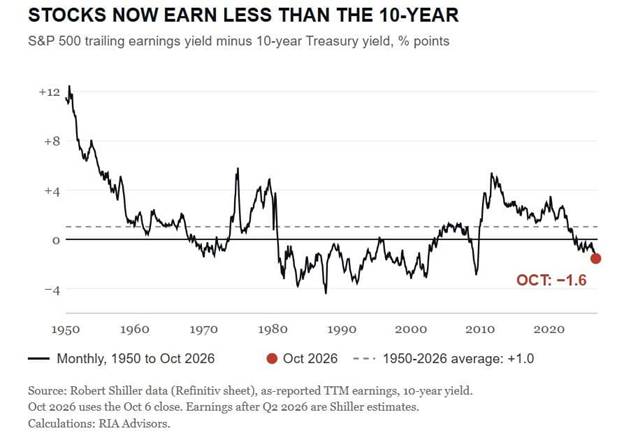
Given this outlook, I continue to be quite conservative within my portfolio allocation. Thirty-five percent of my funds are in cash and short-term treasuries right now. Most of this is held in three-month T-bills yielding right at 4.2%.
That may not look like a big return. However, with the Shiller PE ratio being north of 40x and with zero equity risk premium in the current market, that is more than investors can expect annually over the next decade from equities. At least, that is how things have played out historically. Maybe things will be this “different” this time around. However, more than 40 years of investing has taught me that is more than a risky bet.
At the time of publication, Jensen had no positions in any securities mentioned.