A Weird, But ‘Useful’ Way to Think About the Surge of New Bond Issuance
It’s important to think about new investment grade bond issuance as Sec. Scott Bessent confronts the task he has created for himself.
You've reached your free article limit
You've read 0 of 1 free Pro articles.

There are “weird” things about the dataset of issuance of new investment grade (IG) corporate bonds in the primary debt capital market.
For one, it uses modified durations instead of DV01 because it is easy to see what the duration was at the time of issue. I’m really not sure anyone should ever multiply notional value by duration, but I think there is a reason for doing so in this case (DV01 would have been better, but close enough).
Also, it is difficult to tie into the league table exactly using some of the Bloomberg search functions (at least up to my ability to use them). So, this search picked up $165 billion for August versus league table data of $180 billion. That’s not ideal, but I am going to assume it is consistent over time.
The duration of floaters is a bit incorrect (we treated them as fixed here), but close enough, especially since most floaters are shorter maturity anyways.
We assumed all issuance was at par (close enough for now). And we dropped perpetual bonds, which understates the amount.
It is the Friday before a long weekend, so we will send as is for now, and work on cleaning it up.
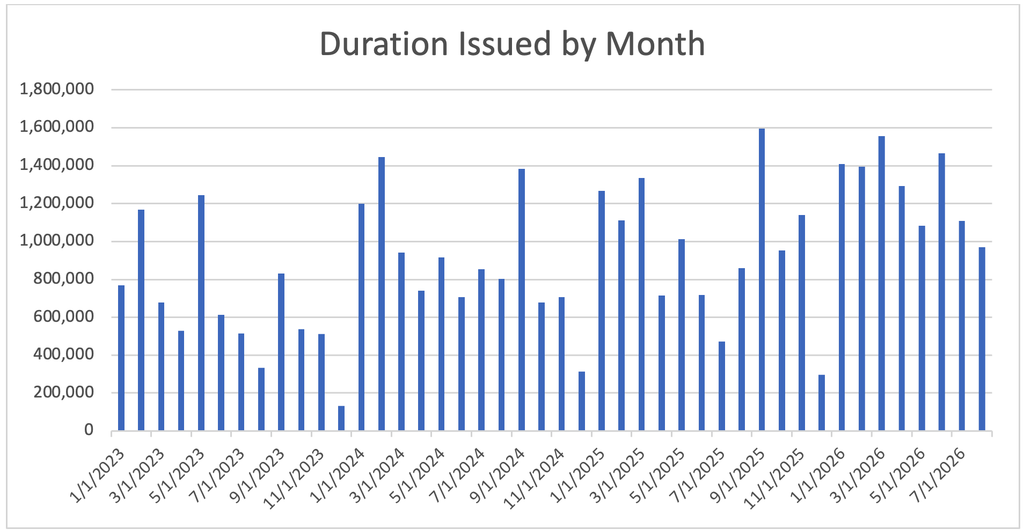
We basically just calculated the duration of each bond issued in the month multiplied by the number of millions of that bond that was issued. The numbers are “only” useful for relative comparison, to give a sense of just how much “risk” the market has been forced to take.
2023: 7.8 million (whatever this number is)
2024: 10.7 million (a hefty increase)
2025: 11.5 million (increased again).
YTD 2026 :10.3 million (almost as much as 2024, and it is only the end of August).
If 2026 finishes at same pace as 2025 did, then the number hits 14.2 million! (almost double 2023).
If we take the average of the first eight months and multiply by 11 (yes, Phil McConkey will be angry that I assumed zero in December), again we come to 14.1 million.
Is this the best way to think about the supply of corporate debt? Probably not.
Is it more useful than just thinking about total issuance or weighted average maturity? Probably yes.
Bond investors think in terms of maturity buckets — of DV01 risk, not just notional risk. So, we think some version of this is what is important as Scott Bessent confronts the task he has created for himself: lowering the long end!