Short-Term Variations Make Us Crazy. They Also Create Opportunities.
Price declines unrelated to poor fundamentals offer one of the best possible times to start or add to positions. Let's examine three examples.
You've reached your free article limit
You've read 0 of 1 free Pro articles.
Investors like to think stock market actions reflect fundamentals in a rational manner.
That is typically true over the long-term. For any given period, however, we see some impossible-to-fathom share-price movements.
This week’s Value Line edition covered the Building Materials industry group. Here are two glaring examples of how out-of-touch share prices can get when compared with the underlying firms’ profitability.
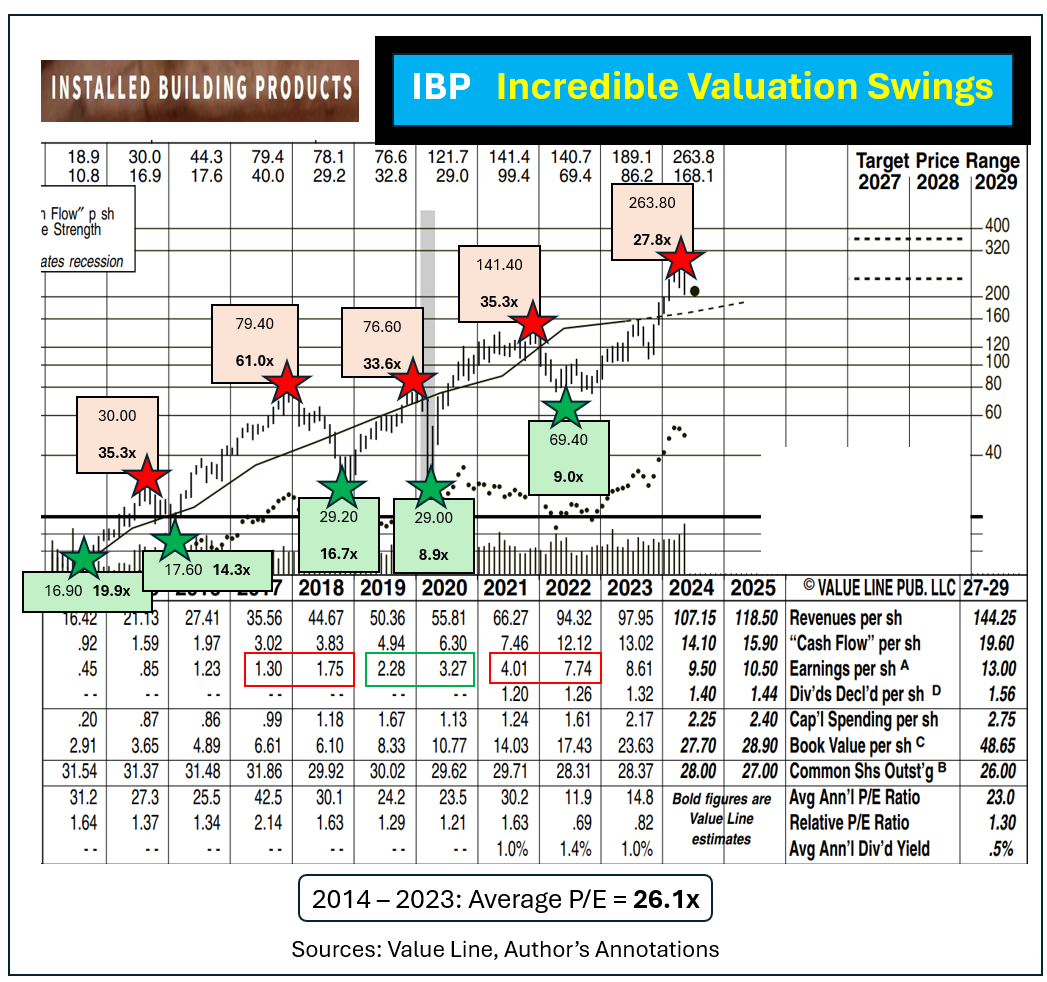
Since 2014 Installed Building Products IBP has seen five full cycles of major gains followed by sharp pullbacks.
The stock’s average P/E over the past decade was 26.1x. All five of the “best entry points” (green-starred below) saw valuations well below that average level.
All five of the “should have sold” moments (red-starred) indicated IBP was fetching way above normalized P/Es.
Buying at cheap valuations saw enhanced future gains. Failure to sell when valuations were very extended caused a lot of pain. Taking new positions at those moments was disastrous. That all makes sense.
What often confounded traders was that many of those large declines came during years when EPS were growing rapidly.
IBP fell from $30.00 to $17.60 (-41.3%) from its 2015 peak to its 2016 low. That six-month plunge came despite EPS being on track to surge from $0.85 to $1.23 [+44.7%].
IBP’s late 2017 peak of $79.40 preceded a sickening selloff to $29.20 (-63.2%) on Christmas Eve of 2018. That belied the fact that EPS grew 34.6% from 2017 to 2018.
A late surge to $76.80 just ahead of the Covid crisis of March 2020 gave way to a 62.4% markdown to $29 even. Ouch.
That was especially painful knowing that EPS were on the way to a stellar gain, from $2.28 in 2019, to $3.27 in 2020.
Stimulus-fueled consumer spending in 2021 and a super-hot market environment pushed IBP shares to $141.40. A putrid overall market in 2022 saw IBP drop 50.9%, to $69.40.
How did fundamentals look in 2022? EPS surged 93% that year while the stock was halved.
Here is what I wrote about IBP back in January 2023 with the shares at $92.74.
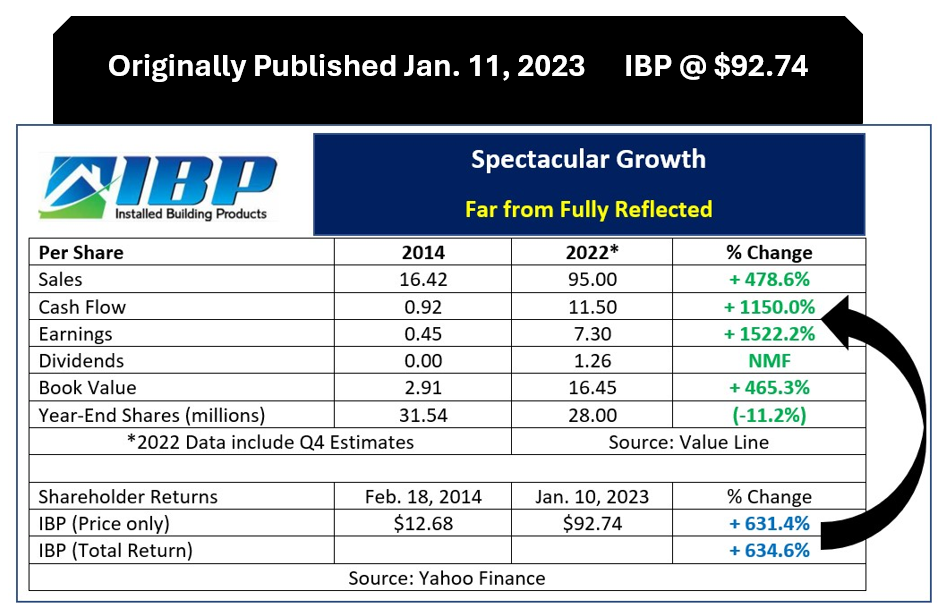
When price action gets detached from fundamentals opportunity knocks.
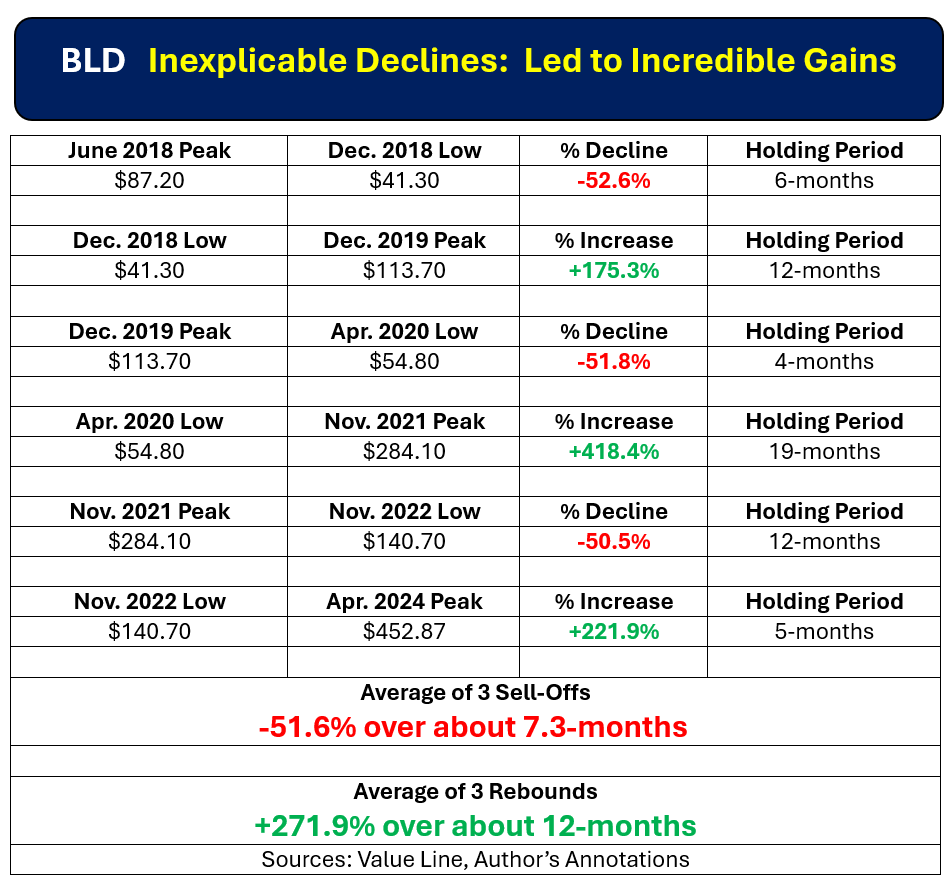
I have spoken many times of the Law of Asymmetric Gains. The table below is simply the latest proof of that.
The second example of this phenomenon is TopBuild BLD. This company was spun off from Masco MAS on June 30, 2015.
After declining from $36.40 near the spinoff date to $23 in January 2016, BLD has seen four major price ramps and three significant selloffs.
The sharp declines occurred even though TopBuild has not had a down EPS year since 2016. In fact, every year since then has set an earnings record.
BLD’s average P/E has run 16.0x. One hundred percent if its best buying opportunities (green-starred below) came with the shares selling at huge discounts to that multiple.
One hundred percent of its “should have sold” moments (red-starred) occurred when BLD commanded well-above-average P/Es.
Seeing shares go down after significant P/E expansions is not surprising. Seeing them plunge while EPS are growing rapidly, though, is unexpected.
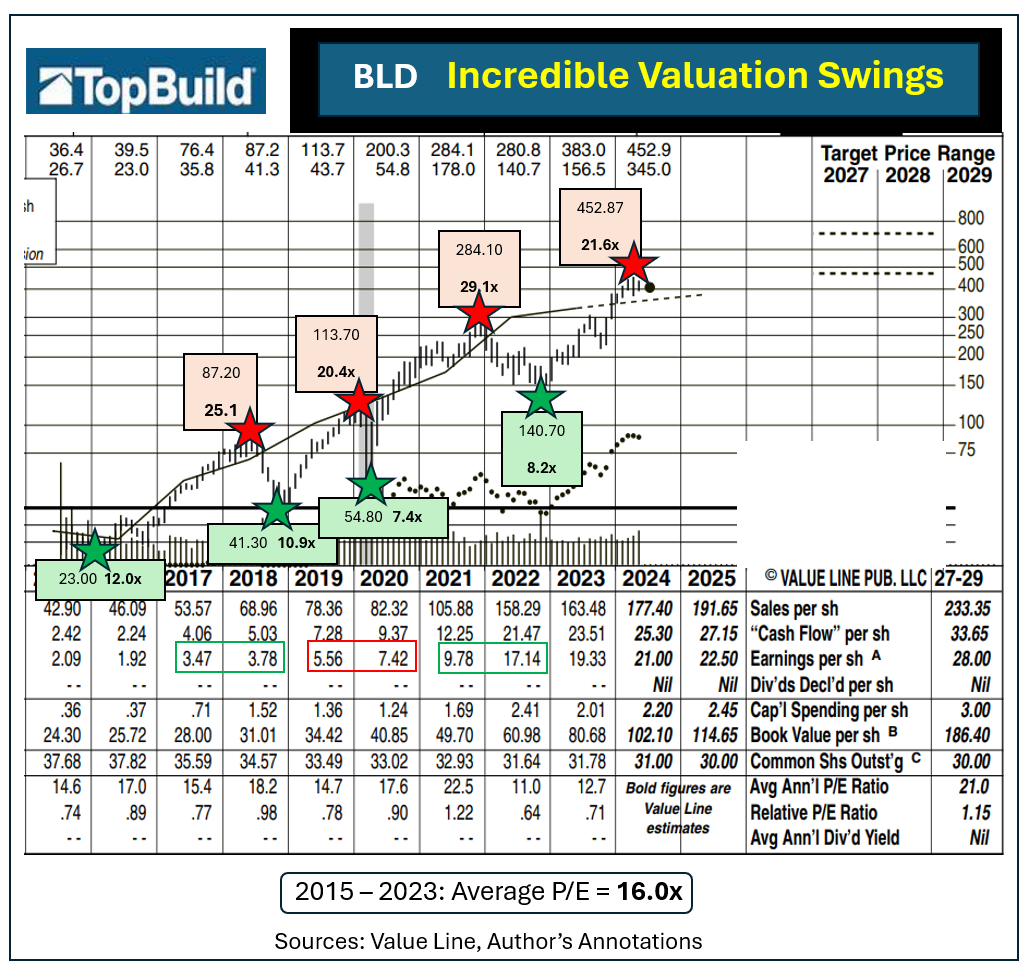
The three large declines came intra-year in 2018 as EPS grew, in early 2020 due to the Covid panic, despite EPS surging from $5.56 to $7.42 [+33.4% YoY], and from late 2021 through December 2022. That final, greater-than-50% plunge, took place as EPS skyrocketed from $9.78 to $17.14.
As noted earlier, price declines unrelated to poor fundamentals offer one of the best possible times to start or add to positions in the underlying shares.
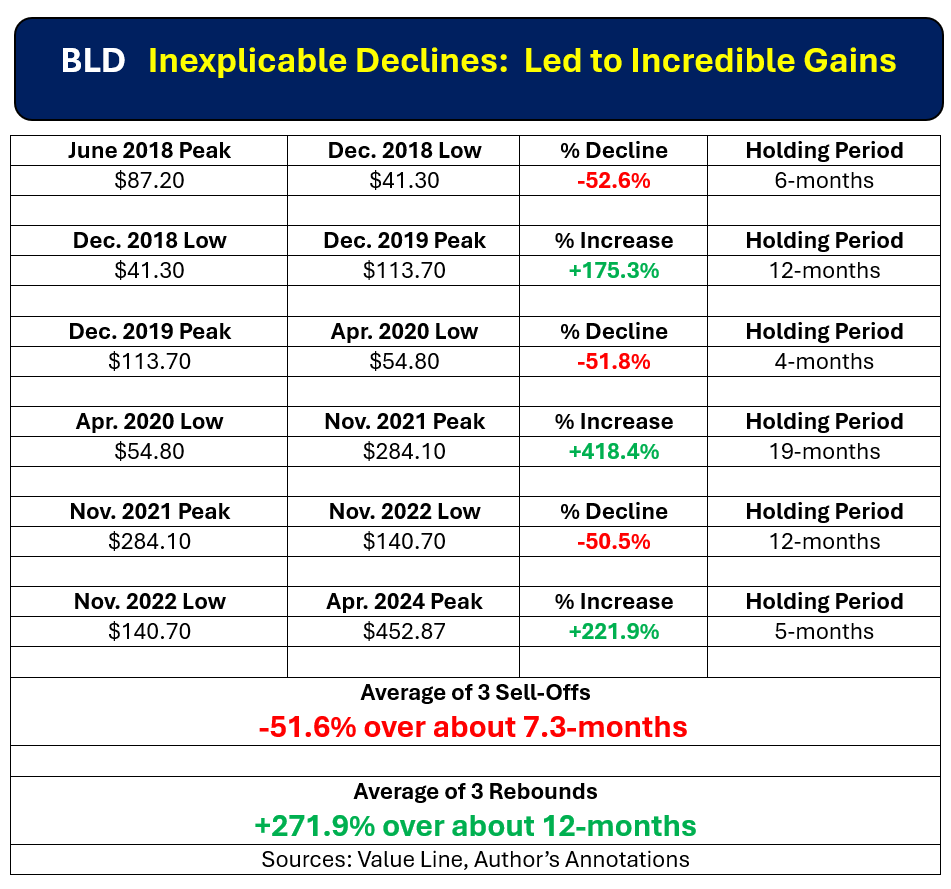
Huge gains like those detailed do not happen overnight. In-and-out traders can only dream about profits of that magnitude barring takeovers, which can cause large gains instantly.
Those short-term traders will also never get favorable tax treatment, which is currently reserved for holders of shares for over one year.
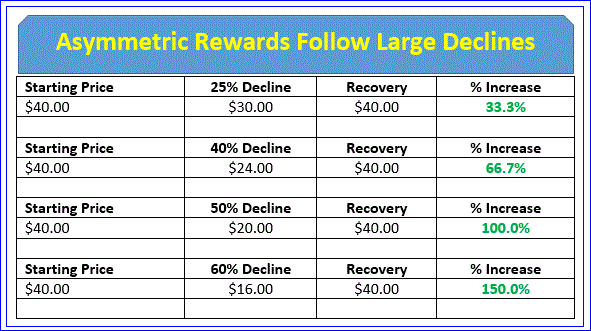
Here again is the math behind the asymmetric rewards that come to brave souls willing to buy badly beaten-up shares.
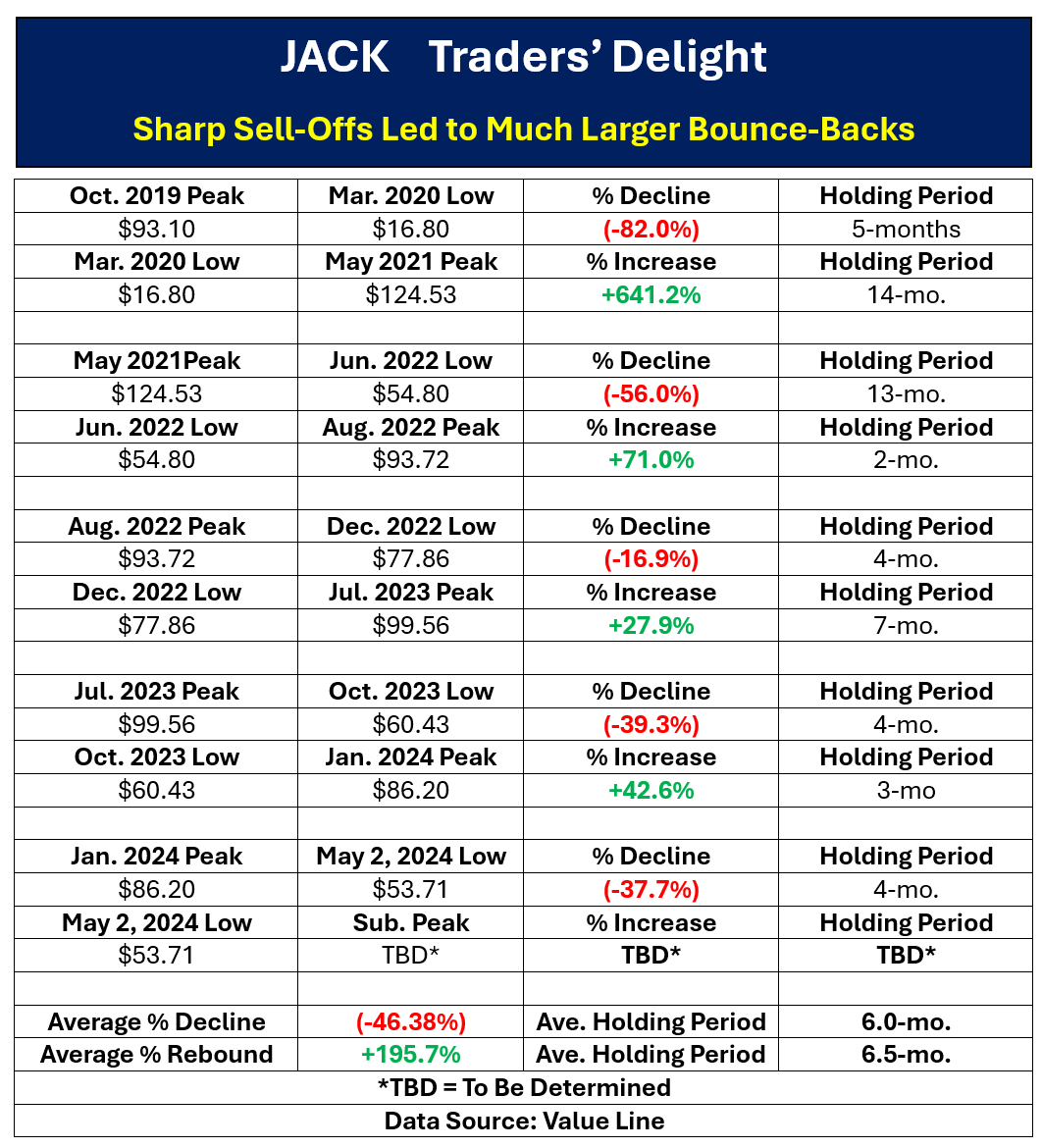
My single largest holding is now Jack in the Box JACK. Here is the lowdown on it based on previous selloffs in recent years.
Its five major declines since 2019 averaged (-46.38%). Those plunges typically took about six months to play out. The rebounds that followed averaged gains of +195.7% over about 6.5 months.
From a top tick of $99.56 on July 31, 2023 JACK bottomed out near $52 on May 29, 2024. It closed at a still crazy low $55.27 on June 13, 2024.
Did EPS decline from last year? No. JACK earned $6.03 in adjusted earnings in FY 2023. It is now expected to post $6.32 in FY 2024 (ends Sep. 30, 2024) and $6.50 or so for the calendar year. Yahoo Finance sees EPS rising to $7.12 in FY 2025.
The 47.8% drop from last July’s peak to JACK’s May 2024 was not justifiable.
Amazingly, Goldman Sachs downgraded JACK on June 13, 2024 rather than recommending it. They were following the technical charts and assuming something must be wrong for it to have fallen so much.
Ignoring fundamentals is not recommended.
The stock’s 10-year median multiple is 19.0x. Its normalized yield ran about 1.6%. JACK now sells for only 8.5 times CY 2024’s estimated EPS while yielding 3.18%. The P/E is now less than half its normal level. JACK’s current yield is now almost double its historical average.
These shares can easily bounce back to between $100-$130 within 12 to 18 months, in my view.
Even a partial reversion-towards-the-mean P/E of 16 times this calendar year’s estimate would send JACK back up to $104.
During the five pre-Covid years from 2014 through 2019 Jack in the Box often commanded P/Es north of 20. On a few occasions it reached 33 times earnings.
In my 46 years of investing I have rarely felt more confident about the 12-to-24-month prospects for any stock.
I hope to be writing about an enormous gain from this position before too long.
More Paul Price:
- Walmart: Far From Bargain-Priced
- Forget Meme Players… What Is GameStop Really Worth?
- Buying Income Is Hazardous to Your Wealth
At the time of publication, Price had no current positions in IBP or BLD. He was long shares and short options in JACK.