Here’s What Should Terrify Any Long-Term PepsiCo Investor
Pepsi lost its fizz years ago — and this quarter didn’t change that.
You've reached your free article limit
You've read 0 of 1 free Pro articles.
Early on Thursday morning, PepsiCo (PEP) reported its second-quarter financial results. For the period ending June 13, PepsiCo posted adjusted EPS of $2.20 (GAAP EPS: $2.18) on revenue of $24.181 billion. While that sales print did narrowly beat expectations and was good for year-over-year growth of 6.4%, the adjusted bottom line fell a penny per share short of what Wall Street was looking for.
Chair and CEO Ramon Laguarta commented in the press release:
“Our second quarter results featured strong organic volume and net revenue growth for the global convenient foods and global beverages businesses. Year-to-date, PepsiCo’s global organic volume has increased at the highest rate since 2022 – aided by the strength of the international business and the continued evolution of the portfolio to offer more choices through portion control varieties, diverse ingredients, functional benefits such as hydration, protein and fiber, energy and zero sugar beverage varieties.”
Operations
For the period, as sales were up 6.4%, the cost of those sales increased 7.4% to $11.07 billion. This left a gross profit of $13.111 billion (+5.6%) as gross margin narrowed to 54.2% from 54.7%.
GAAP operating expenses grew 3.6% to $9.088 billion, leaving GAAP operating income of $4.023 billion (+124.9%). GAAP operating margin improved to 16.6% from 7.9%. Keep in mind that Q2 2025 included impairment charges of $1.86 billion that Q2 2026 was not saddled with.
After accounting for interest, other income & expenses and taxes, GAAP net income attributable to shareholders printed at $2.981 billion (+136%). This worked out to $2.18 per fully diluted share versus $0.92 for the year-ago period.
Once adjustments have been made, core operating profit margin dropped to 16.8% from 17.2% and net income increased 3.8% to $2.907 billion and earnings per share worked out to $2.20.That compares to $2.12 for the same quarter last year.
Sector Performance
– PepsiCo Foods North America generated sales growth of -2%, and operating profit growth of -3.5%.
– PepsiCo Beverages North America generated sales growth of 7%, and flat operating profit growth.
– International Beverages Franchise generated sales growth of 11%, and operating profit growth of 19%.
– Europe, Middle East & Africa generated sales growth of 10%, and operating profit growth of 103%.
– Latin America Foods generated sales growth of 15%, and operating profit growth of 16%.
– Asia Pacific Foods generated sales growth of 12%, and flat operating profit growth.
Guidance
For the full fiscal year, PepsiCo re-affirmed organic revenue growth of between 2% and 4%. Wall Street was looking for something close to 2.75%, so this was seen as a beat. However, the company also guided towards a core EPS growth of between 4% and 6%. Wall Street was looking for 6.1% and the market is taking this rather significant miss quite seriously.
Fundamentals
For the first half of the fiscal year, PepsiCo generated operating cash flow of $2.365 billion. Out of that number came capex spending of $1.266 billion, leaving free cash flow of $1.099 billion. “Out of” this number, PepsiCo had paid out cash dividends of $3.914 billion and repurchased $479 million worth of common stock. No, that does not add up very well.
Turning to the balance sheet, PepsiCo ended the quarter with a cash position of $10.716 billion and inventories of $6.734 billion. That puts current assets at $32.775 billion. Current liabilities add up to $35.106 billion. This includes short-term debt of $10.602 billion.
The company’s current and quick ratios stand at 0.93 and 0.74, respectively, which is, in any legitimate CFO’s book, quite unacceptable. The very fact that the PepsiCo cash position barely covers the amount of debt on the books that is maturing within 12 months should absolutely terrify any long-term investor in PEP.
Total assets amount to $112.189 billion, of which 30.6% is labeled as either goodwill or other intangibles. While I do not love that, it does not fall outside of modern norms. Total liabilities less equity comes to $89.919 billion. Included in that number is a stunning long-term debt load of $42.612 billion.
This balance sheet is an embarrassment.
Opinion
If readers go back to my piece on PepsiCo on February 3 of this year, I warned that the company’s fundamentals were a problem. I congratulated Dougie Kass in that piece for getting out of his long position and told readers that PEP was a “screaming short.” The shares are now down 20.5% and from where they peaked the next week and down 15% from the last sale posted on the chart in that article.
PepsiCo was, in my opinion, in trouble six months ago and is in trouble today. Cash flows could help, but the dividend would have to be cut. The debt load, both for the short and long-term is a monster that the company’s fundamentals as they stand are ill-equipped to handle well. On top of that, the North American businesses are struggling.
There is no reason to be long this stock and there has not been for some time now.
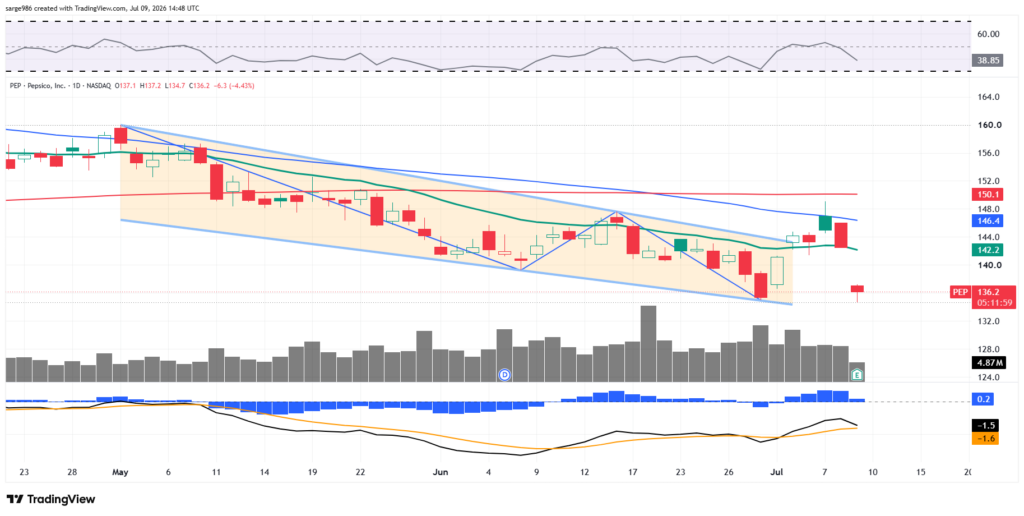
Readers will see that PEP suffered a “death cross” in mid-June. This is when the 50-day simple moving average (SMA) crossed below a static or falling 200-day SMA. That signal does not always work but is seen as bearish in nature.
The stock recently tried to break out of a Falling Wedge pattern of bullish reversal. That in itself can be seen as ominous. Making matters worse, the stock was repelled at its 50-day SMA, which implies professional selling pressure.
The stock found support Thursday morning at its late June low. I would not at all be surprised to see this stock test its 2025 low of $127.60 from above before it retests its own key simple moving averages from below.
Sarge out.
At the time of publication, Guilfoyle had no positions in any securities mentioned.