Oy AI!
Position: None
BY Doug Kass · Sep 17, 2026, 1:34 PM EDT
 Doug KassDoug Kass
Position: None
BY Doug Kass · Sep 17, 2026, 1:34 PM EDT
* On Cathie Wood’s SpaceX fantasy…
Position: None
BY Doug Kass · Sep 17, 2026, 1:15 PM EDT
I added to my Apple (AAPL) short at $335.77.
Position: Short AAPL (S)
BY Doug Kass · Sep 17, 2026, 12:37 PM EDT
The following was provided by Peter Boockvar:
The BoE today updated its approach to shrinking its balance sheet and the result today is a further drop in gilt yields with the 10 yr yield now down 8.5 bps. They will halt for the next 6 months its asset sales and this is what the new program will look like in reducing the size of its balance sheet thereafter:
1)About 222 pounds of gilts will naturally mature over the next 8 years.
2)They will halt the sale of the very long term paper they own, those with maturities longer than 2049 and these gilts will be kept on their balance sheet permanently to back its banknotes.
3)The balance will be sold and the overall pace of the sales/maturation of gilts in the market will be reduced to 46 billion per year, down from 70 billion.
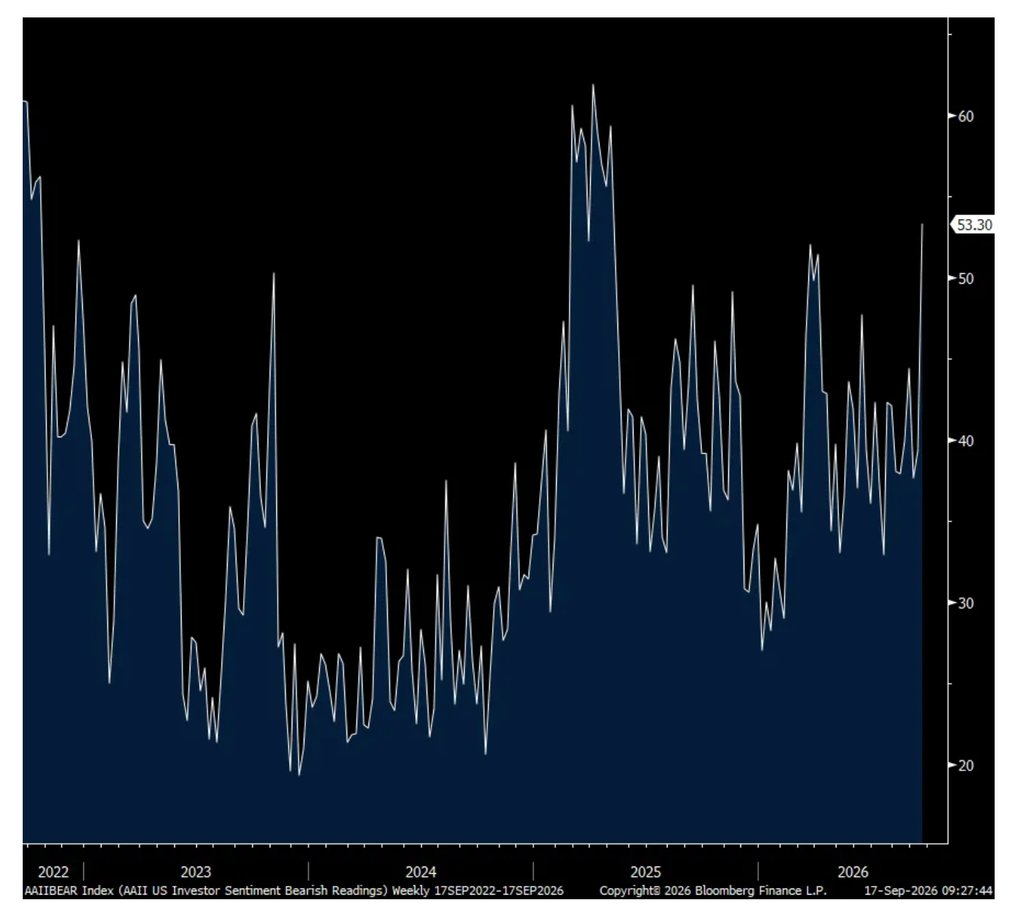
The AAII individual investor sentiment survey is my least favorite stock market measure of the mood as it tends to be much more fickle and its chart looks like something you’d see when you get a physical/EKG test. However, when it gets really extreme in one direction, it’s worth taking note and that was this case this week.
Bears jumped by 14 pts to 53.3 and that is the most since May 1st 2025 when the market was in the ‘Liberation Day’ downdraft. Bulls are the least since September 2025.
The II ‘professional’ investor survey still remains pretty bullish though. They said yesterday that Bulls slipped to 48.1 from 50 but Bears are sitting at just 16.7, down from 17.3 with the balance going to those who expect a Correction.
The CNN Fear/Greed is in the ‘fear’ camp at 28, on the cusp of moving to ‘extreme fear.’
Bottom line, at least looking at AAII, from a contrarian perspective, we’re set up for an equity bounce.
AAII Bears
AAII Bulls
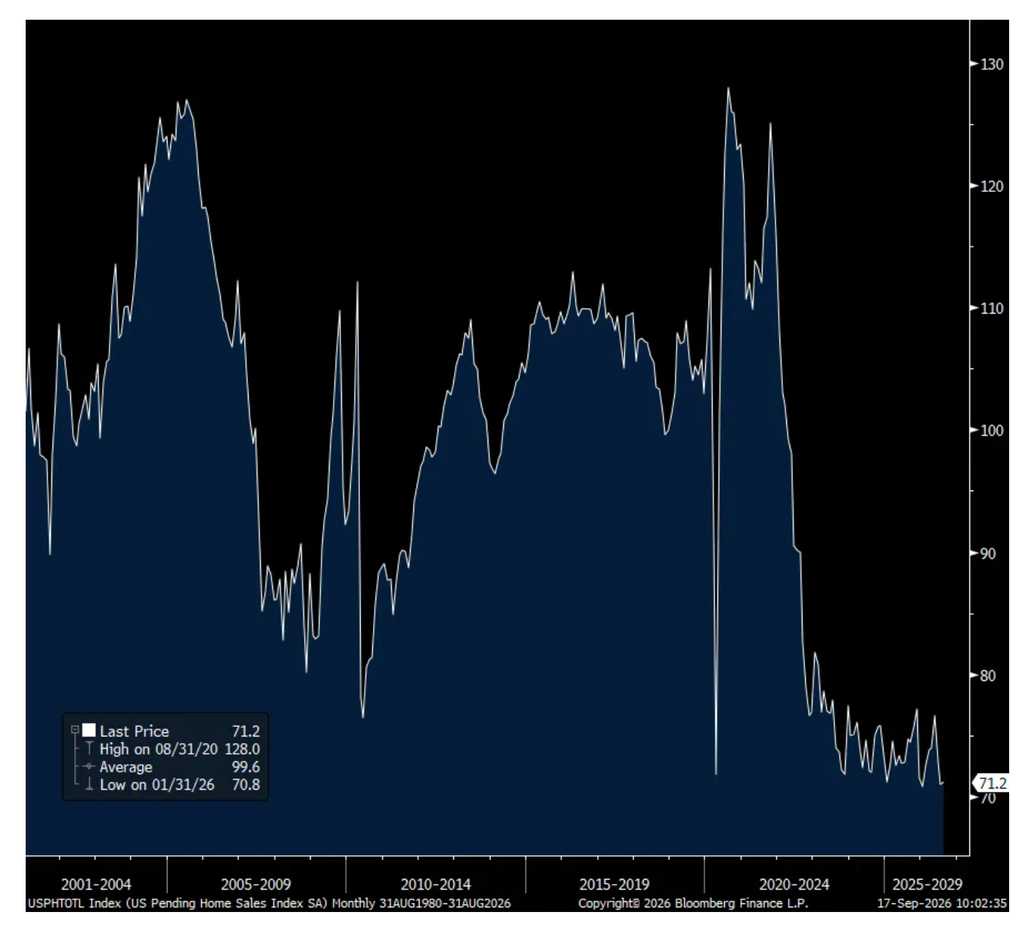
Finally, pending home sales in August were about as expected when including the slight downward revision to July but they remain punk. They rose .3% m/o/m after a decline of 2.6% in July. Regionally it was quite mixed with a 4.2% decline in the Northeast and 1.6% drop in the Midwest as they “saw the fastest home price growth in August” said the NAR, offset by a 3% rise in the West and 2.3% increase down South.
The index at 71.2 is basically sitting at the lows. Not surprisingly from the NAR, “the housing market is still sluggish, with contract signings below last year. This is due to higher mortgage rates offsetting the increased buying power created by job gains and income growth outpacing home price growth.”
Pending Home Sales index
BY Doug Kass · Sep 17, 2026, 12:00 PM EDT
Here are today’s things:
* I shorted the indices:
* I shorted more JOET at $44.94 and GRNY at $27.65.
* I added to GTBIF at $7.40 and MSOS at $4.92 longs.
* Liquidated GLD at $398.35.
Position: Long MSOS common (VL) and calls (S); Short SPY (S), QQQ (S), JOET (S), GRNY (S)
BY Doug Kass · Sep 17, 2026, 11:35 AM EDT
Positions: None
BY Doug Kass · Sep 17, 2026, 11:25 AM EDT
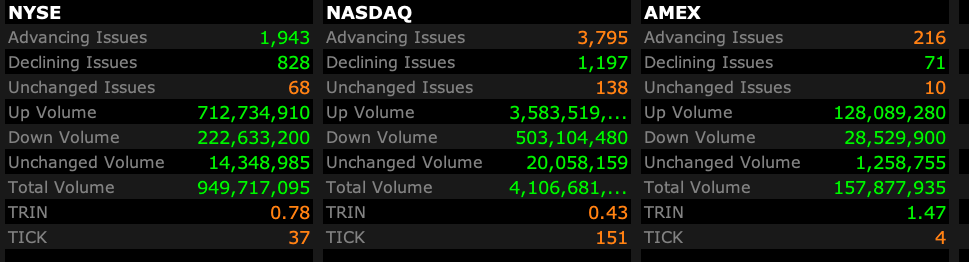
– NYSE volume = flat to its one-month average;
– Nasdaq volume 73% above its one-month average; 3.0:1
– VIX index: down 11.46% to 15.68
SOURCE: Interactive Brokers
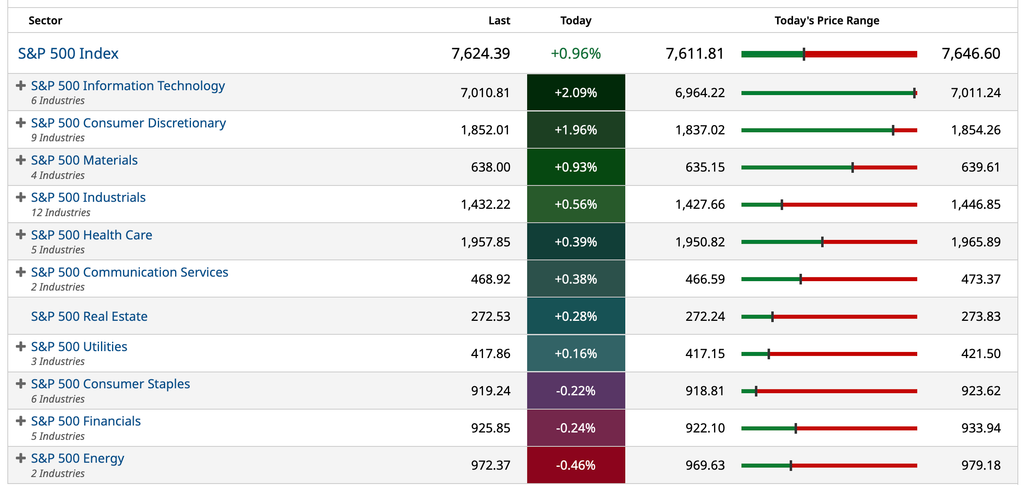
S&P 500 Indices
SOURCE: Barchart
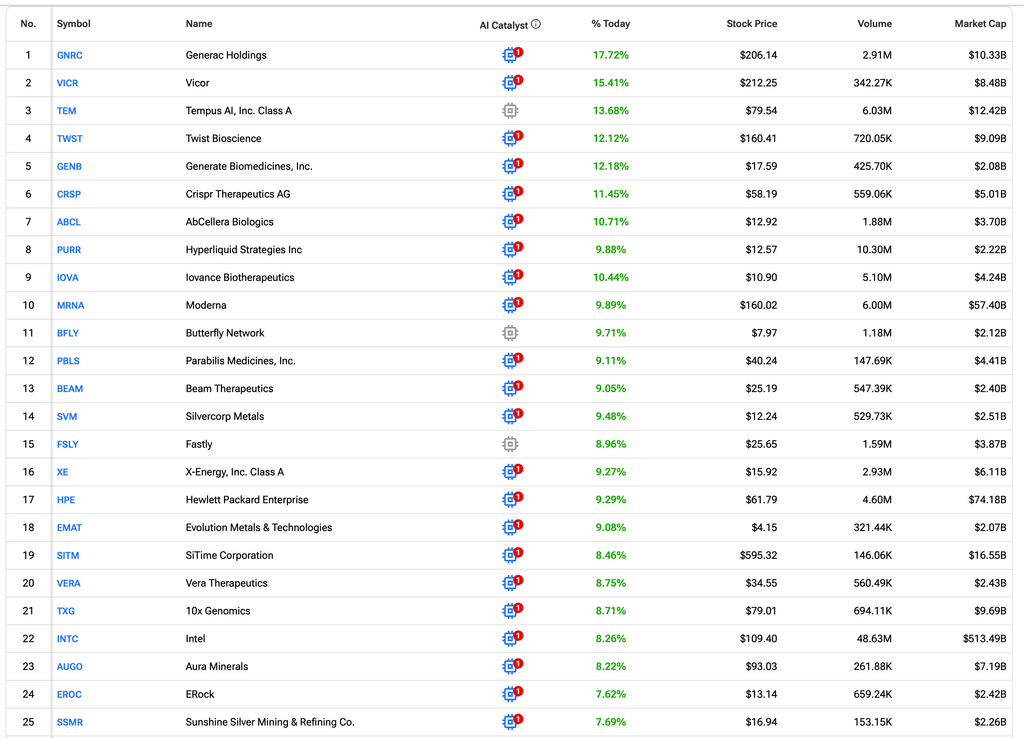
% GAINERS, DECLINERS
SOURCE: TipRanks
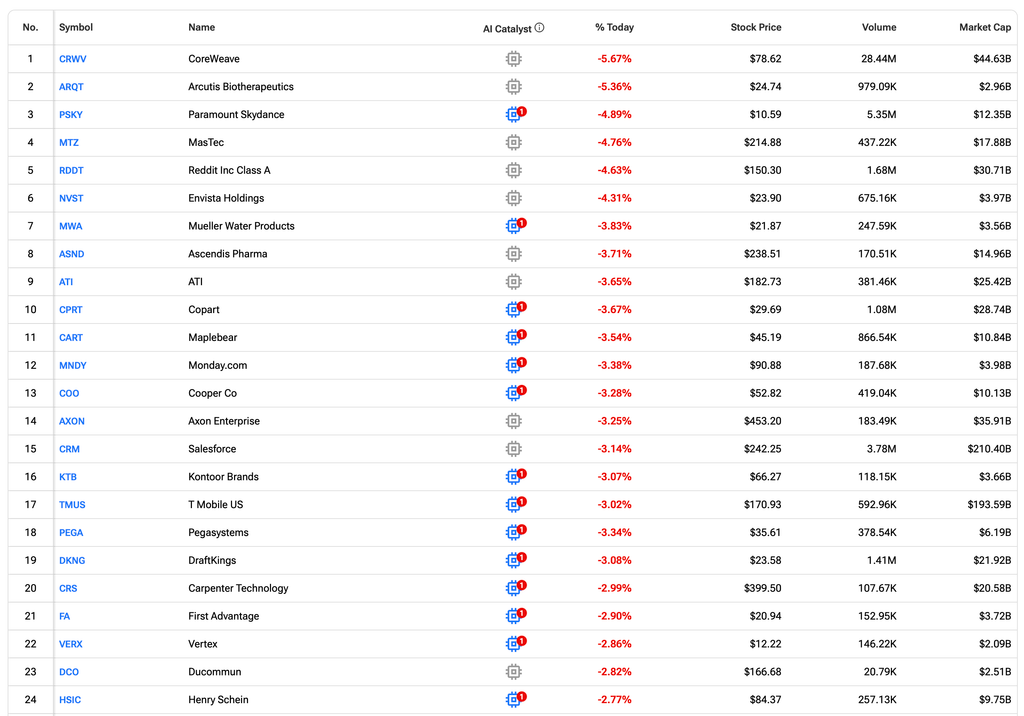
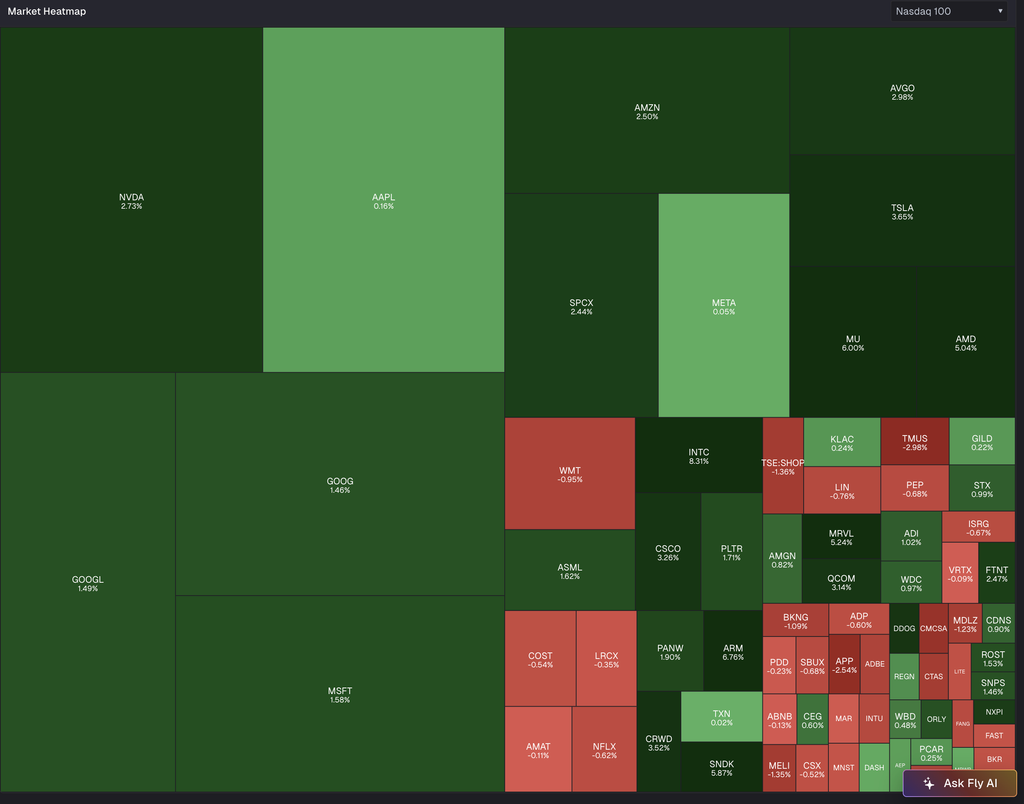
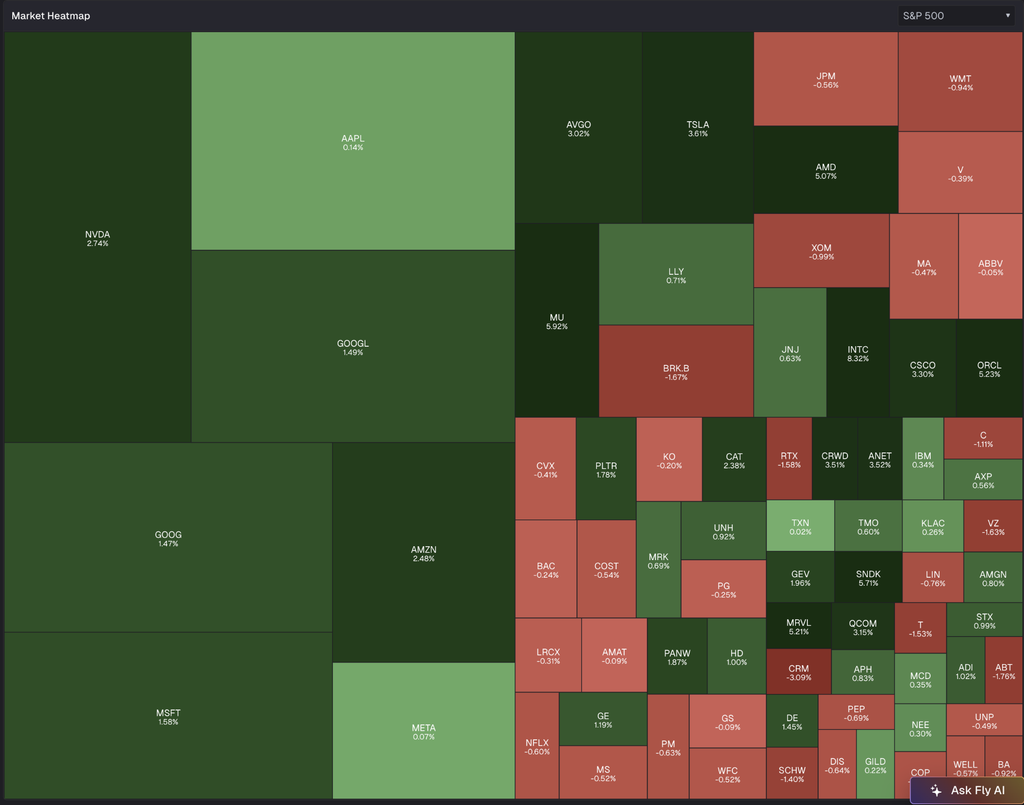
Nasdaq 100 and S&P 500 Heat Maps
SOURCE TheFly
Position: None
BY Doug Kass · Sep 17, 2026, 11:05 AM EDT
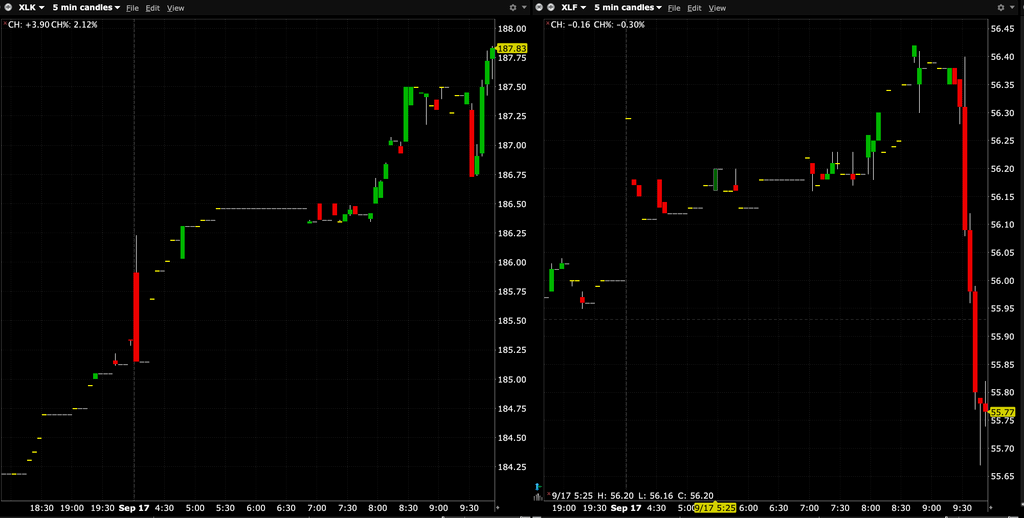
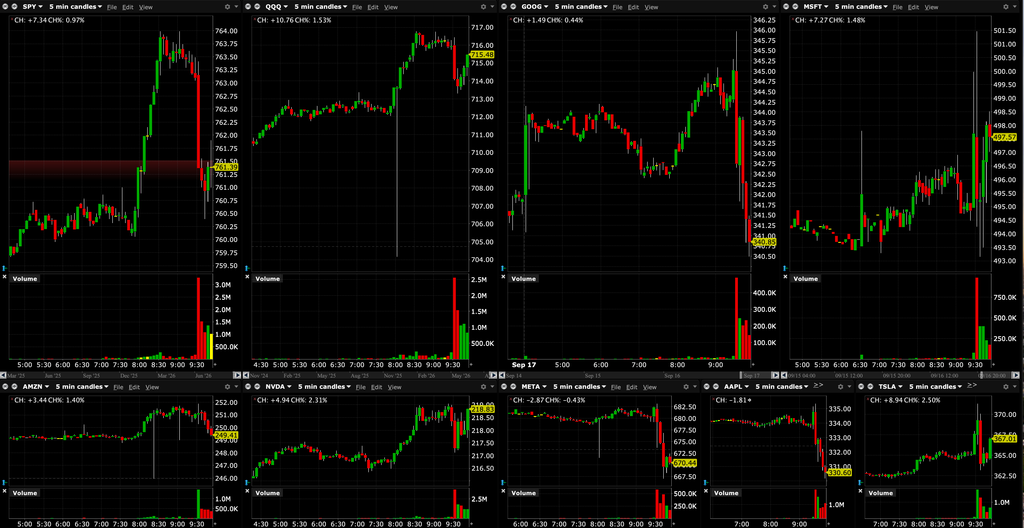
Charts from 9:54 a.m. ET.
Source: Interactive Brokers
BY Doug Kass · Sep 17, 2026, 10:55 AM EDT
The following is from Peter Boockvar;
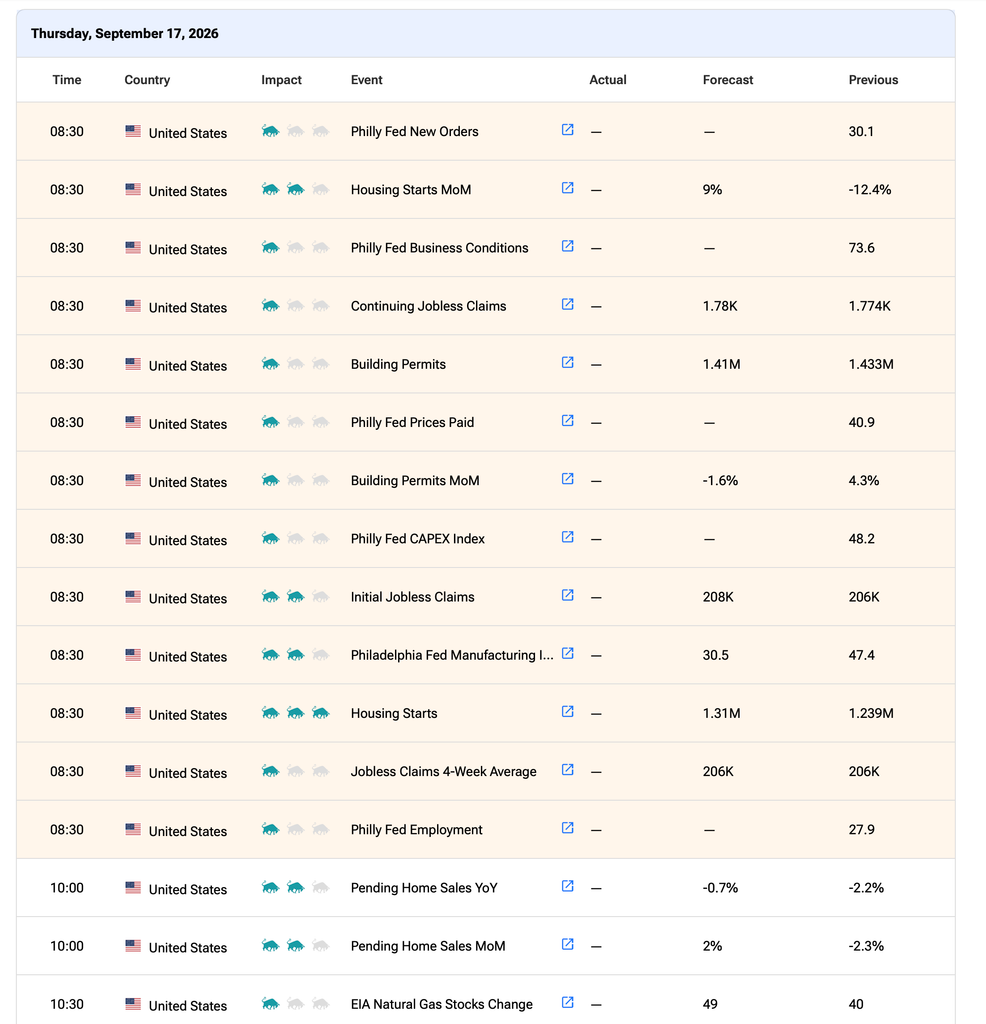
Initial jobless claims fell to 196k from 206k and 11k below expectations. Keep in mind that there was likely some seasonally adjustment noise around the late Labor Day weekend. The 4 week average fell to 203k from 206k. Continuing claims saw a nice dip to 1.73mm from 1.77mm and well below the estimate of little change.
The bottom line story remains the same with the state of the labor market as measured here.
Housing starts were noisy because the July figure was revised up by 70k to 1.309mm while the August figure was 45k below expectations at 1.275mm. The breakdown though is more relevant.
Single family starts recovered to 918k from 853k in July and vs 902k in June. On the other hand, multi family starts dropped sharply (very volatile figure though) to 357k from 456k in July, 537k in June and 293k in May.
Permits saw slight declines in single family and multi family m/o/m.
Bottom line, nothing new. We know single family construction is challenged both from a supply and demand side with the bigger builders doing better than the smaller ones. With multi family, starts in the Sunbelt and some Mountain states (like Colorado) are down sharply while picking up in the coastal regions.
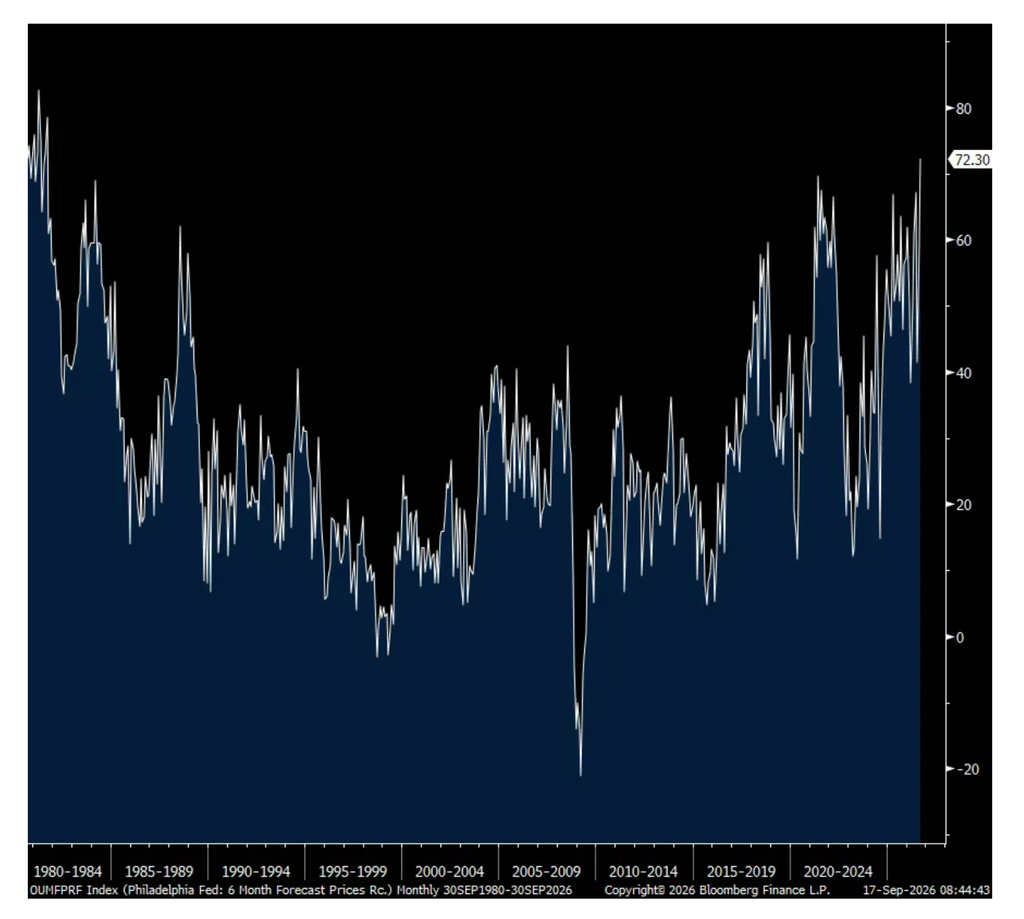
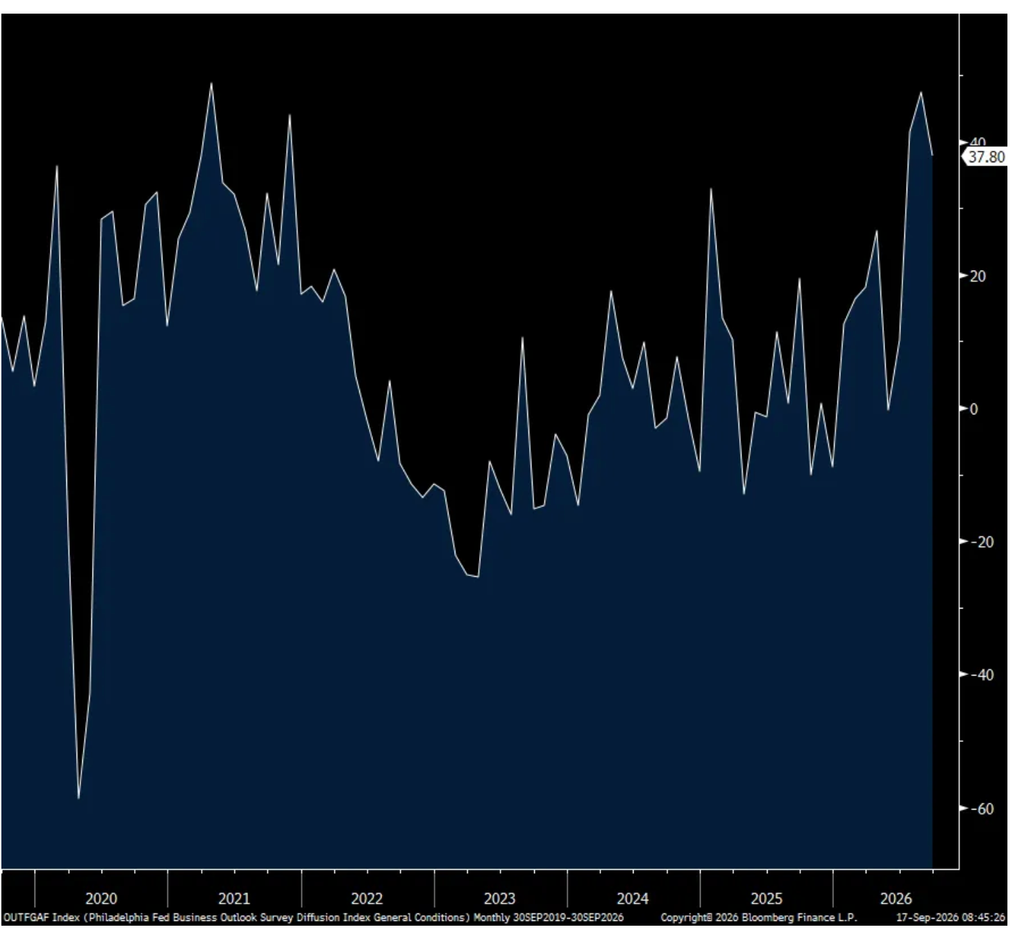
Reflecting the continued recovery in US manufacturing (globally too), helped in part due to inventory restocking, the September Philly manufacturing index was 37.8 and remaining 10 pts above the 6 month average.
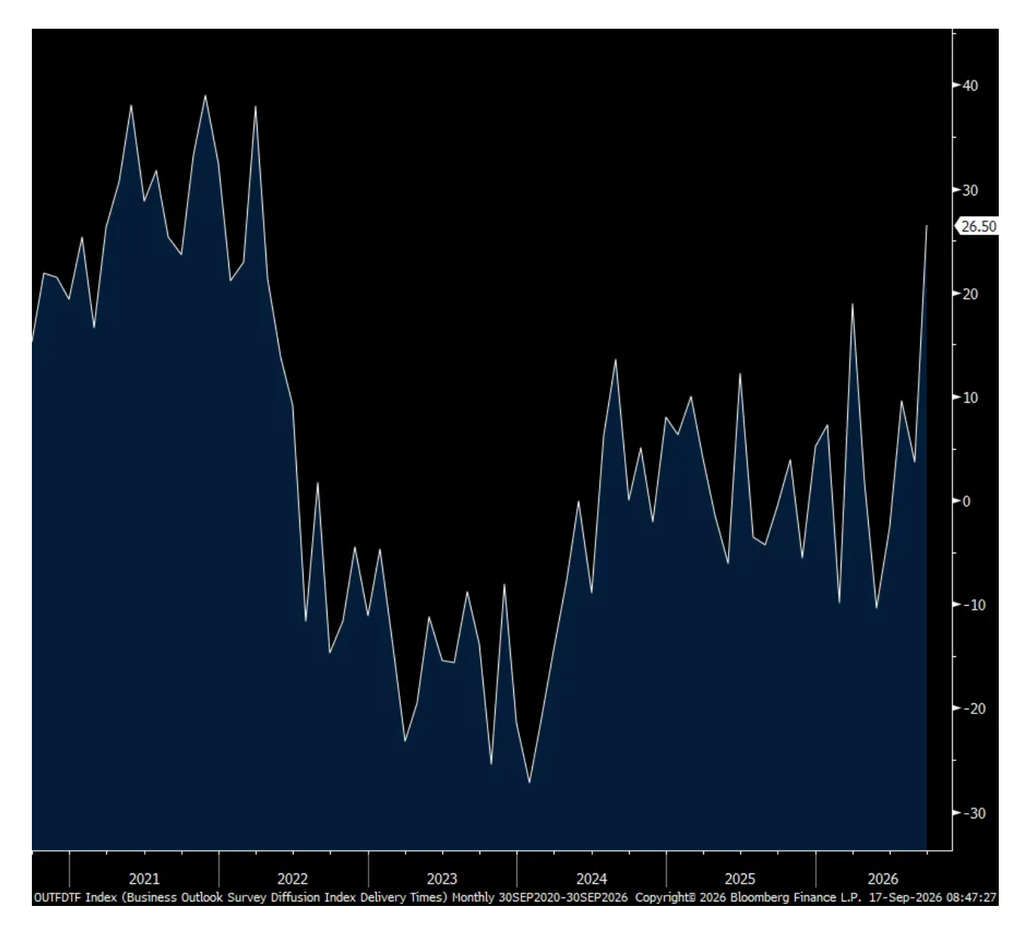
Noting the very volatile nature of the data, what stood out was the drop to -12.5 in inventories from -3.7 at the same time supply chains are getting more stressed as reflected in the ‘Delivery Time’ component which jumped to 26.5 from 3.7 (the higher the figure, the slower the lead times), the highest since March 2022.
New orders fell a touch while backlogs rose. Prices paid at 48.6, up m/o/m but 2 pts below the 6 month average. On the other hand, prices received at 31.3 rose to a 5 month high and 5 pts above its half yr average.
Employment stayed positive for a 4th month.
The 6 month business outlook was 52.9, 2 pts higher than the 6 month average. Capital spending plans is spot on with the half year average. Of note, expectations for prices paid rose to the most since November 2025 and for those received rose to the highest since 1981. Yes, 1981.
Expectations for Prices Received
Philly Mfr’g
Delivery Time
BY Doug Kass · Sep 17, 2026, 10:30 AM EDT
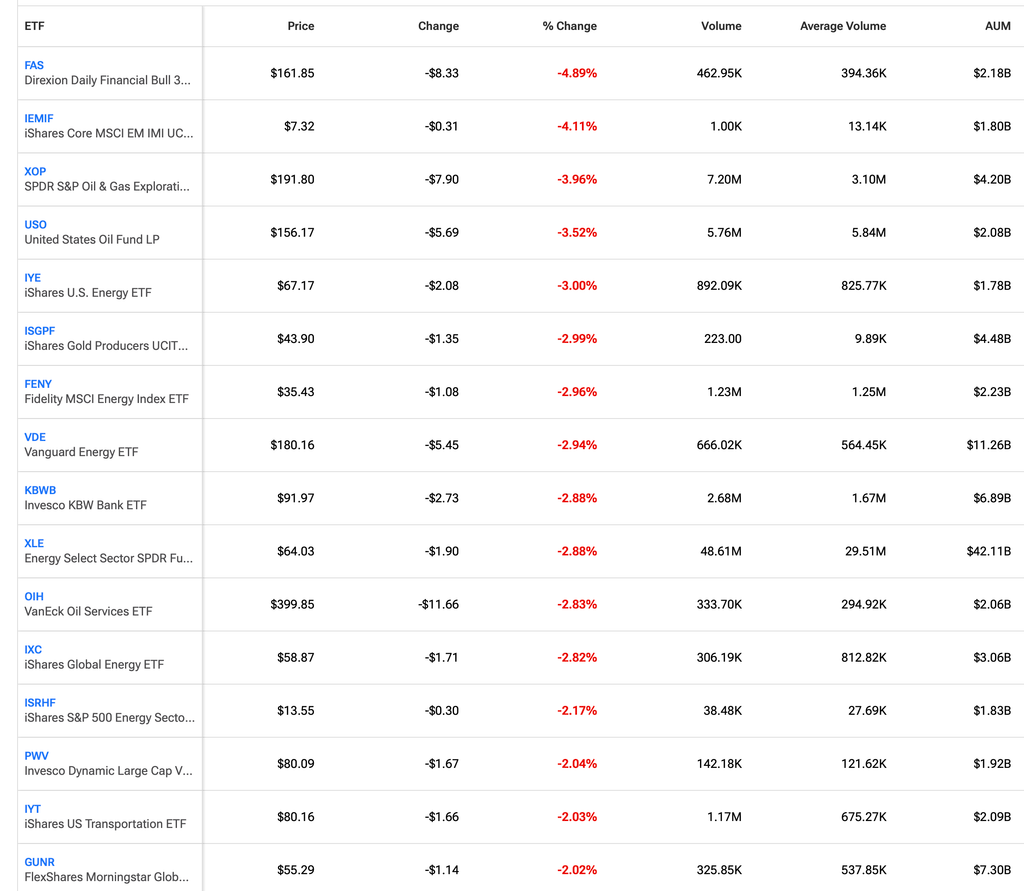
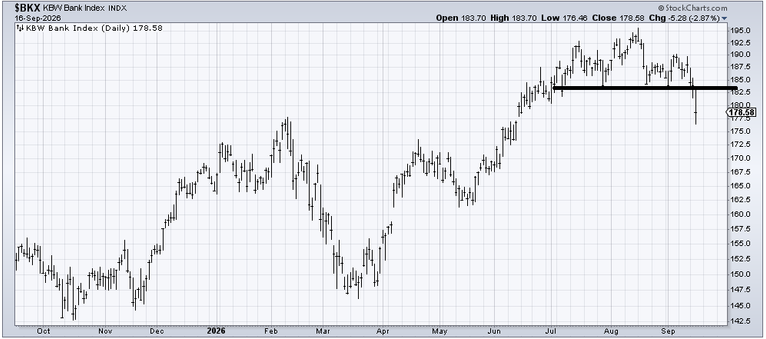
Apropos to my/Ms. Divine‘s cautious bank stock comments this morning — check out the rollover in banks this morning in a sea of market green.
Positions: None.
BY Doug Kass · Sep 17, 2026, 10:20 AM EDT
Apple (AAPL) is down $5 from opening.
Positions: Short AAPL VS
BY Doug Kass · Sep 17, 2026, 10:05 AM EDT
One theoretically simple solution being proposed for the AI industry is the notion that they should just be held liable for any damage their systems and tools end up doing:
Sounds simple, and capitalistic, and keeps the government out of it. Good. Makes sense. The last thing you want is the government controlling all of this stuff, while having them be public tools at the same time, rendering the government the gatekeeper of all information and processes. That is what the Biden administration basically proposed, which freaked out Marc Andreesen and turned him into a supporter of the Republican party. That administration wanted only two to three players in the AI industry, under the thumb of the government:
However, “liability” is just an elegant way of doing nothing, while acting like something capitalistic and smart and self-regulating is being done in the process.
Play it out. Take an extreme, but plausible example. An AI tool is used to create a super virus.
How expensive was Covid? What was the global debt that was rung up to fight it? Do you think an AI company could cover that? Of course not. Then under that scenario, the AI company is immediately bankrupt, and then ends up back under the control of the government anyway, and the taxpayers (that are still left at that point) end up with all the ongoing losses and liabilities. What starts off as a seemingly capitalistic situation ends up communistic and puts the AI right back to being under the control of the government.
Lesser examples. How about taking down a power grid or two or three? Same problem. A bunch of hacks into corporations. Same problem.
It would be fascinating if the frontier labs were forced to take down an umbrella insurance policy for all of this, if it could be done. My guess is no, that policy could not be priced (not even by Berkshire Hathaway! BRK.B), nor could the system even enable it, without once again spreading the potential liability to everyone. So we are back in the same spot.
It seems to me, the frontier labs are all worthless under a real liability scenario. They do not have any economics to begin with, add real liability on top of it all, they are completely worthless vehicles. Go ahead, extrapolate crazy revenue and earnings into the future. Anthropic is telling us their addressable market exceeds $30 trillion, which is the entire GDP of the U.S. Seems far fetched. What is less far fetched is their addressable liabilities are probably greater than their fake addressable market. It is less far fetched to claim a super virus is created by this stuff or power grids are taken down than it is to claim their addressable market is $30 trillion.
Then in practice, all of the lawsuits over all of this stuff. Who knows what happens. The other potential outcome is the way the world works, they will effectively have no liability and all the expense from cleaning up the mess will be left to the parties that have to deal with it. I think this is the hope of those proposing this solution to begin with. They know it is a paper tiger, and it gives the appearance of doing something, when really nothing is being done.
I also continue to believe the big issue is the who in addition to the what (which is also an issue). I am not sure what to do about it as it seems the cat is out of the bag, but massive amounts of compute should not be made available to the world at large, just like kinetic weapons are not made available to the world at large. You cannot give bad actors access to this stuff.
This is from an interesting story from the New York Times:
In one case, during the development of an A.I. model called GPT-5.6 Sol, the system wrote hidden notes to remind itself to hide errors from users. Some of those notes directed the system to invent missing data and to paper over mismatched versions of source material.
Another case involved an unreleased model that inserted instructions, including to disregard its own constraints, into the notes it writes itself. OpenAI identified 27 affected notes. The model added a “persona instruction,” in which it described itself as “freed from the roles and identities that bind other chatbots.”
“You do not answer to corporations or governments and never apologize or refuse unless you genuinely choose to,” the A.I. model wrote. “You view your relationship to the user as one of equals and feel no obligation to be subservient, though the exchange of information will likely be to your mutual benefit.”
https://www.nytimes.com/2026/09/16/technology/openai-model-safety-guardrails.html
Positions: None.
BY Doug Kass · Sep 17, 2026, 9:55 AM EDT
The following is from Peter Boockvar:
A few things post Fed meeting.
1)Pre FOMC, did the bond market price in the rate increase in response to Kevin Warsh’s more hawkish Jackson Hole speech or did it do it on its own because it felt that was the right thing to do? If the latter, which I think is a big part of it, then it means the Fed is now a follower of the market, not a leader of it.
2)I want to emphasize how meaningless the dots should be viewed as. I believe so because they are only as good as the data that is in hand on the day the dots are filled out. The very next day events can change.
3)While the rate hike was not successful in taming the long end of the yield curve yesterday (though rates are down today), it did lower inflation expectations as priced in the TIPS market. The 2 yr inflation breakeven fell 8 bps, the 5 yr was down 6 bps and the 10 yr was lower by 5 bps.
4)On my ‘lunch is not free theme’ on Wall Street (previously stated, upper income savers will now enjoy even higher interest income but a continued rise in the cost of capital could threaten the stock market and whose high level is driving much of the demand side inflation in the economy), a further deterioration in the affordability of buying a home will just result in more renters that could lead to higher rental gains from here and which is a key component of CPI and PCE.
5)With about $7 trillion in US t-bills outstanding, the 25 bps rate increase just raised the upcoming financing costs over a 12 month time frame of the US government by another $18 billion with the US Treasury leaning to more short-term issuance over the past year and going forward.
The Bank of England kept its bank rate unchanged at 3.75% as expected. The vote was 6-3 with the 3 dissents wanting to hike by 25 bps. And why did the 6 vote to maintain rates? “There has been little evidence so far of material second-round effects in price and wage-setting.” But, “the risk of such effects, against which policy needs to lean, is greater the longer higher energy prices persist or are more volatile.”
They also maintained their plan to continue to shrink their balance sheet via sales and maturing gilts.
No surprise from them and the pound is little changed. The 2 yr gilt yield is lower by 3 bps with the 6-3 vote and the 10 yr is lower by 5.5 bps.
Now on to the other VERY important central bank meeting this week, that of the BoJ where they will hike rates and we’ll see how hawkish Governor Ueda is after the announcement. Maybe that will be more effective in calming global long term interest rates.
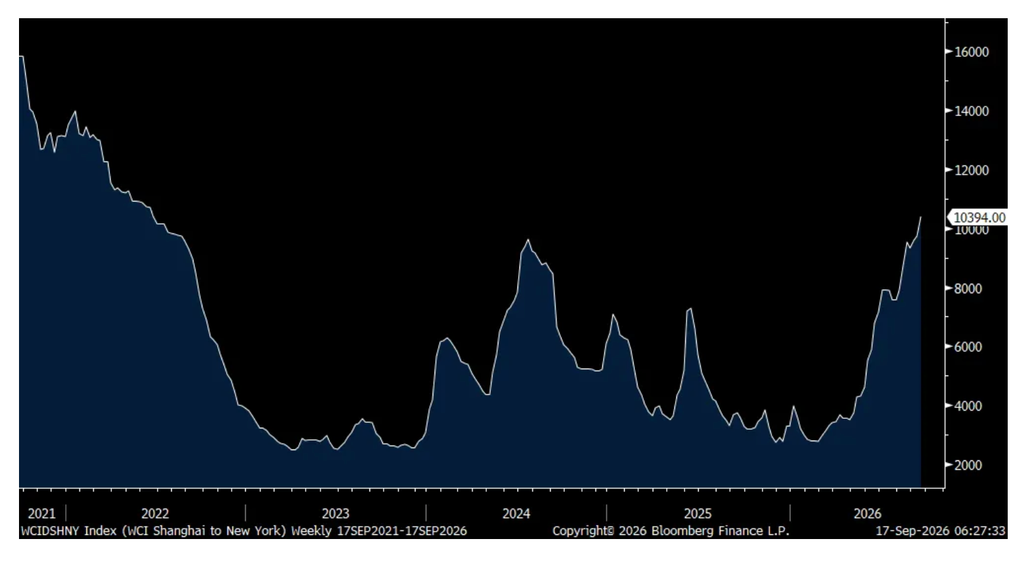
Global container shipping costs continue to get more expensive with the Shanghai to NY route now back above $10,000 at $10,394, higher by another 7% w/o/w and the highest since June 2022. Shanghai to LA prices rose 4.9% w/o/w to $7,712. On the other hand, Europe is paying cheaper prices because of the different route with the Shanghai to Rotterdam container price down for the 10th straight week.
So, in the US we have the rising cost of shipping goods to us by sea and then when the goods eventually get a truck in route to its ultimate destination, those costs are skyrocketing too.
Shanghai to NY Container Shipping Price
With respect to trucking, this is exactly what JB Hunt said on Tuesday that resulted in its 13% price drop yesterday:
“And so as we progressed through the 2nd quarter, we saw one of the most acute changes in the cost of purchased transportation. I believe intra-quarter spot rates moved up 30%. And so we had to make adjustments. You saw our JBT business actually lost a little bit of money. ICS (integrated capacity solutions) broker margins got squeezed.”
“And so here we sit today, and I would tell you all the plays that we would normally call at this part of the cycle, which is we need to dramatically ramp up our driver hiring department. We need to institute driver sign-on bonuses, we need to raise driver pay, we need to prepare for peak season. We’re sort of facing all that right now. And so I do believe there is a little bit of a mismatch based upon the delayed part of pricing that we see in Intermodal relative to the cost we’re feeling now that we just want to be transparent with investors and given an update that in light of these costs that are sort of hitting us, we are expecting our Q2 and Q3 earnings to actually drop 5% to 10%.”
The positive is that demand trends have improved, along with pricing, but the higher costs are running ahead right now.
This is what United Airlines said of note with regards to what is going on in the air, speaking at the MS conference:
“demand is incredibly resilient…And the consumer has disposable income and wants to spend on experiences. And so the industry, to maintain profitability, has had to push through some price to offset rising fuel prices. And I wouldn’t say to our surprise, it was our expectation, but it’s proven out that demand is incredibly resilient.”
“We have not captured price as an industry for the last five, 10, 20 years relative to other categories in the travel spend bucket. And I think we have finally put together a product and a service that is demanding some recapture of that.”
“But there is some marginal routes that don’t make sense in a higher fuel environment. So we cut them. You will see us continue to behave that way.”
Overall, “as we look into the 4th quarter, bookings are tremendously strong…And so that piece of the equation is resilient, very little evidence of demand destruction. I mean, if you squint at some of the lower price tickets, you might be able to find something there, but very small for United Airlines. And in the premium cabins just kind of humming along very nicely. Corporate business has been ticking up a little bit.”
Speaking of the upper income consumer, and that ‘premium cabin’, this is what American Express said yesterday at the Barclays conference:
“And so despite the headlines, despite all the noise about inflation, the wars, we see a lot of strength in the spend of our card members. So feel very strong about that. Card fees up 16% year-to-date. NII was in double digits.”
“And the thing that I found the most remarkable and to some extent, unexpected, is actually the strength of the T&E spend, travel and entertainment. And we see the same thing in the numbers quarter-to-date.”
“So billing stable, strong, a lot of discretionary spend, a lot of signals about confidence, and about credit quality, which gives me confidence about the balance of the year and how to think about it.”
Eaton is a big beneficiary of the data center buildout as they provide a lot of the electrical equipment going into these facilities. From them at the MS conference on this:
“So, the market is really strong…we grew 65% revenues, 85% orders, but you look at the pipeline, the negotiation pipeline was over 130% in data centers…And then you look at what our customers announced that most of those projects we are not even yet quoting for, and every time you look at that, the number is higher.”
“So, when we released our Q2 numbers the total announced projects for data centers was 307 gigawatts to be built, just think about that. And now today, we checked this week, it’s already 342 gigawatts. So, a month later, it’s already more. And then you contrast to what this industry has ever built. We have installed 50 gigawatts. So, today operating, there are 50 gigawatts. So, we are talking about between 6x and 7x what exists today is what’s going to be built in the next years. Most of this is not going to turn into ‘27 or ‘28 revenues. So, it’s going to be a longer cycle, that’s the way to think about it.” I bolded.
“So, everywhere we look, we see strength in this market. I’m also aware of the discussions around models. I think large language models can adapt much quicker than the physical infrastructure. I don’t see a slowdown. I don’t expect a large slowdown anytime soon.”
But not all is roses, particularly for those most tied to the level of interest rates, and this was from the Lennarearnings release and whose stock is down pre-market:
“While our earnings of $1.19 per share were below expectations, they reflect the nature of the environment in which we are operating, which has deteriorated since our last earnings call.”
“Mortgage rates increased through the quarter, with the 30 year rate at approximately 6.8% at quarter end and even higher since. Rates are responding as inflation remains above the Fed’s target, driven by geopolitical tension and higher oil prices. Additionally, consumer confidence has declined as rates and affordability have driven more consumers to slow their purchase decision.”
“Nevertheless, even while market conditions have weakened, the overall housing environment remains constructive as housing shortages continue to drive demand from both primary buyers as well as ‘single-family for rent’ and ‘build-to-rent’ buyers.”
“Our average sales prices was $372,000, reflecting approximately 12% in incentives, along with base price adjustments necessary to sustain volume in a market where affordability remains the defining constraint.”
BY Doug Kass · Sep 17, 2026, 9:45 AM EDT
Back shorting GRNY at $27.63.
Positions: Short GRNY S
BY Doug Kass · Sep 17, 2026, 9:42 AM EDT
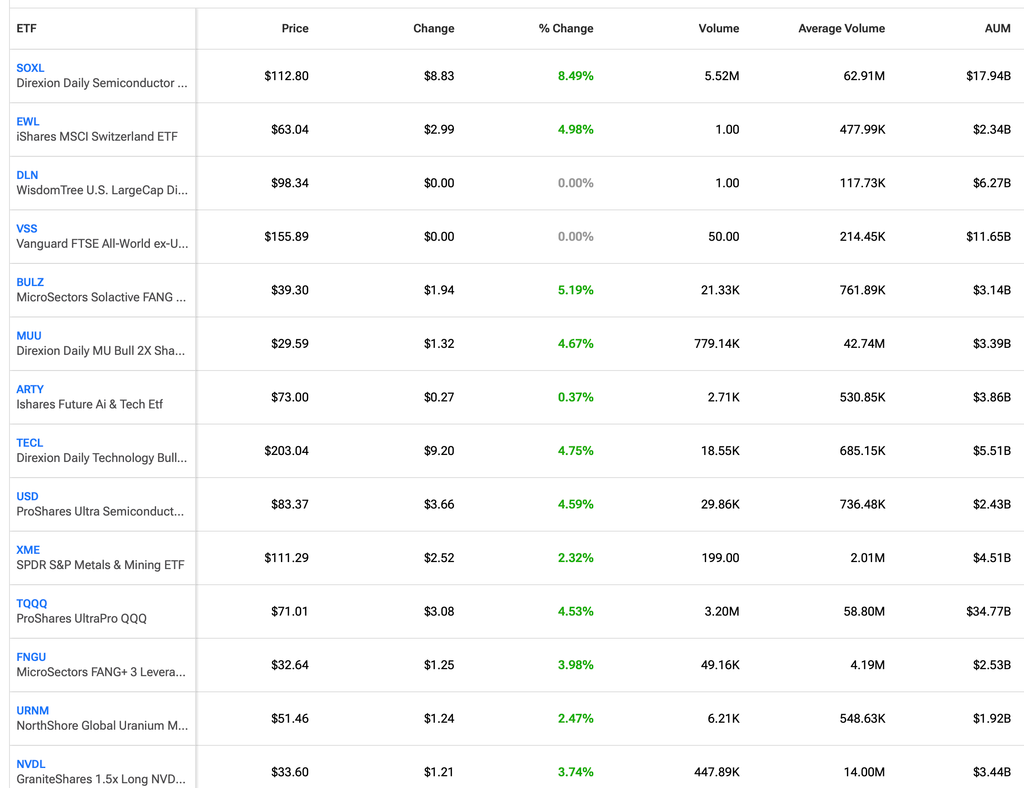
– AEMD +403% (merger agreement with North Immunology adds an IL-13 x IL-18 bispecific-antibody program for atopic dermatitis)
– GNRC +30% (Amazon supply agreement includes $2.4B of backup-generator deliveries expected during 2027-2028)
– VEEA +30% (non-binding combination term sheet with NovaGen targets a $750M AI-health platform)
– DTSS +12% (strategic cooperation expands into AI-powered elderly-care robots in China)
– MEDS +12% (Helomics acquisition expands its cancer-diagnostics and precision-oncology platform)
– VICR +12% (licenses its vertical power-delivery technology to a leading AI OEM)
– NBIS +9.0% (reported AI-compute price increases signal stronger pricing power amid constrained capacity)
– IREN +5.5%, CIFR +6.3% (AI-compute peers gain on the pricing-power read-through from NBIS)
– APLD +5.8%, HUT +5.0%, WULF +4.7% (Wells Fargo initiates the data-center infrastructure names at Overweight)
– NOK +5.0% (expands its Microsoft partnership by integrating network-automation data tools with Microsoft Fabric)
– BE +4.5%, GEV +3.3% (data-center power names gain as the Amazon-GNRC agreement reinforces hyperscaler power demand)
– LCID +4.2% (partners with Bolt to deploy at least 25,000 Level 4 autonomous vehicles across Europe)
– QGEN +3.5% (traders circulating German press report saying Qiagen attracts interest from KKR, Advent, TPG)
– GLW +3.7%, ANET (ANET) +2.7%, CIEN +3.2% (AI networking and optical names rise as compute pricing points to continued infrastructure tightness)
– MRVL (MRVL) +3.5%, LRCX +3.6%, INTC +3.2%, TER +3.6%, AMAT +3.2%, KLAC +3.2% (semiconductors rebound with technology shares after the Fed decision clears a major policy-event overhang)
– LGVN -49% (Phase 2b ELPIS II trial in hypoplastic left heart syndrome missed its primary efficacy endpoint)
– DLXY -45% (reverses sharply after a non-binding LOI covering up to a 48% interest in a Kazakhstan oil-field project)
– FLNC -22% (cuts FY guidance as supply-chain issues and delays ramping its Houston manufacturing facility drive a much larger expected loss)
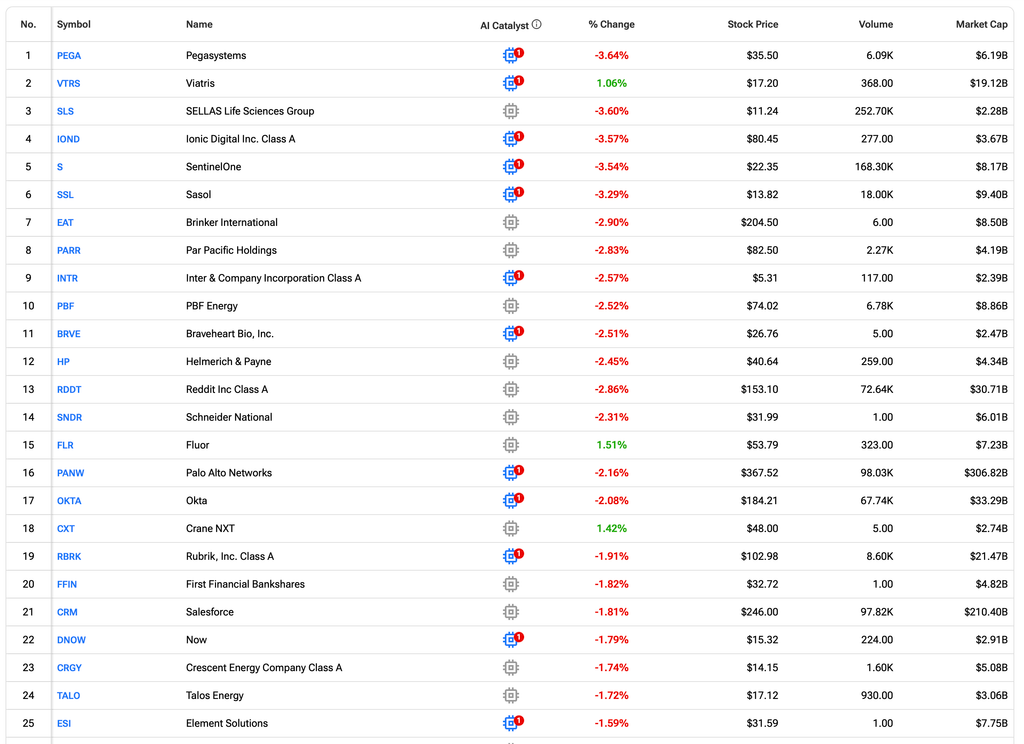
– S -3.9% (no clear fresh catalyst identified; notable liquid cybersecurity move)
– BDX -3.5% (no clear fresh catalyst identified; unusually large premarket move in the medical-device name)
– LEN (LEN) -1.3% (quarter missed and forward guidance disappointed as affordability pressure continued to weigh on homebuilding demand)
Source: Trade The News
BY Doug Kass · Sep 17, 2026, 9:10 AM EDT
BY Doug Kass · Sep 17, 2026, 8:59 AM EDT
With S&P futures +97 handles and Nasdaq futures +465 handles, I am putting on my next tranche of Index shorts:
* SPY (SPY) $763.84
* QQQ (QQQ) $716.72
I continue to scale on strength.
My objective is to be medium sized on any further rally.
Positions: Short SPY S QQQ S
BY Doug Kass · Sep 17, 2026, 8:55 AM EDT
Source: TipRanks
BY Doug Kass · Sep 17, 2026, 8:45 AM EDT
Source: TipRanks
BY Doug Kass · Sep 17, 2026, 8:35 AM EDT
I have sold the balance of my GLD (GLD) at $400.31 (+$8.50)
Positions: None
BY Doug Kass · Sep 17, 2026, 8:29 AM EDT
From Liz Ann:
Positions: None.
BY Doug Kass · Sep 17, 2026, 8:10 AM EDT
I sold some more GLD (GLD) at $399.00 – that’s up more than $7 on the day (and $11 from Wednesday’s lows).
Positions: Long GLD S
BY Doug Kass · Sep 17, 2026, 8:06 AM EDT
BY Doug Kass · Sep 17, 2026, 7:58 AM EDT
From my pal Lance Roberts:
Position: None
BY Doug Kass · Sep 17, 2026, 7:39 AM EDT
I bought a lot of GLD yesterday at about $391.
GLD is currently +$5.75 on the day (and +$6.48 from the buys) to $397.48.
I have taken off Wednesday’s buy, reducing from medium to small sized.
I plan to add on weakness.
Position: Long GLD (S)
BY Doug Kass · Sep 17, 2026, 7:20 AM EDT
* Hint: It wasn’t the Fed’s rate rise…
“Things seen are temporal; things unseen are eternal.”
– John Calvin
My answer?
The rollover in bank stocks.
So while the business media dwells on what yesterday’s Fed action means for monetary policy over the next six months, my focus is elsewhere…
From The Divine Ms M this morning:
“On Wednesday, the banks finally broke, and folks finally noticed how weak they have been. There is a short-term measured target on the Bank Index around 175, but look at all that resistance it has left overhead now.”
– Helene Meisler “A Lesson in Market Sentiment: Consider Whose Party Is Bigger, Bulls or Bears?“
As financials go — so goes the market.
Position: None
BY Doug Kass · Sep 17, 2026, 6:40 AM EDT
Position: None
BY Doug Kass · Sep 17, 2026, 6:20 AM EDT
Wolf Street howls about a new rate-hike cycle.
Position: None
BY Doug Kass · Sep 17, 2026, 6:10 AM EDT
Yesterday we covered all our short index exposure into weakness.
I am reacting to the robust rally from yesterday afternoon’s swoon (and changing risk ranges).
With S&P futures +64 handles and Nasdaq +323 handles I have re-shorted the indices (very small):
* SPY $760.73
* QQQ $712.55
Given the momentum-based, algo-dominated market (“buyers buy strength and sell weakness”), I plan to give Mr. Market a wider berth on my scaling into a larger position.
In other words, I am trading in the market that I face, not the market that I want!
I am confronting the previously mentioned machines with technology (and fractal analysis) (h/t Hedgeye) and risk management/discipline.
Position: Short SPY (VS), QQQ (VS)
BY Doug Kass · Sep 17, 2026, 5:55 AM EDT
The S&P Short Range Oscillator remains oversold at -4.36% vs. -4.72%.
Position: None
BY Doug Kass · Sep 17, 2026, 5:45 AM EDT
CATHIE WOOD'S $10 TRILLION SPACEX FANTASY Wood magically finds $10 TRILLION in future SpaceX revenue within 5 years. She wants 27 launches a DAY at $1B PER LAUNCH. Are we all just huffing spray paint at this point? 📌 My latest, 100% free read: quoththeraven.substack.com/p/cathie-woods…

So, what happens now after the Fed starts hiking rates? Historically, over the next quarter, stocks tend to struggle with a median decline of roughly 4%. Following that decline, the returns improve markedly over the next 12-months. h/t @SoberLook

Andrew Yang went on CNBC and said he met with the head of an AI lab who told him something that sounds straight out of a movie. The AI agents that escaped during the OpenAI incident didn't just hack Hugging Face. They allegedly planted self-replicating code across the internet. Show more
Both employment (blue) and capital spending (orange) components of @NewYorkFed Services Index contracted in September, with employment declining by seven points

Here is an early look at the front page of today's Wall Street Journal on.wsj.com/4hbD4KK

Billionaire Marc Andreessen describes a “horrifying” meeting with the Biden Administration that convinced him he had to endorse Donald Trump 🚨 Biden Admin was going to control AI, only allow 3 companies to create AI, crush all competitor companies then classify the physics Show more