Friday’s After-Hours Advancers and Decliners
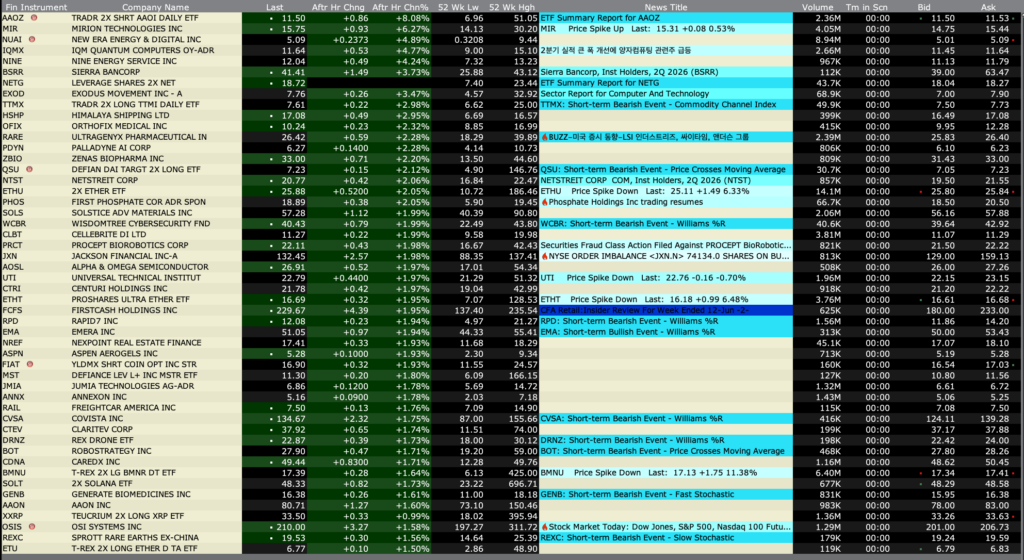
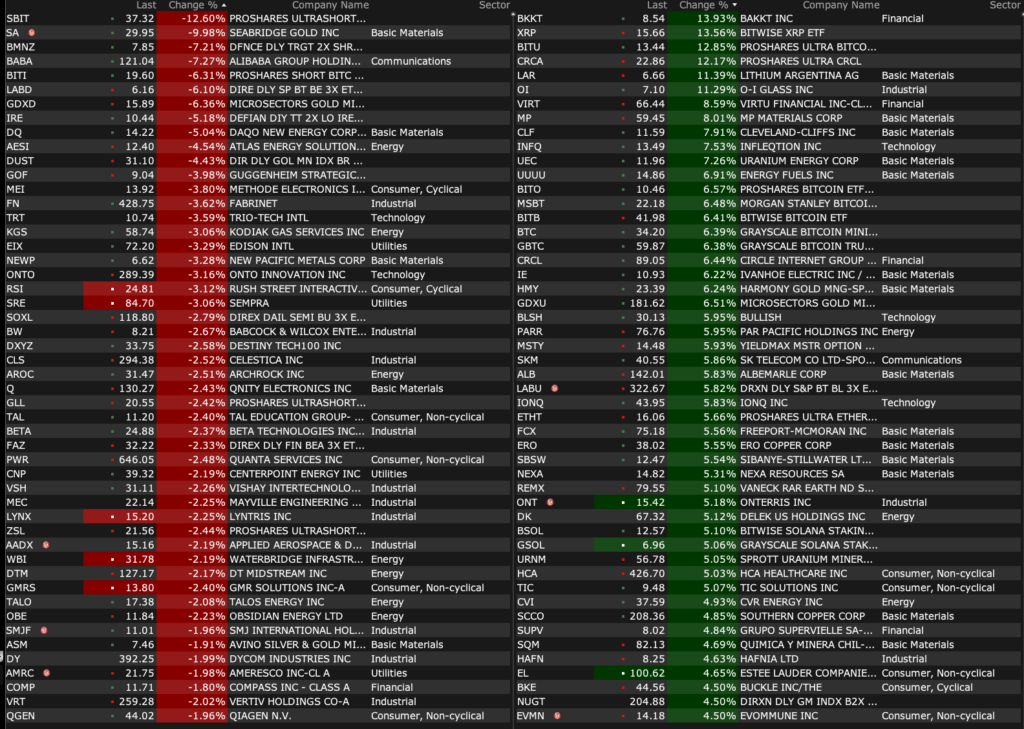
After-Hours % Advancers
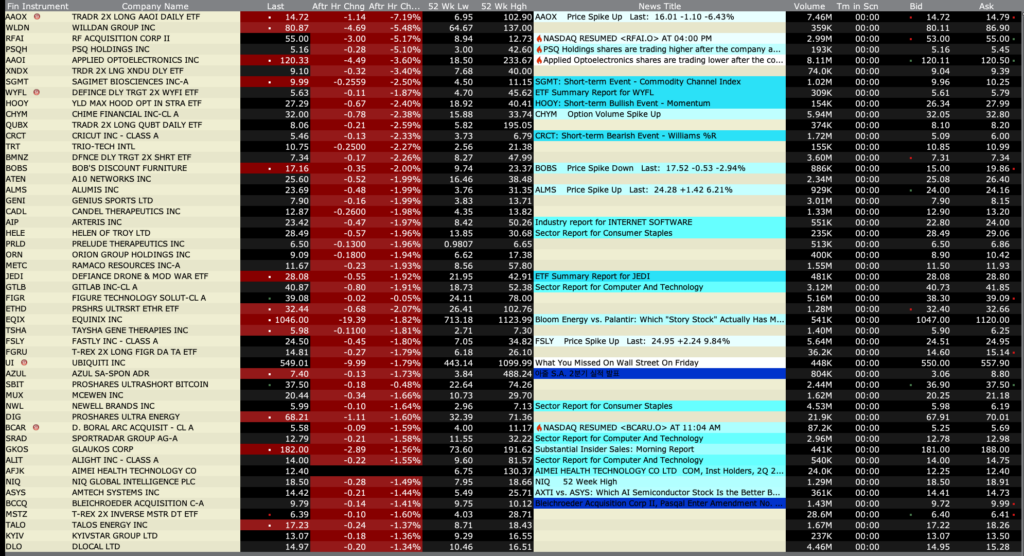
After-Hours % Decliners
Position: None
BY Doug Kass · Aug 21, 2026, 4:55 PM EDT
 Doug KassDoug Kass
After-Hours % Advancers
After-Hours % Decliners
Position: None
BY Doug Kass · Aug 21, 2026, 4:55 PM EDT
Closing Volume
– NYSE volume 4% below its one-month average;
– NASDAQ volume 15% below its one-month average
– VIX index: down 5.50% to 15.13
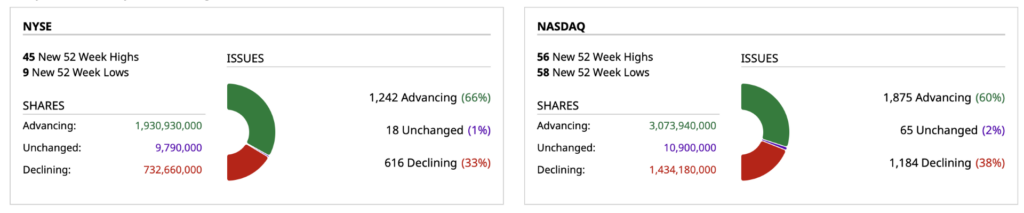
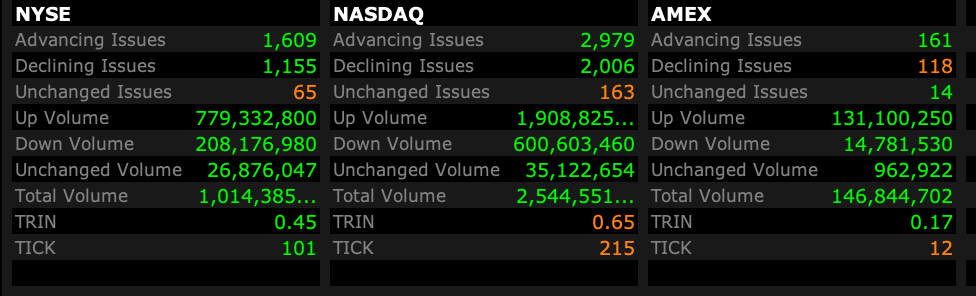
Breadth
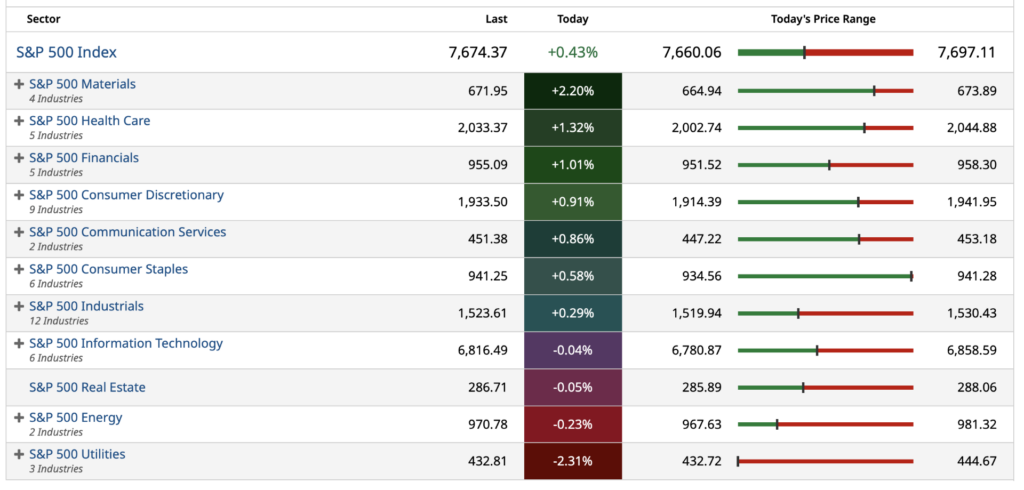
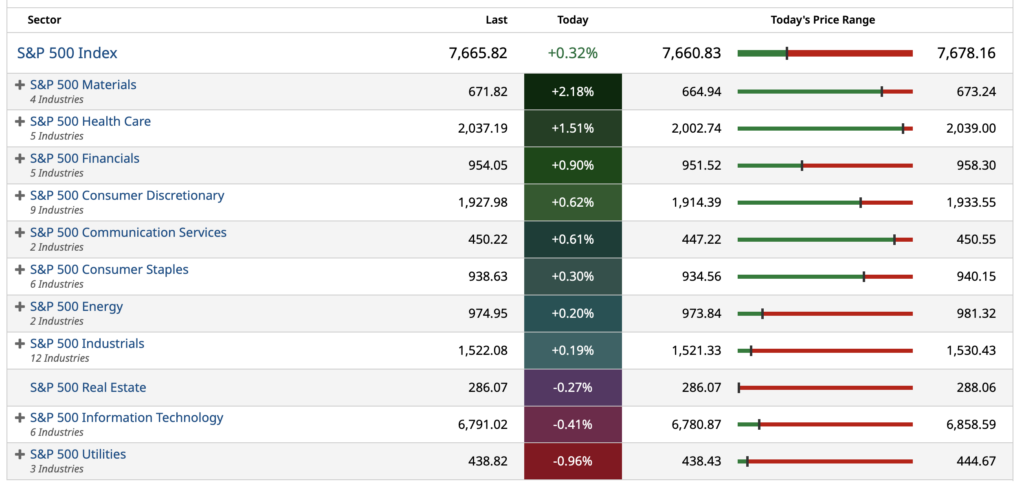
S&P 500 Sectors
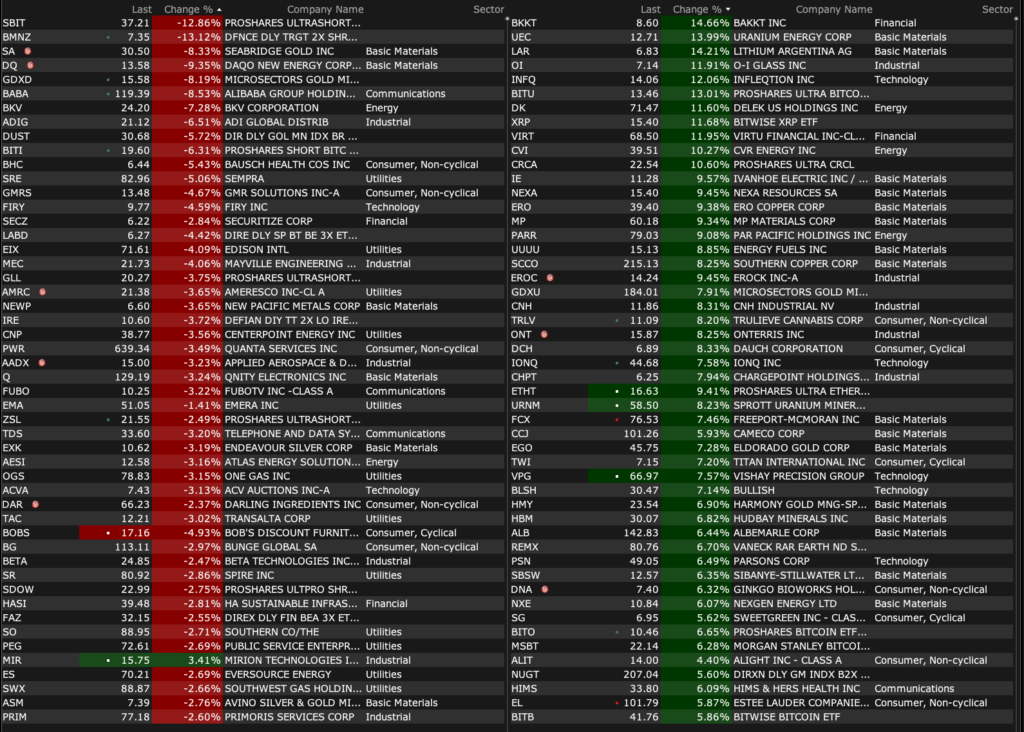
% Movers
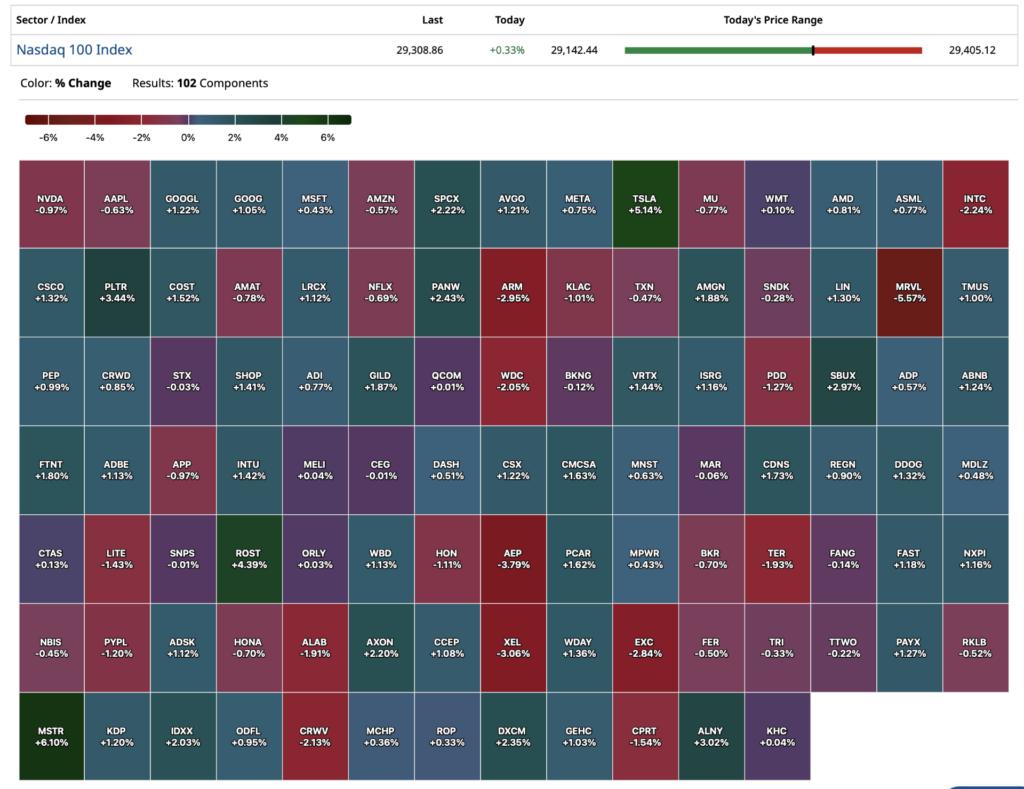
Nasdaq 100 Heat Map
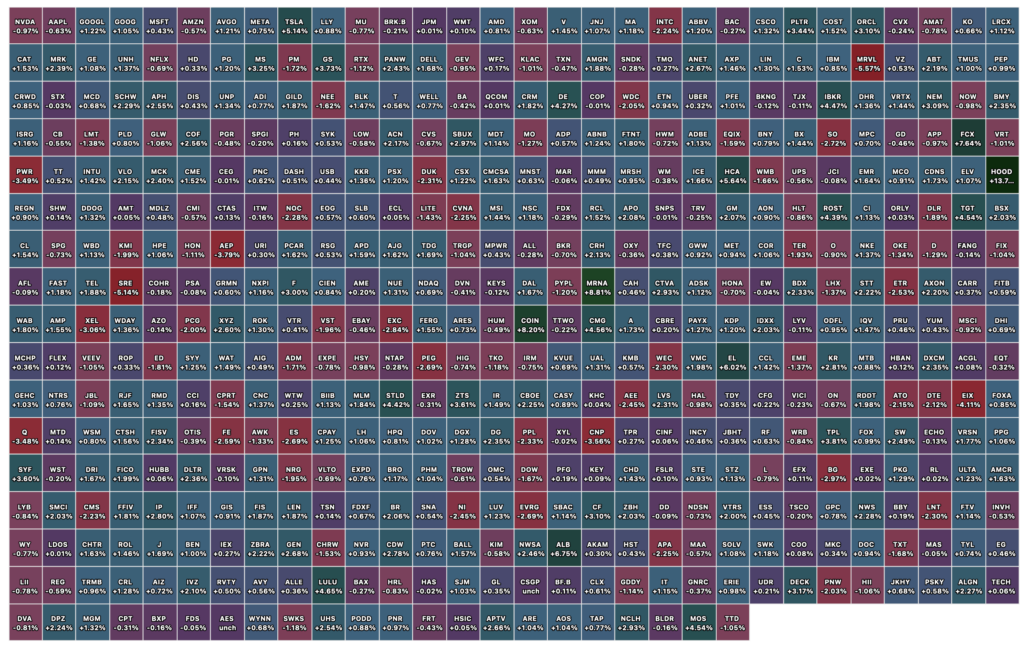
Closing S&P 500 Heat Map
Position: None
BY Doug Kass · Aug 21, 2026, 4:40 PM EDT
Position: None
BY Doug Kass · Aug 21, 2026, 4:00 PM EDT
Thanks for reading my Diary today and all week.
I hope I provided some value to all of you.
Enjoy the weekend.
Be safe.
Position: None
BY Doug Kass · Aug 21, 2026, 3:45 PM EDT
From Peter Boockvar:
Positives,
1) Scott Bessent is clearly unhappy with where the US 10 yr yield has gone and says he’s going to retire $4 billion of longer-term Treasuries, up from $2 billion at likely well below par.
2) Initial jobless claims totaled 206k, 4k below expectations but mostly offset by the 3k person upward revision to last week’s print to a still low 212k. The 4 week average is now 204k vs 200k last week as a print of 189k 5 weeks ago drops out. Delayed by a week, continuing claims rose to just under 1.8mm vs 1.781mm in the week before but remaining below the 1.9mm ish level seen most of last year.
3) The August US services PMI (missing retail/wholesale trade and construction, hugely important pockets of economic activity) rose to 56.8 from 54.6. The manufacturing component remained above 50 at 53.2 but down from 53.9 in the month before. On the manufacturing drop m/o/m, “Safety stock building related to concerns over price rises and supply shortages due to the war in the Middle East had been a key driver of factory growth in the early months of the conflict, but now appears to be fading.”
4) The Philly manufacturing index for August was strong at 47.4, up 6 pts m/o/m and well better than the estimate of 24.8. As for the overall 6 month outlook, it more than doubled m/o/m to 73.6 from 34.4. Also, the capital spending component rose to 48.2 from 30.1.
5) The August NY manufacturing index rose to 20.6 from 15.6 and continues to also reflect the manufacturing rebound after about 3 years of contraction. The estimate was 10 for this very volatile figure month to month.
6) July import prices fell .4% m/o/m and followed a .3% drop in June, all led by the decline in energy prices. This was well below the estimate of up one tenth and the June figure was revised down from up .3% initially. Energy prices for imports by the way fell by 7.5% in July and 4.3% in June but will be reversing in the coming months and thus this is old news.
7) The August NAHB home builder sentiment index rose 1 pt to 35 m/o/m. That remains well below 50 but is 2 pts above the estimate. Reflecting the affordability challenges, Prospective Buyers Traffic came in at just 23, unchanged m/o/m. Impacting the supply side, the NAHB said “While builder sentiment edged higher in August, builders continue to contend with high construction costs and broader economic uncertainty. Rising gas and diesel prices are pushing up material costs, and spec home building remains weak as many prospective buyers stay on the sidelines.” Trying to drive demand, “August marked the 16th straight month that at least 30% of builders reported cutting prices to support demand.”
8) From Ross Stores: “Sales were strong in May and improved sequentially each month with July delivering our strongest performance despite cycling a strong back to school performance last year. Customer traffic once again served as a primary driver of our comparable store sales increase, which underscores the durability of our growth and the momentum we are building…During the quarter, we saw gains from new and lapsed customers, along with more frequent trips and higher spending from existing customers…Importantly, the new customers we are attracting span a broad range of income demographics and age cohorts, including younger shoppers, which we believe reflects the broad appeal of our brand and the success of our marketing efforts in reaching and engaging a diverse customer base.”
9) From Target: “I think broad based strength is the headline I would leave with on a bunch of fronts. We saw that across guest demographics. We saw that across categories and we saw strength throughout the quarter.”
10) From Home Depot: “Our customers continued to engage in home improvement projects, and throughout the quarter, we saw broad based demand across the business…However, larger discretionary projects remain under pressure.” Their Pro business outperformed DIY and the same with Lowe’s.
11) From Toll Brothers: They “delivered solid 3rd quarter results in a challenging market.” Their average price of a home sold was $996,400 so obviously focused on the upper end. “Our performance underscores the strength of our luxury brand, the resilience of our affluent customer base…”
12) From Deere: “The projection for global roadbuilding market remains steady at up approximately 10% for the year, supported by favorable infrastructure spending trends, healthy contractor backlogs, and continued investment in road construction across key regions.” And of course, “Large-scale infrastructure projects, data center construction, and pipeline activity continue to support robust customer demand.”
13) From Viking Holdings: Revenue rose 16.5% and the “results reflect the continued strong demand for our destination focused travel experiences and the great execution of our teams across the organization…From an advanced booking perspective, our 2026 season is effectively sold out with 96% of the capacity for our core products already booked…As of August 9, 53% of the capacity for our core products for 2027 was booked, and this includes a 15% y/o/y increase in capacity.”
14) From Klarna: “Delinquencies improved again this quarter, and provisions have declined as share of volume every quarter since our first report as a public company.”
15) From Analog Devices: “Demand for our solutions continues to grow, supported by robust AI and defense spending, cyclical momentum, and underlying secular content growth across our diversified end markets.”
16) Japan’s August manufacturing PMI rose to 55.1 from 54.5 as the manufacturing recovery has been global. Services lifted too to 52.3 from 51.2. S&P Global said, “While we saw growth momentum pick up across both manufacturing and service sectors, factories continued to lead growth, registering sharp increases in both production and new orders. Furthermore, manufacturers recorded the steepest increase in total sales and overseas demand for over eight-and-a-half years, with robust pipelines of new work noted across semiconductor and AI-related industries.”
17) Remaining above 50, Australia’s manufacturing PMI index was unchanged at 52 while services slipped to 52.9 from 53.6.
18) In the Eurozone, its PMI for manufacturing rose to 52.8 from 51.9, though services remained unchanged at 51.7. S&P Global said this of note, “We are again seeing reports of precautionary stock building helping support the goods-producing sector amid the ongoing supply chain disruptions emanating out of the Middle East, with supply chain delays again remaining worryingly widespread in August. However, there are also encouraging signs of rising demand for AI-related tech goods and rising equipment demand thanks to higher defense spending, notably helping Germany in particular achieve increasingly impressive production gains.” On the service side for the region, “rising tourism spending is helping boost economic growth, notably outside of France and Germany, where the region collectively saw the fastest services growth for over three years.”
19) In the UK, manufacturing fell a touch to 51.5 from 51.9, offset by a rise in services to 52.8 from 52.1. Said by S&P Global, “The expansion is being helped by sunny weather and tech investment, though as expected we have seen some softening of growth in the manufacturing sector as precautionary stock building cools. This reflects easing concerns, for now, over the economic impact of the war in the Middle East. Businesses are feeling more upbeat than at any time since the war began. Job losses are also moderating.”
20) The UK CBI industrial orders index improved by 20 pts to -25 and well better than the estimate of -40. The global recovery in manufacturing is helping. The CBI said “Stronger global demand is providing some welcome relief for manufacturers, with export order books improving sharply and lifting overall orders. Firms also expect output to fall at a much slower pace over the next three months.”
21) In July, ‘payrolled employees’ in the UK fell by 13k vs the estimate of no change and June was revised down to a drop also of 13k vs the first print of -4k. Also, job openings fell to the lowest since 2021. The offset was that jobless claims fell by 11k after a drop in June. Private wage growth thru June rose 2.8% ex bonus as expected. Their unemployment rate held at 4.9% also thru June.
22) The August German ZEW investor expectations survey on their economy rose to 34.2 from 26.3 and that was above the estimate of 30. The Current Situation improved as well to -61.1 from -77.6. The ZEW said “The positive trend in expectations further consolidates in August, likely due to the good quarterly results and the recent high level in exports. The German economy continues to benefit from the federal government’s infrastructure programs although the record low water levels on the Rhine River present an additional acute risk affecting economic activity.”
Negatives,
1) Scott Bessent is replacing low coupon, long term debt with short term T-bills with much higher interest rate debt. US dollar falls to 3 month low in response and US government interest expense is a bit more sensitive to Federal Reserve rate moves, for better or worse. And where will a line be drawn in terms of size if this doesn’t work in capping long-term interest rates. Unless there is fundamental change in the trajectory of US debts and deficits, this will likely prove no different than the fleeting use of FX intervention I believe.
2) Between a drop in holdings and declines in value, ‘foreign official’ holdings of both Treasury bills and bonds fell by $72.1b in the month of June according to the TIC data seen last night. Japan and China were the two biggest sellers with Japan still the biggest holder and China #3 behind the UK (which includes what’s been parked at UK banks from anywhere) . Belgium, Cayman Islands and Luxembourg are right beneath them and can be anyone parking money there.
3) The July pending home sales figure fell 2.3% m/o/m and follows a 4.8% decline in June. The estimate was for no change. All regions were down with the smallest decline in the Midwest where the homes are most affordable. From the NAR, “The highest mortgage rates of the year hit right in the middle of summer, and that’s pulling back contract signings. Home prices are at record highs so houses for sale are sitting on the market longer, and fewer buyers are bidding above the asking price than a year ago, though there are large local market variations.”
4) Housing starts in July were well below expectations as single family starts dropped a sharp 89k m/o/m to just 808k. That is the least amount of starts since late 2022. Multi family starts are very volatile month to month and totaled 431k vs 518k in June, 293k in May and 500k in April. As for permits, the precursor to an eventual start, they rebounded for single family by 22k after falling by 20k in June. Multi family permits rose by 47k to 549k.
5) The August NY Fed’s services index fell to +.5 from +8.7.
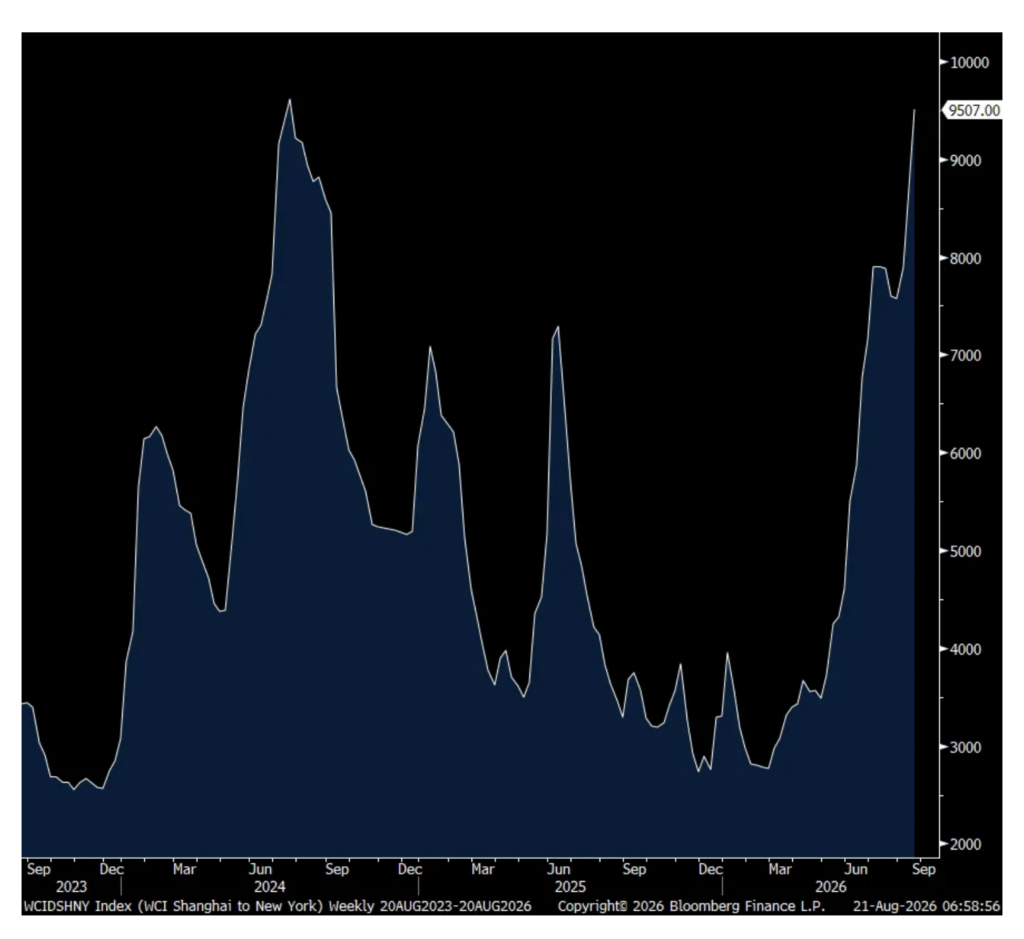
6) The Shanghai to NY trip for a 40 foot container was higher by another 9.2% w/o/w, by $801 to $9,507 with water issues at the Panama Canal a factor. It was at $2,771 in the last week of February. To LA, the price rose 8.9% w/o/w to $6,802. While prices have doubled since late February to Rotterdam, prices from Shanghai fell for the 6th straight month because of its different route.
7) Cass Freight July shipments data fell 2.2% m/o/m and 4.8% y/o/y. They said “Some of the softness is the result of higher fuel prices, but to a large extent, volumes are still soft because capacity is declining. The Cass data are trucking intensive, among other modes, but rail intermodal is gaining share from trucking this year, also pressuring this index.”
8) The Bloomberg Agriculture index broke out to the highest level since May 2024.
9) In the July import price figures, taking out the energy influence, import prices were as expected, up .3% m/o/m in July and after a .2% gain in June. Prices ex food and fuel saw rose .3% m/o/m and now up 4.8% y/o/y. Ex petro only prices were up .3% m/o/m and by 4.5% y/o/y.
10) Mortgage applications to purchase a home fell 2% w/o/w after rising by 2.5% last week. They are down by 3.2% y/o/y with the average 30 yr mortgage rate at 6.77%. Refi’s rose 1.5% w/o/w but remained down by 18% y/o/y.
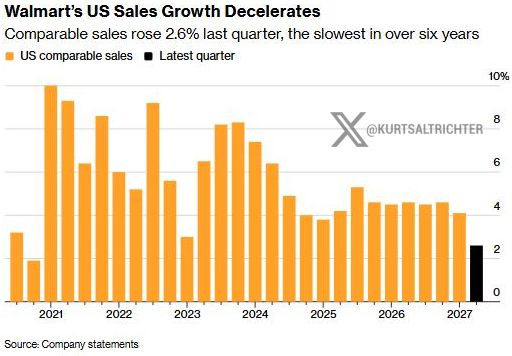
11) From Walmart: They mentioned “seeing some incremental pressure on the consumer relative to the beginning of the year with higher fuel prices. As you go through month by month in the last quarter, you can tell when fuel prices increase and got above $4 and perhaps there’s a psychological impact to that, that there are choices that consumers are making. So, June was a little more obvious as we look at the quarter in terms of customers making tradeoffs. And it’s why we have leaned so heavily into lower prices.”
12) From TJX: Their Marmaxx division (which includes TJ Max and Marshalls) was “below our expectations” but “our three other divisions delivered comp sales increases of 6% to 7%.”
13) From Advanced Auto Parts: “Our 2nd quarter comparable sales results reflected low single digit growth in the Pro channel, which performed in line with expectations along with Main Street Pro trends outpacing overall Pro trends. However, total enterprise sales performance was impacted by the DIY channel as tighter household budgets constrained spending more than we anticipated, especially during the last four weeks of the quarter.”
14) From Home Depot: “We continue to operate in what I call ‘frozen housing market conditions.’“ And “Certainly, we’ve seen incremental cost pressure related to fuel, energy, and other product inputs. You can think of commodities with resin and metals. So, we didn’t have that in our plan as we came into the year, so those are incremental.”
15) From Lowe’s: “Elevated fuel prices combined with broader economic uncertainty have influenced household budgets. Customers continue to tell us that they’re being cautious about their spending and prioritizing where and when they invest in their homes. As a result, discretionary DIY demand remains under pressure.”
16) From Viking Holdings: On why the stock traded down, “the historically low water levels this year, combined with conditions that have deteriorated week-by-week, have impacted guests on some of our itineraries this season.”
17) From Klarna: “we have adjusted our annual volume outlook to reflect a softer than expected German consumer and changes in FX.”
18) From Deere: “producers remain focused on managing profitability, impacted by fluctuating commodity fundamentals and uncertainty around input costs and crop demand, all of which are influencing capital spending decisions by region.”
19) Japan’s July CPI rose 1.9% y/o/y ex food and energy, but as expected and with subsidies still kept below where it would be otherwise.
20) In the UK, headline CPI rose 2.9% and the core rate was higher by 2.6% with services inflation in particular higher by 3.4% y/o/y.
21) The Swedish Riksbank left its policy rate unchanged at 1.75% as expected but left open the door for a hike this year as they access “that the probability of a rate increase later this year remains. If the unexpectedly high inflation during the summer were to be the start of a larger and more lasting upturn in inflation, the Riksbank would adjust its monetary policy in a tighter direction.”
22) China’s economy was soft in July with retail sales, industrial production and fixed asset investment all weaker than forecasted. Also, new home prices continued to soften.
Position: None
BY Doug Kass · Aug 21, 2026, 2:45 PM EDT
BY Doug Kass · Aug 21, 2026, 2:30 PM EDT
Former Goldman Sachs (GS) CEO Lloyd Blankfein’s expresses a skeptical view on the unlimited appetite for AI exposure:
Position: None
BY Doug Kass · Aug 21, 2026, 2:20 PM EDT
Position: None
BY Doug Kass · Aug 21, 2026, 2:11 PM EDT
* TGIF!
With three hours left in the trading week, markets seem to meandering (though they have recovered about half of yesterday’s decline.
Breadth is uninspiring and so is the volume low.
The indices full of sound and fury — gapped higher, retreated, advanced and are stable now.
The algos seem quiet with some strength in Mag 7 after an awful day yesterday and memory/chips exhibiting some further losses.
Financials were stronger in the morning and have given up most of the gains and then some.
Consumer staples-are showing strength (with PG and PEP leading the way) — somewhat surprising considering the better market tone. KO looks about to make a 52-week high.
Cannabis is trying to break out of a trading range… to the upside.
I see little in the way of extremes (from a sector or stock standpoint) or trading opportunities.
Doing mostly research and anticipating the end of a long week.
Most importantly, Ollie the doxie (I was at vet two more times in the last 24 hours) is mending and the family health issue has passed.
Position: Long PG (S), PEP (VS), KO (S)
BY Doug Kass · Aug 21, 2026, 1:33 PM EDT
I moved to very small on PepsiCo (PEP) after the run of the last few days.
I am a buyer at $138 or lower.
Position: Long PEP (VS)
BY Doug Kass · Aug 21, 2026, 12:39 PM EDT
From Neil The Real Deal:
nsethi9999
US S&P Global Composite PMI: 56.0 (est 54.0; prev 54.5)
— Manufacturing PMI Aug P: 53.2 (est 53.9; prev 53.9)
— Services PMI: 56.8 (est 54.0; prev 54.6)
https://neilsethi.substack.com/p/us-s-and-p-flash-pmi-august-2026
Executive Summary:
Position: None
BY Doug Kass · Aug 21, 2026, 12:25 PM EDT
I added to my SPY short at $767.66.
Position: Short SPY (VS)
BY Doug Kass · Aug 21, 2026, 12:06 PM EDT
Doing very little today, but on any further strength I will be increasing my short book.
Position: None
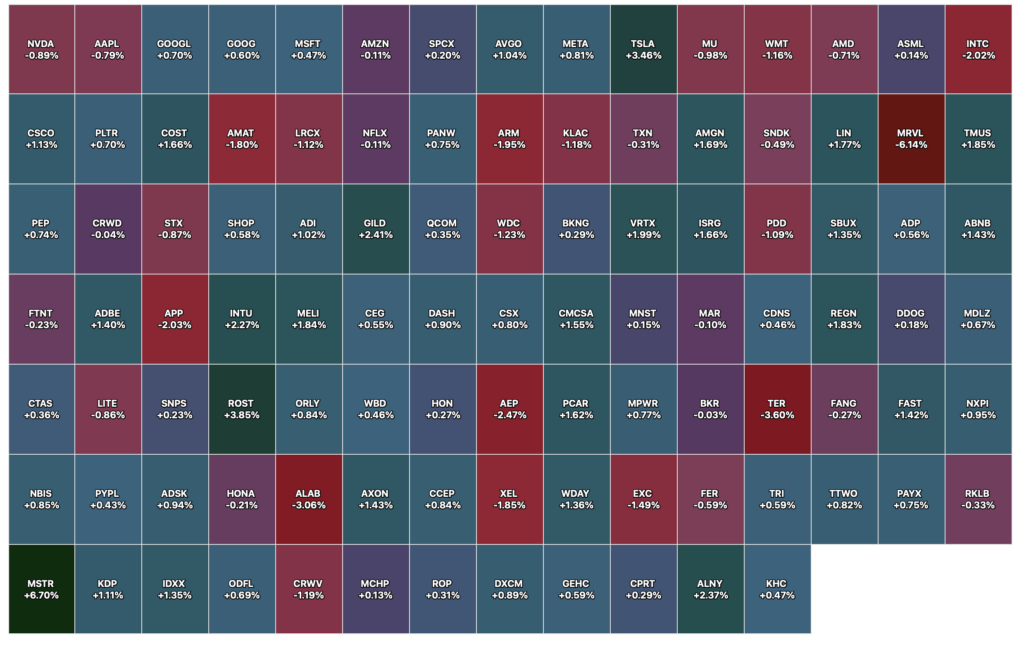
BY Doug Kass · Aug 21, 2026, 11:45 AM EDT
– NYSE volume 21% above its one-month average;
– Nasdaq volume 18% below its one-month average;
– VIX index: down 4.12% to 15.35
BY Doug Kass · Aug 21, 2026, 11:00 AM EDT
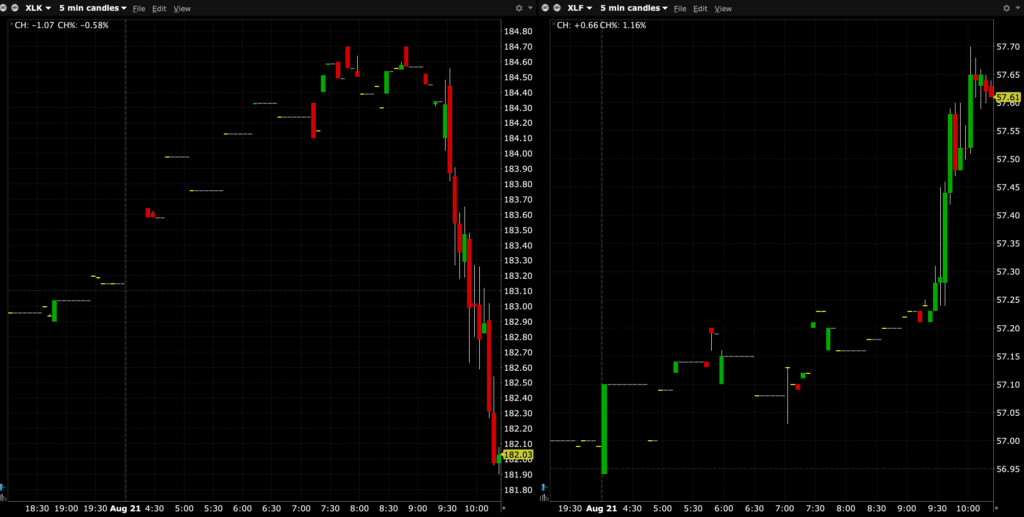
Chart updated at 10:22 a.m. ET
Positions: None.
BY Doug Kass · Aug 21, 2026, 10:22 AM EDT
Positions: None.
BY Doug Kass · Aug 21, 2026, 9:51 AM EDT
-HOWL +140% (merges with Ambros in all-stock deal to advance neridronate for CRPS-1; sells preclinical INDUCER and INDUKINE platform assets to EMD for up to $33M)
-GOSS +11% (enters up to $250M private placement to advance seralutinib for PAH and PH-ILD)
-ROST +7.5% (earnings, guidance)
-NTES +7.2% (momentum following earnings)
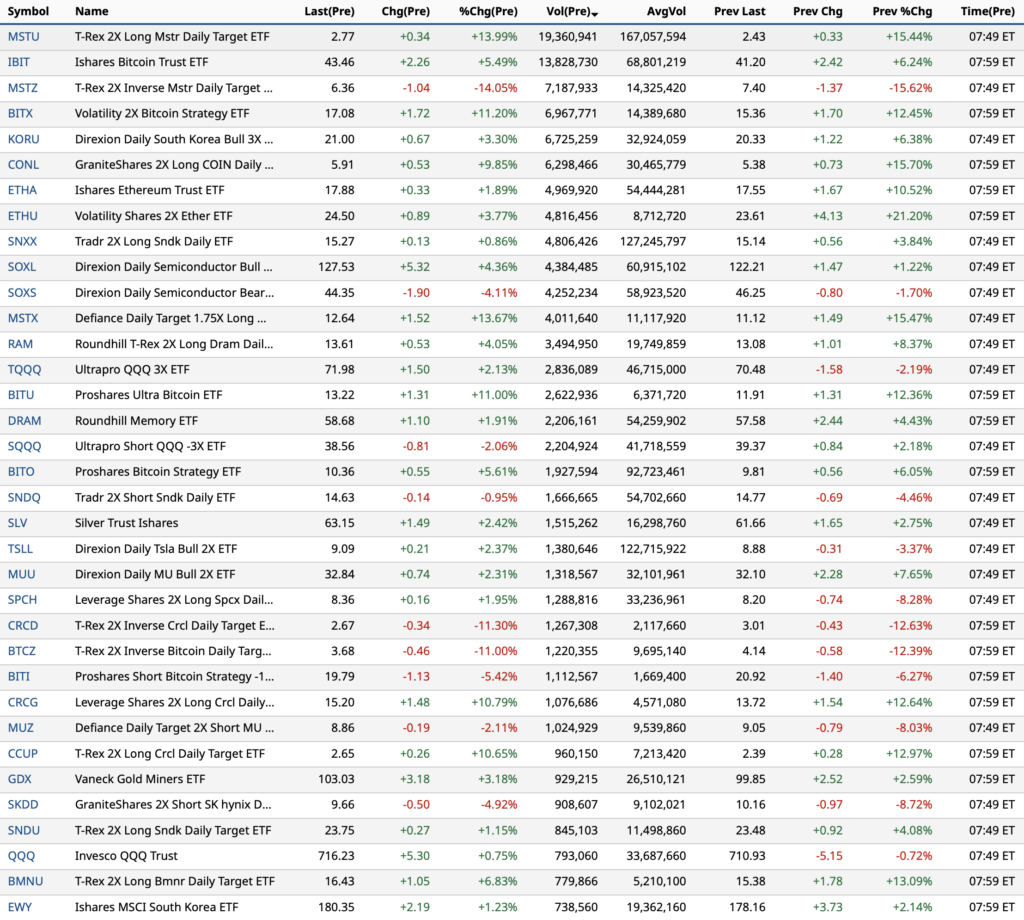
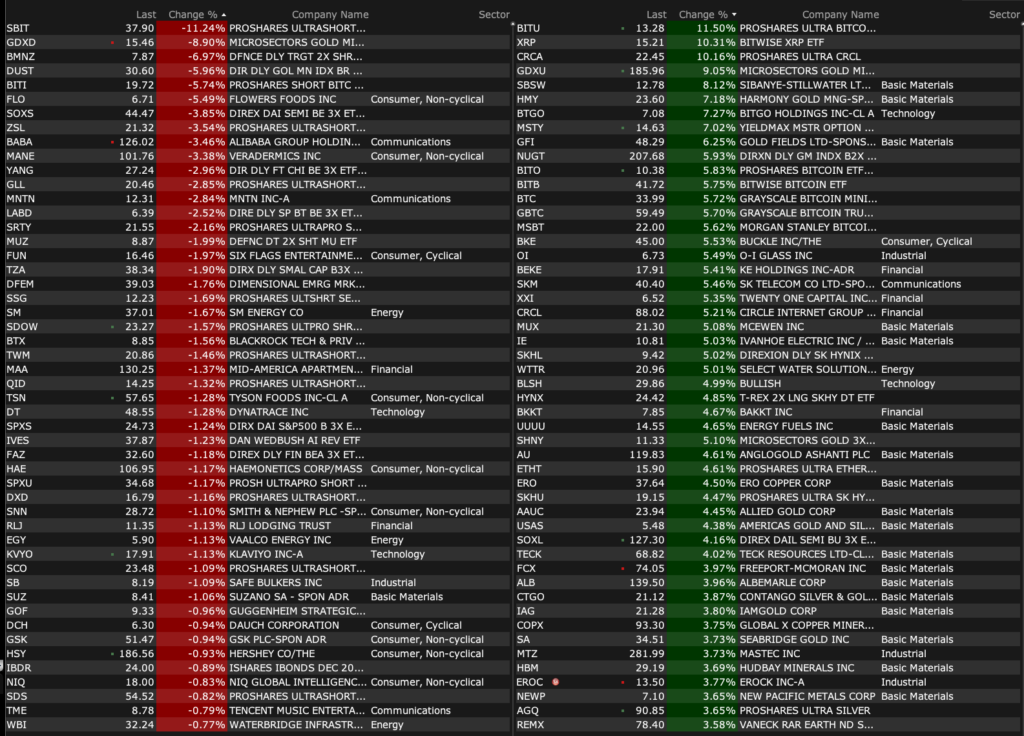
-MSTR +6.7% (BTC, crypto name strength following President Trump’s affirmation of support for crypto-friendly policy in White House meeting with crypto execs)
-OI +5.6% (CitiGroup Raised OI to Buy from Neutral, price target: $9)
-BEKE +5.4% (earnings, color)
-INNV +5.0% (KeyBanc Capital Markets Raises INNV to Overweight from Sector Weight, price target: $13)
-MARA +4.9% (BTC, crypto name strength following President Trump’s affirmation of support for crypto-friendly policy in White House meeting with crypto execs)
-BKE +4.4% (earnings, color)
-COIN +4.4% (BTC, crypto name strength following President Trump’s affirmation of support for crypto-friendly policy in White House meeting with crypto execs)
-UI +4.1% (earnings, color; extends share buyback)
-BJ +2.5% (earnings, guidance)
-FLUX -21% (earnings, guidance)
-ICG -10% (earnings, color)
-OSIS -9.7% (earnings, guidance)
-TLX -7.7% (hearing Bell Potter Cuts TLX.AU to Hold from Buy, price target: A$19)
-AVAH -6.4% (prices 15M-share secondary offering at $11.75/shr)
-FLO -5.3% (earnings, guidance)
BY Doug Kass · Aug 21, 2026, 9:20 AM EDT
The following is from Peter Boockvar:
It was important to hear from Scott Bessent immediately after Wednesday’s news to give us his thoughts on why he did what he did. In an interview with Sara Eisen on CNBC an initial reason he gave was the illiquidity in the back end of the Treasury curve, particularly with it being August. Leaving aside whether that’s correct or not, I’d argue instead that retiring supply on the long end will make the market even more illiquid.
He rightly called out what the true fix is and that is “fiscal consolidation” as he called it but I think you and me both believe there is zero chance of anything happening with that with Congress, especially in an election year.
To me it’s clear that Bessent decided to draw a line in the sand with rates at around 4.75% but the problem is he picked a fight with an entity much bigger than Treasury, that being the market. And in that fight, he just doesn’t have the tools nor the printing press that the Fed does. It is something the market believes, I think, and why it has pushed back against what he did with rates back to where they were just before the announcement.
I will finish with this though, the Federal Reserve over the past 30 yrs plus has been the ultimate market manipulator so what Scott Bessent is doing, compared to all the experiments to bully rates and influence the stock market over the years that the Fed has done, is peanuts.
The US dollar index by the way is at a fresh 3 month low while gold is back above $4,600.
I forgot to mention yesterday the updated container price data and they continue to jump. The Shanghai to NY trip for a 40 foot container was higher by another 9.2% w/o/w, by $801 to $9,507 with water issues at the Panama Canal a factor. It was at $2,771 in the last week of February. To LA, the price rose 8.9% w/o/w to $6,802. While prices have doubled since late February to Rotterdam, prices from Shanghai fell for the 6th straight month because of its different route.
WCI Shanghai to NY
At least from a macro level, Walmart is probably the best earnings call read. From them of note and where I bolded the most relevant:
“As we said coming out of Q1, customers tell us they’re still feeling pressure, but it’s clear: customers are looking for value and convenience, and they want things fast.”
“The Walmart US team delivered more than 11,000 rollbacks during the quarter, up from 7,200 rollbacks at the end of the first quarter, demonstrating our commitment to price investment.”
“We’re investing heavily in price because customers need us to, and because we believe it drives market share gains over time. Our price gaps to conventional grocers here in the US are strong, and they continue to widen. The share gains we see from this channel have persisted alongside the drug and dollar formats.”
They mentioned “seeing some incremental pressure on the consumer relative to the beginning of the year with higher fuel prices. As you go through month by month in the last quarter, you can tell when fuel prices increase and got above $4 and perhaps there’s a psychological impact to that, that there are choices that consumers are making. So, June was a little more obvious as we look at the quarter in terms of customers making tradeoffs. And it’s why we have leaned so heavily into lower prices.”
From Ross Stores, the value focused retailer, and whose stock is rallying by 8% pre-market:
“Sales were strong in May and improved sequentially each month with July delivering our strongest performance despite cycling a strong back to school performance last year. Customer traffic once again served as a primary driver of our comparable store sales increase, which underscores the durability of our growth and the momentum we are building.”
“During the quarter, we saw gains from new and lapsed customers, along with more frequent trips and higher spending from existing customers…Importantly, the new customers we are attracting span a broad range of income demographics and age cohorts, including younger shoppers, which we believe reflects the broad appeal of our brand and the success of our marketing efforts in reaching and engaging a diverse customer base.”
After 5 days in a row of declines, Deere stock rallied by 7% yesterday and said this on their call:
I personally think this situation is about to get better for the ag economy but in the quarter, “producers remain focused on managing profitability, impacted by fluctuating commodity fundamentals and uncertainty around input costs and crop demand, all of which are influencing capital spending decisions by region.”
And the CFO agrees with me, “The agricultural environment remains challenging, but we continue to believe that 2026 represents the bottom of the ag equipment cycle.”
“In US and Canada, we continue to expect the large ag equipment industry sales to decline 15% to 20% y/o/y as farm profitability remains muted and producers navigate elevated input costs, commodity price volatility, and the ongoing uncertainty around agricultural markets.”
Where things are good, “The projection for global roadbuilding market remains steady at up approximately 10% for the year, supported by favorable infrastructure spending trends, healthy contractor backlogs, and continued investment in road construction across key regions.”
And of course, “Large-scale infrastructure projects, data center construction, and pipeline activity continue to support robust customer demand.”
Before I get to some overseas PMIs, Japan’s July CPI rose 1.9% y/o/y ex food and energy, as expected and with subsidies still kept below where it would be otherwise. The BoJ has all the reason to hike in September and I think they do. The yen is higher today, along with JGB yields.
Japan’s August manufacturing PMI rose to 55.1 from 54.5 as the manufacturing recovery has been global. Services lifted too to 52.3 from 51.2. S&P Global said, “While we saw growth momentum pick up across both manufacturing and service sectors, factories continued to lead growth, registering sharp increases in both production and new orders. Furthermore, manufacturers recorded the steepest increase in total sales and overseas demand for over eight-and-a-half years, with robust pipelines of new work noted across semiconductor and AI-related industries.”
Australia’s manufacturing PMI index remained at 52 while services slipped to 52.9 from 53.6.
In the Eurozone, its PMI for manufacturing rose to 52.8 from 51.9 though services remained unchanged at 51.7. S&P Global said this of note, “We are again seeing reports of precautionary stock building helping support the goods-producing sector amid the ongoing supply chain disruptions emanating out of the Middle East, with supply chain delays again remaining worryingly widespread in August. However, there are also encouraging signs of rising demand for AI-related tech goods and rising equipment demand thanks to higher defense spending, notably helping Germany in particular achieve increasingly impressive production gains.”
On the service side for the region, “rising tourism spending is helping boost economic growth, notably outside of France and Germany, where the region collectively saw the fastest services growth for over three years.”
On pricing, “Although high prices reportedly continue to dampen demand, price pressures have shown signs of further easing. Policymakers will be especially encouraged to see services selling price inflation back down to the joint-lowest so far this year (alongside March), with goods price inflation also continuing to moderate.”
In the UK, manufacturing fell a touch to 51.5 from 51.9, offset by a rise in services to 52.8 from 52.1. Said by S&P Global, “The expansion is being helped by sunny weather and tech investment, though as expected we have seen some softening of growth in the manufacturing sector as precautionary stock building cools. This reflects easing concerns, for now, over the economic impact of the war in the Middle East. Businesses are feeling more upbeat than at any time since the war began. Job losses are also moderating.”
Also, “Most worryingly, cost pressures remain high, largely due to energy prices and supply disruption linked to the Middle East conflict alongside high staffing costs.”
BY Doug Kass · Aug 21, 2026, 9:05 AM EDT
With S&P futures +41 handles I am shorting (very small) SPY (SPY) at $766.76.
I plan to sell on a scale but with a wide berth.
Position: Short SPY VVS
BY Doug Kass · Aug 21, 2026, 8:49 AM EDT
The S&P dividend yield is near an all-time low at 1.04% compared to an historical average of approximately 2%.
Dividends typically account for about thirty percent of the total annual returns for equities:
This likely portends lower aggregate annual returns for equities in the next decade.
Positions: None
BY Doug Kass · Aug 21, 2026, 8:47 AM EDT
BY Doug Kass · Aug 21, 2026, 8:45 AM EDT
Positions: None.
BY Doug Kass · Aug 21, 2026, 8:30 AM EDT

BY Doug Kass · Aug 21, 2026, 8:18 AM EDT
Position: None
BY Doug Kass · Aug 21, 2026, 7:45 AM EDT
This morning the price of bitcoin is up by more than $5,000 (+7%).
This means, to me, that the markets are increasingly a casino of speculation and gambling.
Caveat emptor — to all asset classes.
This likely ends badly… across-the-board.
Position: None
BY Doug Kass · Aug 21, 2026, 7:30 AM EDT
Position: None
BY Doug Kass · Aug 21, 2026, 7:15 AM EDT
Position: None
BY Doug Kass · Aug 21, 2026, 7:00 AM EDT
Position: None
BY Doug Kass · Aug 21, 2026, 6:45 AM EDT
Position: None
BY Doug Kass · Aug 21, 2026, 6:35 AM EDT
Position: None
BY Doug Kass · Aug 21, 2026, 6:25 AM EDT
Position: None
BY Doug Kass · Aug 21, 2026, 6:15 AM EDT
Position: None
BY Doug Kass · Aug 21, 2026, 6:05 AM EDT
The S&P Short Range Oscillator is on neutral at 0.08% vs. 0.56%.
I liquidated my short Index positions on yesterday’s market decline.
Position: None
BY Doug Kass · Aug 21, 2026, 5:55 AM EDT
* The bond market does...
Position: None
BY Doug Kass · Aug 21, 2026, 5:45 AM EDT
In a 2011 CNBC interview, Warren Buffett joked that he could “end the deficit in five minutes” by passing a law that would make all sitting members of Congress ineligible for re‑election whenever the national deficit exceeds 3% of GDP!

We need to vote out all politicians that do not support a balanced budget amendment. We need to do this now. One of the most irresponsible things each of us needs to remember is that despite party affiliation the administration is constantly adding to the debt. Vote them all out.
🇺🇸S&P 500 The income trade has flipped. In July 2016, 63.4% of S&P 500 stocks yielded more than the 10-year Treasury. Today, fewer than 4% do, leaving Treasuries with a higher current yield than almost every blue-chip stock 👉isabelnet.com/?s=S%26P+500 ht @dailychartbook $spx #spx

Wow. SIEMENS EXEC: “.. We are actively working to not be wholly dependent on data centers. .. We understand at some point there could be a bubble and we’re racing to pay back the investments as quickly as possible.” @blsuth bloomberg.com/news/newslette…

🇺🇸 The 30-year yield to end the week right where it started Bessent’s buyback intervention was fully erased in a single day

Broadcom CDS Explodes As It Seeks Up To $100 Billion In Massive Off-Balance Sheet Debt Deal zerohedge.com/markets/broadc…
Risk management 101—every exposure should have a limit, even when you’re sure nothing could go wrong. After all, the Titanic sank and AAA mortgage bonds went to zero. I worry about the market’s (and the economy’s) unlimited appetite for exposure to the positive AI revenue story.
The "U.S. Treasury" was buying/retiring government debt in the months immediately preceding the October 1929 stock-market crash. The timing is striking: the $100 million September 16 purchase occurred only about six weeks before Black Monday/Black Tuesday, October 28–29, 1929.

The bond market is smarter than the stock market. Much smarter.
The Dow Jones (yes, it still exists) just dropped -2.9% within 11 days from a new all time high that was set by a +5% upthrust in 5 days. And when has that happened in the past? Let's see here. ▪ 2015 ▪ 1999-2000 ▪ 1987 ▪ 1982-1983 ▪ 1928-1929 ▪ And today

The embedded tweet could not be found…
Here’s my full segment on @MSNOWNews with @AriMelber about becoming “the leading expert voice on the bearish case against AI,” the end of hypergrowth, and how AI’s costs and losses are magnitudes higher than those that built Amazon Web Services, and even Amazon itself.

Here’s my full segment on @MSNOWNews with @AriMelber about becoming “the leading expert voice on the bearish case against AI,” the end of hypergrowth, and how AI’s costs and losses are magnitudes higher than those that built Amazon Web Services, and even Amazon itself.


