Where We’d Buy Yum Brands Amid Food-Borne Illness Dip
Here’s where we’d buy shares in the KFC and Taco Bell parent company.
You've reached your free article limit
You've read 0 of 1 free Pro articles.
One of the best trades you could have placed during the previous decade would’ve been buying shares of Chipotle Mexican Grill (CMG) in the wake of several food-borne illness outbreaks.
At first, the stock was crushed by the crisis, and the bad news just kept coming. In 2015, Chipotle, which had been a solid performer since the 2008 crash, fell 29.9%. This was followed by declines of 21.37% in 2016, and 23.4% in 2017.
Eventually, the crisis passed. Investors who bought Chipotle experienced spectacular gains of 49% in 2018, followed by 93% in 2019. The stock then climbed 65% in 2020, and 26% in 2021.
YUM Brands Takes a Hit
Meanwhile, the current food-borne illness outbreak in the U.S. is spreading.
Over 3,000 people have fallen ill in Michigan alone, where the outbreak appears to be centered. While officials haven’t confirmed a link, the Taco Bell Mexican restaurant chain, a subsidiary of YUM Brands (YUM), has voluntarily and temporarily removed certain ingredients from its offerings.
YUM is the parent company of the Taco Bell and KFC fast-food restaurant chains, which were spun off from Pepsico (PEP) in 1997. Pizza Hut, which was also part of that transaction, is now privately held within the U.S.
Sliding From All-Time High
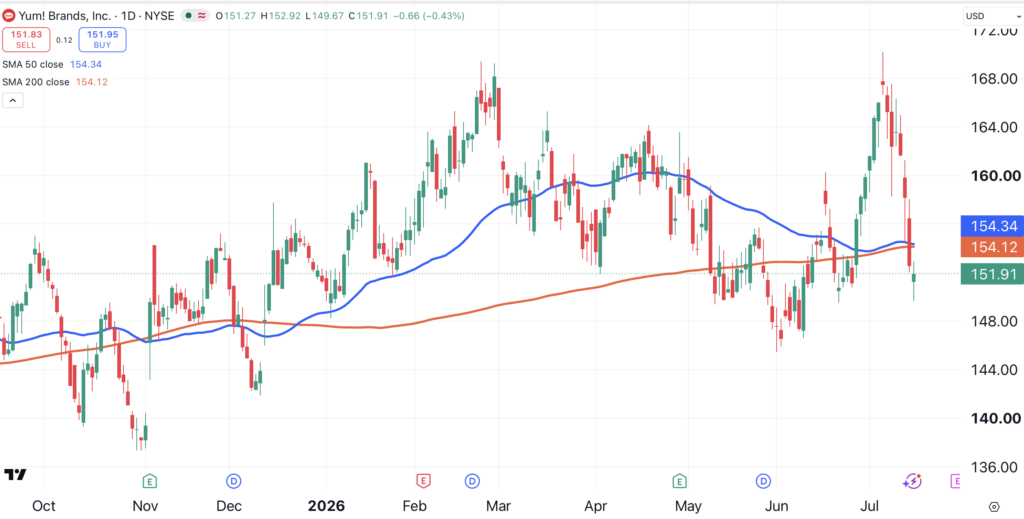
Meanwhile, shares of YUM Brands, which traded at an all-time high just last week, are sliding. YUM has lost about 11% since reaching an all-time intraday high of $170.14 on July 7. Now the stock has tumbled beneath its 50-day (blue) and 200-day (red) moving averages.
YUM’s Big Picture
However, if we zoom out to the monthly chart, we see a potential opportunity unfolding. YUM has bounced sharply from its 50-month moving average (blue) on two previous occasions this decade.
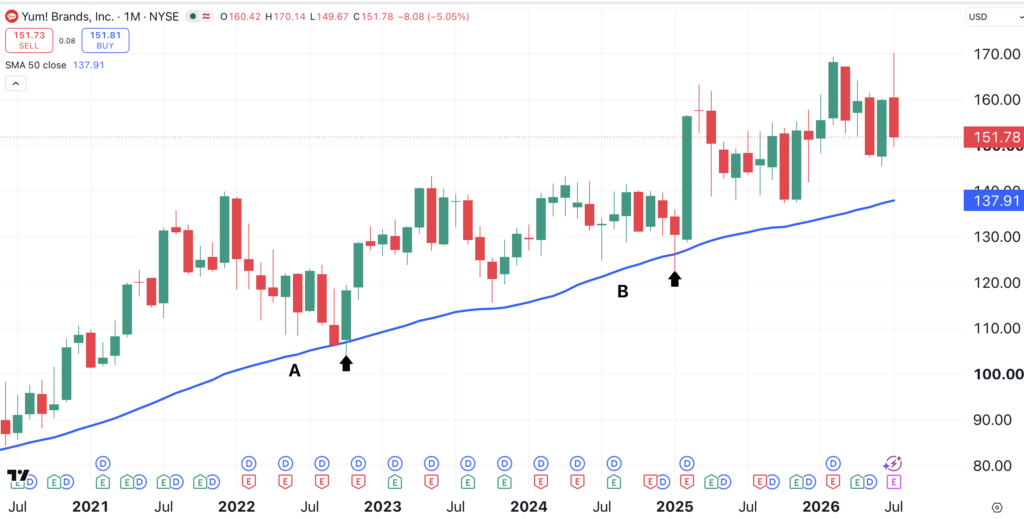
The first time was in October 2022 (point A). That pullback led to a gain of 31% over the following seven months. The second bounce, in January of 2025 (point B), led to a gain of over 24% in just two months.
Will a third bounce occur from YUM’s 50-month moving average? For that to happen, YUM requires a deeper pullback to the $138 area.
Our Strategy for YUM
If that pullback occurs, we’ll buy the stock at or near $138. If YUM subsequently falls below its January 2025 low of $122, we’ll cut our losses.
Since this trade is based on a monthly chart, we’ll refrain from creating target prices for now. First, let’s see if we get our entry, and then analyze the stock’s subsequent behavior.
At the time of publication, Ponsi had no positions in any securities mentioned.