Netflix Sends Weak Message to Investors as Disappointment Drives Selloff
The streaming giant hasn’t been able to convince Wall Street after a poor revenue update.
You've reached your free article limit
You've read 0 of 1 free Pro articles.
On Thursday evening, former “FANG” member Netflix (NFLX) released the firm’s second quarter financial performance and that performance might be best described as “pedestrian.” For the three-month period ended June 30, Netflix posted a GAAP EPS of $0.80 on revenue of $12.56 billion. The top-line print was good enough for year-over-year growth of 13.4%, though it did fall just short of what Wall Street was looking for. The bottom-line result did manage to beat Wall Street by a penny.
You knew that Wall Street might not take these results well when, in the press release, Netflix pointed to view hours that grew 2% during H1 2026 as an acceleration over 1.5% growth for all of 2025 as some kind of victory. Netflix even pointed out that this growth occurred “despite the competitive impact of the Winter Olympics and the World Cup this year.”
The firm attributed the 13% revenue growth to increased membership, increased pricing and higher advertising revenue. The firm also made clear that it is “leveraging artificial intelligence to provide a more personalized, immersive and interactive experience for members, enhance ads capabilities for brands, and improve the quality of our series and films.”
Disturbingly, the company also said it would cut back on how often it releases its “What We Watched” reports. These reports give investors a clearer look at engagement. Wall Street took this intentional step back into the opaque quite badly overnight.
Operations
While quarterly revenue increased 13.4% from the year-ago period to $12.56 billion, sales and marketing expenses were up, technology and development costs were down small and administrative costs were down. This left an operating income of $4.193 billion (+6.6%) on an operating margin of 33.4% (down from 34.1%).
After accounting for interest, other income and expenses and taxes, GAAP net income hit the tape at $3.401 billion (+8.8%). This worked out to a fully diluted GAAP EPS of $0.80, up from the year-ago comparison of $0.72.
Regional Sales Performance
U.S. and Canada generated revenue of $5.432B billion(+10%, down from +15% a year ago).
Europe, Middle East and Africa generated revenue of $4.034 billion (+14%, down from +18% a year ago. In constant currency, +11%, down from +16%).
Latin America generated revenue of $1.584 billion (+21%, up from +9% a year ago. In constant currency, +16%, down from +23%).
Asia Pacific generated revenue of $1.51 billion (+16%, down from +24% a year ago. In constant currency, +18%, down from +23%).
Guidance
For the current quarter, Netflix is projecting a GAAP EPS of $0.82 on revenue of $12.86 billion. Wall Street had been looking for guidance close to $0.84 on roughly $13 billion. This miss is being seen as quite disappointing by investors. For the full fiscal year, the firm sees revenue of $51 billion to $51.4 billion, which at the midpoint, falls short of the $51.38 billion consensus.
Fundamentals
For the period reported, Netflix generated operating cash flow of $1.744 billion (-28%). Out of this number came capex spending of $218.6 million. This left free cash flow of $1.525 billion, which is quite robust on its own merits. That said, this number is down 32.7% from the year-ago comp. Out of that free cash flow number (said in jest), the firm did not pay any cash dividend to shareholders but did manage to repurchase $4.714 billion in common stock. Yes, if I am “Joe shareholder,” I am offended.
Turning to the balance sheet, Netflix ended the period with a cash position of $9.128 billion and current assets of $13.853 billion. Current liabilities hit the tape at $12.135 billion, including short-term debt of $2.484 billion. That’s debt that matures or has to be rolled over within 12 months. On the bright side, there is $1.797 billion in deferred revenue labeled as current which is not a true financial obligation. This puts the firm’s current ratio at 1.14. Adjusted for deferred revenue, that ratio rises to 1.34, which, while nothing to write home about, is acceptable.
Total assets amount to $58.45 billion. None of that is described as intangible, so it’s all legit. Total liabilities less equity comes to $28.298 billion. This includes long-term debt of $11.825 billion. No, this is not a top-notch balance sheet. That said, it’s at least average. Netflix can meet its obligations.
Opinion
There’s a lot to dislike here. The guidance for both the current quarter and the full year is weaker than Wall Street had modeled. Operating and free cash flows are decelerating. The firm has been too aggressive (my opinion) in repurchasing common stock relative to its cash flows, cash on hand and debt loads. Does that benefit shareholders?
Sure doesn’t feel like it on Friday morning. Or at any point since April. My judgement is that, while Netflix is not being overtly mismanaged, the company is certainly not well managed. Maybe having co-CEOs wasn’t such a hot idea after all.
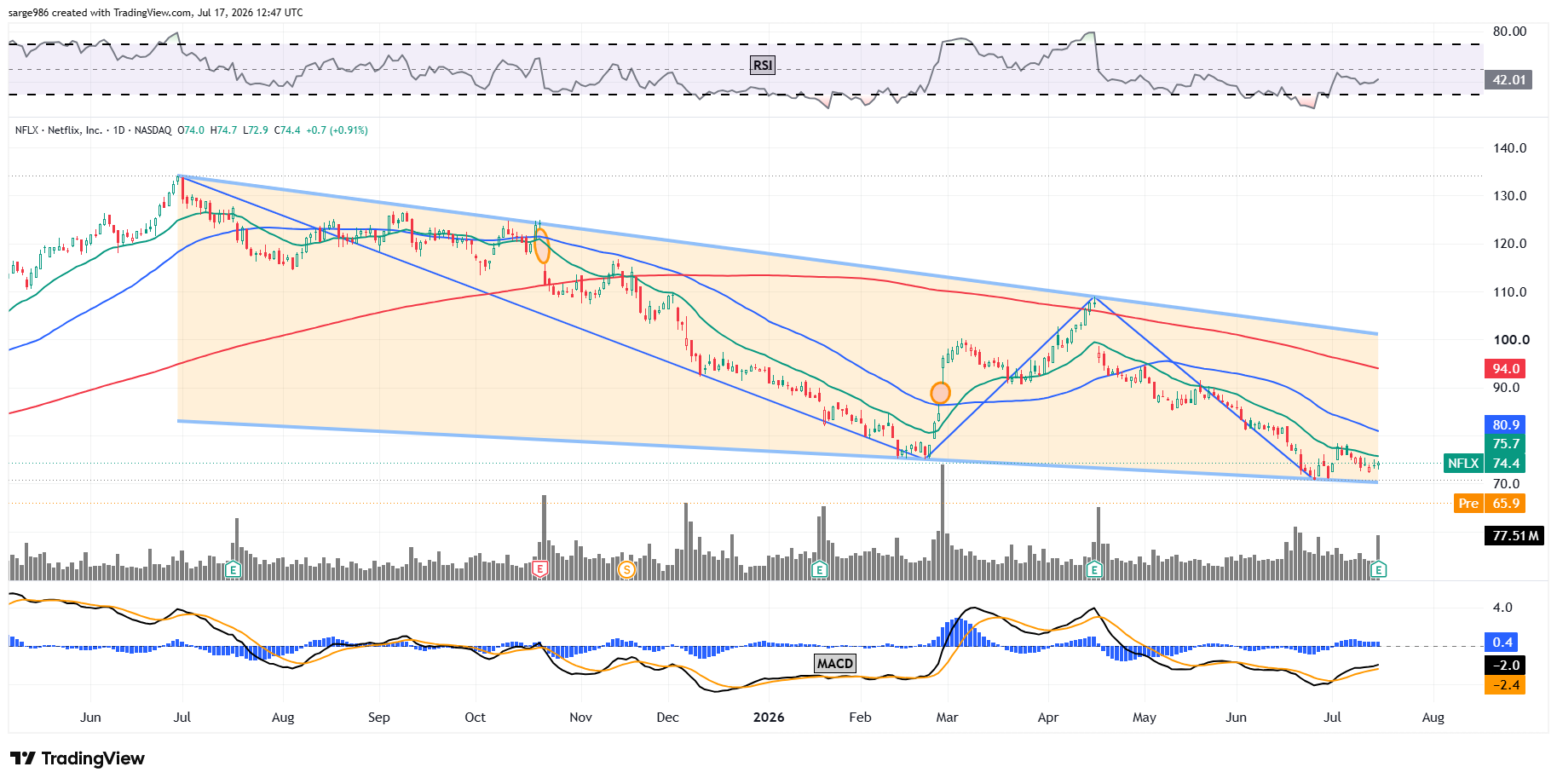
There are a couple of things going on in this daily chart of NFLX. On Friday morning, the shares are trading 51% off of their year-ago highs. This long downtrend is illustrated by what I see as a falling wedge of bullish reversal, which could be a positive. In getting here, NFLX has surrendered both its 50-day and 200-day SMAs forcing professional managers to reduce exposure. The stock also lost its 21-day EMA, losing the swing crowd. The 21-day EMA has acted as recent resistance, implying that swing trades were correctly bearish coming into the earnings print.
This is the current situation. Should the bottom trendline of the wedge hold on Friday, Netflix investors still have a ball game. Should the share price fall below and lose contact with that line, this could get truly ugly. There is almost nothing worse for investors than when a typically bullish technical set-up breaks to the downside. NFLX is in danger of experiencing this kind of activity in the present. That could make the 10% overnight beatdown seem pleasant.
At the time of publication, Guilfoyle had no positions in any securities mentioned.