The Future Is for Everyone, But Is META Stock for You? This Week’s Pro Survey.
Meta Platforms is embroiled in a lawsuit while the company’s shares sit, teetering, on support. We look at our Pro’s thoughts on the stock as well as interest rates and the stock market.
You've reached your free article limit
You've read 0 of 1 free Pro articles.

It’s a three-parter this week. We begin with our usual sentiment survey and find that our team is solidly bearish. They’re also putting their money where their mouths are and most are underweight stocks, or even outright shorting them. Only one person has been loading up on shares.
Next, the team answers my questions on interest rates. What will the Fed do, why might they do it, and where should you allocate the fixed income part of your portfolio?
Finally, Meta Platform’s (META) Mark Zuckerberg recently said that “The Future is for Everyone.” But what we want to know is whether Meta shares are for you. I’ve asked our team about the future of the stock and their opinion on the company, which is currently embroiled in a lawsuit alleging that Meta designed their products to hook younger users.
Part 1: TheStreet Pro’s Sentiment Survey Results
Question 1:
Direction: Over the next 2-4 weeks, how do you feel about the S&P 500?
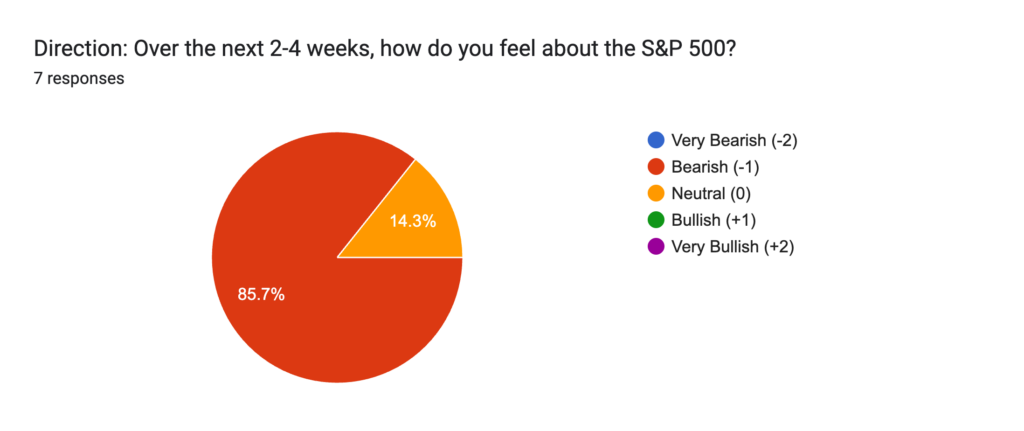
Score: -6
Commentary: Wow. Six bears and one neutral rating. Our team is looking for lower prices on the major indexes over the next 2-4 weeks. I think this is the most aligned the team has been since I started this survey.
Question 2:
Positioning: How are you currently positioned?
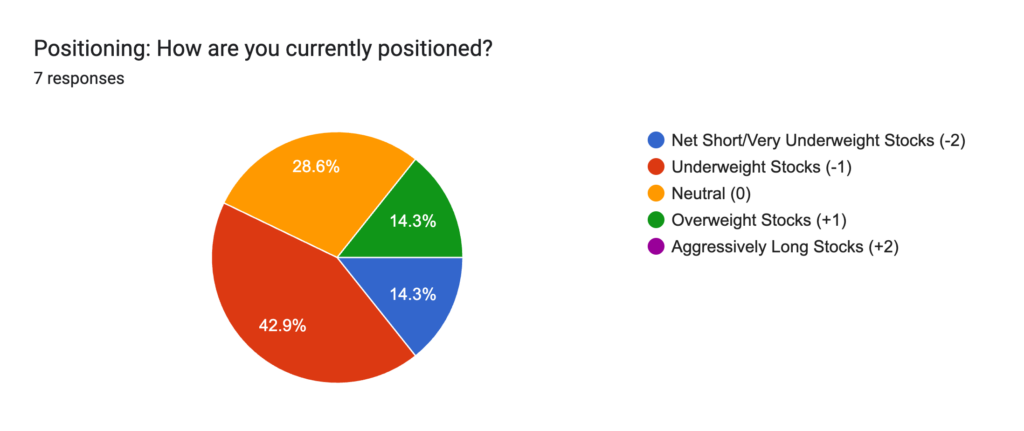
Score: -4
Commentary: In a market decline, you have two basic choices: buy or sell. What’s interesting to me is that, while our team generally believes that there’s more downside to this latest decline, we’ve got a buyer and a seller on our team. One person is net short, looking to make a profit on what he sees as an inevitable decline in the market. Balancing him out is one person who’s been on a buying spree and is now overweight stocks. Among the five others, three are underweight stocks, waiting for an opportunity to buy, while two are neutral weighted.
Part 2: Interest Rates
Question 1: Rates. What do you expect at the Fed’s next meeting in September?
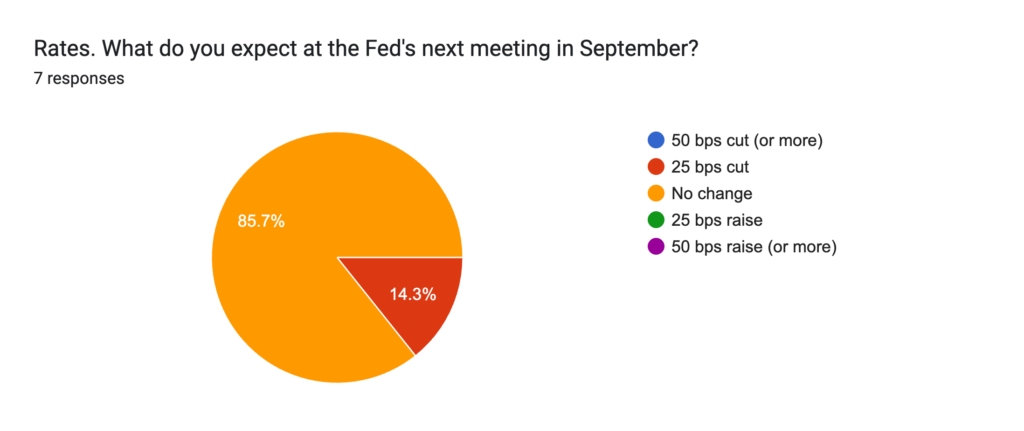
Commentary: Overwhelmingly, our team doesn’t believe that there will be any change at the Fed’s next meeting. Just one of the seven members of the team who responded is looking for a cut, which will be just 0.25%.
Question 2: Why do you believe what you said about rates and is there anything else you’d like to add?
- The Fed is unlikely to cut before the midterms
- It all depends on the inflation reports just before the next meeting
- Political implications are likely to keep the Fed on hold. That said, the discussion is hold or hike, NOT hold or cut.
- The Fed probably should hike rates given rising inflation, but probably won’t with significant continuing dissents.
- Renewed inflation pressures from the Iran war driving oil, gas, and diesel prices higher, and the likelihood we see further output price pressure.
- The inflation outlook is currently riddled with crosswinds from various geopolitical factors that affect oil prices. History also shows that stock-market volatility tends to rise in the period leading up to midterm elections and usually calms down once the likely outcome becomes clearer. This could cause a potential near-term drag on consumer sentiment. Widely discussed worries about an overheated AI market and the risk that capital for the sector could dry up may cause some investors to sell more if momentum falls. Those are the factual and historical points as I see them. My own opinion is that the market will get more volatile in the near term and then rally again later. I also think investors will start allocating capital more carefully — focusing on real cash flow, interest-rate sensitivity, and how strong a company’s competitive moat really is. A lot of people who used to believe “indexes are the only way to go” will shift toward wanting to protect their capital (stock picking). Many investors are sitting on the highest portfolio values they’ve ever seen and are therefore carrying meaningful risk. For those reasons, I believe a moderate position is the smart place to be right now.
Question 3: Based on your thoughts regarding the Fed, would investors be better off owning the long or short end of the yield curve?
- Long end, 5, 10, 20 year treasuries
- Short
- Neither. If anything, own T-Bills while you’re looking for higher yielding opportunities.
- Given the G7s unwillingness to even begin to address profligate spending, I am only holding short-term treasuries despite my fears of an oncoming recession.
- I think a barbell approach is still best. I would stay balanced between short- and very long-term fixed-income securities. This will help investors if rates make a bigger move up or down. If rates fall, you get a capital-gain boost on the long end. If rates rise, you have shorter-term instruments maturing that can be reinvested at a higher rate. It is important that the balance between the two sectors is neutralized for volatility. Long-term bonds are very volatile, so you need much less of those securities than short-term ones. Also, shorter-term high-yield non-US fixed income is a good diversifier now, including emerging markets in a smaller allocation.
Part 3: Meta
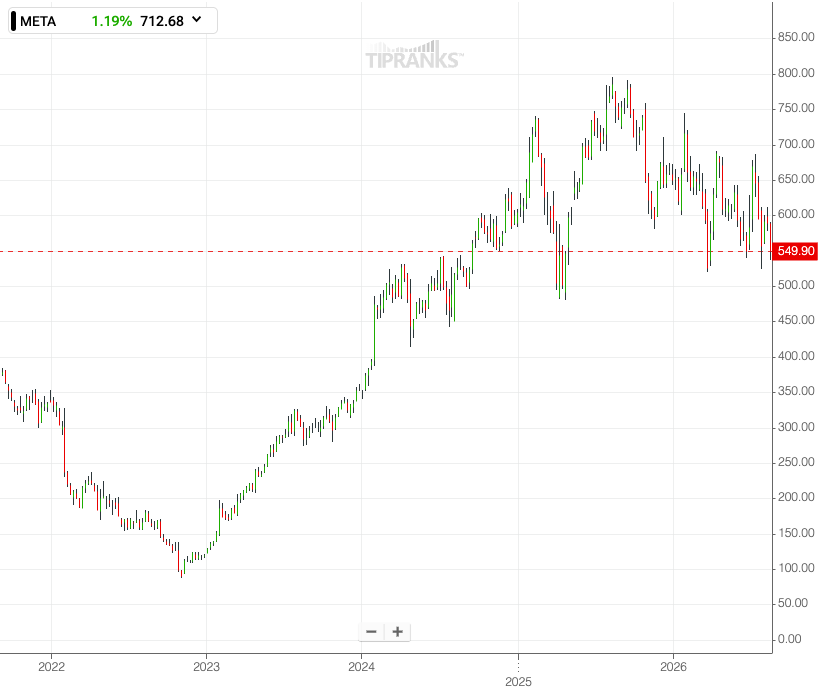
Question 1: Let’s talk Meta (META).
It’s down around 17% YTF and sitting on some support. Wall Street analysts have a $750 target on it, nearly 40% above the current price. The company is in the midst of a lawsuit against 29 states alleging that the company’s products were deliberately designed to addict young users. Do you have any opinions on the company’s news or fundamentals?
- The stock has broken down amid big volume. No catalyst to rise until earnings in October.
- Avoid
- Meta is likely to begin making more aggressive moves around the open source side of the LLM equation. They’re not positioning themselves to be a fronteir model competitor (Anthropic/Open Ai) — Zuck spelled it out with his August 10th piece “The Future is for Everyone”
- META threw away $90 billion on the Metaverse and has an unclear AI strategy recently announcing it would rent the compute capacity it built for itself. I am steering clear.
- The company has had a string of poor uses of capital, including huge investments in Reality Labs that generated large losses, buying back large blocks of stock at high prices, and now announcing massive AI investments that may take time to generate sufficient ROI. With that said, I think CEO Mark Zuckerberg was right on the money in his essay titled “The Future is for Everyone.” His vision is spot-on in my opinion: “personal superintelligence” rather than concentrating advanced AI in a few labs or institutions, open-source AI models as a positive force, and a warning that extreme concentration of AI power is inherently problematic and historically risky. He is also proposing closer collaboration with the U.S. government and supporting communities near Meta’s data centers through the $1 billion “Future Is for Everyone Fund.” He is truly trying to look far ahead so the U.S. can maintain its lead in AI while managing risks.META is also vulnerable. I think the stock could break support if the AI boom slows. It is already discounting quite a bit of downside potential, trading around 17x forward earnings. The problem is that those forward earnings could be optimistic. If the stock breaks significantly, I may buy more. I do own it, but in smaller size.
- Shares are likely to trade sideways until the ruling in late September or October. If the company made some announcements on other businesses efforts outside of social media, especially on cloud compute, that would likely help the shares.
- The chart looks terrible, but that was true regardless of this lawsuit. Not interested in owning the stock at current levels.
Question 2: Is there a price you would consider buying META at?
- Just under $500
- Lower
- $430-450
- No
- $433 is roughly 15x TTM EPS. If that happened, there would be haters all over the news and a good time to buy if you’re underweight.
- $350
- It’s 3% of the portfolio. Might be interested in buying more here, near support, but only if we see positive developments emerge for the lawsuit and for Meta to say more about the cloud compute business it recently teased.
Final Thoughts
It’s a tough market. There’s so much uncertainty among investors, and stocks are off their highs. The economy is uncertain, too. While many statistics remain strong, there are serious worries out there, from $40 trillion in US debt to inflation and the health of the consumer.
So, should you buy META? Without knowing the outcome of the lawsuit, consensus among our team is no. Even Chris Versace, who owns shares in our Portfolio, is waiting. Other members of the team see the stock as a good value at prices 10% to 30% lower.
One thing I know is that this isn’t a market for the faint of heart. The people who do best will be opportunistic. They’ll look for great stocks and buy them tactically. It’s a stock picker’s market, which is where our team thrives.