Morgan Stanley Turns Heads With S&P 500 Projection
Trump's rumored TACOs, fence-sitting with the Fed, and Morgan Stanley's bullish call
You've reached your free article limit
You've read 0 of 1 free Pro articles.
 Morgan Stanley
On Monday evening, crude oil dropped sharply on a Wall Street Journal report that President Trump might be willing to end the war in Iran without reopening the Strait of Hormuz.
Am I buying stocks or shorting crude oil on this news? Not a chance.
Clearly, the market is hoping for a TACO — an acronym that stands for "Trump Always Chickens Out."
I doubt Trump will back off now. Essentially, it would be an admission that the U.S. is unable to dislodge the current Iranian regime. That regime would then consolidate power, making it even more difficult to displace in the future.
Traders who are betting that Trump will retreat now are gambling on a long shot.
Kargh Island TACO Stand
Earlier on Monday, President Trump threatened to destroy Iran’s Kharg Island oil export facility, along with key infrastructure, unless Iran meets U.S. demands:
“Great progress has been made but, if for any reason a deal is not shortly reached, which it probably will be, and if the Hormuz Strait is not immediately ‘Open for Business,’ we will conclude our lovely ‘stay’ in Iran by blowing up and completely obliterating all of their Electric Generating Plants, Oil Wells and Kharg Island (and possibly all desalinization plants!), which we have purposefully not yet ‘touched,’” the president stated.
Despite this threat, Monday morning stock futures remained green, and oil rose only modestly. It was another case of the market betting on a TACO — this time, that Trump wouldn't attack Kharg Island.
Only later in the day did the indexes finally turn red. By the close, U.S. crude oil had gained 2%, an insignificant amount considering Trump had threatened Iran's largest energy hub. It's estimated that over 90% of Iran's oil passes through Kharg Island.
The Key Phrase
Before you assume Trump won’t attack Kharg Island, consider this: Trump used the words, "we will conclude our stay" in that statement. This seems to indicate that a ground invasion is unlikely.
Perhaps an attack on infrastructure, cutting off Iran’s main source of income in the process, is being considered as an alternative to boots on the ground. If we believe that a ground invasion will not materialize, the likelihood of an attack on infrastructure increases. That is, unless Trump backs off completely, which seems unlikely.
Hitting Iran’s energy infrastructure would likely drive crude oil higher. Judging by Monday’s reaction, the market seems nearly certain that this attack won’t happen.
I’m not so sure. This is another TACO I wouldn’t touch.
If such an attack occurs, crude oil could go much higher, generating upside pressure on inflation.
Speaking of inflation…
Fence-Sitting with the Fed
During a speech at Harvard University, Federal Reserve Chair Jerome Powell mentioned both “downside risk to the labor market” and “upside risk of inflation.” In other words, the Federal Open Market Committee isn’t committed to raising or lowering interest rates.
If we project forward to the September 16 Fed meeting, the CME’s FedWatch Tool suggests a nearly 90% chance that the fed funds target rate will remain where it is on Tuesday, between 3.5% and 3.75%.
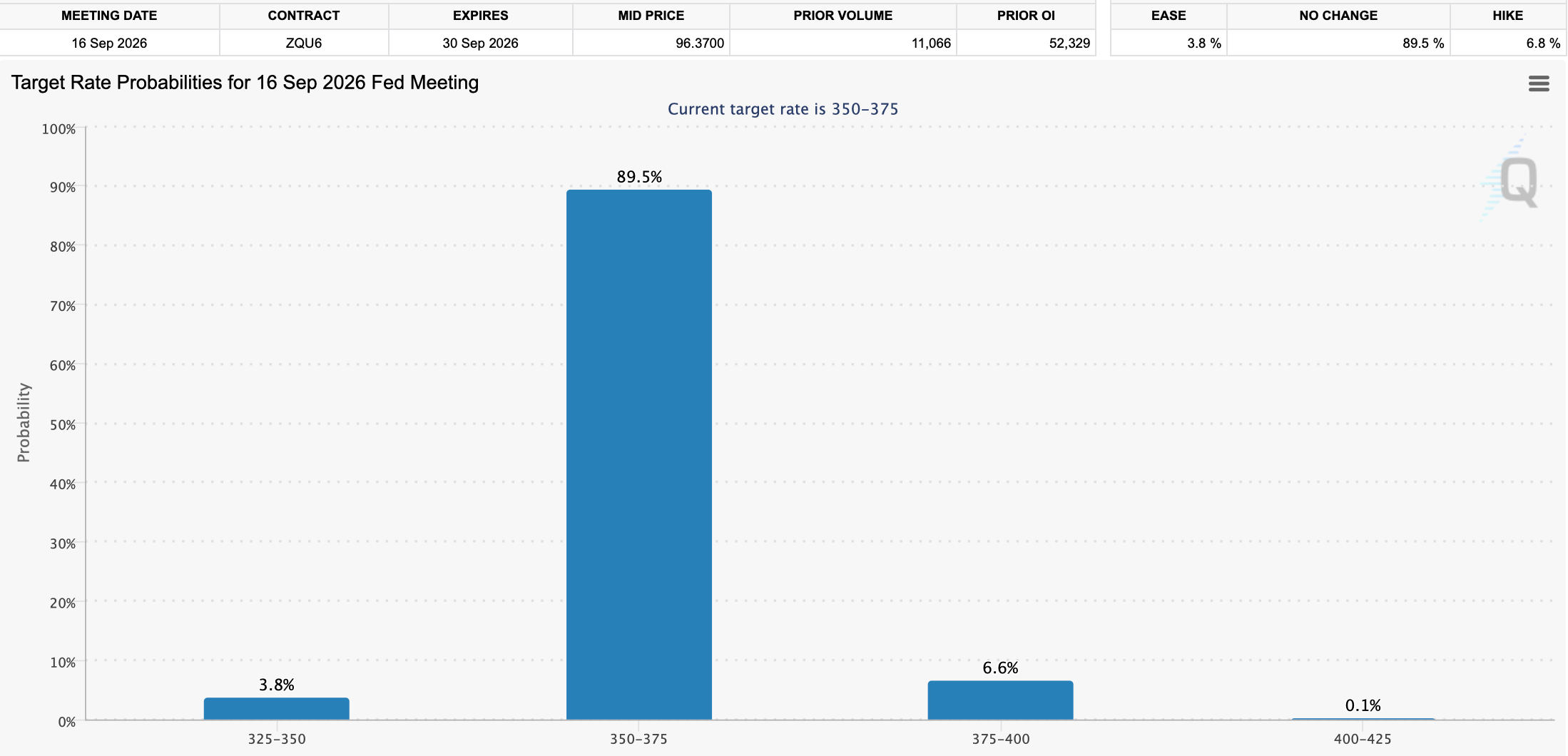
According to this projection, there is an 89.5% chance of no change to the Fed funds rate by mid-September. If this is correct, summer will be almost over, the NFL football season will be underway, and rates will be right where we are now.
What about the remaining 10.5%? It’s split: 6.6% chance of a rate hike and just 3.8% odds of a cut. This is a master-class in fence sitting.
Powell also reiterated his commitment to an inflation target rate of 2%, a figure that has eluded the Fed in recent years.
He’d better hurry. The upcoming April 29 Fed meeting is scheduled to be Powell’s last, as his term expires in mid-May.
Morgan Stanley’s Bullish Call
On Monday, analysts at Morgan Stanley reiterated their year-end target for the S&P 500 at 7,800. That figure represents a 23% gain for the large-cap index over the next nine months.
“From a relative value perspective, we think the group looks quite attractive here after having already been through six months of consolidation,” per the analysts.
Why so bullish? The venerable New York-based investment bank believes that the valuations of large-cap stocks, particularly the Magnificent Seven, are attractive now that those names are well off their highs.
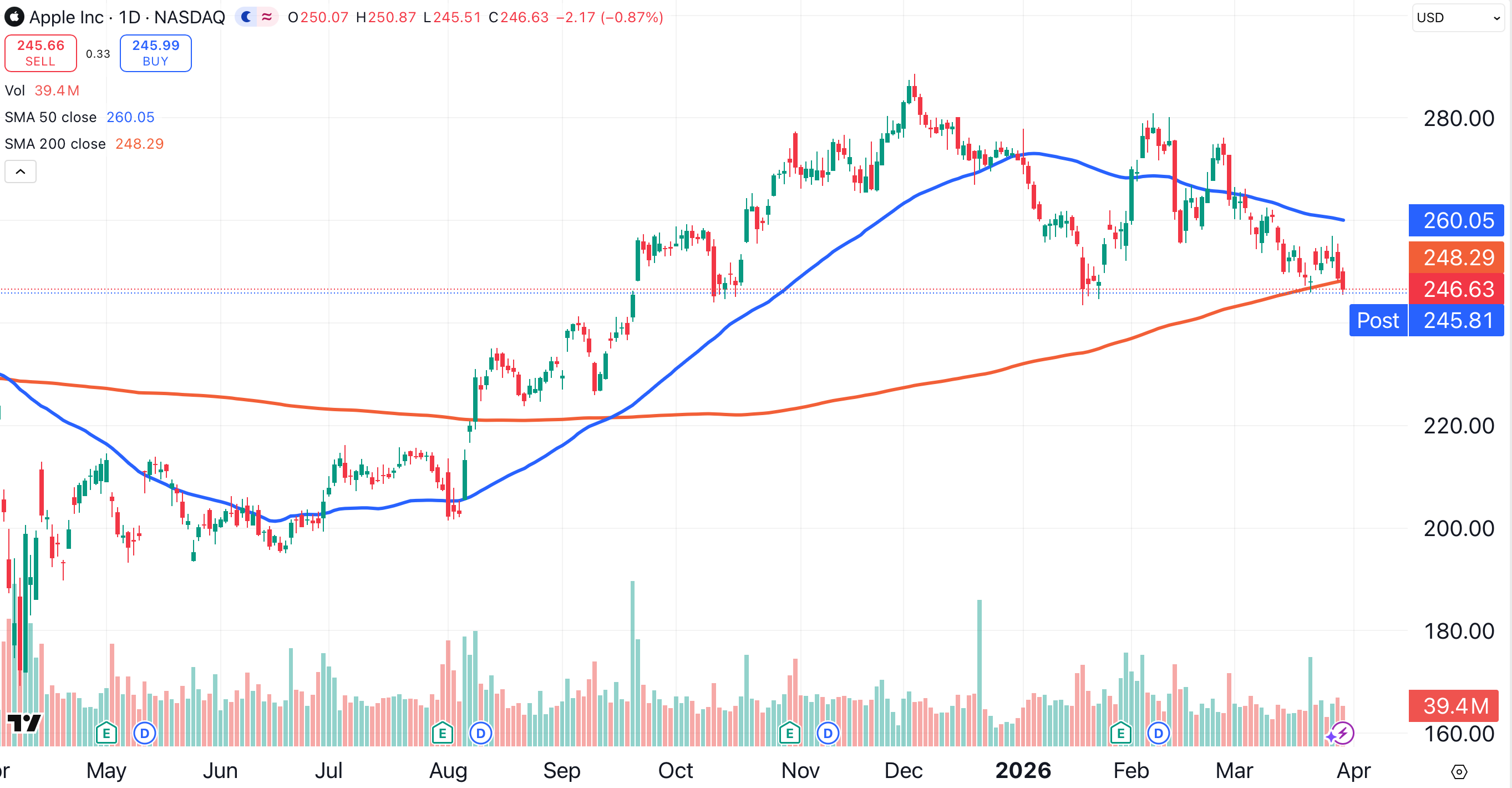
I’d be wary. For the most part, the charts of the Magnificent Seven aren’t attractive, as indicated here.
Apple (AAPL) remains the best of the bunch, but the Cupertino tech giant closed below its 200-day moving average (red) on Monday. The last time that happened was in August of last year.
For now, Alphabet (GOOG) is the only Magnificent Seven stock above its 200-day moving average. That stock has lost ground in eight of the past nine sessions. Since early February, shares of Alphabet have fallen by 20%.
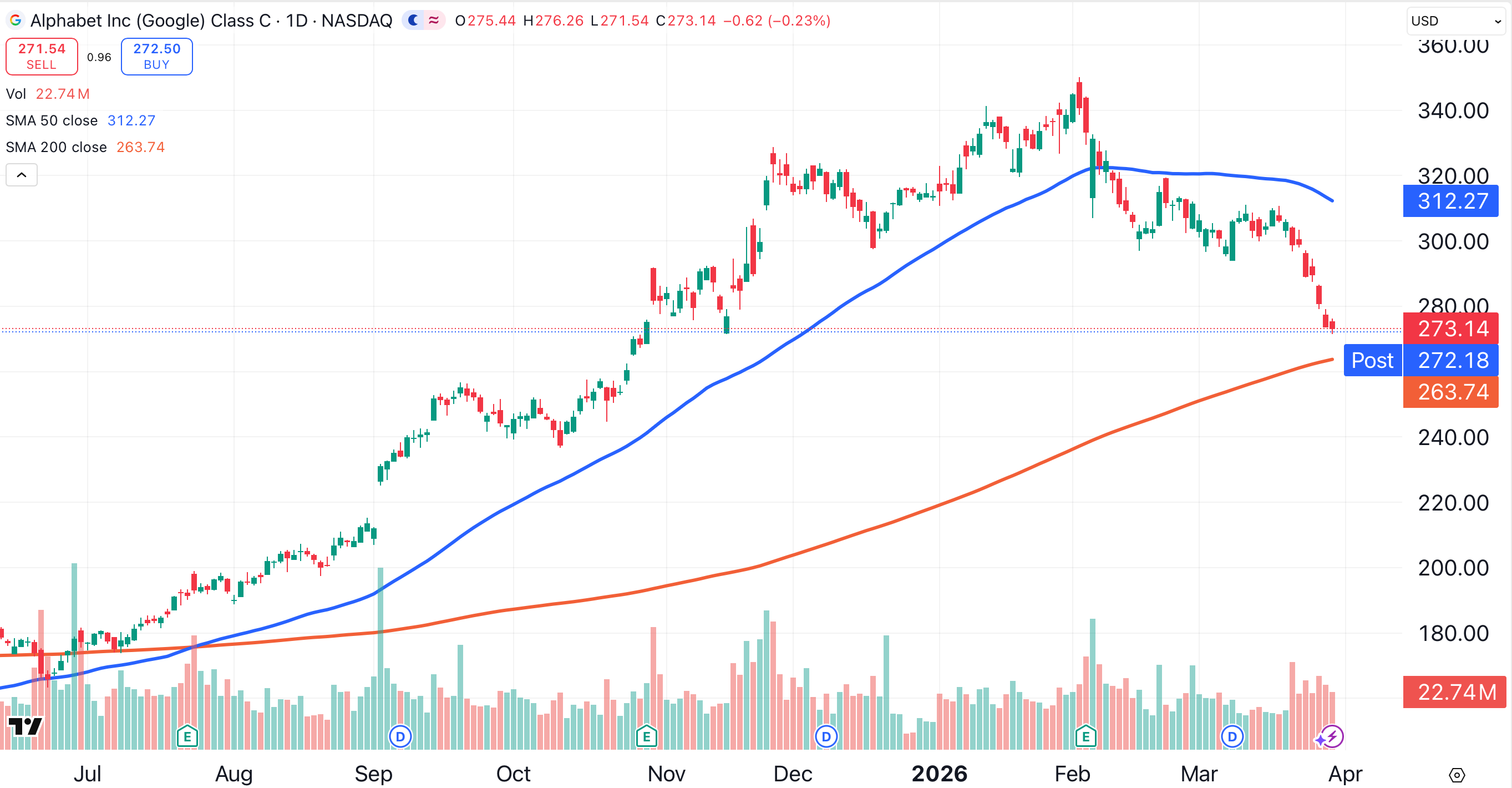
No doubt, valuations are improving as stocks fall. If they keep falling — a strong possibility, according to the charts — the valuations will show further improvement.
While we all hope that Morgan Stanley’s advice is correct, I’d like to see some positive technical action, or an indication that institutions are heavy buyers, before stepping in to any Mag Seven names.
Related: 3 Potential Outcomes in Iran and What They Mean for Financial Markets
At the time of publication, Ponsi was long AAPL.