Did You Really Think Nvidia Could Sprint Forever?
The tech star still shines brightly, but we can see a sharp deceleration from a few years ago. Let's see why this is normal, the quarter's fundamentals and my plan.
You've reached your free article limit
You've read 0 of 1 free Pro articles.
Nvidia NVDA was the single-most looked forward to earnings release of the entire season. Too bad it comes late in the season, with the retailers instead of early in the season with the banks. The elite, high-tech chip designer has been at the very heart of the entire generative artificial intelligence craze since its inception, and it has benefited most from the dramatic increase in capital spending by many of the nation's consumer-facing high profile tech companies.
For the quarter, Nvidia posted an adjusted earnings per share of $0.68 (unadjusted earnings of $0.67) on revenue of $30.04 billion. The EPS print beat Wall Street by a few cents. The revenue number beat Wall Street by considerably more than $1 billion, while also besting the whisper number that I had heard the most -- but not the highest numbers that were thrown around. That revenue print was also good enough for year-over-year growth of 122.4%.
While that kind of growth is usually only seen in the performance of much smaller tech startups that have not really started to yet worry about profitability, for Nvidia, this is actually a sharp deceleration (not unexpected) from the pace of the past few quarters. Oh, and last but not least, the company's board has approved adding $50 billion to the share repurchase authorization without an expiration date.
Hot Hopper
“Hopper demand remains strong, and the anticipation for Blackwell is incredible," said CEO Jensen Huang in the press release. "NVIDIA achieved record revenues as global data centers are in full throttle to modernize the entire computing stack with accelerated computing and generative AI.”
Solid Operations
As revenue generation grew 122.4% to $30.04 billion, the cost of those sales increased 84.6% to $7.466 billion. This left a gross profit of $22.574 billion (+138.6%), as unadjusted gross margin improved from 70.1% to 75.2%. That's more than impressive. Operating expenses increased 47.7% to $3.932 billion, leaving a unadjusted operating income of $18.642 billion (+174.2%). That put operating margin at 62.1%, up from 50.3% (not a misprint). After accounting for interest, other income and losses and taxes, unadjusted net income printed at $16.599 billion (+168.2%). This worked out to $0.67 per fully diluted share, up from the year-ago comparison of $0.25.
Segment Revenue Stats
Data Center drove revenue of $26.272 billion, up 154%, crushing expectations.
The vast majority of sales in this segment came from Compute, while Networking provided a minority share. Roughly 45% of segment sales were driven by the big three cloud providers... Microsoft's MSFT Azure, Amazon's AMZN AWS and Alphabet's GOOGL Google Cloud.
Concerning China, during the call, CFO Colette Kress said, "Our data center revenue in China grew sequentially in Q2 and is a significant contributor to our data center revenue." That said, Kress added... "As a percentage of total data center revenue, it remains below levels seen prior to the imposition of export controls."
Gaming drove revenue of $2.88 billion, up 16%, decisively beating expectations.
This segment includes AI-infused personal computers. During the call, Kress stated that both demand and inventories are healthy in this space.
Professional Visualization drove revenue of $454 million, up 20%, just beating expectations.
This is the home of the Nvidia Omniverse, which is kind of, sort of comparable to Meta Platform's META Metaverse.
Automotive drove revenue of $346 million, up 37%, just beating expectations.
This includes robotics. The company is seeing increased customer demand for self-driving platforms and AI uses for autonomous robotic arms and mobile robots.
OEM & Other drove revenue of $88 million, up 33%, decisively beating expectations.
Fundamentals of Envy
For the quarter reported, Nvidia generated operating cash flow of $14.489 billion. Out of that number came capital spending of $977 million and principal payments of capital spending of $29 million. This left free cash flow of $13.483 billion. Incredibly, while operating cash flow was up 128% from the year-ago comp and free cash flow was up 123%, both fell slightly short of expectations. Out of that FCF number, the company spent $7.158 billion on the repurchase of common stock and paid out $246 million in cash dividends to shareholders.
Turning to the balance sheet, Nvidia ended the period with a cash position of $34.8 billion; inventories of $6.675 billion; and current assets of $59.633 billion. Current liabilities add up to $13.969 billion. This includes no short-term debt. The current and quick assets stand at a very muscular 4.27 and 3.79 respectively. Total assets amount to $85.227 billion, including $5.574 billion in goodwill and other intangibles. At 6.5% of total assets, this is barely worth mentioning. Total liabilities less equity comes to $27.07 billion, including long-term debt of $8.461 billion. This is something that the company could take care of more than four times over out of pocket. Obviously, this is a balance sheet to be envious of for any large or mega-cap firm.
Good on Guidance
For the current quarter, Nvidia projects revenue generation of $32.5 billion give or take 2%. This is above the $31.75 billion Wall Street consensus. Adjusted gross margin is seen at 75%, with unadjusted gross margin at 74.4%. These projections are plus or minus 50 basis points. The company sees the entire year to be in the mid-70% area. Adjusted operating expenses are expected to print at $3 billion, in line with expectations. Unadjusted operating expenses are seen at $4.3 billion. For the full year, operating expenses are seen growing in the mid to upper 40% area.
About That Blackwell Delay
"We believe our Hopper will continue to grow into the second half. We have many new products for Hopper, our existing products for Hopper that we believe will start continuing to ramp in the next quarters, including our Q3 and those new products moving to Q4," said CFO Colette Kress.
"Additionally, we have the Blackwell on top of that, and the Blackwell starting of -- ramping in Q4. So, hope that helps you on those two pieces."
CEO Jensen Huang added: "We expect to grow our data center business quite significantly next year. Blackwell is going to be a complete game-changer for the industry. And Blackwell is going to carry it into the following year."
Wall Street's View
Wall Street was mostly positive on Nvidia overnight. There were quite a few increases made to target prices. Since these earnings were released last night, I have come across 28 highly rated sell-side analysts who have opined on NVDA. Among the 28 analysts, there are 27 "buy" or buy-equivalent ratings and one "hold" rating. One of the "buys" did not set a target price, so have just 27 of those. After allowing for changes, the average target price across these 27 analysts is $152.44 with a high of $180 (John Vinh of KeyBanc) and a low of $9 (Gil Luria of DA Davidson). Once these two are omitted as potential outliers, the average target across the remaining 25 analysts rises to $153.84.
My Take
Yes, there is some deceleration. If that's enough to keep investors away, then so be it. These results are outstanding. The guidance is strong. Demand shows that the hyper scalers are still more afraid of underinvesting in generative AI than they are of overspending. Cash flows are muscular. The balance sheet is fortress-like. Then, there's the additional $50 billion being added to the buyback authorization. At 44-times forward looking earnings, is NVDA still cheap here? I don't think so, but maybe Jensen "The Fonz" Huang does.
Really no change from the chart I recently showed readers going into last night's release. What we see here is a double-top pattern that did successfully produce a bearish reversal.
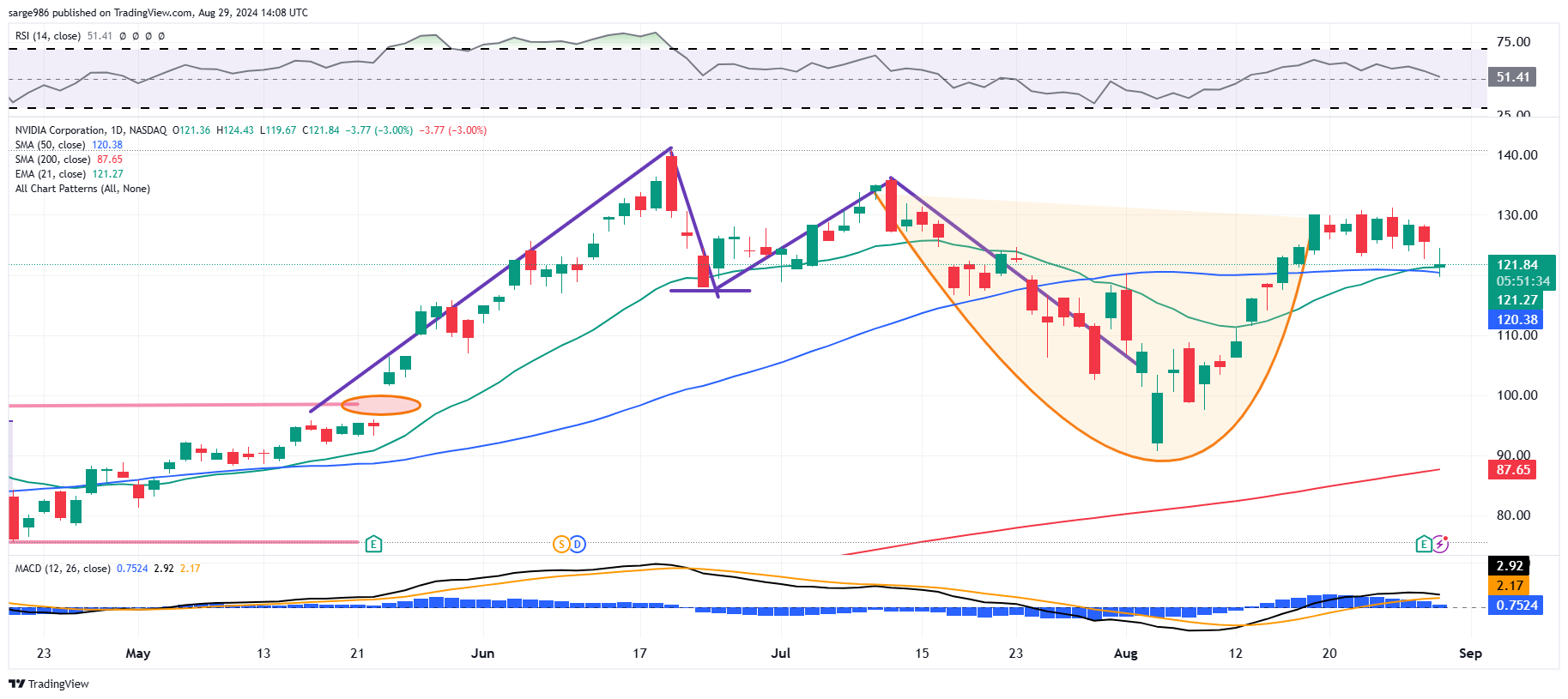
But that bearish reversal has now morphed into a cup pattern that now develops a shallow handle. That moves pivot from the left side apex of the cup ($136) to the right ($130). Relative strength is still on the strong side, but leaning toward neutrality, while the stock's daily moving average convergence divergence indicator remains modestly bullish in posture. The stock has also experienced a bullish crossover of its 50-day simple moving average by its 21-day exponential moving average. My target price is $156, as it has been. I will not add until I know whether or not the stock can hold its 50-day SMA.
At the time of publication, Guilfoyle was long NVDA, MSFT, AMZN equity.