New Delta Trade Idea After Unexpected Guidance
The airline turned some heads on Wall Street while “executing from a position of strength.”
You've reached your free article limit
You've read 0 of 1 free Pro articles.
On Friday morning, Delta Air Lines (DAL) released the firm’s financial results for its fiscal third quarter, which ended on June 30.
For that three-month period, Delta posted an adjusted EPS of $1.56 (GAAP EPS: $2.44) on revenue of $19.8 billion. These top- and bottom-line results beat expectations across the board while the sales print was good for year-over-year growth of 18.7%. The press release led with statements that the firm expects continued momentum for the current quarter, strengthened its balance sheet through an intentional debt pay down and rehashed the previously announced dividend increase.
CEO Ed Bastian commented in that release:
“We delivered $1.4 billion in pre-tax profit while absorbing the highest quarterly fuel expense in our history, reflecting broad demand strength, growing brand preference and momentum across our diversified revenue base.”
Bastian added:
“Delta is executing from a position of strength, and we expect momentum to carry into the second half with double-digit margins and a return to earnings growth. For the full year, we are affirming the guidance we set at the start of the year to grow earnings by 20 percent, overcoming a multi-billion-dollar fuel headwind. This reinforces Delta’s durability while positioning us to continue our momentum into 2027.”
Operations
As revenue grew 18.7% to $19.757 billion, total GAAP operating expenses increased 23% to $17.893 billion. This left a GAAP operating income of $1.864 billion (-11%) as GAAP operating margin dropped from 12.6% to 9.4%. Refinery expenses were up 83% for the quarter while fuel and related taxes were up 67%.
After accounting for interest, other income and expenses and taxes, GAAP net income printed at $1.604 billion (-25%). This works out to $2.44 per fully diluted share, down from the year-ago comparison of $3.27. After adjustments made for changes in the valuation of investments and for hedges, primarily against fuel prices, that fully diluted EPS tag lands at $1.56, down from $2.12 a year ago.
Guidance
For the full year, the firm reaffirmed guidance for an adjusted EPS between $6.50 and $7.50. Wall Street was looking for a haircut here to something below $6.00. Hence, in my view, this has to be seen as positive guidance. The firm sees full year free cash flow at $3 billion to $4 billion. For the current quarter, Delta projects revenue growth in the mid-teens, percentage-wise. This is above the growth of 11.6% that Wall Street had in mind. Operating margin is seen at 11% to 13% and adjusted EPS is seen at $2.00 to $2.50. That, too, is well above the $1.50 consensus coming in. This is very strong guidance.
Fundamentals
For the quarter reported, Delta generated operating cash flow of $1.596 billion. After cash used in investing activities of $1.512 billion and a number of much smaller adjustments for items such as airport construction projects, free cash flow printed at $209 million, down from $733 million a year ago. (For the first six months of the calendar year, free cash flow ran at $1.436 billion.) For the three months reported, Delta paid $123 million cash dividends to shareholders.
Turning to the balance sheet, Delta ended the period with a cash position of $4.307 billion and inventories of $2.558 billion. That puts current assets at $14.236 billion. Current liabilities stand at $33.604 billion including short-term debt and leases of $3.442 billion but also deferred revenue of $5.243 billion. This puts the adjusted current and quick ratios at 0.50 and 0.41, respectively, which is, to be honest, awful.
Total assets amount to $86.321 billion, of which only 18% is labeled as either goodwill or other intangibles. Total liabilities less equity comes to $64.506 billion. This includes another $10.51 billion in longer-term debt and leases. This also includes another $4.327 billion in deferred revenue. This balance sheet is in no way healthy. That said, there has been an obvious effort made to improve the quality of this balance sheet, and it is clearly stronger than it was six months ago.
Opinion
The quarter was strong when the headings encountered are considered. The guidance was very strong and unexpected. Cash flows are a little wobbly and the balance sheet is in lousy shape. At least that balance sheet is improving. I would consider DAL for a long position, but not at these prices.
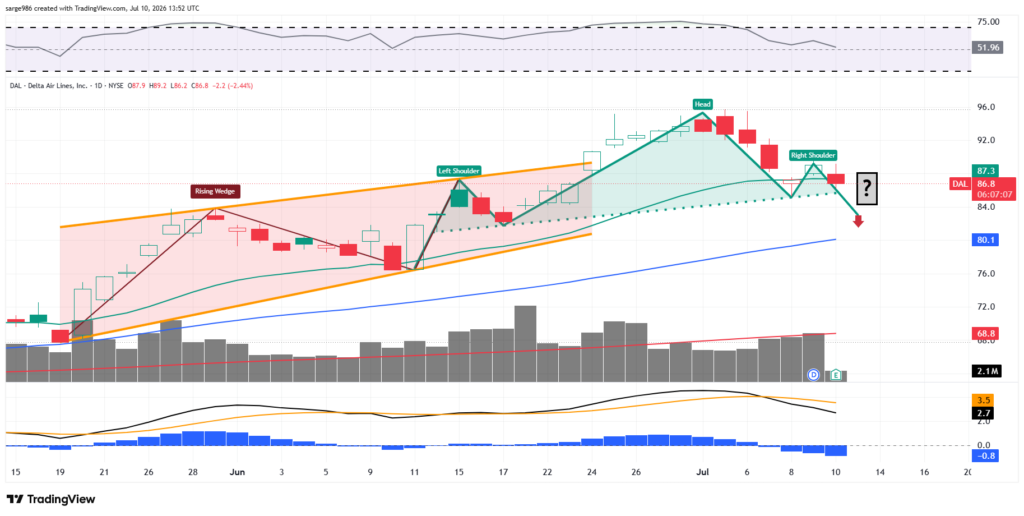
Readers will see that DAL briefly ran higher out a rising wedge of bearish reversal before faltering. In doing so, the stock has developed what appears to be a nearly complete head-and-shoulders pattern, also of bearish reversal.
Moving on to the indicators, relative strength remains neutral but is falling from recent highs. The daily MACD is postured quite bearishly. The histogram of the nine-day EMA is now well below the zero-bound and the 12-day EMA has crossed well below the 26-day EMA.
I see potential here, but not before a test from the upside of the stock’s 50-day SMA. One could probably sell (write) August 21 $80 puts for about $9.00 right now. That might be the better play than simply buying the equity on the dip.
At the time of publication, Guilfoyle had no positions in any securities mentioned.