3 Moves You Can Make Right Now to Trade the U.S. Election
With so much uncertainty, how should we handle the election? This is the key to a successful trading result.
You've reached your free article limit
You've read 0 of 1 free Pro articles.
You’re probably seeing a ton of commentary about how traders and investors should handle this week’s U.S. presidential election. My take on this subject begins with a quote by Copernicus:
“To know that we know what we know, and to know that we do not know what we do not know, that is true knowledge".
This should be your mantra for the next few days, but what does it really mean?
Here's an example of the type of commentary I'm seeing: "The market will do X if Candidate A wins, but it’ll do Y if Candidate B wins".
Does it make sense to gamble on an A or B outcome? There are better ways to handle this situation.
For example, the election could be called on Tuesday evening, or two weeks from now. The coming weeks could be filled with legal challenges and courtroom drama, or it could go smoothly.
With so much uncertainty, how should we handle the election? We may not know what will happen next, but we can reduce market risk.
Step 1: Close Open Positions
I’m closing out all but a handful of my trading positions. This applies to any trade or investment that isn’t performing as expected.
Any trade that is currently losing money — and some that are not — are on the chopping block. I’m holding a select group of winners, including SoFi SOFI and Palantir PLTR. These are the type names I wouldn’t mind holding through a pullback, should one occur.
This doesn’t necessarily apply to long options positions. A simple long call or long put position already has a clearly defined risk, so an increase in volatility would be less of a concern.
Step 2: Cancel Open Orders
Closing most of your trades is one way to reduce risk. Canceling all open entry orders is another.
Some of the biggest losses start out as trading errors. Many times, an order is executed because someone forgot to hit the cancel button. While these trades can sometimes work out in your favor, they often do not.
Most of your open entry orders should be canceled. Those that remain open should be adjusted to account for an increase in volatility. Here's how:
Step 3: Prepare for Volatility
Markets are likely to become volatile in the coming days. That’s not necessarily a bad thing, but it does mean that adjustments should be made.
Perhaps the best way to explain this is by using a setup for silver from last week as an example.
Initially, we had two entry points for silver — $33 and $32, for an average of $32.50. Our entry at $33 has been executed, but the entry at $32 hasn’t.
Here is the silver chart, reflecting last week’s setup. Entries are in green, the stop is red, targets are in blue.
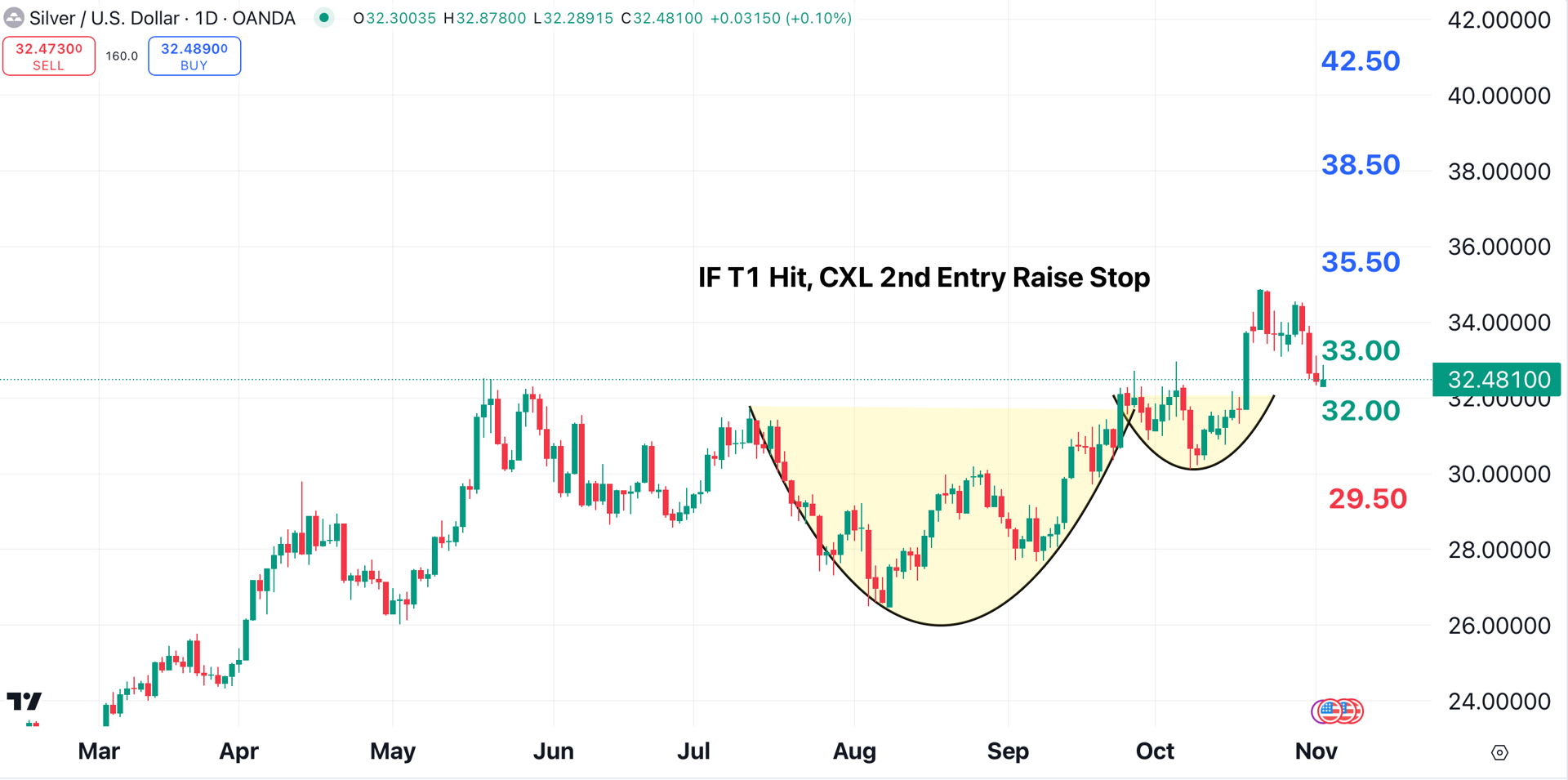
Normally, I would be fine with my remaining entry at $32 and my stop at $29.50. However, that entry and stop are liable to be too close if we see a huge burst of election-related volatility.
Because of this, I’m adjusting my setup by lowering the unfilled entry from $32 to $30, and lowering the stop from $29.50 to $28.50. Now the setup looks like this:
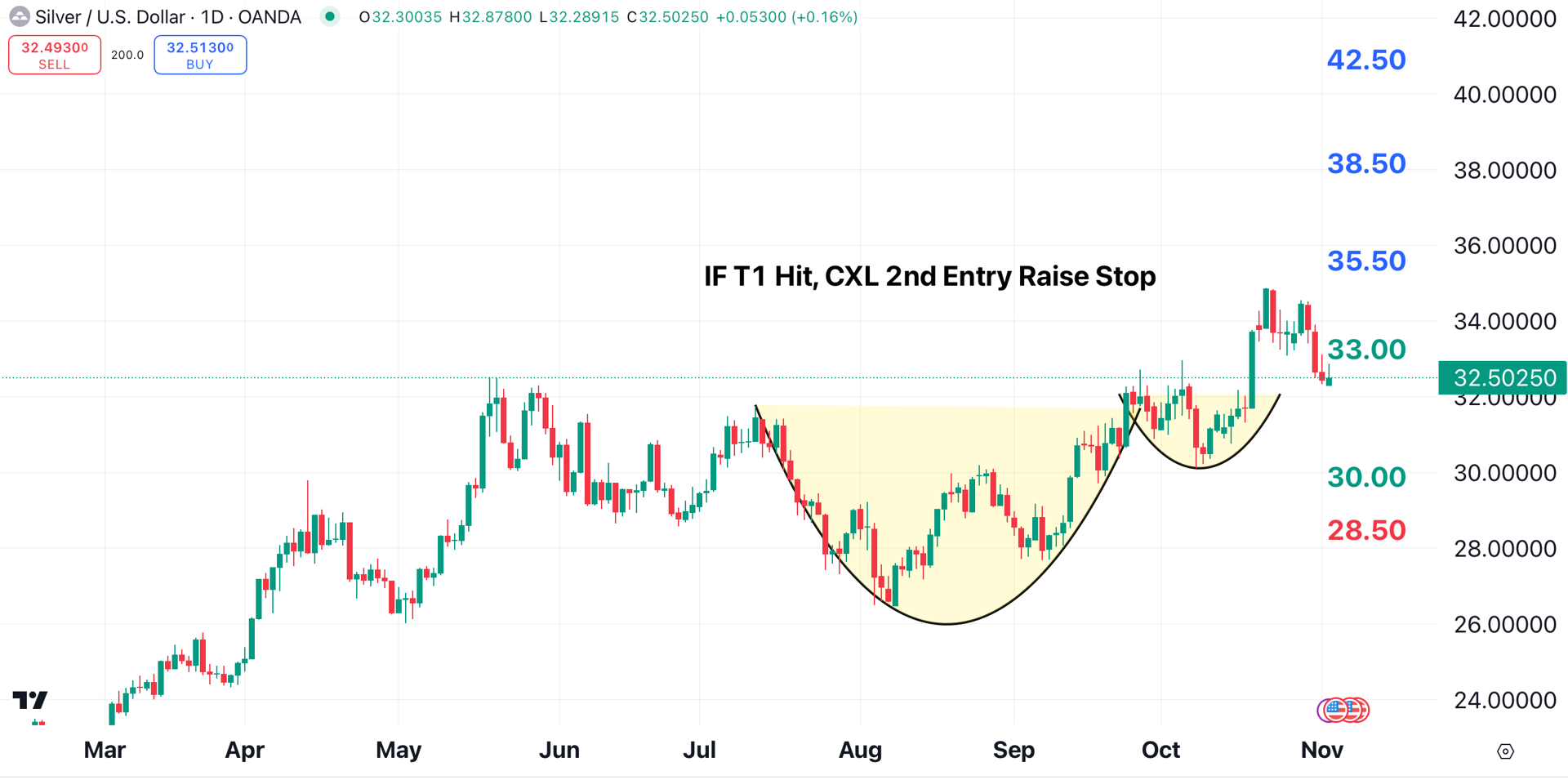
This changes my average entry to $31.50, a full dollar below our earlier anticipated average entry. We have also lowered the stop by $1. The reward-to-risk equation has barely changed.
I know that I don’t know what will happen next, but an increase in volatility is a reasonable expectation. If volatility fails to increase, I'm unlikely to be harmed.
For most markets, I wouldn’t be surprised to see an extreme move in either direction, followed by a reversal. The adjustment in my silver setup is my way of compensating for such a move.
At the time of publication, Ponsi was long silver, PLTR, and SOFI.