Why We’re Boosting Our Boeing Price Target, Eyeing Eaton
Rising production and improving margin prospects have us bullish on BA; also, let’s connect the dots to ETN.
You've reached your free article limit
You've read 0 of 1 free Pro articles.
We are moving our Boeing (BA) price target to $265 from $260 given the improving prospects for the company’s aircraft production levels that should lead margins to rebound and improve free cash flow levels. Based on upcoming monthly delivery figures, we will revisit the Portfolio’s BA price target as needed.
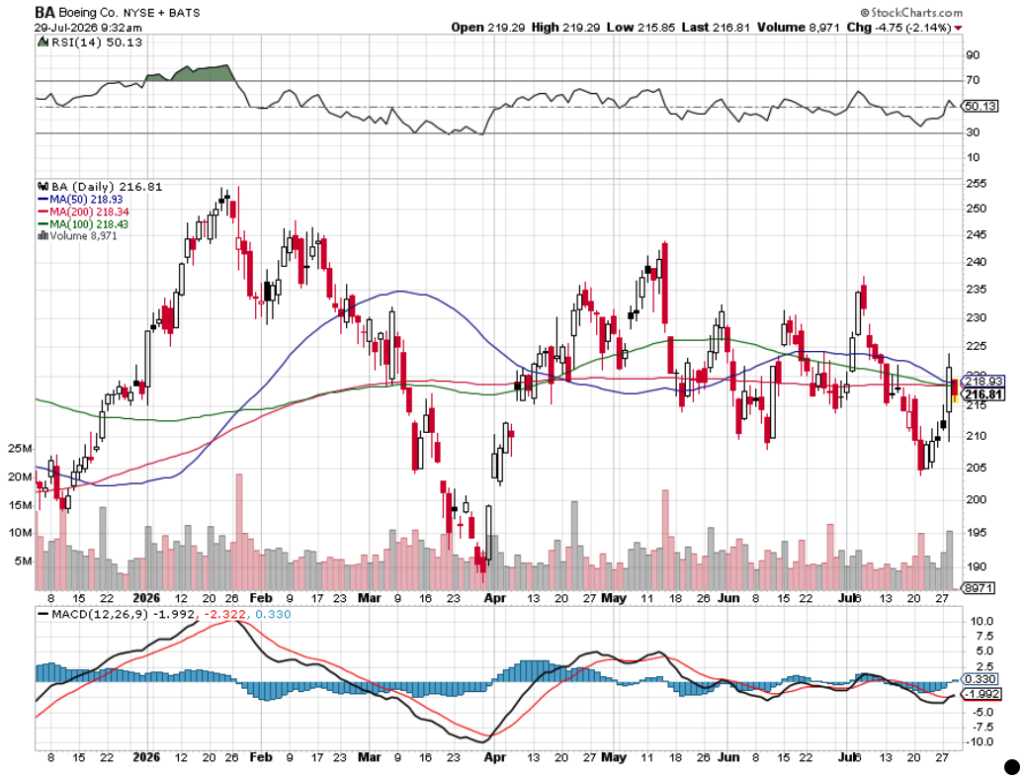
We have room to add further to the Portfolio’s position, but given our comments about the near-term hurdles the market faces between hyperscaler earnings today and tomorrow, and the outcome of today’s Fed policy meeting and press conference, we are going to wait in the wings. Should BA shares hold the confluence of support levels between $218-$219, that would increase our willingness to put additional capital to work in the shares, especially given our cost basis near $224.
Boeing Commercial Aircraft
During the earnings call, Boeing described “exceptional demand and market conditions” across its commercial aircraft segment (45% of revenue). Quarterly deliveries reached 171 airplanes total, the highest since 2018, with 129 737s and 25 787s with the company targeted 500 737s for the year and 90-100 for 2026. 737 production is ramping to 47 per month in the current quarter with management targeted a new low-rate production line coming on stream that should eventually take that figure to 52 per month. 787 production has been stable at nearly eight per month, but Boeing is aiming to ramp that to 10 per month as GE Aerospace (GE) increases its engine production levels.
Looking ahead to 2027, the Federal Aviation Administration already restored Boeing’s authority to issue airworthiness certificates for all 737 MAX and 787 aircraft earlier in July. The 737 MAX 7 has completed testing and Boeing expects an amended type certificate from the FAA “very soon.” The MAX 10 just completed its final test flight, and certification is expected to follow the MAX 7 — both variants are still targeted to begin deliveries in 2027, giving us another reason to expect higher production levels next year.
As those production levels increase, we should see stronger deliveries in the second half of 2026 compared to the second half of 2025 and first half of 2026 as Boeing chews through its record backlog of more than 6,200 airplanes exiting June at a quicker pace. And that should carry over into 2027. Improving fixed cost absorption should help drive segment margins higher and better pricing in the company commercial aircraft backlog should bring some additional lift in the coming quarters.
As we touch on Boeing’s backlog, remember that figure does not include recent wins from the Farnborough Airshow or the expected China order for ~200 aircraft. In a post earnings interview, Boeing CEO Kelly Ortberg shared the company is now in negotiations with various Chinese airlines and we should expect to hear more on that aggregate China order later this year. It would be a very nice win for the company, but there is the possibility it becomes a political football when Presidents Trump and Xi meet in the coming months.
But BCA margins are big for us. Management’s commercial aircraft operating margin target is to approach 2018 levels on the 737 and actually surpass 2018 levels on the 787 by the end of the decade, with further room to improve beyond that. For context, Boeing’s Commercial Airplane segment operating margin in 2018 was 13%, a far cry from the -2.7% posted in Q2 2026. It’s the flight path toward that low-teen operating margin and the impact on Boeing’s bottom line and cash flow that we aim to capture as owners of the shares.
Boeing Defense, Space & Security
While Boeing’s Commercial Aircraft segment gets the majority of attention, it would be a mistake to overlook the company’s Defense, Space & Security segment (BDS) as it accounts for roughly 30% of sales, and sizable piece of the company’s backlog. During the quarter, BDS delivered 35 aircraft in the quarter and management noted robust demand, with particular strength called out in missiles/munitions and secure communications satellites. That tracks with comments in recent days about the need for the U.S. military racing to rebuild its supply of munitions, and that bodes well for segment revenue in the back half of the year. BDS booked $7 billion of new orders in the quarter and holds an $85 billion backlog.
The segment’s operating margin was -0.2%, entirely due to a $280 million charge on the VC-25B (Air Force One replacement) program. Excluding that charge, BDS margin was 3.5%, and management guided to roughly 2.5% for the full year including the charge. Measured against the2.1% figure posted for the first half of 2026, that points to a step up in the coming quarters. Longer-term, management targets high-single-digit margin figure by the end of the decade.
In our view, the combination of the segment’s backlog and its improving margin profile make for a steady business on which Boeing can flex the ramp at BCA.
Boeing Global Services
While this is Boeing’s smallest revenue contributor at 22% of sales, given its high-teens operating margin, in the near-term it is the primary driver of Boeing’s profits and cash flow. As such, while the other two segments tend to receive investor attention, it’s importance as a stable base of profits should not be overlooked. Given the service and aftermarket nature of the business, it tends to be relatively steady one with growth attached to new program wins.
During the quarter, BGS booked $5 billion of orders and ended the quarter with a backlog of $33 billion, which based on current quarterly revenue should carry the segment into 2028. We should see BGS continue to benefit from airline outsourcing and program modifications tied to military customers.
Boeing’s free cash flow and cash
During the quarter, Boeing generated $631 million in free cash flow, which was ahead of the company’s guidance. Full-year guidance is unchanged at $1 billion-$3 billion in free cash flow. Working capital is expected to be a net source of cash in the second half, helped by higher deliveries, increased advances (including the usual Q4 KC-46 advance), and BCA progress payments.
Cash and marketable securities ended the quarter at $20 billion and repayments year-to-date left it with $45.9 billion in debt with a fully undrawn $10 billion credit facility maintained. Longer term, management reiterated confidence in reaching $10 billion of annual free cash flow, with growth beyond that into the next decade, driven by rising commercial aircraft delivery rates and further margin improvement. That is a lofty target, but for the stock to work, Boeing only needs to get on a runway that puts that figure in sight.
Connecting the Dots to Eaton Corp.
Rising production levels at Boeing are a positive for the Aerospace business at Portfolio holding Eaton Corp. (ETN). Much the way the market focuses on Boeing’s BCA segment, it also focuses on Eaton’s electrical business. But the move to spin out Eaton’s Mobility Segment means the Aerospace one will drive nearly 20% of the adjusted revenue stream. The more important area to focus is the margins tied to Eaton’s Aerospace business, which run in the mid-20% area compared to the very high-teens for its Electrical Global Segment (29% of adjusted revenue). That makes Aerospace the second largest generator of profits and cash flow behind Eaton’s Electrical Americas Segment (54% of revenue) and its mid-to-high 20% margins.
Rising production levels at Boeing and Airbus (EADSY) should translate into favorable Aerospace guidance from Eaton when it reports its quarterly results this Friday. And we continue to see Eaton benefitting from rising electrical utility spending as they address the looming electrical grid pain point.
At the time of publication, TheStreet Pro was long BA, ETN shares.