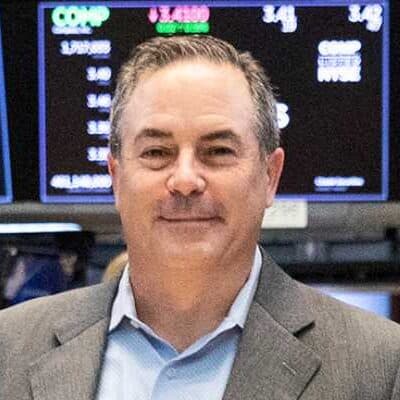
VIDEO: National Vision CEO Gives Sneak Peek Into Eye Care Market
We sit down with Alex Wilkes to discus National Vision and the growing eye care market — and Meta glasses.
You've reached your free article limit
You've read 0 of 1 free Pro articles.
Chris Versace sits down with National Vision (EYE) CEO Alex Wilkes to discuss the eye care market, and how the optical retailer is elevating its product assortment, while leveraging technology to reduce cost and improve the customer experience. Wilkes says that with about 70% of Americans now covered by managed vision care, National’s business has a level of resiliency that is also supported by the aging population and increasing myopia rates. In addition, we touch on smart eyewear, with Wilkes offering some interesting use cases for Meta’s (META) Smart Glasses.
For more on National Vision, visit the company’s Investor Relations page and review its latest Investor Day presentation.
Transcript
Chris Versace: Hey folks, Chris Versace here, and I’m pretty excited to share this conversation with you. It’s a little different for the Pro Portfolio, but I think as you listen to it, you’ll see that it plays into a couple of different dynamics that our thematic strategies here at the Pro Portfolio have identified and that we lean into with several other holdings in the portfolio.
The company we’re talking with today is National Vision Holdings. It’s the largest optical retail company in the United States, with over 1,200 stores in over 40 states and Puerto Rico. You’ve probably seen the company across its different retail brands, from America’s Best Contacts and Eyeglasses, to Eyeglass World and Vista Optical. They also operate the e-commerce website Discount Contacts. Consensus expectations are looking for revenue to grow mid-to-low single digits this year and next. But to tell us a lot more about the company and where it’s headed, please welcome CEO Alex Wilkes. Alex, thanks for joining me.
Alex Wilkes: Chris, thanks so much for having me today. Looking forward to having a chat with you.
Chris Versace: So I assume you’re sporting your company’s products there?
Alex: You know, I am. This is actually one of the newer introductions that we just launched within the last couple of months. We’ve been down a path of improving our assortment recently, and this is one of the newer frames we’ve added just in the last few months as we move a bit more upmarket in terms of the frames we’re offering to the consumer.
Chris Versace: I’m very interested to hear more about that, as I’m sure our listeners are too. But before we get rolling, let’s talk a little more about the eye care market, because I think it’s kind of overlooked. And I say that because I think a lot of people tend to take glasses and contacts almost for granted today. So from your perspective, what’s driving the eye care market? I know there are some demographic tailwinds — aging of the population, screen time as we all stare at these devices more and more. But what else is driving it? Can you help educate us on the eye care market?
Alex: Yeah, for sure. First and foremost, at National Vision we see almost seven million patients a year. We employ over 2,000 optometrists across our network, and we’re super proud that we’re one of the leading healthcare delivery systems in the United States across all of healthcare, not just optical. As you mentioned in the opening, America’s Best is our flagship banner with almost 1,200 stores, plus Eyeglass World, plus Vista. We’re also proud to run the optical shops on AAFES military bases — that’s part of our legacy portfolio as well.
Part of what makes the optical industry — and one of the reasons I love it so much — is that it’s incredibly resilient. It’s a product that consumers need. Your eyes change almost like clockwork. The vast majority of folks have some form of vision correction need, and it’s constantly evolving as you get older. And now we’re even seeing, as you mentioned, especially with kids on devices more, the progression of myopia at a younger age. So we’re in a really resilient category that’s a consumer need, with a ton of tailwinds in terms of an aging population, the progression of myopia, and the progression of presbyopia, which is when you start to require multifocal glasses.
Chris Versace: I’m afraid, Alex, I could be entering that cusp — because while I don’t usually wear my glasses, I’m at the point now where if I have my glasses or my prescription sunglasses on and I pull up my smartphone, I can’t see anything.
Alex: Yeah, well, for sure. What’s the old adage — there are two things that are predictable, death and taxes? It’s actually three: death, taxes, and presbyopia. You’re not escaping it. Sorry, Chris.
Chris Versace: Great, great, great. All right, well, so it sounds like a relatively steady, growing market with some tailwinds there. What about the company’s position in that market? How do you go to market? How do you compete?
Alex: Yeah, so one of our greatest assets is our employed doctor network. We’re actually one of the very few optical retailers that employs our optometrists, and what that allows us to do is ensure consistency of care on the doctor side of the equation. If you think about our optical shops, we sell glasses, we sell contact lenses, but we also provide almost seven million eye exams a year, and across our network we can ensure the highest degree of quality in the eye exam — always conducted with the same exam equipment and with connectivity of data between our locations. So if you visit one America’s Best location in one state, a doctor at another location in another state would have access to your health records as part of our network. That’s a big point of differentiation for us that historically we haven’t leaned into that much.
But as we talk about the future aspirations of the company — as we become more digital, more omni, and ultimately more connected — that’s a huge differentiator and a huge part of our value story.
Chris Versace: Interesting. So as you’re talking about becoming increasingly connected, it raises an obvious question about using technology to drive cost out of the business. I haven’t heard anything yet about AI. Is that something you guys are leaning into, either on the diagnostic front or somewhere else?
Alex: Yeah. So over the last couple of years, on the cost side — when I came into the company in 2024, it was really with a thesis that was threefold. There was opportunity to take costs out, in particular as we professionalize the company, and reinvest it in things like more advanced marketing technologies and more advanced tech capability around product and consumer segmentation. We’ve started to execute on that playbook, and over the last two years — taking cost out, generating increased profitability, while actually investing in the business — we’ve upgraded our MarTech stack. We’re now at a point where, relatively soon, we’re going to start deploying some really cool technologies to help both consumer navigation and cross-channel shoppability that’s frankly going to lead the category.
Chris Versace: So, Alex, I just want to make sure I’m understanding what you’re saying. The company has been investing, and you’re on the cusp of realizing those benefits. I’m not trying to pin you down to any one particular quarter, but is it reasonable to think that in the coming quarters the opportunity to recognize operating leverage is greater than it’s been over the last twelve to twenty-four months?
Alex: When we released our long-term algorithm in the fourth quarter of last year, we said that in any given year you should expect National Vision to grow operating income by 50 to 150 basis points. And we’re proud to be doing that while we’re investing in capabilities that reposition the company and allow us to grow the top line. I actually think that’s part of the remarkable story of what we’ve been able to accomplish in the last two years — we’ve invested in transformational aspects of the business while significantly increasing our operating leverage and our operating income, both as a percentage and in dollars. As a matter of fact, through eight months of 2026 we will have delivered the same operating income as we did in full-year 2025, while making investments in inventory to support segmentation and in replatforming our entire e-commerce stack, to allow us to progress into some more progressive and provocative ways of conducting commerce in this category.
Chris Versace: Provocative ways — I like that. You mentioned your long-term targets. Just a couple of questions on that: did you give any specific operating margin or EBITDA margin guidance? And did you discuss the mix of the business between brick-and-mortar and online e-commerce?
Alex: We didn’t give a specific EBITDA long-term target. Again, over our mid-to-long-term horizon — think the next three to five years — we said we’d grow 50 to 150 basis points, with 100 at the midpoint. So that would place us back into double-digit operating income percentage by the end of our LRP horizon. That’s a pretty good calibration.
We haven’t yet guided on what portion of our business will come from brick-and-mortar versus e-commerce. Today we’re highly under-indexed in terms of our e-commerce sales — even under-indexed relative to the category. Our perspective is that because we have such a strong brick-and-mortar asset and our employed doctor network, that actually gives us a point of differentiation to win in the e-commerce sector, where we’ve historically been underdeveloped. Chris, I like to say: imagine a world where we can tell the consumer, “Buy your glasses online from us, and if you need to see a doctor, we’ve got your back. Buy your contact lenses online from us, and if three months into your annual supply you’re seeing a little blurry, come into one of our stores, get an exam, and exchange your lenses for a new prescription. We’ve got your back.”
Chris Versace: Sure, sure.
Alex: So that’s what we’re building toward — an experience where our brick-and-mortar assets are both the reason to believe and the piece that takes away the consumer anxiety of making a medical device purchase online.
Chris Versace: I hear what you’re saying, and I liken it to buying something online from Costco and bringing it to the local warehouse to return or exchange it.
Alex: Exactly right, Chris — it removes that barrier to entry. At the end of the day, most consumers — 80% of them — view optical as a medically necessitated purchase, and to some degree that also constrains your TAM, because there’s the fashion consumer who will buy online just to get a new pair of glasses. But those who think about it from a “my eyes changed” or “my vision insurance has changed” perspective — that’s 80% of the market. So being able to back an online purchase with quality care, and with in-store access if it’s required, we think that’s a real differentiation point, and that’s ultimately what we’re building against.
Chris Versace: So to do that, though, you’re also accelerating your brick-and-mortar footprint. I believe you’re targeting thirty to thirty-five stores this year and next, but then, if I remember the story correctly, you’re going to accelerate after that — almost double that level.
Alex: That’s right, Chris. We target about 5% a year of our top-line revenue into CapEx and operating-income-related expenses — think cloud CapEx and that type of thing. So five to six percent is roughly the guide of what we reinvest back into the business. Historically, most of that has gone into store growth, but in the last two years we’ve taken a bit of a pause and put that money against replatforming e-commerce, replatforming our CRM, and moving to a new ERP on the back end, so that we’d ultimately have an entire connected digital ecosystem to support this unified commerce growth. We now have a lot of those investments either behind us or close to behind us. So what we’ve said publicly is that we’re taking our foot off the accelerator a bit — from historically growing 70 to 100 stores over the last couple of years, down to thirty-five or so — while we make investments in other aspects of the business. Once those things are behind us and our Unified Commerce engine is humming, we’re going to reaccelerate our brick-and-mortar growth back into that seventy-plus-a-year range.
Chris Versace: That sounds like a lot of companies that are ramping capacity in the short term — and once that capacity is in place, you reap the benefits. That’s what that sounds like to me.
Alex: Chris, that’s exactly right. We’re putting capabilities in place that we believe will make our capital deployment more efficient and payback faster once we have them in place. Now, that’s on the digital side. We’ve also done a lot to transform our in-store operating model. Up until this year, we were a replicator of a very simple business model, and that worked really well for 20 years. If you visited one of our 1,200 stores, you’d get the same assortment of product in every store, whether it served a higher-income demographic or a completely different geography. So just this year, we’ve introduced five store segments at America’s Best that get a different assortment based on the consumer they’re serving. We’ve seen increases in our average transaction value through this that have been driven more by mix evolution than by price. So you couple that with the investments we’ve made to make our capital more efficient, and we think that’s a really winning and successful recipe for longer-term redeployment into brick-and-mortar capital.
Chris Versace: So just out of curiosity, how did that change come about? Because it sounds like, after 20 years, that’s a pretty big shift — introducing more SKUs and other things. Was there a sea change in management, or was it tied to you coming into the CEO role last year? What was it?
Alex: Yeah, I think it’s a multitude of things. It was myself and a new group of leaders joining the company. But there’s also been an incredibly important dynamic that’s taken place over the last 20 years in the category, and that’s the growth of managed vision care — the insured consumer. When National Vision and America’s Best started to grow, managed vision care was a small fraction of the U.S. population. Now almost 70% of Americans are covered by some form of optical insurance. So the business model that was originally architected around a cash-paying consumer — someone not using an insurance benefit — was seeking value differently than the managed-vision-care customer seeks value today. We didn’t evolve our model as the consumer evolved and more Americans became covered by insurance. That’s one significant component. The other is that, over time, we captured a lot of customers with our promise of value in the category — that you don’t have to spend a lot to get great care, great lenses, and great frames. But even with that promise, consumers’ wants for more premium products, even on the non-insured side, had evolved, and we hadn’t caught up to meet the consumer where they were. So that’s really the step change in product assortment and premiumization we’ve been working on hard over the last twenty-four months.
Chris Versace: So is it fair to say, then, Alex, that you’ve gone from — I hesitate to use the word “basic” — but from basic, standard product to a higher-end assortment? And if so, how do you determine which ones to purchase? There’s a variety of vendors out there, and as we know, consumer preferences can be a little fickle sometimes.
Alex: Yeah, I’d say we were very functional — functional is probably the best word. We were historically a great place for value and function, but we weren’t necessarily a joyful retail experience, in a category that’s bogged down with anxiety — from the eye exam, to “am I buying a frame that’s going to look great on me,” to “are the lenses going to help me see well.” This category has a lot of anxiety, and reducing those anxiety points along the way, we introduced technology in the store. Every one of our store associates can now use an iPad to take digital measurements and give the patient confidence that they’re going to get lenses that are right for them. We also use the iPad to do virtual try-ons, so consumers can see what they’ll look like in the glasses before they purchase them, for greater confidence. And on the frame side in particular, we know that brands matter, and as we started to lean into some higher-end brands, we’ve actually seen the inventory turns of those increase above our expectations. So over the last year, we’ve seen call it eight to nine percent AUR expansion, but the vast majority of that is coming through mix change and consumer trade-up, versus through pricing and pricing-architecture moves.
Chris Versace: So it sounds like you’re really leaning into a step up — from functional to more fashion-forward, fashion-friendly. How does that drive the revenue line? Because you’re doing the exams, you’re selling the product — when you look at your average price per frame, are you starting to see that step up, and are you seeing a greater margin step up on that as well?
Alex: We’re certainly seeing a greater margin-dollar step up. We’re not managing the business to gross margin rate, because one of the interesting nuances about this category is that as you go more premium, almost across all commodities in this category, you see gross margin rate dilution and gross margin dollar accretion that flows through to the bottom line — especially as we’re getting stronger leverage out of SG&A, given some of the cost moves we took in ’24 and ’25. So we’re seeing consumers raise their hands and opt into some of the higher-end frames. We’re seeing nice expansion, and I’ve talked about this publicly — we believe we’re one of the most prolific sellers of smart eyewear, one of the most exciting things to happen in the optical category over the last two decades. We introduced Ray-Ban Meta in late 2024, expanded it through 2025, and now we’re selling it in every one of our locations. It’s one of our fastest-turning SKUs in the assortment.
Chris Versace: Fascinated. So when people come in, what’s the interest they’re sharing? I’m fascinated because it’s not a pervasive offering yet — we’re seeing more people get into it, Google’s (GOOGL) going into it, Apple’s (AAPL) supposedly getting into it. And I will ask, you can say no, but I will ask: My understanding is that next week Meta is going to unveil a new line of smart eyewear that I believe doesn’t have cameras. Have you seen or heard anything about this?
Alex: You know, Chris, I’d probably have to give you my firstborn if I acknowledged one way or another. But the category is super exciting, and I think as the use cases become more relevant to consumers’ everyday lives, and they connect with those use cases and understand how they can help and assist them —
Chris Versace: Fair enough. Fair enough.
Alex: — that’s really the magic of these products. And it ranges from simple stuff. Say you’re wearing Ray-Ban Meta glasses and you’re in Italy looking at a menu — you can say, “Hey Meta, translate the menu for me, and point out something that’s compatible with my pistachio allergy,” and it’ll help you navigate that. That’s an amazing use case. Some of the ads you may have seen recently show how it can assist folks who have some type of vision impairment. Meta is running a great campaign right now around a giveaway to blind veterans, where you can use Ray-Ban Meta to ask, on an airplane, “Am I at row 13 yet? Yes or no,” and it’ll guide you there. So the use cases run from life-altering, for those who are vision impaired, all the way down to whimsical and curious. And I think that’s where the magic of these frames is going to continue to drive consumers into the category.
Chris Versace: So then the natural question is, are you Meta-exclusive, or do you see more smart glasses coming not only to market but into your stores?
Alex: Yeah, so Chris, right now we’re selling Ray-Ban Meta. I wouldn’t say exclusive, but it’s the product we’re selling, because the other tech firms have made some announcements, others have kind of indicated interest. My desire is for us to be the equivalent of what Carphone Warehouse was in the UK two decades ago. If you needed —
Chris Versace: That is a very dated reference for a lot of people out there. Fortunately, I know what you’re talking about.
Alex: I know, right? You know what I’m talking about. Like, if you needed to go somewhere for unbiased advice based on whatever your personal operating system is — that would be my aspiration. So if you’re a Meta lover, an iOS lover, if Android is your operating system, whatever — I think we’re agnostic. We’re agnostic, and we can give you unbiased advice on smart eyewear. That’s our aspiration. And as a matter of fact, as we’re working on our next-generation store design, we’re building that in — so back to your earlier question, Chris, around the deployment of capital into new store growth: as we look ahead, we’re thinking of a store design that incorporates a warm, engaging area for consumers to engage with smart eyewear across different brands.
Chris Versace: Sounds like you might need a little Genius Bar section.
Alex: Trademarked.
Chris Versace: You know what I mean. So just a couple of questions on this capacity expansion, since you mentioned you employ your optometrists — is there any hurdle there? For example, in assisted living and senior living, there’s a nursing shortage that’s hobbling things in some areas of care. Are you seeing anything like that?
Alex: One of the things management did well pre-2024 was working on doctor capacity and innovating in remote eye care. About 750 of our locations can offer remote eye care today — an optometrist sits in front of their system at home, dialed into a store; the tech in the store takes the measurements, and the optometrist meets with the patient on screen. That allows them to flex their capacity across multiple locations. So we have a really strong and extensive network that enables that. Optometrist capacity will always be a concern in this category, but we’ve built a flexible operating model that allows for the delivery of care in multiple ways. We’re also the largest recruiter of optometrists — last year we recruited about 11% of the graduating class across all optometry schools. They like us a great deal, because students graduating today like the mode of care: they can practice the purest form of optometry. They don’t have to worry about managing the nuances of insurance, payments, receivables, and inventory management on optical and contact lenses — they can just focus on patient care. That’s a real differentiator for us and one of the reasons we’ve been so successful recruiting optometrists.
Chris Versace: That’s a very nice way of describing teleoptometry without naming it — well done. So if we’re looking at the growth trajectory, it sounds like you’re expanding the products you’ll be selling, expanding the number of locations, investing in your online presence, and you’ve made investments to help ramp that capacity and deliver operating leverage. So it sounds like a really good story. My question now is: what’s the shoe that could drop? What keeps you worried? What are some risks in the business — is it the consumer, and perhaps a slowdown in replacing or upgrading glasses, or is it something else?
Alex: It’s a category that, at the highest macro level, is super resilient — but that doesn’t mean it’s immune from wobbles when you see energy prices spike, and I think we’re living through a bit of that at the moment. The Vision Council just published its data through the second quarter, which showed a slowdown in eye exams and unit sales versus last year. I’m proud to say we outperformed the Vision Council’s data — we’re taking share in a category that saw some negative pressure in the first couple of quarters of the year. We’re really sensitive even to a small extension in the purchase cycle. We disclosed after Q2 that the purchase cycle for our existing customers increased by two weeks year over year, which puts about a two-week headwind on our traffic number, so there is some sensitivity there. That said, the beautiful thing about the category is that with 70% of Americans covered by managed vision care — which pays for an annual eye exam and for replacement glasses — that provides a lot of insulation. So we’re in this kind of funny place where we’re not a purely discretionary purchase. There’s purchasing power locked up in the insurance benefit, which puts a floor under the risk — you can’t see the bottom completely drop out of a category like ours, because it’s supported by this notion of healthcare and the insurance benefit.
Chris Versace: But you’re less cyclical, and it’s almost perceived as a benefit, right — in the sense that I have this benefit, it’s almost “use it or lose it” once a year. I have to get my eyes checked, almost like going to the dentist or the doctor.
Alex: That’s exactly right. And Chris, that insight gets at exactly what’s changed in the model versus over the last twenty years — this notion of an annual eye exam. Historically, we didn’t have the MarTech stack to remind someone about their next exam, to market to them, to create the communication stream to drive retention. Your dentist probably does that. Your primary care physician probably does that. But historically we didn’t have the capability, because we’d grown into an organization seeing seven million patients a year, and managing that degree of data was really tough. Starting in the fourth quarter of this year, we actually have a recall platform in place — we’ve had conversations with patients about the importance of an annual eye exam, we know what their insurance benefits are, and now we have the ability to recall them and get them back into our marketing flow. That’s a big step forward for us, and to your exact point, it leans into the idea that you have a benefit, you’ve paid into that benefit during the year, so you might as well get utilization and use out of it.
Chris Versace: Get your money’s worth. So before you move into this — you said fourth quarter of this year, this will begin — historically speaking, what’s been the retention rate of customers?
Alex: Broadly, we see about half of our customer mix being new customers and about half being retained or repeat customers. That’s roughly the mix we’ve seen.
Chris Versace: So there’s some opportunity to increase that retention level, then.
Alex: Absolutely right. And Chris, that’s part of our thesis for why we’ve invested in a leading, world-class CRM platform. It’s also why, last year, we introduced the operational components in the store to start booking annual eye exams before we had the capability in place, because we knew it was coming — we asked our doctors and store associates to begin the conversation and start capturing them. We built the capability in Q4. It’s not like we’re starting the ask now — Q4 of this year is when we’re going to start reaping the benefit of the work we put in place over the last three quarters.
Chris Versace: So that’s an early piece of training mixed with some software that should help on the conversion rate. Pretty simple.
Alex: Absolutely. And it’s been part of our roadmap — we’ve outlined our playbook for the next three years in terms of assortment changes, mix changes, how we’re evolving the brands, where we’re investing in our e-commerce platform, and how we’re investing in CRM. All of those components are tied together to architect the growth of the company through our three-to-five-year time horizon.
Chris Versace: Great, great. Well, Alex, you’ve been so generous with your time. Before we wrap up — anything we didn’t touch on that we should, that people considering National Vision and its stock should think about?
Alex: Yeah, Chris, I’ll just double down on my earlier comment. I couldn’t be prouder of what the organization has accomplished — we’ve grown profitability while investing in foundational capabilities for the business, and we’ve seen a great uptick in our AUR. We’ve really hit the mark on all the things we hoped we would. Frankly, when I joined the company in 2024, I came in with a thesis, and I’m proud that we’re probably a year ahead of where I thought we’d be when I joined just two years ago. Those are my closing remarks, Chris. It was really nice to spend some time with you today.
Chris Versace: Same here. But before you go — for folks who want to do more homework on National Vision, what’s the best place to go?
Alex: Obviously, our investor relations website. I’d point everyone to our investor day deck and presentation — you can see the webcast captured from the fall of 2025. That really outlines our strategy and thesis for the evolution of the company. Couple that with some of the more recent things we’ve put out in the market about our unified commerce aspirations, and you can get a really good picture of where the company’s headed.
Chris Versace: Excellent, excellent. All right, Alex Wilkes, CEO of National Vision Holdings, thank you so much for joining us. And folks, we’ll be back with a fresh conversation before you know it.