Whispers of Black Monday as S. Korean Stocks Sink, Iran Fighting Resumes
I don’t think it’s ugly enough for a 1987 repeat, but just the idea can put a trader on edge. Let’s check the latest of the markets, Iran conflict, the Fed.
You've reached your free article limit
You've read 0 of 1 free Pro articles.

Black Monday? The environment is a little rough out there this morning for investors and traders. Asian markets put in a tough day. The KOSPI Composite in South Korea closed almost 9% lower. SK Hynix (SKHYV) suffered a beating of roughly 15%, leading Korean stocks lower coming off of the debut of that company’s Nasdaq-listed offering in the U.S. on Friday. In sympathy, Samsung Electronics gave up close to 11% in Korean trade. Those two names in aggregate account for close to a 60% weighting in that index.
Some traders in South Korea are referring to Monday’s trade as a “Black Monday” event. Though quite significant, those numbers are not ugly enough in my opinion, to use the “Black Monday” moniker. That said, for those of us of a certain age, just hearing or reading that term used to describe a modern market event takes us right back to 1987 and certainly makes one’s hairs stand up on the back of their neck. Nobody ever wants to experience anything like that ever again. There have been many crashes over the years, but there has never been anything like that one since.
This Korean beatdown has traveled globally. European stocks are struggling out of the gate. On top of that, U.S. equity index futures are under some pressure. This pressure is about more than just equity valuation concerns impacting those Korean giants or other memory/storage names. Tensions in the Middle East are obviously intensifying.
On That Note…
It looks like U.S. forces have carried out at least five rounds of offensive military strikes on Iranian forces and Iranian military-supporting infrastructure since Pres. Donald Trump declared the ceasefire (that only the U.S. was adhering to anyway) over. CENTCOM (U.S. Central Command) acknowledged two rounds of strikes on Sunday alone that were intended to “degrade Iran’s ability to continue attacking international shipping flowing through the Strait of Hormuz.”
CENTCOM stated that the most recent strikes came after the Islamic Revolutionary Guard Corps fired at yet another civilian commercial vessel, this one Cypriot-flagged. Those most recent strikes are being said to have targeted air-defense systems, radar sites, missiles and drone capabilities, and small boats. Iranian state media is reporting explosions in Bandar Abbas, Sirik, Jask and Qeshm. Those locations all line The Strait. Sites in central and western Iran were supposedly hit as well.
As tensions have escalated, the IRGC has reiterated it’s belief that the Strait is closed to commercial traffic, even as Pres. Trump insisted on the Sunday news shows that the Strait was open. The IRCG is also said to be targeting U.S. military sites in Jordan, Bahrain, Kuwait and Oman with missiles and / or drones.
Last Week
Last week ended strong, despite some back and forth activity throughout. As mentioned above, tensions flared in the Middle East as Iranian forces continued to launch strikes against civilian tankers and cargo ships. This forced a U.S. military response as Pres. Trump declared the already dead ceasefire to be over. That out a new and unwelcome bid under crude oil prices.
Optimism crept back into U.S. markets by week’s end as SK Hynix launched that firm’s ADRs at the Nasdaq Market Site, raising about $26 billion. That camouflaged a sloppy earnings release by PepsiCo (PEP) that highlighted both weakened North American consumer demand and the firm’s own messy balance sheet.
From a central banking, macroeconomic or even an earnings perspective, last week was extremely quiet. That said, there was strong global demand (even if domestic demand was light) for the all-important midweek auction of $39 billion worth of U.S. Ten-Year Notes by the Treasury Department.
Week Ahead
Tis’ the season? Yes it is. It’s finally the second quarter earnings reporting season, gang. Oh, we heard from a couple of firms last week. Think of that as the “re-season.” The big U.S. banks will go to the tape this week as the season kicks off.
The Geopolitical: Geopolitical issues, both in the Middle East and in Eastern Europe have obviously deteriorated. These concerns and the quick or not so quick resolution to these issues will continue to inflict increased volatility on currency valuations, yields for sovereign and commercial debt securities, crude oil futures markets and sentiment.
Macro: This will be a very active week for our domestic macroeconomic calendar. On Tuesday and Wednesday, the Bureau of Labor Statistics will release June data for consumer- and producer-level inflation. While some relief is expected to be visible for the June from May period, the annual data could still be tough to look at. The consumer price index is expected to show more relief than will the producer price index. June retail sales on Thursday will be followed by June industrial production on Friday. In addition, we’ll see July results for regional manufacturing surveys done by the New York and Philadelphia Feds on Wednesday and Thursday, respectively.
The Federal Reserve: Our central bankers will be out in force this week. It’s been a while. This morning, we’ll hear from Fed Govs. Michelle Bowman and Christopher Waller, both of whom are considered to be influential. Most importantly, new Chair Kevin Warsh will testify before the House Financial Services Committee on Tuesday morning as well as before the Senate Banking Committee on Wednesday morning.
Prepare yourselves ahead if you’ll be watching. This will be painful. Several of our legislators will reveal themselves to be both less intelligent than one could imagine and financially illiterate. If anything can make financial folks feel bad for our central bankers, it’s watching and listening to them having to deal with this motley and grossly underprepared crew. Word to these legislative committees: Give us a break and do some homework.
In all, I have 13 public appearances by Fed officials on my radar for the week and I have no one on my screen as of yet for Friday. In addition, to public speakers, the Fed will release the latest edition of its Beige Book on Wednesday afternoon.
Earnings: Second-quarter earnings season is ready to rock. Just not today. On Tuesday morning, Bank of America (BAC), Citigroup (C), Goldman Sachs (GS), JPMorgan Chase (JPM) and Wells Fargo (WFC) will all go to the tape with their quarterly numbers. On Wednesday, we’ll hear from BlackRock (BLK), Johnson & Johnson (JNJ), Morgan Stanley (MS) and PNC Financial (PNC). Finally, on Thursday morning, Abbott Labs (ABT), GE Aerospace (GE) and UnitedHealth Group (UNH) and Netflix (NFLX) will report.
The Week That Was…
The S&P 500 posted a fourth winning week in five last week, as did the Nasdaq Composite. That said, the period did get volatile mid-week. This is how it went…
- The S&P 500 gained 0.42% on Friday and 1.23% for the week.
- The Nasdaq Composite added 0.29% on Friday and 1.74% for the week.
- The Nasdaq 100 climbed 0.33% on Friday and 1.69% for the week.
- The Russell 2000 lost 0.49% on Friday and 0.61% on the week.
- The S&P Small Cap 600 closed almost flat on Friday and lost 0.69% for the week.
- The S&P Midcap 400 closed almost flat on Friday and lost 0.6% for the week.
- The Dow Transports closed almost flat on Friday but added 0.74% for the week.
- The Philly Semis closed almost flat on Friday and gained 2.7% for the week.
- The KBW Bank Index gained 0.5% on Friday and 1.68% for the week.
On Friday, 10 of the 11 S&P sector SPDR ETFs closed out the session in the green. Overall, the defensive sectors out-performed for the day. Despite that, the materials (XLB) while health care (XLV) was the lone loser.
For the week, just five of the eleven S&P sector SPDR ETFs finished in the green. Cyclicals and growth outperformed the defensives for the five-day period. Energy (XLY) and tech (XLK)-led the winners higher, while the materials and health care led the losers lower.
The Chart
Readers will see that the Nasdaq Composite regained both its 21-day exponential moving average and 50-day simple moving average last week. This could have put both the swing crowd and the professionals on the same side of the football. Those lines will likely come under some pressure early in the Monday session. We can also see that the “rising wedge” pattern of bearish reversal that culminated in early June, did produce a sell-off as one might have anticipated. (I said “might have.” I did not say that I did.)
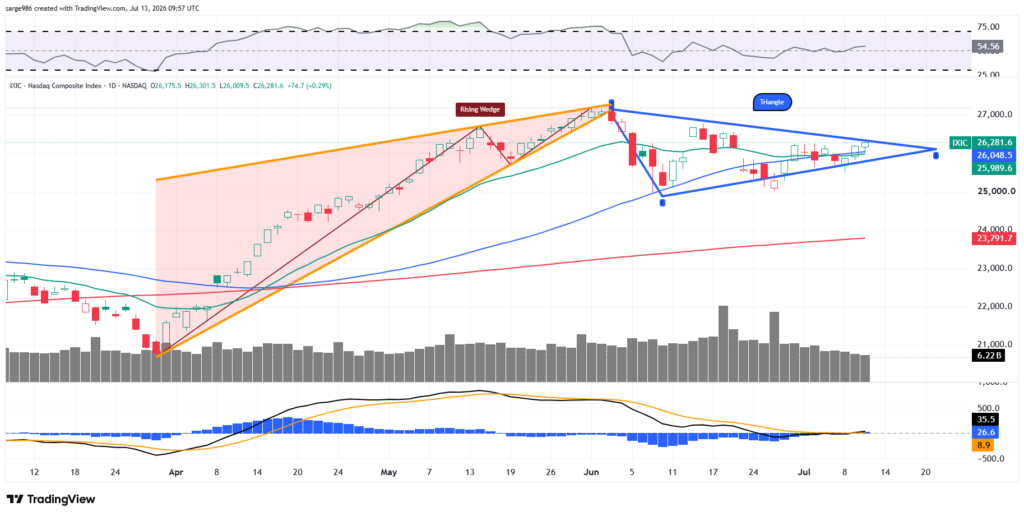
That pattern has been followed up by what looks to be a nearly completed triangle pattern. Now, triangles are tricky. These patterns do not foretell a directional move. They do, often foretell, upon their closing, a period of increased volatility. So, keep your helmets on and buckle your chin straps.
The indicators that I tend to lean on, Relative Strength and the daily moving average convergence divergence, went into the weekend in good shape. That said, neither is in good enough shape to withstand a significantly negative session.
Signs
Signs Signs
Everywhere there’s signs
F%&$ing up the scenery
Breaking my mind
Do this, don’t do that
Can’t you read the sign?
– Les Emmerson (Five Man Electrical Band), 1971
Earnings
As of July 10, according to FactSet, for the second quarter, Wall Street now expects to see year-over-year-earnings growth for the S&P 500 of 23.6%, up from 23.3% last week. Wall Street also sees revenue growth of 12.3%, up from 12.2% one week ago. For the second quarter, 49 S&P 500 companies have issued negative earnings guidance while 62 have issued positive guidance.
For the full year of 2026, Wall Street now looks for earnings growth of 24.2%, up from 24.1% last week, and up from 14.7% more than two months ago. This would come on revenue growth of 10.6%, down from 10.8% last week but up from 7.7% a rough 10-plus weeks ago. The outlook for the third quarter is also very positive. Third-quarter S&P 500 earnings growth is now estimated at 26.6%, year-over-year.
At the moment, the energy and technology sectors are projected to have grown Q2 earnings an absolutely jaw-dropping 122.9% and 63.3% respectively. Just one sector, health care (at -9.0%) is currently projected to have suffered a Q2 earnings contraction.
Valuation
Still using data provided by FactSet, the S&P 500 ended last week trading at 20.5-times 12 months’ forward-looking earnings, up from 20.4 times last week but down from 21.6 times more than ten weeks ago. This is still well above the five-year average of 19.9 times for the index as well as being well above its ten-year average of 19 times.
The S&P 500 also ended last week trading at 28 times trailing twelve months’ earnings, up from 27.8 times just one week ago, and also above levels that the index reached more than two months back. This also stands well above the five-year (24.5 times) and ten-year (23.4 times) averages for the index.
Only four of the eleven sectors are now trading below their five-year average valuations, down from six sectors one week ago. One sector, the REITs, is trading at its five year average PE ratio. Six sectors, led by the Industrials (25.5 times) are trading at a premium to their five-year average valuation.
Fed Funds Futures
Fed Funds futures trading in Chicago are currently pricing in a 64% probability (down from 78% a week ago) for no change to be made to the current target range (3.5% to 3.75) for the Fed Funds Rate at the culmination of the next FOMC policy meeting on July 29. There is no visible chance for a rate cut at the moment, but there is now a 36% likelihood being priced in for a rate hike being factored for.
There are no rate cuts fully priced in at any point in the future looking out toward year’s end 2027. That said, there is now a rate hike priced in for September 16th of this year (73% probability, up from 55%). That probability rises to 88% if given the rest of the calendar year 2026.
Economics (All Times Eastern)
2:00 p.m. – Federal Budget Statement (June): Last $-293B.
The Fed (All Times Eastern)
05:25 – Speaker: Reserve Board Gov. Michelle Bowman.
12:30 p.m. – Speaker: Reserve Board Gov. Christopher Waller.
Today’s Earnings Highlights (Consensus EPS Expectations)
Before the Open: FAST (.33)
At the time of publication, Guilfoyle had no position in any security mentioned.