The Monterey Collector Car Auctions Set Records, But Not All Cars Performed Equally
Can collector car auctions tell us anything about the economy? We answer this question here in the first of three articles covering Monterey Car Week.
Note: This article will be the first in a three (more?) part series on what I learned about economic strength from this year’s Monterey Car Week. A second article will discuss the overall vibe of Car Week and the conversations that I had. A third will be based on my interview with the head of Land Rover US.
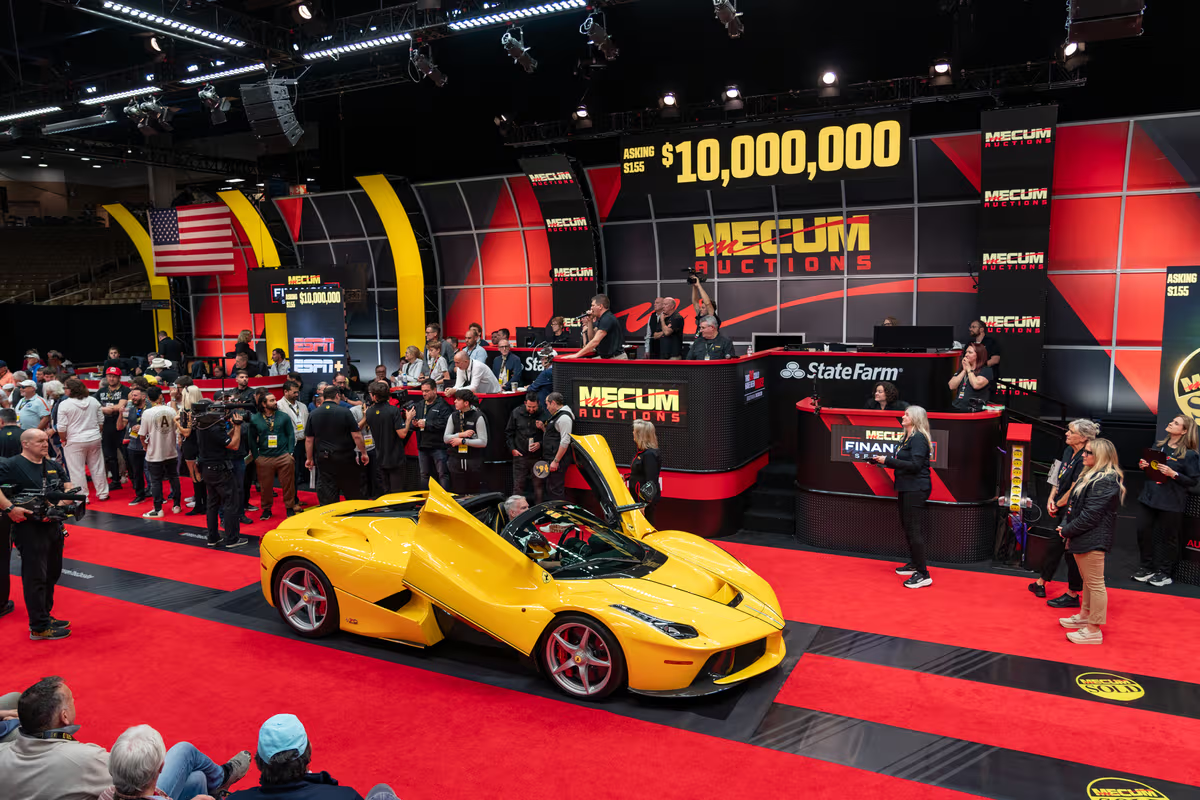
By the numbers, the Monterey car auctions were a huge success. According to Hagerty (HGTY), the five auction houses saw sales of $756 million, nearly $300 million over the prior record set in 2022.
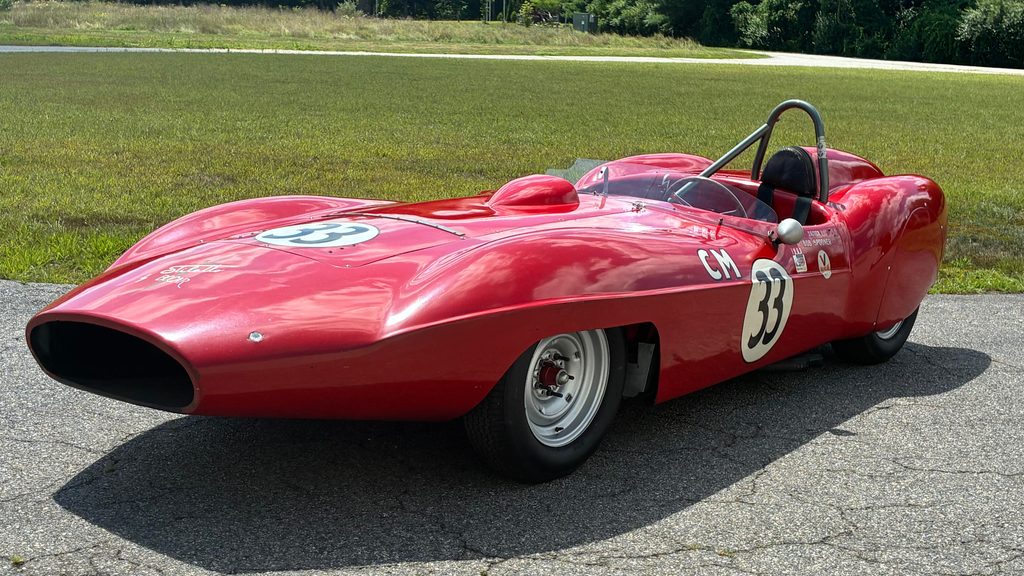
Here’s the thing. The top of the collector car market vastly outperformed everything else. If you were selling a car worth more than $500,000, you were probably happy. If you were selling something less exotic, even if it was historic, you were probably disappointed. Case in point, I threw in a lowball bid on a very rare 1962 Morgan +4 Super Sports factory lightweight and nearly won the car. My $30,000 bid was less than half of the minimum estimate. It sold for just over $35,000. And this 1950s Bocar Stiletto sports car, which once raced at Pikes Peak, failed to reach its reserve when bidding stalled at $50,000. It’s a special car that had a 6-figure estimate, but that wasn’t enough in 2026.
I tracked around 77 auctions, cars that I thought were bellwethers and could provide insight into the health of the market. They included 32 that were expected to sell for over $1 million and six, with expectations closer to $50,000 or below. In the end, the cars at the top of the market topped expectations, while those on the low end did not.
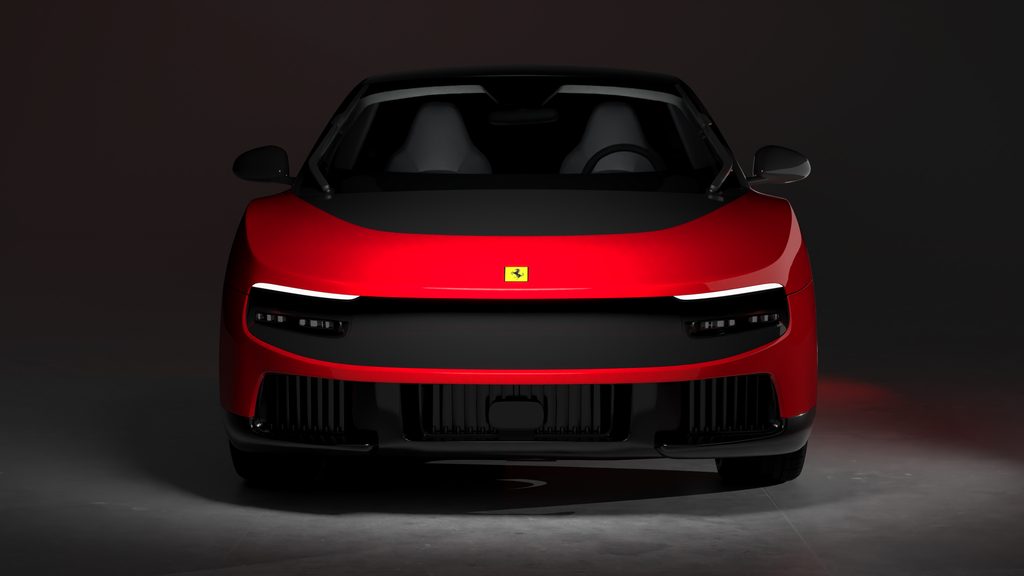
Let’s start with the $40 million that some guy paid for the new electric Ferrari, the Luce. This car was sold to benefit Ferrari’s own charity, which supports educational causes. The car is worth closer to $600k, and less if you listen to social media. It’s an outlier, and most analysts are removing it from the data. I’ll do the same, though it does support the case I make below.
High-End vs. Ordinary and Modern vs. Old
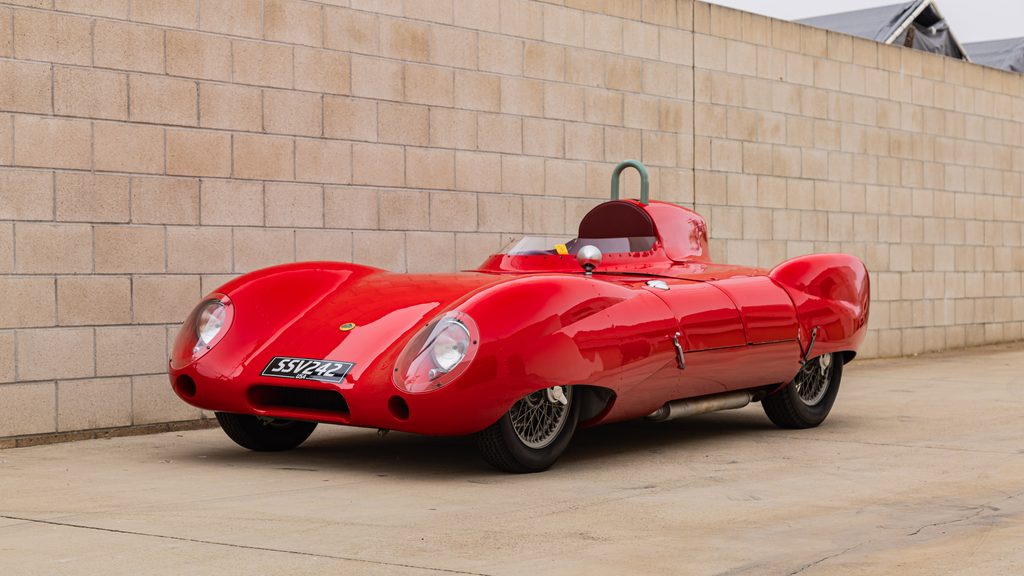
Pre-auction estimates are generally published as a range. Rather than compare the final selling price to the high or low estimate, I’m using the midpoint to get a single price. For example, this 1956 Lotus Eleven was estimated to sell for between $100,000 and $150,000. So I compared the car to its $125,000 midpoint. That car disappointed by nearly 50% when it sold for just $66,000. Someone got a bargain.
The cars being sold in Monterey included everything from ordinary collectibles you might see on your neighborhood streets, like a classic pickup truck, to museum pieces valued in the tens of millions of dollars. And they ranged in age from the early days of motoring through that 2026 electric Ferrari Luce. There really was something for everyone.
With such a broad range, I chose to divide the cars to tell two different stories: high-end vs. ordinary and newer cars vs. older cars.
Let’s start with the high-end vs. ordinary cars.
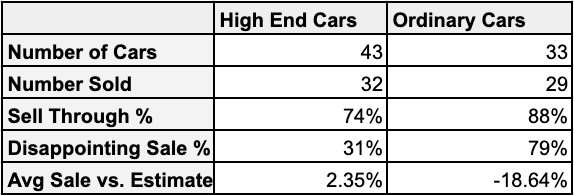
In the rarified world of Monterey auctions, I decided to call any car expected to sell for over $500,000 “high end.” There were 43 of those cars on my list, excluding the Luce. 32 of them sold at an average of 2.35% above their estimate. Just 31%, ten cars, had disappointing sales. Many of these cars will end up in museums or collections as investments, and not be driven.
Let’s call anything below that $500,000 threshold an “ordinary” collector car, even though many are anything but. Rather, these are the cars that mass affluent collectors might buy to drive and enjoy. This segment told a different story from the high-end cars. It was a story of low demand. While 88% of the 33 cars I tracked in this bucket were sold, the average selling price was 19% below the mean estimate. Only two cars beat their estimate, while 79% disappointed, selling for more than 10% below estimates.
Modern vs. Pre-1980
Many of the top sellers were modern hypercars. So, could the Monterey results be explained simply as a changing of the guard as Gen X and Millennial collectors buy what they love, while the Boomers stayed home? That’s a good thesis, but only partially true.
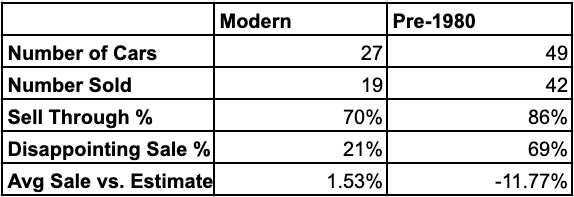
I tracked 27 modern cars from 1980 through today. 19 of those cars were sold at an average of 1.5% above their estimate. Just 21% disappointed, while eight, 30%, were no-sales. So, really, the auction houses nailed the demand for those cars.
On the other hand, I tracked 49 cars from before 1980. 42, or 86%, of those were sold, which was a strong result. However, many of those sales were disappointments. 69% of those 42 cars were sold for at least 10% below their mean estimate. On average, the pre-1980 cars sold for 11.77% below their mean estimates.
Combining Price and Age Categories – High End Cars
So far, the higher-end cars outperformed the ordinary cars, and newer cars beat older cars. Let’s dig deeper.
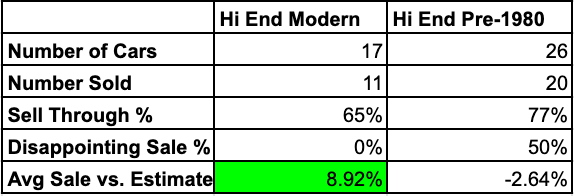
The 11 modern high-end cars that sold outperformed the 20 pre-1980 high-end cars. The modern cars didn’t suffer a single disappointing sale (excluding the 35% no sales) and sold for an average of nearly 9% above estimates. The pre-1980 cars had a higher sell-through rate, though 50% of the sales were more than 10% below estimates, and the average sale was 2.64% below the estimate.
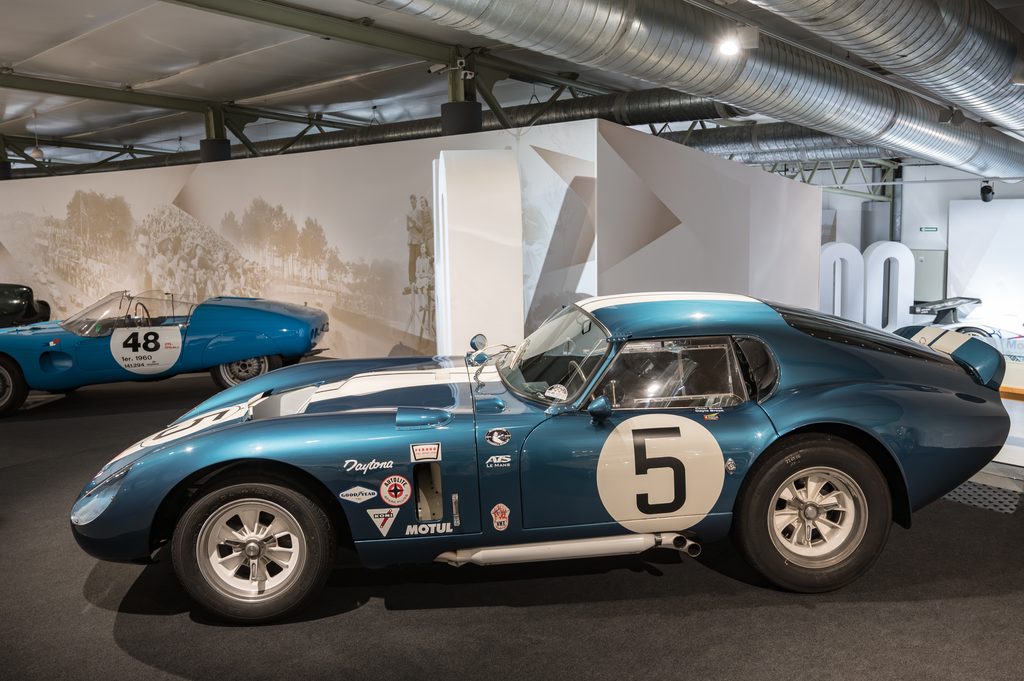
Actually, the top-performing category overall was those modern high-end cars, although the top seller at any of the Monterey auctions fell into the High End, Pre-1980 category, a 1964 Shelby Cobra Daytona Coupe similar to the one in this picture.
Combining Price and Age Categories – Ordinary Cars
If the top performers were among the modern high-end cars, are the worst performers among the pre-1980 ordinary cars?
I tracked 10 ordinary modern cars. 80% were sold for an average of 8.64% below estimates. While the sell-through rate was strong, the prices were not. However, the 92% of the 24 pre-1980 ordinary cars that sold went for an average of 20.08% below the estimate. High sell-through, but disappointing sales.
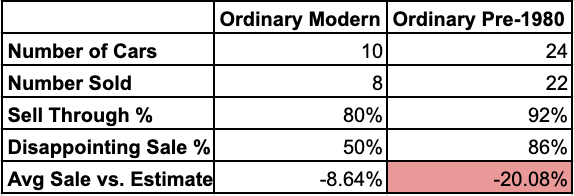
So, yes, the worst performing category was the pre-1980 ordinary group, which included a 1967 Corvette 427/400 coupe and a Porsche 911S from the same year.
Insights
Back to the Ferrari Luce. While it’s reasonable to remove it from the analysis, it shows that there’s plenty of money sloshing around, just waiting for the right opportunity. In this case, the car was secondary. The charity, and perhaps the noise the sale generated, was the reason.
However, the auctions highlighted a change in the market. The modern high-end cars I tracked sold for an average of $8.6 million, again, excluding the $40 million Ferrari Luce. Those cars sold for an average of 9% over their estimates. That’s serious cash and shows that the billionaire class is buying. The rest of us, not as much.
That begs the question: Was Monterey an anomaly? I don’t think so. The market for older sports cars like the Porsche 356 or anything British has been flat to lower for the last few years. According to Hagerty, prices for a bellwether 1950s Beetle have fallen by more than 30%. Same with Jaguar’s XK 120. It’s the cars that younger collectors desire that are increasing in value. Cars that might have been on a poster in a teenager’s room over the last 40 years are the cars that people are collecting now. The problem is that those cars trade for prices that few of us can buy.
The good news is that those of us who had been priced out of the market over the last decade can now buy that driver-quality Alfa Romeo Giulietta or Corvette. They’re truly special cars and should be enjoyed on the open road.
So, what does this mean for the stock market and the economy? Again, the uber wealthy have money to spend, and they’re spending it, while the rest of us are being cautious. We’re buying, but at prices that offer a margin of safety because we’re worried about the future. That shows in the stock market, too. The big tech names are leading, while the rank-and-file stocks are underperforming. This is just one datapoint, but it’s an important one.
There’s more to come on this topic. Look for two more articles in the coming weeks based on my visit to Monterey. I hope you enjoyed this.

Conversation