Taiwan Semi to Hike Prices, AMD Advances, Iran Fighting Expands
Here’s the latest on the war with Iran, threatened tariffs on Canada, and the semiconductors as AMD & Microsoft cozy up with Helios deal.
You've reached your free article limit
You've read 0 of 1 free Pro articles.

As you slept, yet another oil tanker was attacked by Iranian forces while trying to traverse the Strait of Hormuz. This tanker happened to be the Kuwaiti-flag Kaifan. That ship was hit by a still unidentified projectile northeast of Limah in Oman. This attack came after strikes on several tankers owned by Greek shipper Dynacom had taken place over several days. According to Bloomberg News, exactly zero ships have successfully transited the Strait so far on Tuesday.
For the week ended Sunday, July 19, still citing Bloomberg, crossings averaged just seven tankers per day, down from 16 per day the week prior. For the sake of comparison, the pre-war average was in the 130s. Further complicating the situation, the Iranian-backed Houthis in Yemen, have stated an intention to impose a maritime blockade of Saudi Arabia via the Red Sea. For those readers that are not students of geography, all Saudi Arabian oil must be exported via either the Strait of Hormuz or the Red Sea. Saudi Arabia, for your information, is the world’s second largest exporter of crude oil (about 6 million barrels per day) behind only the U.S.
On that note, U.S. forces hit targets inside Iran for a tenth consecutive day on Tuesday. On Monday, after an Iranian missile had fatally hit a U.S. barracks facility in Jordan over the weekend, Pres. Trump posted to social media, “Every time Iran kills an American Soldier they will pay for that killing many times over.”
Readers will notice that despite what appears to be the expansion of hostilities, crude prices have eased and equity index futures are trading higher. Reuters is reporting that mediators have proposed a 10-day ceasefire. The U.S. has reported that a rough 100 service members have suffered some degree of injury since the resumption of open warfare on July 7. Fortunately, it appears that 96 of those service members have already returned to duty, implying that perhaps most of those injuries were less than severe.
Oh, Canada!?
On Monday, the Trump administration announced an intention to impose a 50% tariff on some imports from Canada over what the administration calls the unfair treatment of U.S. exports in Canada of alcohol, automobiles, and dairy products. Interestingly, there is no exemption mentioned for exporters shipping under the rules of the USMCA pact, which replaced the NAFTA deal. Overall, about 5% of Canadian imports are on the new list. The tariffs are set to go into effect in 30 days. The U.S. president has often used these kinds of threats as a negotiation tactic. He has also often used the time in between such an announcement and implementation as an opportunity to cut a deal. We shall see.
Chips are Hot Tonight
Early on Tuesday morning, Japanese news service Nikkei reported that Taiwan Semiconductor (TSM), easily the world’s largest silicon foundry, has held discussions with clientele about increasing prices by as much as 10% in 2027. TSM is the main producer for household names such as Apple (AAPL), Alphabet (GOOGL), Amazon (AMZN) and Nvidia (NVDA) among many others.
These price changes will impact both advanced (smaller) and legacy or mature (larger) chips. TSM, despite announcing plans to increase its own capital spending, is pushing its price increases out into next year in order to give customers the necessary time to adjust. TSM’s primary U.S. competitor in the foundry business, though still far behind, is Intel (INTC).
More on Chips
Shares of Advanced Micro Devices (AMD) closed up 1.6% on Monday and are up another 4% overnight after announcing the expansion of a strategic partnership with Microsoft (MSFT)’s Azure cloud service. Azure is set to deploy AMD’s Helios Rack-scale Solution for large-scale AI inference and support Azure AI services. Helios is meant to compete directly against Nvidia’s (NVDA) GB200 NVL 72 rack-scale system. The aim is to be able to efficiently run workloads such as “Large Language Model” training and inference as well as provide for agentic artificial intelligence for hyperscaler/enterprise type clients.
This enhanced collaboration will also include the new AMD EPYC central processing units and broader adoption of Pensando data processing units across Microsoft’s cloud platform. What Helios does is integrate Instinct MI455X graphics processing units, EPYC Venice CPUs, Pensando networking, and ROCm software into a unified artificial intelligence-capable infrastructure platform. The rapidly growing AI data center market may need as many rack-scale systems as both AMD and Nvidia can provide. Just an opinion there. You know I’m long both. Both are in my Top 10 positions. I do have more exposure at present to AMD.
Monday’s Markets
Treasury yields ran higher on Monday with the U.S. Ten-Year Note paying 4.6% (+5 bps) by day’s end and the Two-Year Note paying 4.22% (+4 bps). This pressure on debt securities was a little too much for equity markets, that had been trading higher for most of the day, to bear. Stocks sold off into the afternoon on Monday.
On the day, the S&P 500 gave up 0.19% as the Nasdaq brothers closed almost unchanged. (The Nasdaq Composite was down 0.05% while the Nasdaq 100 was up 0.04%.) The small to mid-cap indexes struggled through the session. losing between 0.67% and 0.81%. The Dow Transports and KBW Banks both surrendered more than 1% for the session. Only the semis, coming off of an awful week, were able to hold their gains at all into the closing bell.
Breadth & Chart
Breadth was weak on Monday. Losers beat winners at the NYSE by a rough 5 to 3 margin and by about 9 to 5 at the Nasdaq. Advancing volume took just a 44.3% share of composite Nasdaq-listed trading volume on Monday and about a 43.6% share of NYSE-listed trade. Trading volume, however, lightened up on Monday. Aggregate trade was down 8.1% on a day over day basis across Nasdaq-listed names and down 2.9% across NYSE-listed stocks. This does detract from the seriousness of Monday afternoon’s late sell-off.
Only three of the 11 S&P sector SPDR ETFs closed out the day in the green on Monday. Interestingly, Energy (XLE) led along with the two growth sectors. There was no real outperformance visible behind that concerning the never-ending tug of war between cyclical and defensive sectors.
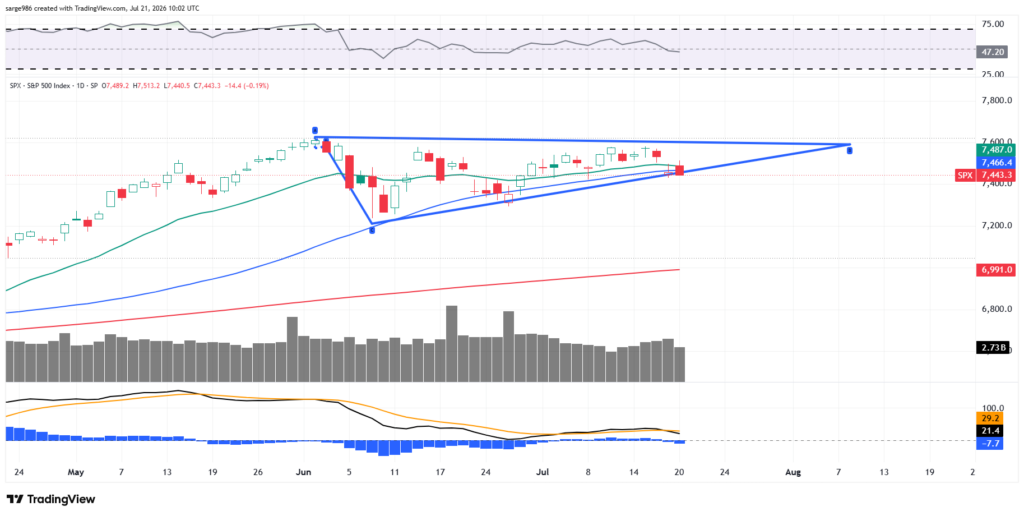
Readers will see that the S&P 500 has been testing its 50-day simple moving average from above. Should that line, which is running close to concurrently with the lower trendline of the above triangle pattern, hold, that would be a big deal. Like the Nasdaq Composite, the S&P 500 has developed this triangle.
The closing of any triangle often foretells an explosive move without signaling direction. Unless that triangle resembles either an ascending or descending triangle. Notice the flat top. This is an ascending triangle, which is a pattern of bullish continuance. We just need that 50-day line to hold. That would keep the professional money from heading for the door.
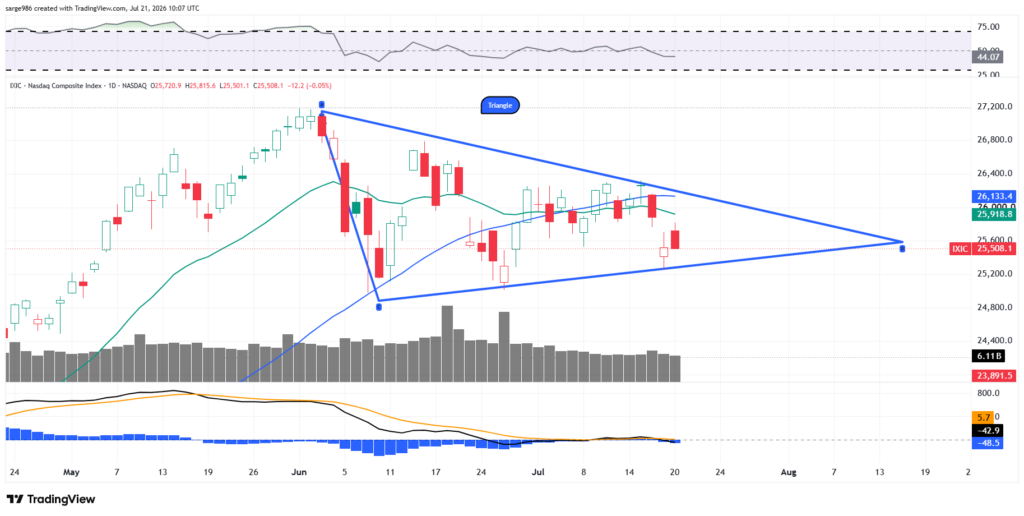
For comparison’s sake, this is the Nasdaq Composite’s triangle, which is just a triangle. No flat top. No flat bottom. This signals an explosive move without telling us much else. The S&P 500 though? That looks like a directional signal and that direction is northerly in nature.
Economics (All Times Eastern)
08:15 – ADP Employment Change (Weekly): Last 19.75K.
08:55 – Redbook (Weekly): Last 8.2% y/y.
4:30 – API Oil Inventories (Weekly): Last -56K.
The Fed (All Times Eastern)
Fed Blackout Period.
Today’s Earnings Highlights (Consensus EPS Expectations)
Before the Open: MMM (2.25), DHI (2.98), DHR (1.84), GM (3.18), HAL (.54), HAS (1.13), NOC (6.82)
After the Close: CB (6.73)
At the time of publication, Guilfoyle was long TSM, AMZN, INTC, AMD, MSFT, NVDA equity.