Job Growth Rebounds to 3-Month High as Manufacturing Hits Four-Year High
ADP’s gauge of private payrolls beat expectations on a rebound in goods producers.
You've reached your free article limit
You've read 0 of 1 free Pro articles.

US ADP Employment Change Sept: 90K (est 75K; prev 38K; prev R 36K)
Executive Summary
- September ADP job growth rebounded to 90,000, the most in three months and above expectations for 75,000, up from a downwardly revised 36,000 in August. The three-month average, though, slipped again to 57,000 from 58,000, a fourth consecutive decline from the June peak of 107,000.
- Services added 59,000, essentially in line with its 12-month average, with education and health services accounting for more than half the total gain, leading all sectors for a 12th straight month.
- Goods producers then drove the improvement, adding 31,000, the best month since March after shedding 10,000 in August. Manufacturing added 17,000, its strongest showing since September 2022.
- Weakness was concentrated in white-collar services. Financial activities lost 16,000, its first decline in 11 months, and professional and business services lost 11,000, a second straight decline and now down 91,000 year-to-date.
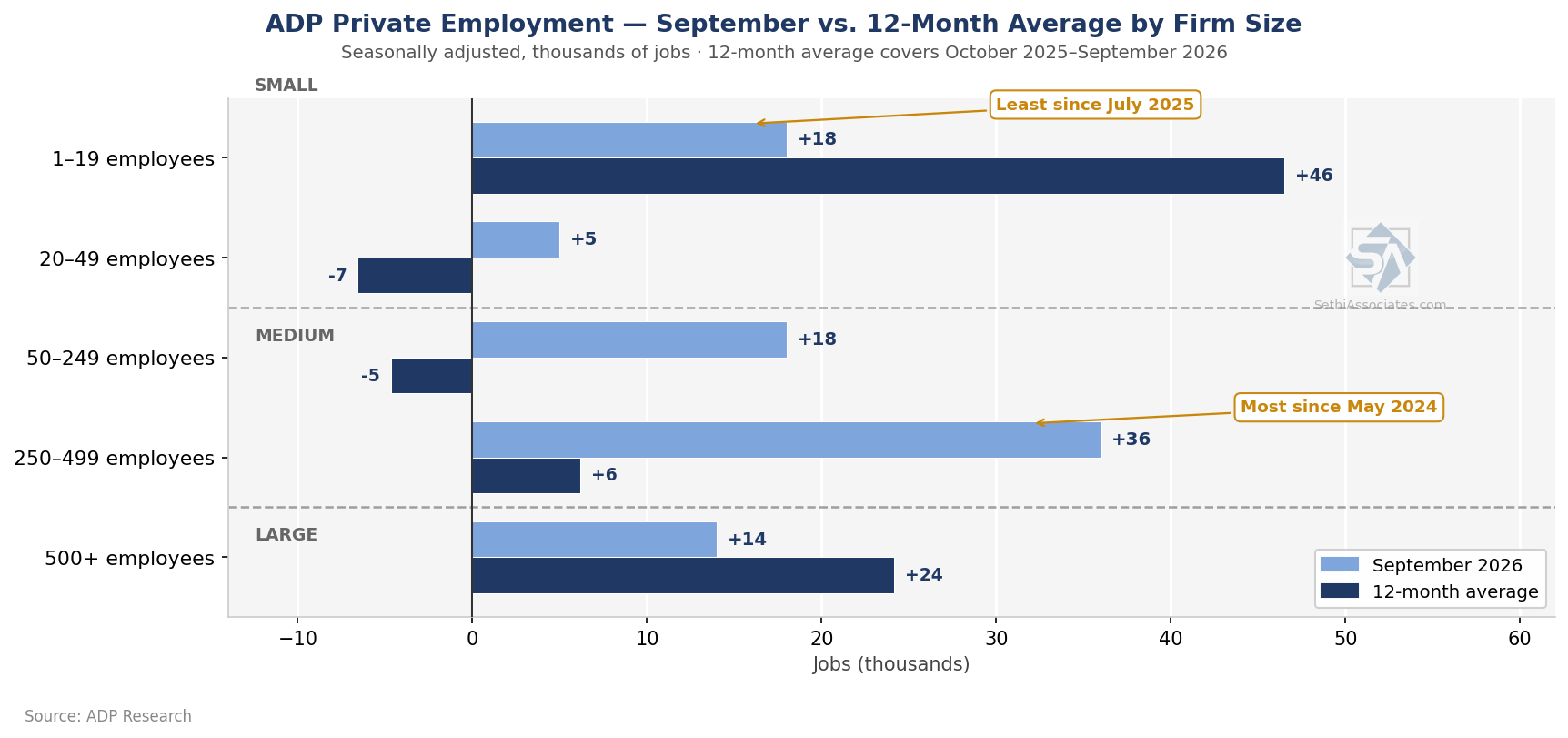
- All five establishment size tiers added jobs for the first time since June, but leadership rotated: firms with 250 to 499 employees added 36,000, the most since May 2024, while the smallest firms slowed for a fourth straight month.
- Median gross pay growth for job-stayers held at 4.4% year-over-year for a seventh straight month, while job-changers eased to 7.3% from 7.4%.
September ADP
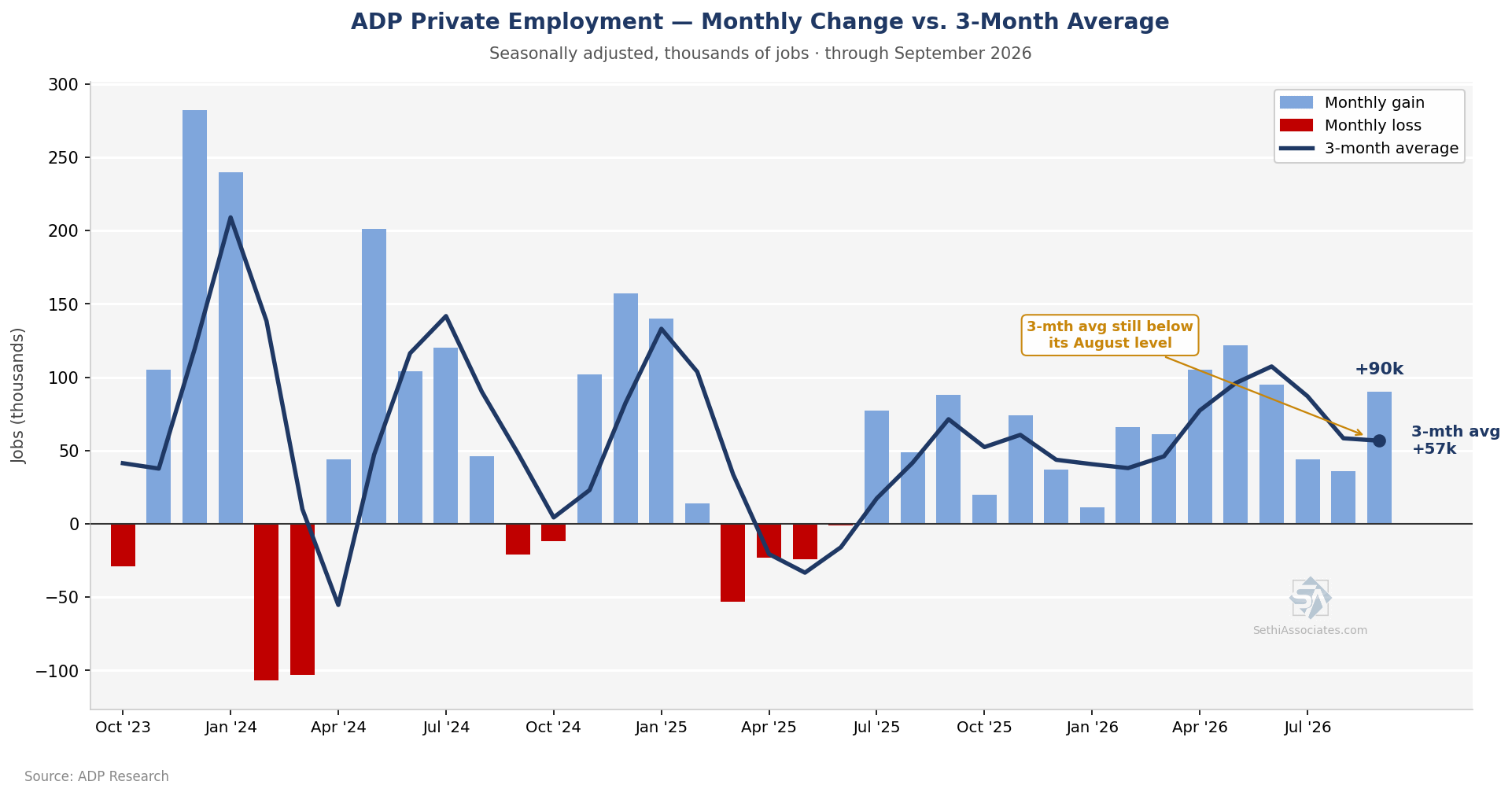
Private employers added 90,000 jobs in September, the most in three months, above the 75,000 median estimate in a Bloomberg survey and up from a downwardly revised 36,000 in August (from 38,000). It was the 15th straight month of job gains, and as ADP noted, the first acceleration since May.
The three-month average though slipped to 57,000 from 58,000 — a fourth straight monthly decline from the June peak of 107,000, as June’s 95,000 rolled out of the window. Year-to-date, private sector job growth stands at 630,000, averaging 70,000 a month.
“It’s a strong report,” said Dr. Nela Richardson, chief economist at ADP and a contributor to Bloomberg Television, in a statement. “After a three-month slowdown, job creation rebounded and pay growth remained solid.”
Sectors
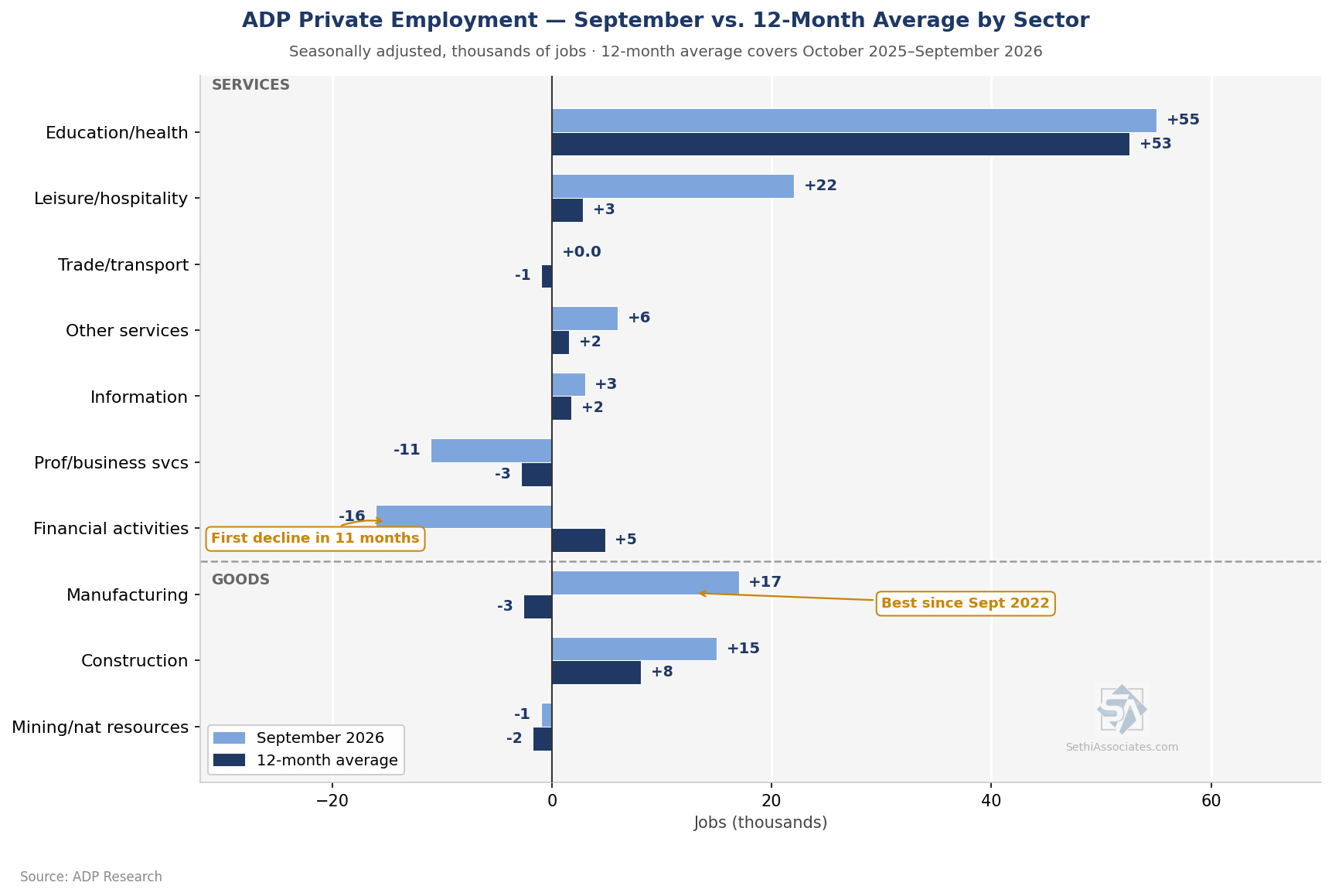
Services added 59,000 after 46,000 in August, roughly in line with the 12-month average of 60,000, continuing to be led by education and health services, the top sector for a 12th straight month:
- Education and health services added 55,000, the best since May. As Bloomberg noted, more than half the total ADP headline gain has come from this one sector (up 461,000 year-to-date, up 631,000 over the last 12 months).
- Leisure and hospitality added 22,000 after 18,000, the best since August 2025 and a second strong month following the July decline (up 54,000 year-to-date, up 34,000 over the last 12 months).
- Other services added 6,000 after 5,000, a fifth straight positive month (up 23,000 year-to-date).
- Information added 3,000 after losing 4,000 (up 26,000 year-to-date, up 21,000 over the last 12 months).
- Trade, transportation and utilities was flat after losing 7,000 (up 19,000 year-to-date, but down 12,000 over the last 12 months).
- Professional and business services lost 11,000 after losing 15,000, a second straight decline and by far the weakest sector of the year (down 91,000 year-to-date, down 34,000 over the last 12 months).
- Financial activities lost 16,000 after adding 7,000 — its first decline in 11 months and the worst since September 2025, a 21,000 swing below its 12-month average of roughly 5,000 (up 47,000 year-to-date, up 58,000 over the last 12 months).
Goods producers added 31,000 after losing 10,000 in August, the best month since March and far above their 12-month average of roughly 4,000.
- Manufacturing added 17,000 after losing 15,000 in August — the strongest month since September 2022 and a striking reversal for a sector averaging losses of roughly 3,000 a month over the past year (down 14,000 year-to-date, down 31,000 over the last 12 months).
- Construction added 15,000 after 10,000 in August, a ninth straight positive month and the best since March (up 107,000 year-to-date, up 97,000 over the last 12 months).
- Natural resources and mining lost 1,000 after losing 5,000 in August, a fifth straight decline (down 2,000 year-to-date, down 21,000 over the last 12 months).
Establishment Size
All five size tiers added jobs for the first time since June, but the leadership rotated sharply to the middle of the distribution.
- The smallest business, firms with 1 to 19 employees, added 18,000 after 22,000 in August, a fourth straight monthly deceleration and the least since July 2025. That tier has been the engine of this report, up 558,000 over the last 12 months against a national total of 772,000, but it has slowed every month since May (up 391,000 year-to-date).
- Firms with 20 to 49 employees added 5,000, the first gain in three months, after losing 14,000 (down 7,000 year-to-date, down 79,000 over the last 12 months).
- Firms with 50 to 249 employees added 18,000 after losing 3,000 (up 50,000 year-to-date, though still down 56,000 over the last 12 months).
- Firms with 250 to 499 employees added 36,000, the most since May 2024, after losing 5,000 (up 55,000 year-to-date, up 74,000 over the last 12 months).
- Firms with 500 or more employees added 14,000 after 34,000 (up 154,000 year-to-date, up 290,000 over the last 12 months).
Regions
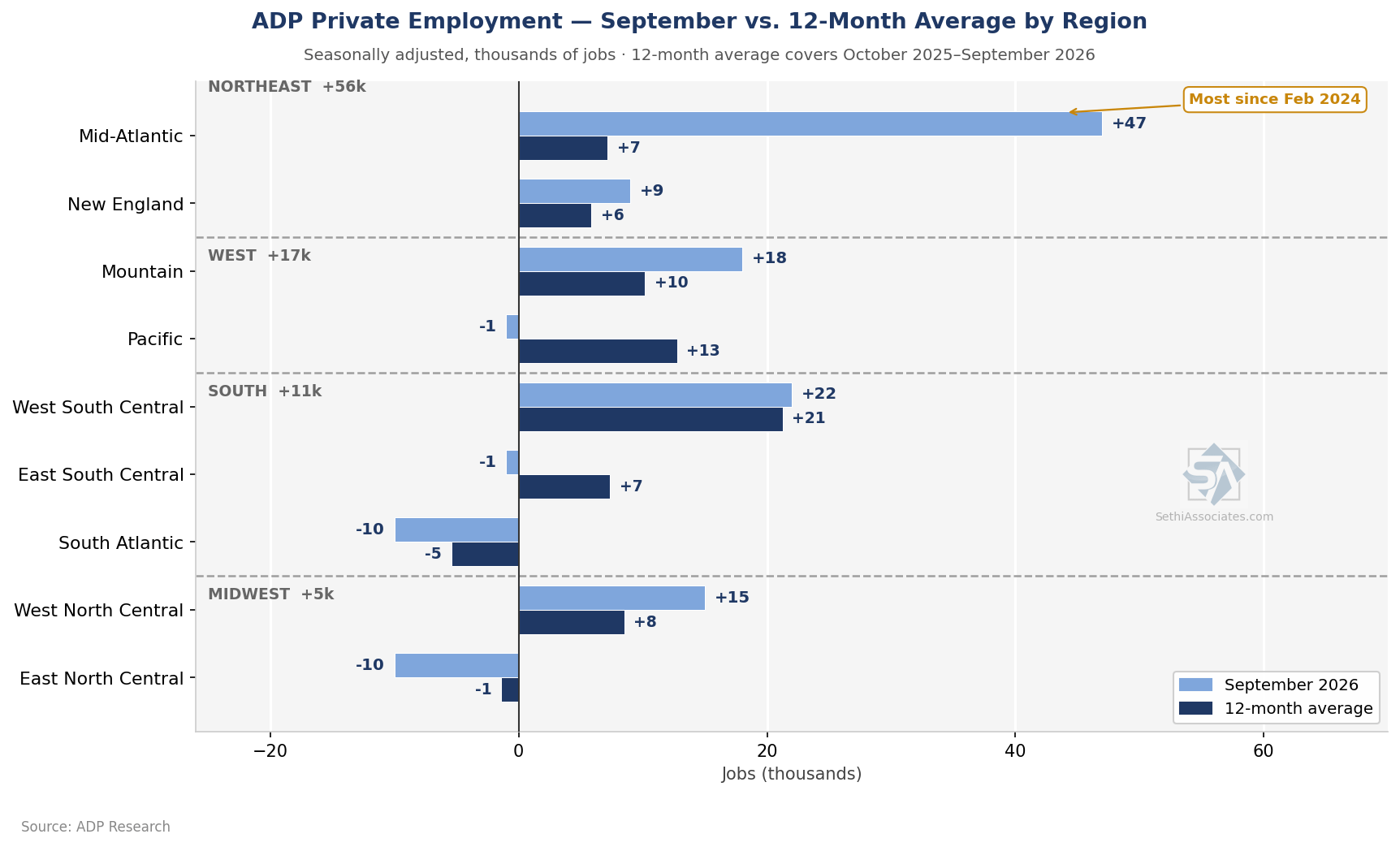
- The Northeast led with 56,000, the best since February 2024, driven by the Mid-Atlantic’s 47,000 — also its strongest since February 2024 — with New England adding 9,000.
- The West added 17,000 as the Mountain division added 18,000 and the Pacific lost 1,000.
- The South added 11,000, with the West South Central up 22,000 offsetting the South Atlantic’s 10,000 decline and the East South Central’s 1,000 decline.
- The Midwest added 5,000, as the West North Central’s 15,000 gain outweighed a 10,000 decline in the East North Central.
Pay
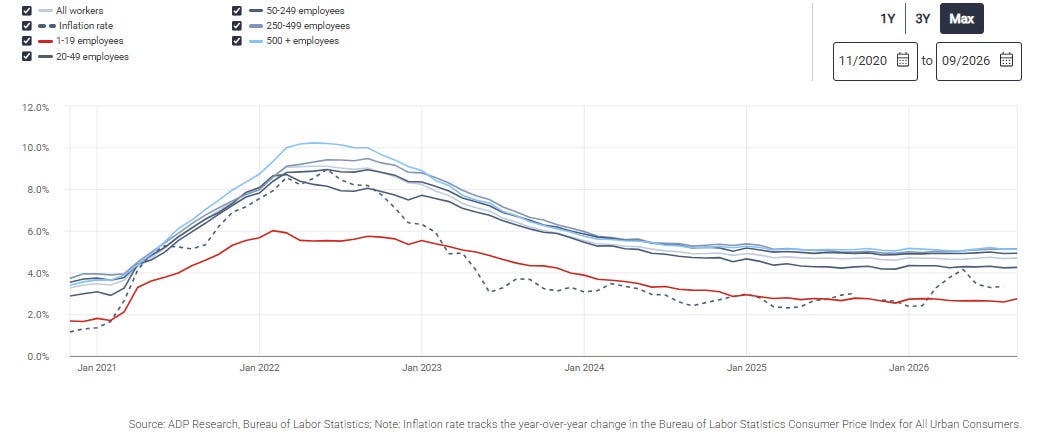
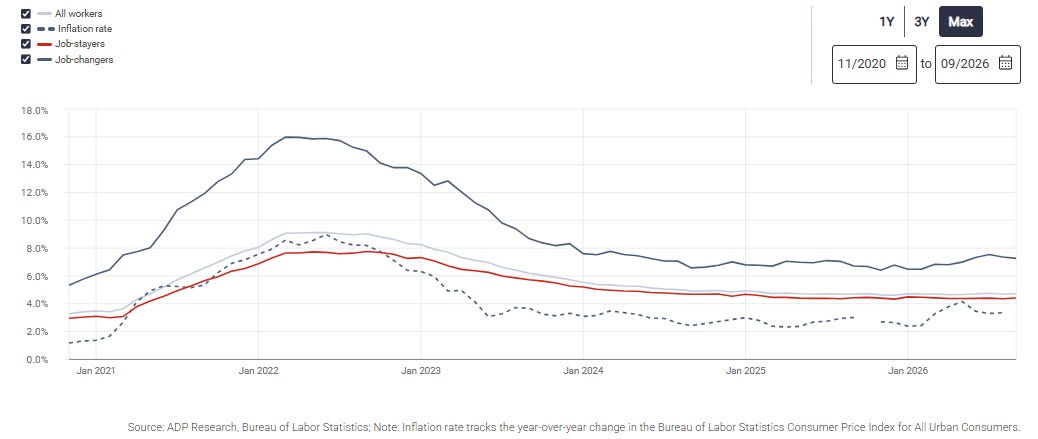
Median gross pay growth for job-stayers held at 4.4% year-over-year for a seventh straight month, while job-changers eased to 7.3% from 7.4% in August. The job-switching premium narrowed slightly to 2.9 percentage points from 3.0, but remains well above the 2.0 points of last November. On ADP’s base pay measure, job-stayers held at 3.0% and job-changers ticked up to 4.8%.
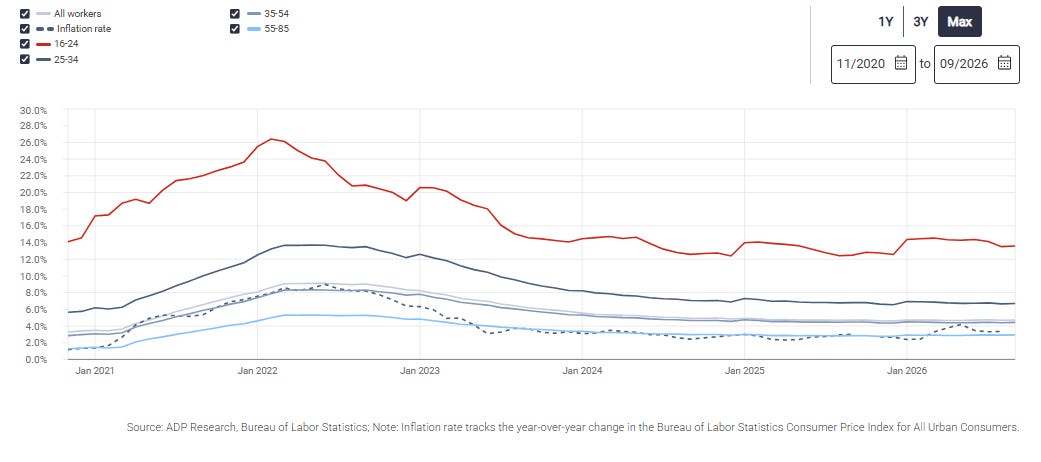
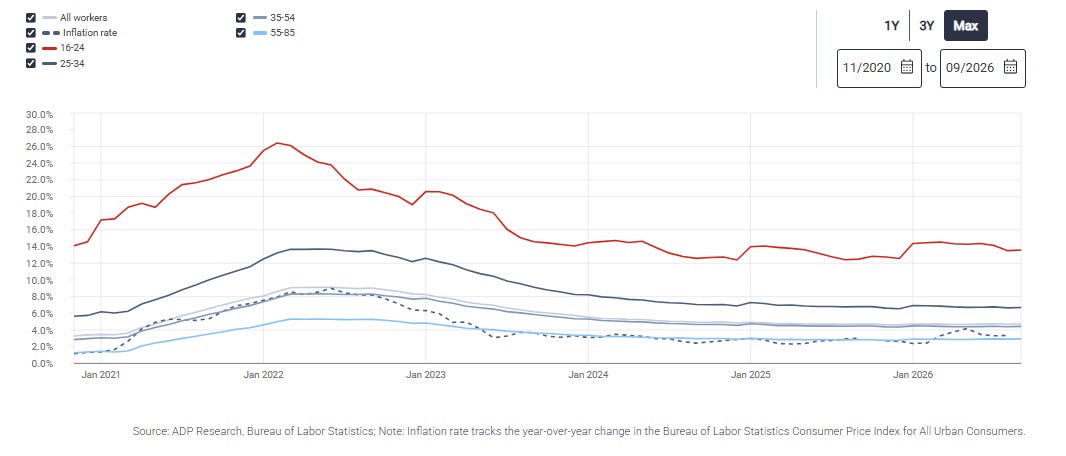
Wage growth remains heavily skewed toward the youngest and lowest-paid workers. By age, 16 to 24 year-olds saw 13.6% growth against 2.9% for those 55 and older.
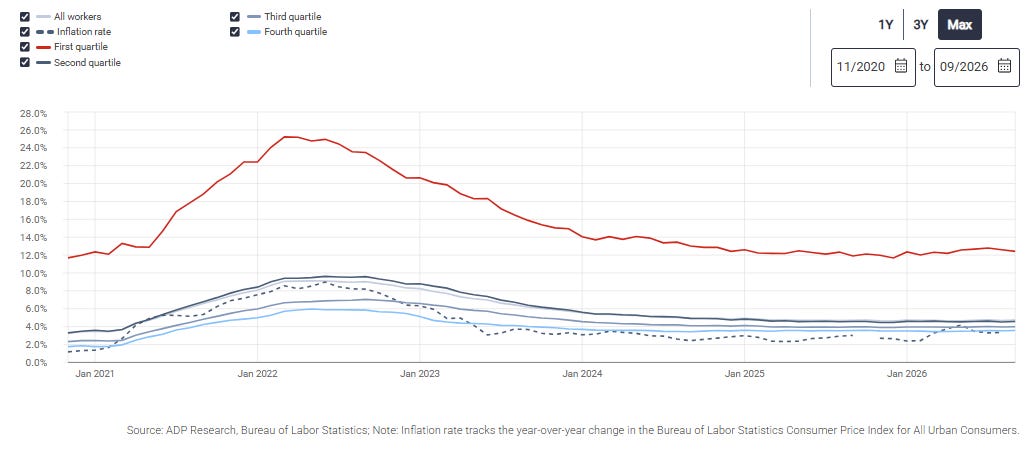
By pay quartile, the bottom quartile ran 12.4% against 3.6% for the top.
By gender, both men and women were at 4.7%.
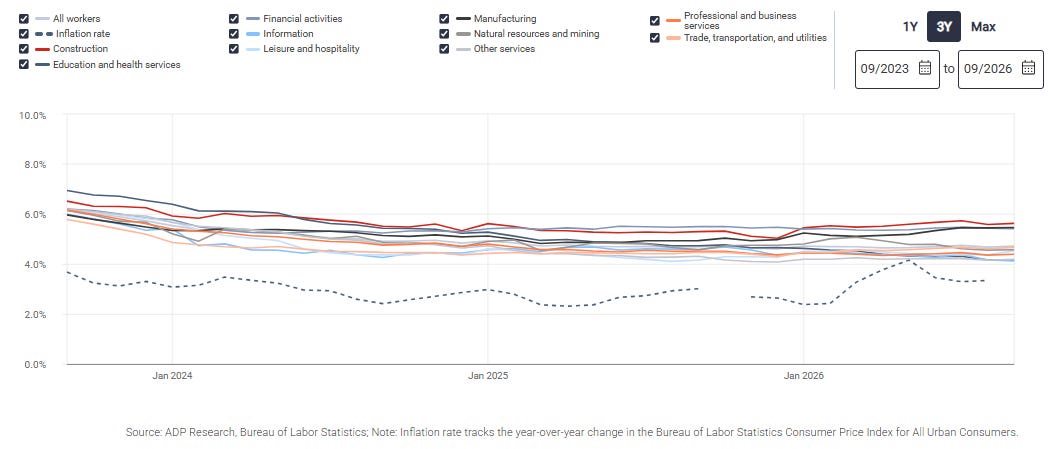
By sector, construction led at 5.6%, followed by manufacturing at 5.5% and financial activities at 5.4%. Trade, transportation and utilities was 4.7%, natural resources and mining 4.6%, leisure and hospitality 4.5%, professional and business services 4.4%, education and health services and other services both 4.2%, with information the laggard at 4.1%.
By firm size, the gap between the smallest and largest firms persists: firms with 1 to 19 employees at 2.8% vs 20 to 49 at 4.3%, 50 to 249 at 4.9%, 250 to 499 at 5.2% and 500 or more at 5.1%.