Feeling the Weight of the Market
Investors must now adapt to a changing environment as we approach the midterms, the fighting with Iran continues, and we’re getting AI warnings.
You've reached your free article limit
You've read 0 of 1 free Pro articles.

You know what this market is starting to feel like? It’s starting to feel like having to carry a certain amount of gear on foot in a heavy rain. The more it rains, the heavier the gear gets. The heavier the gear gets, the more it makes one think about shedding unnecessary items. The more it rains, the more slippery the fitting as we continue to travel over dirt, over rocks, and over vegetation. Yep. That’s at least how I’m starting to feel.
In actuality, equity markets have hung in there pretty well. While rising inflation has been a pain in the tail for most of the year, driven by upward pressure on oil prices that really should have been more temporary than this, stocks have had a decent year. To date. The “to date” tag is key here. The S&P 500 closed on Monday afternoon, up 11.3% for 2026, as the Nasdaq Composite closed up 12.7%. The Philadelphia Semiconductor Index has been our year-to-date champion. Despite giving up 5.9% on Monday, that narrow but important index is up a more than impressive 57.2% for 2026.
That said, the S&P 500 has given back 2.5% since posting its most recent all-time high a month ago. Over that same time frame, the Nasdaq Composite has lost 2.6%. The Philadelphia Semiconductor Index, get this, has lost 24.1% since apexing back in late June. That’s right, the U.S. equity engine is up 57% for 2026, despite being down 24% since late June.
Not whining. Not at all. Been there. Done this. A few times over. I have, very gratefully, had a long career. That said, for the younger or newer kids … unless one knows how to squirrel away some dough and live somewhat conservatively when one is kicking tail, paying the bills gets complicated for professional traders when the market does not offer us what we need on a silver platter. Professionals know how to or at least learn how to narrow exposure, change posture and raise cash levels when it gets difficult.
The level of difficulty is increased when the bond market sells off alongside stocks. The level of difficulty is increased when the policymakers are not allies. This does not disparage policymakers. We do want them to be legitimate economists who try to do what they think is the right thing for the economy that will benefit the majority of those participating in said economy. It’s just that sometimes, they make it easy for us.
While the replacement of human traders by high-speed algorithms has made markets less fair for small investors, by causing illogical price overshoot, it has made intraday trading easier for those of us who can read charts. That’s because algorithms are, despite the best efforts of those writing them, easier to understand and reverse-engineer on the fly than would be the semi-emotional mind of an actual opponent. That aids the short-term trader, but the investor a bit less. The investor still has to understand economics, policy, fundamentals and technicals as well.
Simply put, understand that we are in a changed environment. The Fed, tomorrow, is a short-term catalyst that is probably mostly priced in at this point. The mid-term elections in early November are the next irregularly timed catalyst. I don’t know if markets will react well to anything but expected gridlock. The inability to increase federal spending recklessly might be taken well by financial markets. Well, my even-tempered rant is over. You know what you have to do. Understand, Identify, Adapt, Overcome and then carry on. That’s how we roll.
How will you ever know if the Sarge got himself into a jam? That won’t be hard. I never want to work for anyone else ever again. I have been living solely off of my ability to trade and invest since 2016. I even gave half of my wealth away in a divorce settlement. You see me taking on a role where I am not the kid running the show? Then you’ll know I got myself into a jam. Rock on.
Tuesday Afternoon
Tuesday afternoon
I’m just beginning to see
Now I’m on my way
It doesn’t matter to me
Chasing the clouds away
Something calls to me
The trees are drawing me near
I’ve got to find out why
Those gentle voices I hear
Explain it all with a sigh
– Justin Hayward (The Moody Blues), 1967
Overnight
U.S. equity index futures traded lower yet again, ahead of Tuesday’s regular session as markets wait for the Federal Open Market Committee’s policy decision and press conference on Wednesday afternoon. Fed Fund futures trading in Chicago are now pricing in a 95% probability for a 0.25 basis-point rate hike, which would take the benchmark overnight rate up to a range spanning from 3.75% to 4.00%. That’s up from an 86% likelihood just 24 hours ago and just a 60% likelihood a week ago.
Meanwhile, as the yield paid on the U.S. 10-Year Note rose to 5.02% (from 4.98% last night), front-month WTI Crude traded up to a rough $104 per barrel from less than $101 last night and less than $94 as recently as last Wednesday. This has happened as the Saudis were forced to shut a key pipeline that bypasses the Strait of Hormuz by Iranian-backed Houthi rebels and fresh attacks by Iranian forces on civilian vessels in the Persian Gulf force continued concerns regarding global supplies.
Manic Monday?
We already know that at the index level, U.S. stocks sold off on Monday and look to stand on weaker footing on Tuesday. The fun and games really kicked off over the weekend, as a bevy of U.S. AI-industry leaders warned about slowing down the advance of this technology and showed a preference for building some kind of guardrails so as to avoid an extinction event. Oh joy. Do I believe this is about avoiding extinction or slowing down the competition? Maybe a bit of both, to be honest.
Now, breadth was tricky on Monday. It wasn’t awful, but trading volumes finally popped. Eight of the 11 S&P sector SPDR ETFs closed out the Monday session in the red led lower by tech (XLK) as the semis were pounded. The industrials (XLI) and utilities (XLU) also suffered heavy losses. Communication services (XLC) was the big winner as internet stocks swam upstream. Overall, defensive sectors, sans the Utilities, outperformed more cyclical sectors.
Check this part out. Losers beat winners at the NYSE by a rough three to two and at the Nasdaq by about five to four. Negative, but not a rout. Advancing volume took a 42% share of composite NYSE-listed trade and get this, a 49.1% share of composite Nasdaq-listed activity. Again, negative. Again, definitely not a rout.
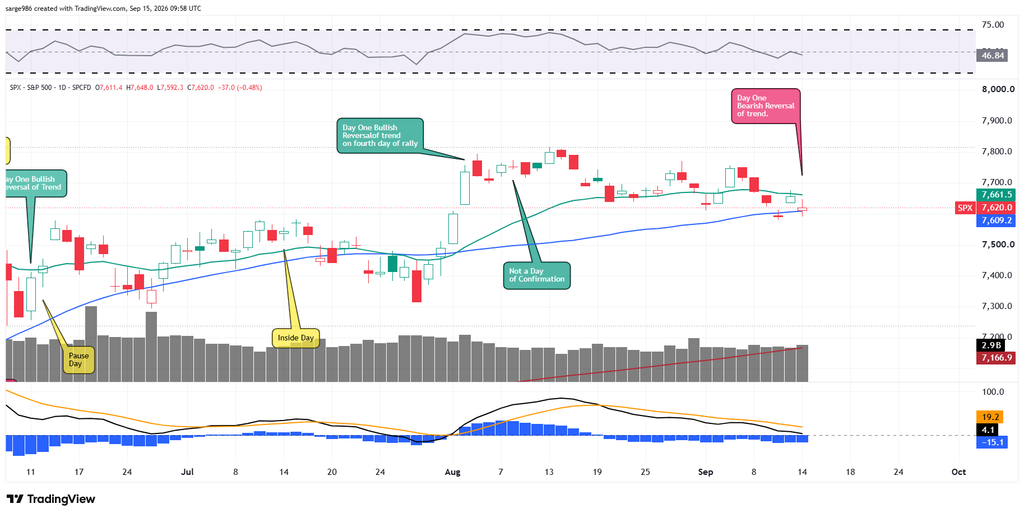
Now, for aggregate trading volumes. On a day-over-day basis, activity was up 5.1% across NYSE-listings and up 9% across Nasdaq-listings. Activity was also finally higher across the membership of the S&P 500. So, does the activity on Monday constitute a “Day One” bearish reversal of trend?
Readers will see the increased trading volume and negative breadth on a red candle day on Monday. Technically speaking, this is a “Day One.” So, the answer is, yes. Be careful, though, the signal is weak at this time. There needs to be a pause in between a “Day One” and a “Confirmation Day.” What that means is that weakness on Tuesday would be seen as a continuation of the same move (the reversal) and not a confirmation of said reversal. One might note that for the S&P 500, the daily moving average convergence divergence is sending bearish signals. That said, it has been doing this since mid-August, which is about the time the music stopped.
More on AI
Pres. Donald Trump dismissed concerns over AI during a surprise phone call with Nvidia (NVDA) CEO Jensen Huang at the All-In Summit in Los Angeles on Monday. This came as the debate over whether the pace of AI development should be slowed took center-stage over the weekend and impacted Monday trading.
The CEO put the president on speakerphone before a live audience. Pres. Trump said, “The robots will not be taking over. The AI will not be taking over the rest of the world. The whole thing is a hoax.”
As the exchange went on, the president stated, “The data centers are great. They make people wealthy. They make states wealthy. AI is bigger than the internet. These people are playing right into the hands of China. We’re not going to let that happen.”
Huang came right back with, “You’re right, we’re not going to let that happen, sir.”
Readers who follow me are well aware that the Sarge-folio added to its long position in Nvidia twice on Monday in response to broad market and industry specific weakness. The move took NVDA to the doorstep (No. 11) of finally re-entering my Top 10 holdings. I would like to leave at least part of that addition in place, to grow the core position. That said, if I see an early morning pop, I will take profits on at least a partial.
Economics (All Times Eastern)
08:15 – ADP Employment Change (Weekly): Last 12K.
08:30 – Empire State Manufacturing Index (Sept): Expecting 14.4, Last 20.6.
08:55 – Redbook (Weekly): Last 8.3% y/y.
1:00 p.m. – Twenty-Year Bond Auction: $13B.
4:30 – API Oil Inventories (Weekly): Last -300K.
The Fed (All Times Eastern)
Fed Blackout Period.
Today’s Earnings Highlights (Consensus EPS Expectations)
After the Close: TCOM (5.74)
At the time of publication, Guilfoyle was long NVDA equity.