Enjoy 2026? This Is Probably ‘As Good as It Gets’
If the AI bubble continues to deflate, GDP is likely to take a hit, especially as consumers continue to feel price pressures, credit gets crunched, and the deficit balloons.
You've reached your free article limit
You've read 0 of 1 free Pro articles.
I hope everyone enjoyed a day with turkey, football, family and friends yesterday. Investors definitely needed the day off. Wednesday was another extremely volatile day on Wall Street. The Nasdaq fell more than 4% in early trading. Partly on news of a wave of upcoming tariffs, just the latest headwind for equities. But then stocks staged an impressive rebound heading into the holiday. The Nasdaq managed to close just over .6% in the red while the Dow climbed a third of 1%. Just the latest day of significant sector rotation.
Third-quarter gross domestic product growth was revised significantly higher in its second estimate. Up to 4.3%, the fastest economic growth in three years. The increase was driven by government spending, the AI data center buildout, and higher consumer expenditures. Stealing the title of a Jack Nicholson classic, this is as good as it gets.
After increasing over 90% year-over-year in 2026, the combined capital spending growth by the hyperscalers and neocloud providers will slow dramatically in 2027 due to a variety of factors. Anthropic (ANT) and Space Exploration Technologies Corp. (SPCX) are now trading below their initial public offering prices, which is hardly encouraging. Alphabet (GOOG) and Meta Platforms (META) have done their own huge equity raises after previous being serial repurchasers of their own stock for years.
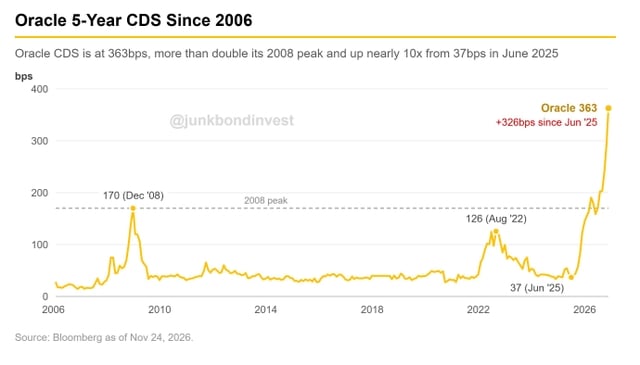
And the credit markets are buckling under all the AI-related debt issuance. Credit default swap prices on Oracle’s (ORCL) debt hit all new highs last week. It costs more to insure Oracle’s debt than it did for Bear Stearns in January 2008, just before that investment bank collapsed. Things are worse at neocloud provider CoreWeave (CRWV). Some of its recent bonds are yielding 17% and selling at 75 cents on the dollar. Earlier this week’s the credit default swap prices against its debt were implying a two thirds chance of default over the next five years.
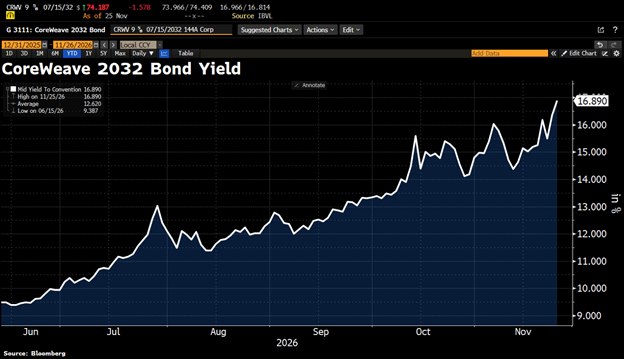
Nonetheless, the company’s bankers are looking to float another $4.5 billion for a data center. They are hoping to land an investment-grade rating and interest rate in the seven to 8% as the data center is backed by a lease from Meta. Good luck with that. Many banks like Societe Generale and ING are trying to dump some data center-related bonds at a discount. Mid-term election results could also slow the permitting of new data centers in states like Ohio and Texas.
It is also hard to see how the federal government can maintain an annual $2 trillion fiscal deficit. 2027 is likely to be a year of gridlock, and potentially another government shutdown at some point. There will be legislation proposed to regulate AI to some degree and more congressional hearings around the whole Nvidia (NVDA) soap opera.
Finally, we have the consumer where wages are not keeping up with the official rate of inflation let alone the real rate for most households. Consumer spending growth is being powered by the top of the “K”-shaped economy. And if the AI narrative that has driven the equity rally for years until recently, continues to deflate, that spending pace is likely to slow notably. Therefore, I don’t expect GDP growth to see 4% for the foreseeable future. Goldman Sachs recently projected the U.S. economy will experience GDP growth of 2.4% in 2027. And if that was the betting line, I would take the under.
At the time of publication, Jensen had no position in any security mentioned.