Cocoa's 2024 Rally Is a True Black Swan Event
Even the most bullish of bulls probably didn’t see $10,000 cocoa on the horizon. It is both unjustifiable and unsustainable.
You've reached your free article limit
You've read 0 of 1 free Pro articles.
Since the early 1980s, cocoa has been arguably the most boring commodity. Until now, the price of cocoa hovered between $1,500 and $3,000 per ton, with only a few temporary breaches of this range. More recently, cocoa futures spent a decade mostly trading between $2,000 and $3,000.
Thus, the market was well overdue for a supply scare. However, even the most bullish of bulls probably didn’t see $10,000 cocoa on the horizon. I have some strong and controversial opinions on the matter.
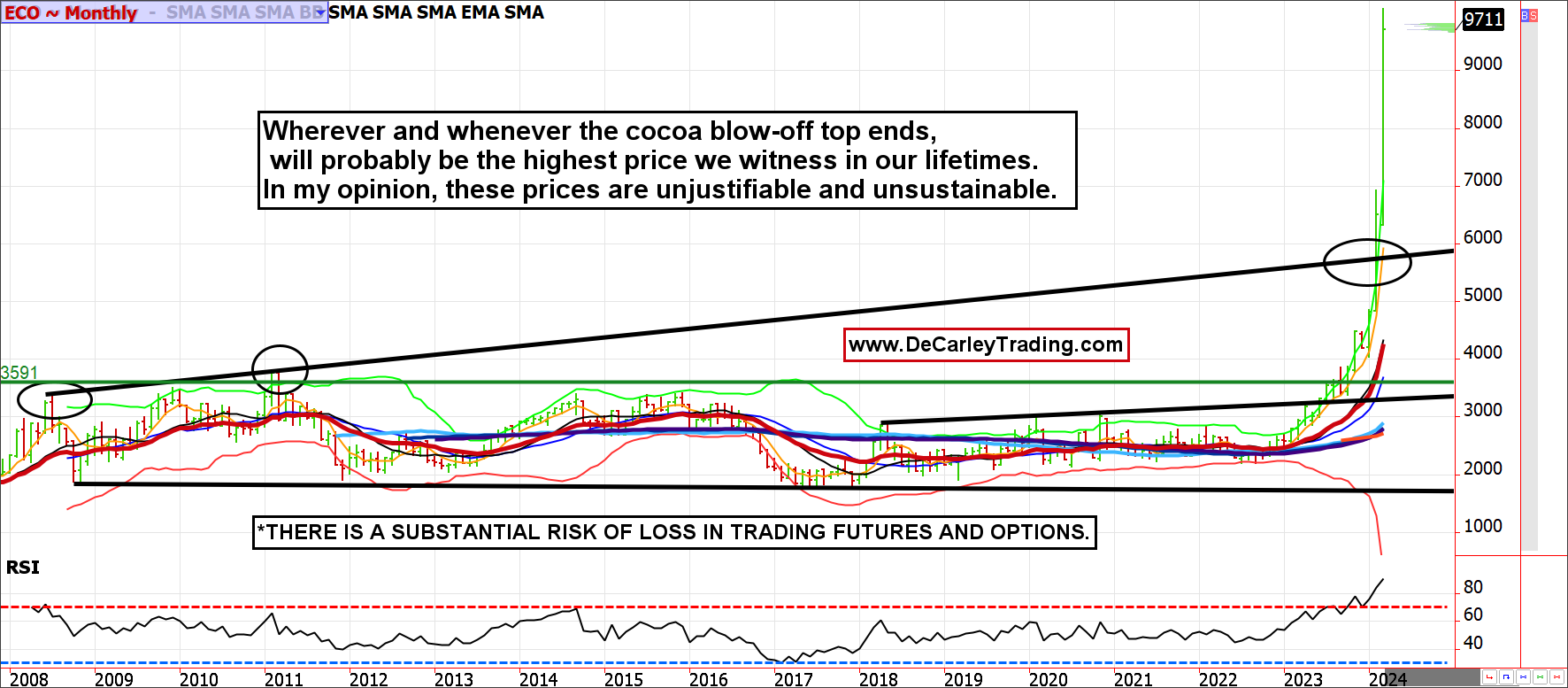
There is no mathematical or logical reason for cocoa prices to have reached such heights. The market assumes demand is inelastic, but that isn’t the case. Chocolate is a want, not a need. Additionally, third-party analysts believe cocoa output will drop to around 4.5 million tons during the 2023/2024 growing season, or 350,000 tons lower than the previous year. I’m not a mathematician, but a 7 to 10% decline in production might not explain a rally from $2,000 to $10,000 per ton.
I believe prices should have been capped at nearly $6,000 due to technical resistance on a monthly chart, but also based on the high prospects of demand destruction and a lack of reliable supply data. Of course, the market is always right.
Instead, gains accelerated above $6,000, forcing the RSI on a monthly chart to over 90.00, resulting in an entire monthly trading bar outside the Bollinger Bands. These are two statistically improbable events, making the 2024 cocoa rally a true Black Swan event by any definition.
Further, cocoa is mainly grown in underdeveloped parts of the world, where news and data are unreliable. In the U.S., we have a government entity in charge of collecting and reporting commodity supply and demand data, and, in theory, other branches of the government are policing market integrity. That doesn’t exist in many cocoa-growing areas.
Sixty percent of the world’s cocoa comes from the Ivory Coast, Ghana, and Indonesia. Not only are the headlines and fundamental statistics potentially inaccurate, but they might even be intentionally misleading to manipulate market price. Remember that producers have a strong incentive to talk their book. This happens in the U.S. as well, but our data reporting systems account for this by independent data collection methods. While our (U.S.) system is far from perfect compared to others, it is quite desirable.
Adding fuel to the fire is the quirky nature of the cocoa trades on the ICE Exchange, which does not offer around-the-clock trading, and the open and closing times mainly cater to London and other overseas markets. For instance, cocoa starts the trading day at 5:45 a.m. Eastern and closes at 1:30 p.m. Eastern, or 2:45 a.m. to 10:30 p.m. for those of us in the Pacific time zone.
Also, real-time cocoa data is expensive to obtain, so most users are operating on delayed price information. Until recently, the exchange incorrectly kept margin requirements too low to accommodate trader and brokerage risk. As a result, unsuspecting speculators were allowed to get overleveraged on the short side of cocoa, leaving clients in peril and brokerages scrambling to keep the doors open. Exchanges guarantee each transaction on the exchange, but only because the wallets of brokers are on the table to cover the risk.
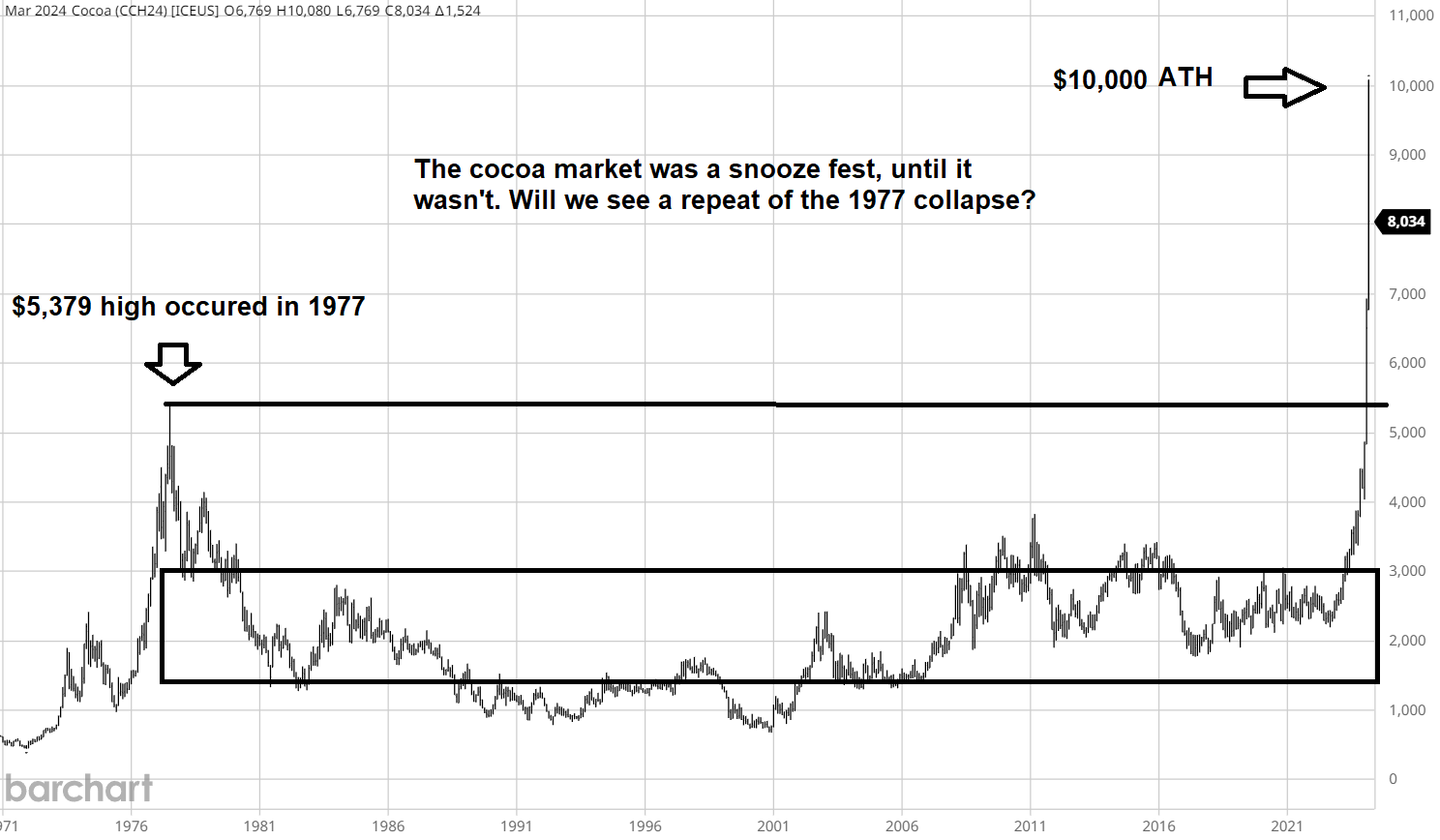
Although I believe circumstances have allowed the rally to overshoot reality, the original move was legitimately triggered by excessive rains damaging crops in Ghana and the Ivory Coast, followed by a drought. The result is the lowest record supplies since the late 1970s, but the historical chart above offers some insight.
Similarly tight inventories in the late 1970s, triggered a parabolic rally that eventually failed and gave way to decades of lower prices. Will we get a repeat? Most likely.
We don’t know when and where the high in cocoa will be, but our guess is we might never see that price again in our lifetime; it is both unjustifiable and unsustainable.