The Hottest ETFs of 2026 Come With a Dangerous Warning Label
Single-stock leveraged ETFs top 2026’s performance charts, with gains above 500%. But their own prospectuses warn investors away, and a collapse in South Korea shows what happens to retail buyers when the trade turns.
You've reached your free article limit
You've read 0 of 1 free Pro articles.

What if the SEC’s Investor Advisory Committee took the time to create a document warning investors about a particular type of exchange-traded fund, but then it turns out that these funds perform spectacularly well?
No big risk, no big reward, right?
Well, not necessarily.
The list of top-performing ETFs so far in 2026 includes:
- Direxion Daily MU Bull 2X ETF (MUU): + 585.03%
- GraniteShares 2x Long DELL Daily ETF (DLLL): +773.54
- Leverage Shares 2X Long ARM Daily ETF (ARMG): +318.95%
What you’re seeing there are ETFs that make two times long bets on AI stocks.
This strategy isn’t limited to AI, though; you can also find single-stock leveraged ETFs for growth companies such as Coinbase (COIN), Tesla (TSLA), Netflix (NFLX) and Hims & Hers Health (HIMS).
The Daily Reset
Let’s take a look at the charts for MUU, DLLL and ARMG.
These ETFs move fast in both directions. That’s to be expected given that they aim for twice the daily return of a single stock. In addition, techs and growth stocks typically show bigger price swings than old school blue-chip dividend kings like Procter & Gamble (PG).
Here’s how these funds work: They use derivatives to amplify their returns, a process called leverage. A 2x fund holds swaps and other derivatives so that a $1 move in the underlying stock results in a move of about $2 in the fund.
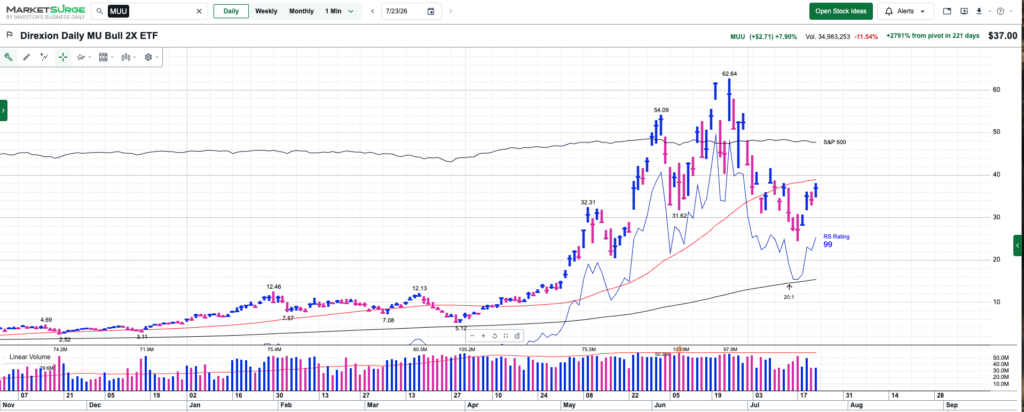
That amplification doesn’t choose a direction. The same leverage behind MUU’s 585% year-to-date gain took the fund down more than half between mid-June and early July.
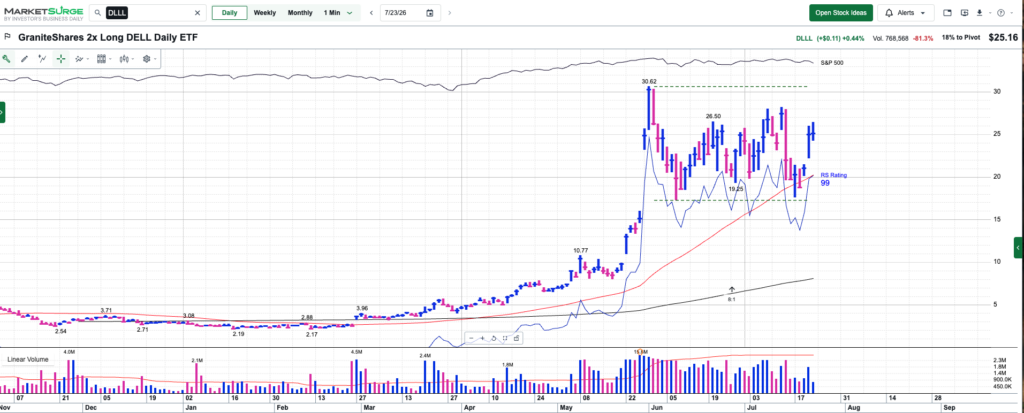
DLLL shows the same type of pattern. This ETF fell from $30.62 in early June to about $19.25 by July 20. That’s a decline of about 37% in about seven weeks. There was a good deal of whipsaw action between those two dates.
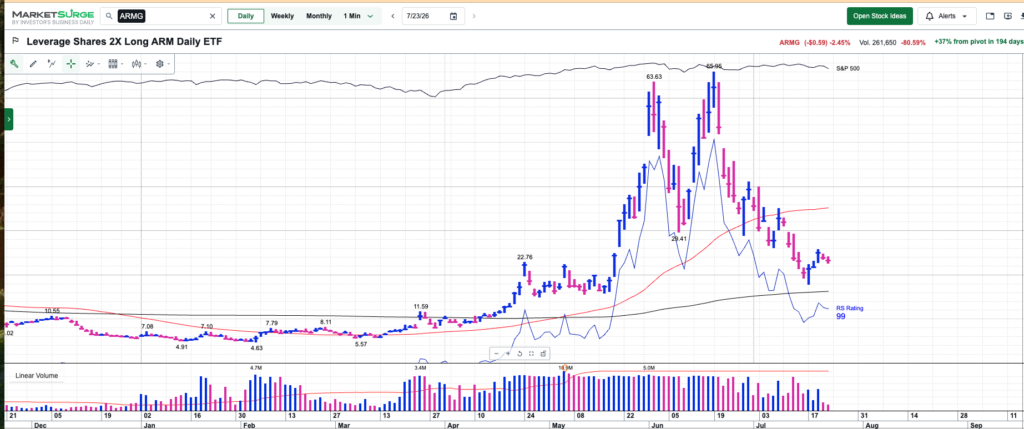
ARMG illustrates the pattern most clearly on the downside. The fund peaked at $65.95 in mid-June and has since fallen to around $23, a decline of about 65% in five weeks.
All those charts make the point. These are short-term trading vehicles, not holdings.
These ETFs reset daily, which means a return over longer periods of time is the product of each day’s leveraged return compounded. In volatile or choppy markets, the ETF can lose money even when the underlying stock is flat.
They also carry their own warning labels.
For example, in the prospectus for their T-REX suite of leveraged and inverse single-stock ETFs, REX Shares warns: “Investors who do not understand the Funds, or do not intend to actively manage their funds and monitor their investments, should not buy the Funds.”
Who’s Actually Holding These?
In its report, the SEC found that, “Retail investors are predominantly the largest holders of single stock ETFs. As of January 31, 2023, retail accounts made up 92% of the holders across 26 of the most popular single stock ETFs.”
There’s even more recent data to show that the products are landing where their developers intended: With retail investors who don’t have the margin accounts or options trading permissions that would otherwise allow them to access leverage.
In a February 2026 Reuters article, author Suzanne McGee reported that nearly 90% of all trading in leveraged single-stock ETFs in the U.S. are transactions by individual investors. That’s from a study by Direxion, provider of leveraged single-stock ETFs, along with Vanda Research and The Compound Insights.
“The data shows that the proliferation of these exchange-traded vehicles, which allow investors to speculate on short-term moves in an underlying stock, has been almost entirely driven by their allure for these retail investors,” McGee wrote. “The study also found that last year trading in the leveraged single-stock ETFs accounted for 8% of total trading on all U.S. exchanges.”
How It Could End
South Korea offers a preview of how the story might play out for U.S. investors.
Single-stock leveraged ETFs launched there on May 27, and retail investors bought in to the tune of about $9.4 billion in under two months.
When the AI semiconductor rally reversed in June, the Korea-listed KODEX SK Hynix Single Stock Leverage ETF fell roughly 70% from its peak. It is down about 50% since launch, even though the underlying stock declined by a smaller amount.
Here’s how that looked.
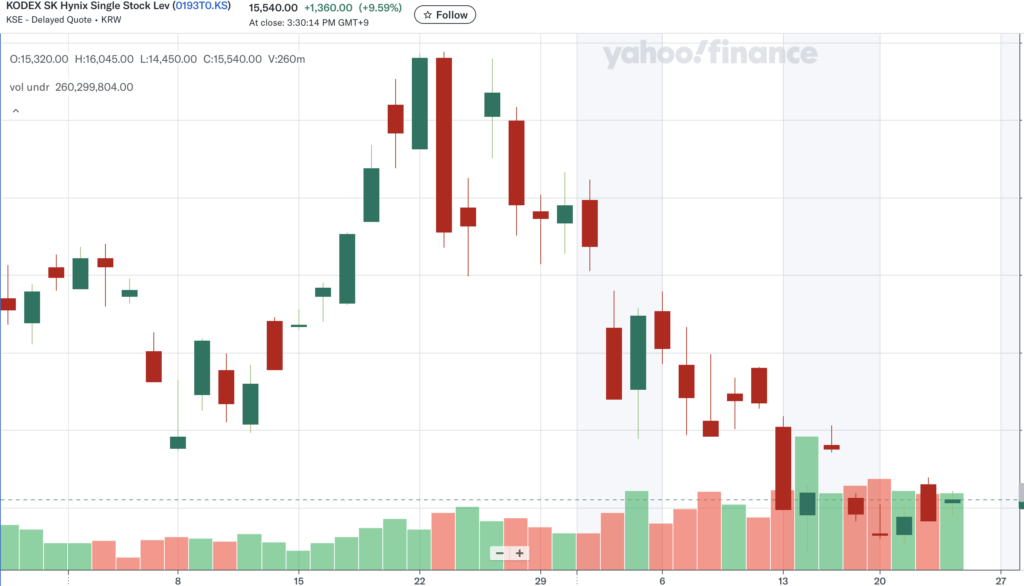
That performance gap is that daily reset doing its work, amplifying returns. Great when it’s to the upside, not so great when the stock declines.
It’s not just regulators wagging their fingers to scold about these products. Even the companies that manufacture them are pretty clear: There’s plenty of room to see big losses.