Chips Take a Dive, Oil Slides, SpaceX Burns Off … a Trillion
The good news is Iran and the U.S. seem to be talking again. The not-so-good news is the AI tech trade and all its parts are falling fast. Let’s dig in.
You've reached your free article limit
You've read 0 of 1 free Pro articles.

The trade in AI, semiconductors, memory and storage stocks took another hit on Monday.
The day’s regular session started out strong enough. The U.S. and Iran both continued their pause in shooting at each other, or in the Iranian military’s case, at civilian vessels carrying cargo through the Strait of Hormuz. Then the trap door swung open and the high-tech stocks of this era, especially chip stocks, fell through.
The catalyst appeared to be talks that would lead to a supposed deal between Nvidia (NVDA) and OpenAI where the chip designer will backstop the AI model provider with guarantees of up $250 billion for chips so that the latter could lease a 10-gigawatt project that a subsidiary of Softbank (SFTBY) is developing in southern Ohio. Nvidia, as reported by both Bloomberg News and the Wall Street Journal, is said to be working on AI infrastructure deals potentially exceeding $750 billion overall.
This “circular” funding scheme is being seen by investors as potentially problematic. The issue is this: Nvidia, or a major supplier, would provide capital, guarantees, or financing that enables a major customer, such as OpenAI, to purchase or lease capacity reliant upon the supplier’s products (general processing units, systems). Capital flows from said supplier, Nvidia, in this case, and returns as sales-driven revenue as demand has been locked in. A quick search reveals that as of the end of the first quarter, OpenAI had about $73 billion in cash on hand and an additional $40 billion or so in marketable securities. Such a guarantee would amount to more than twice OpenAI’s known cash position.
SanDisk (SNDK) led the AI trade lower on Monday, giving up 11% on the session. The shares of Advanced Micro Devices (AMD), Nvidia, Lam Research (LRCX) and Applied Materials (AMAT) were also hammered as the Philadelphia Semiconductor Index gave up 2.23% for Monday. The rout carried over into Asia. In South Korea on Tuesday, Samsung Electronics and SK Hynix (SKHY) were both hit especially hard.
In Other News…
On Monday, U.S. Pres. Donald Trump told the world that the U.S. and Iran were currently engaged in diplomatic efforts to end the conflict but also warned that the two sides would return to military operations if there were not some rapid progress made. From Air Force One, the president said, “The only reason they want to meet is because we’ve been hitting them very hard. There’s a good chance that something could happen, and if it does good. If it doesn’t, we go back to doing what we were doing.”
Crude oil prices have continued to drop. This morning, I have seen front-month WTI Crude futures cross the tape just above $80 per barrel, down from more than $93 per barrel last Thursday afternoon. Brent crude is now trading with an $83 handle, down from more than $101 per barrel last Thursday.
This is largely due to a reported peace proposal that would reopen the middle passage of the Strait of Hormuz, which has largely been avoided by ships since the start of the conflict in late February. Vessels have instead taken either a northern route close to Iran (out of fear of Iranian missiles and drones) or a southern one (seeking U.S. naval protection) that passes near the Omani shore.
Treasuries have also shown some recent strength. The U.S. Ten-Year Note is yielding 4.62% as the zero-dark hours pass on Tuesday morning. This is down from more than 4.71% as recently as Friday morning. The Thirty-Year Bond pays 5.11% this morning after having yielded more than 5.19% late last week.
Marketplace
On Monday, the S&P 500 closed up small after giving up what looked to be an impressive morning rally. The Nasdaq Composite did give that rally back, closing down 0.18% for the day’s regular session. Small caps outperformed the broader market. The Russell 2000 gained 0.62% while the S&P 600 added 0.44%. Joining the Philly Semiconductors in leading the day’s slide, the Dow Transports lost 1.82%.
Breadth was sloppy. Seven of the 11 S&P sector SPDR ETFs closed out Monday in the green, led by the staples (XLP) and the discretionaries (XLY). Energy (XLE), for obvious reasons, was the big loser.
Winners beat losers by a rough three-to-two margin at the NYSE, but losers beat winners (by about four to three) at the Nasdaq market site. Advancing volume took a 56.2% share of composite NYSE-listed trade on Monday, but just a 35.9% share of composite Nasdaq-listed activity.
Trading volume did increase on a day over day basis across the listings of both exchanges and across the membership of the S&P 500. That said, the lack of direction leaves me without any technical proclamations to make. Especially ahead of the Federal Open Market Committee policy meeting that begins today and will conclude tomorrow afternoon with a statement and press conference.
The Chart
The S&P 500’s ascending triangle pattern, which is bullish in nature, is still intact. Readers should note, however, that for three straight sessions, the index has found support at the lower trendline of the triangle while hitting resistance at its 50-day simple moving average.
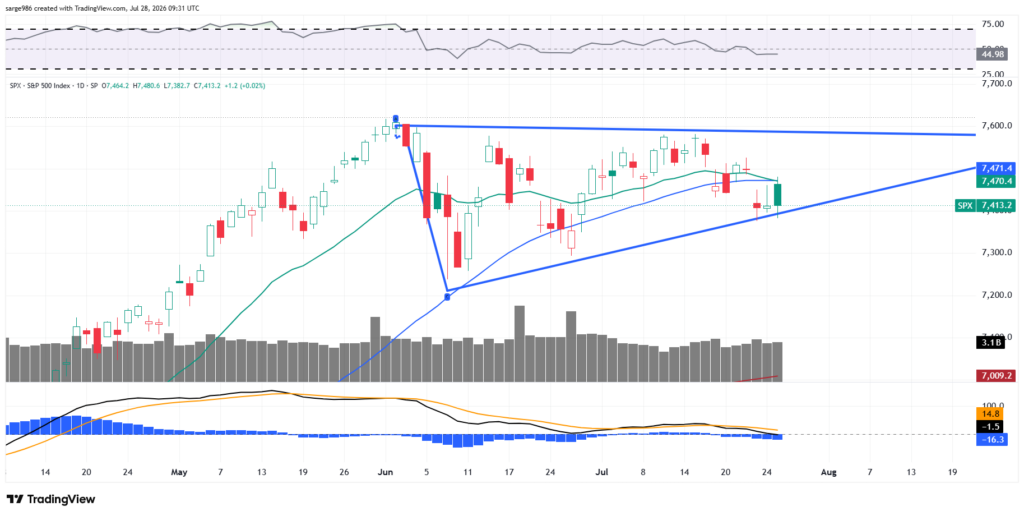
That is a recipe for a breakout one way or the other as much as the triangle is a bullish set-up. Readers should also be alert to the imminent cross-under of that 50-day simple moving average by the 21-day exponential moving average. Some swing traders will see this development as a negative signal. Does not always work perfectly. Understand that this is out there.
SpaceX, Tesla Lost Big, But Still BIG
SpaceX (SPCX) has lost more than $1.2 trillion in market cap since apexing at $225.64 during the stock’s third day of trading publicly, in mid-June. Those shares gave up 1.4% on Monday, closing at $113.50. The stock has now closed lower for 10 of the past 12 trading sessions. To put this in perspective, SpaceX still has a market cap of roughly $1.5 trillion. Tesla (TSLA), another Elon Musk company, has a market cap of slightly more than $1.2 trillion. Basically, since peaking, SpaceX has lost the near equivalent of Tesla. I just saw SPCX cross the tape at $110.99 with about four hours to go until the opening bells ring in New York.
Economics (All Times Eastern)
08:15 – ADP Employment Report (Dec): Last 16.5K.
08:30 – Goods Trade Balance (June-adv): Last $-105.9B.
08:30 – Wholesale Inventories (June-adv): Expecting 0.2% m/m, Last 0.1% m/m.
08:55 – Redbook (Weekly): Last 7.8% y/y.
09:00 – Case-Shiller HPI (May): Expecting 0.8% y/y, Last 1.1% y/y.
09:00 – FHFA HPI (May): Expecting 0.2% m/m, Last -0.1% m/m.
10:00 – CB Consumer Confidence (July): Expecting 92.1, Last 91.2.
10:00 – Richmond Fed Manufacturing Index (July): Expecting 3, Last 4.
4:30 p.m. – API Oil Inventories (Weekly): Last +2.603M.
The Fed (All Times Eastern)
Fed Blackout Period.
Today’s Earnings Highlights (Consensus EPS Expectations)
Before the Open: BA (-.31), KO (.93), HLT (2.27), PYPL (1.28), UPS (1.66)
After the Close: F (.35), KLAC (1.00), NXPI (3.52), QRVO (1.06), V (3.23), WM (1.98)
At the time of publication, Guilfoyle was long SNDK, AMD, NVDA equity.