Chip Stocks Dented by Trump’s Confused Criticism of Taiwan
Presidential candidate Donald Trump says Taiwan, which has a US$20 billion backlog of U.S. weapons on order, should pay protection money to the United States.
You've reached your free article limit
You've read 0 of 1 free Pro articles.
Taiwan’s chipmakers are seeing their shares descend Wednesday, after presidential candidate Donald Trump struck a confrontational tone as to how, if elected, he plans to handle the island.
Taiwan is a key U.S. ally in Asia, both politically and commercially. The chip “fabs” of foundry Taiwan Semiconductor Manufacturing Co. TSM (TW:2330) physically produce all the high-end semiconductors for the likes of Nvidia NVDA and Apple AAPL, part of the output that gives TSMC 61.7% of the market for chip-foundry production.
But Republican presidential nominee Trump says the island should pay for U.S. protection. “I know the people very well, respect them greatly,” he says in an interview with Bloomberg Businessweek. “They did take about 100% of our chip business. I think, Taiwan should pay us for defense.” The interview was just published, although it was conducted on June 25.
It sounds a lot like a gangster demanding protection money. “You know, we’re no different than an insurance company,” Trump adds. “Taiwan doesn’t give us anything.”
And that’s how Trump views many things … in terms of money. You want protection? Pay up. Geopolitical importance be damned.
The hint of a loss of support has sent the Taiex in Taipei down 1.0% Wednesday. Taiwan stocks have been pushing record levels on the back of extremely strong gains this year for TSMC.
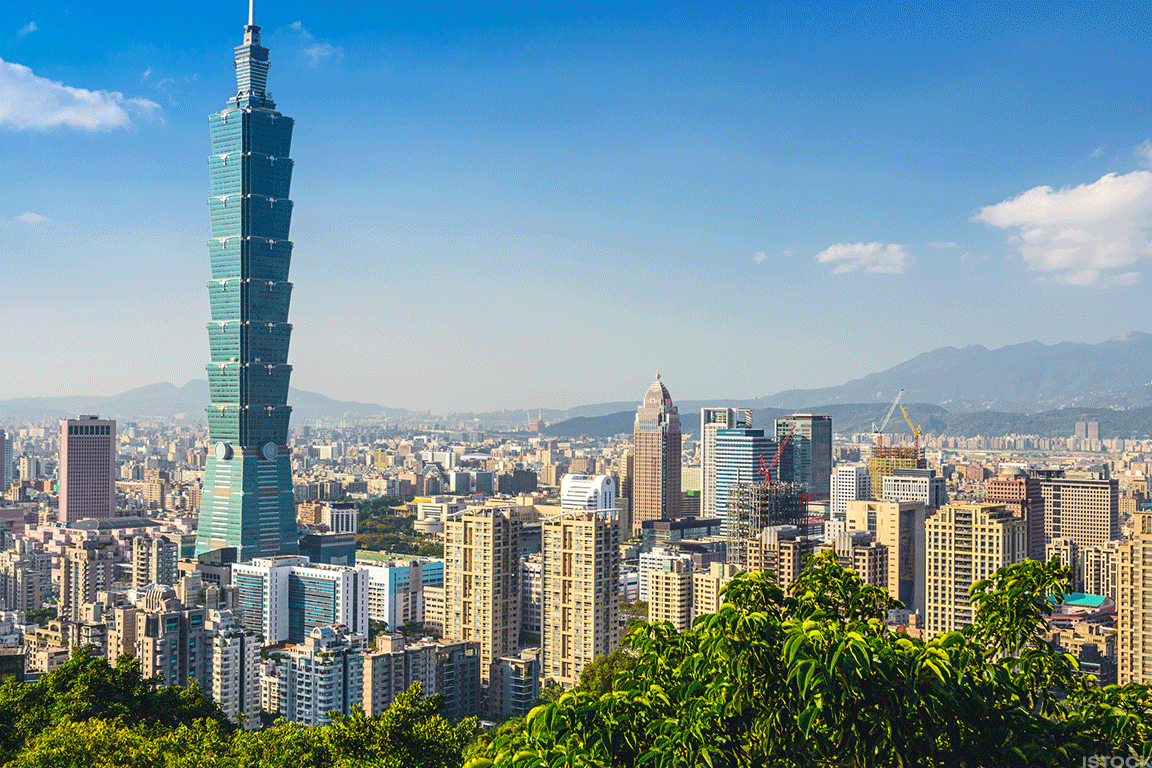
In Taipei trade Wednesday, TSMC shares fell 2.4%. My pick for the top stock to watch in Asia this year set a record high close last Thursday, at TW$1,080, but is now 4.6% down from that peak. Nevertheless, the chip giant’s shares have advanced 73.7% to date this year.
Fellow Taiwanese chipmaker United Microelectronics Corp. UMC (TW:2303) has not experienced the same joy, after it reported disappointing 2023 earnings at the end of January. UMC shares were flat Wednesday but have slipped this week. They peaked in mid-June, since when they’ve suffered a couple of significant dips, leaving them little-changed for the year, up just 2.1%.
Why? It’s falling behind. Whereas TSMC anticipates sales growth in the “low-to-mid 20%” for full-year 2024, UMC forecast a “mid-single digit” revenue hike.
“Fabless” chip designer MediaTek MDTKF (TW:2454) shares slipped 1.5% Wednesday. They have advanced 35.1% to date in 2024 and, like TSMC, are near record levels, having also peaked in mid-June. The company, which spun out of UMC, engineers chipsets and licenses its designs, particularly for smartphones, entertainment and smart devices, estimating that its tech runs in around 20% of homes and close to 1 in 3 mobile phones. In April, it reported Q1 sales were up 39.5% over last year, with margins improving, suggesting 2024 as a whole is looking strong.
Let’s hope Trump’s comments are just political rhetoric. A strong stance on Taiwan is one of the few issues that has bipartisan support in Washington, particularly when we see how Beijing has cracked down here in Hong Kong after getting its hands on the territory.
If so, this dip could be a buying opportunity for TSMC shares. The chip industry is key in the trade relationship, but I’d argue Taiwan is more than paying its way.
The United States exported US$40.0 billion in goods to Taiwan last year, according to the U.S. Census Bureau, with US$87.8 billion in imports into the United States moving in the other direction. Shipments remain at a similar level so far this year.
Taiwan does pay huge sums to the United States for weapons. In fact, there’s a backlog of US$20.5 billion in military orders that Taiwan has paid for, but have not arrived, at last count from the Cato Institute, which tracks the issue monthly.
And that’s how the relationship works. Unlike Japan and South Korea, Taiwan has no formal defense treaty that requires the United States to protect the self-governed island – which, let’s not forget, is the nation that’s not a nation.
The United States in 1979 switched to recognize Beijing and the People’s Republic of China as the representative of “China” at the United Nations, not the Republic of China, which is what Taiwan calls itself. So there can be no treaty between the two.
U.S. President Joe Biden has broken with the typical, deliberate strategy from Washington of “strategic ambiguity” over Taiwan when he firmly said that the United States would defend Taiwan if it was attacked by China. Twice in 2022 he explicitly said the United States would come to Taiwan’s aid, which I noted in a column at the time surprised the reporters present when he made those remarks in Tokyo.
It was a political shot across China’s bows, warning it off ambitions to seize Taiwan. The issue grew more pressing after Russian President Vladimir Putin ordered the invasion of Ukraine, which Putin considers Russian soil. Biden was standing alongside Japanese Prime Minister Fumio Kishida, who trotted out the traditional diplomatic line that Japan calls for “peace and stability” in the Taiwan Strait, and against “any unilateral effort to change the status quo using force.”
Trump’s term as president was, frankly, a disaster on the foreign-policy front. Global leaders laughed at him behind his back. His trade policy amounted to slapping tariffs in place that, as Nobel laureate economist Paul Krugman explains, U.S. consumers end up paying. And his whole “Talk tough on China” shtick is a ruse designed to win more business in China, necessitating closer ties with arguably the greatest threat to U.S. national security.
I’m no huge fan of Biden. But he has at least made a coherent attempt to engage with Asia, instead of pushing an isolationist line, and has had considerable success in cutting off the supply of high-end semiconductor chips to China. His team’s diplomacy brought together companies in Japan and the Netherlands, the other main producers of top-flight chips, to coordinate efforts to hold back the supply of the most-powerful chips for data centers and Artificial Intelligence. Those chips eventually make their way into the Chinese military-industrial complex, and intellectual-property theft from China is also rife.
So while China is no doubt casting a watchful eye on the U.S. election cycle, there’s good reason that, as the estimable Foreign Policy magazine put it in February, “In all likelihood, China is rooting for Trump.” The lack of unified multinational diplomacy works in the favor of China, which likes to use its economic might to secure one-on-one trade deals with individual nations.
TSMC will report earnings on Thursday, so it is in a quiet period and has not responded to Trump’s comments. However, the company has already announced a total investment of US$65 billion to build three chip fabs in Phoenix, where it intends to make cutting-edge 4-nanometer and then 2-nanometer chips. So it should be a major boost to U.S. chip production, and the U.S. chip industry.
TSMC currently has 15 fabs in Taiwan, supplemented by two in mainland China. So it’s with the company’s vital role in chip supply that analysts warn any conflict over Taiwan could be devastating to the global economy. It’s now also expanding to make chips in Germany.
China has simulated a blockade of Taiwan with war games around the island, which it has harassed via almost daily air and sea sorties into contested waters, so-called “gray zone” tactics that help exhaust Taiwan’s military resources. The Chinese military held two days of such exercises after current President Lai Ching-te took office in Taipei in May, actions Beijing said were “punishment” for Lai’s election. China paints Lai as a separatist, although he has repeatedly offered to hold talks with China so long as neither is “subordinate,” only to be rejected. Lai says only the Taiwanese people can decide the island’s future.
Taiwan’s premier, Cho Jung-tai, did respond to Trump’s remarks, noting the United States and Taiwan are on good terms. He points to Taiwan’s spending on defense and orders for U.S. planes and munitions as indications that the island is paying its own way. “We are willing to take on more responsibility, we are defending ourselves and ensuring our security,” Cho said at a press conference today.
Asian investors are also having to make sense of “Trump trades,” with a Trump victory now a 66% odds-on bet, as noted by Nomura’s chief Japan macro strategist Naka Matsuzawa. But the strategist is more concerned about signs of a global economic slowdown, which Matsuzawa believes will soon grab the market’s attention.
I would expect the shares of TSMC and MediaTek to resume their rise. But it is worth watching this space as the election cycle kicks into full swing. Taiwan seemed to be on a sure footing in terms of U.S. relations, with a deepening connection to ensure steady supply of top-flight tech. Long may that continue.