Why You Should Think Twice About That 12% ETF Yield
A 12% yield sounds better than 3%, until you look at what’s actually generating each payout.
You've reached your free article limit
You've read 0 of 1 free Pro articles.

You’ve got a choice between an investment with a 3% yield and another with a 12% yield.
Easy call?
Not really. Before you click the “buy” button for one versus the other, look under the hood at what’s actually generating each payout. You’re sorting out the difference between durable income (what the ETFs’ stocks can sustain) and current income (I want it now!).
SCHD Offers Dividend Stability
The Schwab U.S. Dividend Equity ETF (SCHD) measures total return of the Dow Jones U.S. Dividend 100 Index.
The ETF’s 30-day SEC yield is 3.35%. Investors appreciate the dividend stability, and have been piling into this fund; assets are currently north of $100 billion.
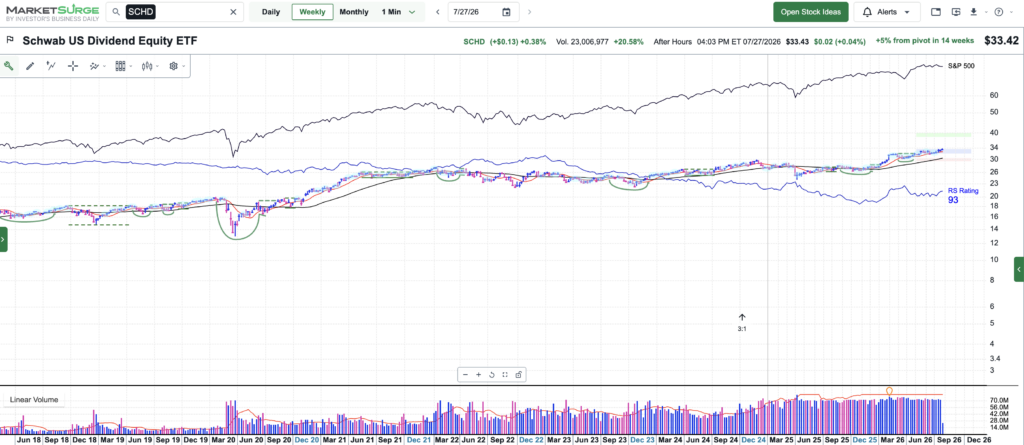
The underlying index is constructed by screening 2,500 U.S. stocks, keeping only those with 10 or more years of consecutive dividends. It ranks that batch on cash flow to debt ratios, return on equity, yield and five-year dividend growth rates. The resulting 100 stocks make the cut for the index, which is rebalanced every year in March.
As you can see, the index, and by extension, the SCHD ETF, is built for dividend quality and sustainability, not just high yield.
The ETF’s largest holdings and their track record of increasing payouts are:
- Home Depot (HD): 16 years
- Procter & Gamble (PG): 70 years
- Amgen (AMGN): 14 years
- UnitedHealth Group (UNH): 15 years
- Merck & Co. (MRK): 14 years
QYLD Offers Higher Yield
Who would ever guess that an ETF whose ticker is short for Nasdaq (that’s the “q” part) mashed up with yield?
The Global X NASDAQ 100 Covered Call ETF (QYLD) writes covered call options on the Nasdaq-100 Index. According to Global X, this strategy “historically produces higher yields in periods of volatility.”
The ETF’s 30-day SEC yield is .03%.
Wait, what? Shouldn’t the yield be much higher?
That’s where the “distribution yield” comes in. That figure is 11.99%, and it consists of everything the fund pays out monthly. That’s mostly options premiums, along with some dividends.
Don’t forget: The Nasdaq-100 holdings, for the most part, aren’t exactly known for being reliable dividend payers like those in SCHD.
Here are the top five holdings in QYLD, along with their yield.
- Nvidia (NVDA): 0.51%
- Apple (AAPL): 0.32%
- Micron Technology (MU): 0.07%
- Microsoft (MSFT): 0.94%
- Amazon.com (AMZN): No dividend
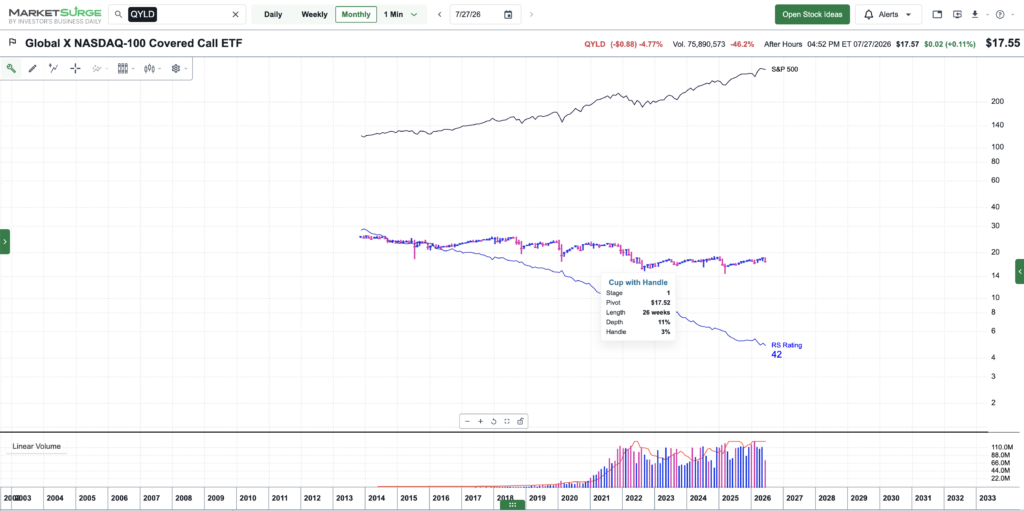
Unlike SCHD, this ETF has been shrinking. According to data from TradingView, QYLD has seen outflows totaling $726.07 in the past year.
This monthly chart shows the gradual downward trajectory.
What Really Generates That Higher Yield
Because QYLD sells call options on its Nasdaq-100 holdings each month, it mutes returns from price appreciation. If stocks rally past the strike price, gains get capped and the call option buyer keeps that upside, not QYLD owners.
That’s the tradeoff for investors receiving that option premium every month.
Other ETFs, such as the Vanguard High Dividend Yield ETF (VYM), the SPDR Portfolio S&P 500 High Dividend ETF (SPYD) or the iShares Core High Dividend ETF (HDV) just hold dividend-paying stocks. No options, no synthetic income or mechanism working against price appreciation, as you see with QYLD.
The concept is simple: If the ETF’s price drops, it’s just market action.
With QYLD and other ETFs based on an options strategy, part of the price drop is baked into the expectations.
The One-Two Nasdaq Punch
Say you like the idea of collecting income on the regular, but you also want price appreciation. That’s sound, as even in retirement, it’s not enough to own income investments; you also need growth to help stay ahead of inflation.
When it comes to Nasdaq-100 growth and income, there’s a way you could get the best of both worlds. Split the position between the Invesco QQQ Trust (QQQ) and QYLD.
That lets you capture all of the Nasdaq-100’s growth potential, which has historically been strong, while still collecting steady monthly income from QYLD’s covered-call strategy. It’s a simple way to balance long-term appreciation with cash flow, without betting the whole position on just one approach.
When You’re Seeking Yield
Gravitating toward the highest yield is a pretty good sign that you’re overlooking some of the potential pitfalls.
- Distribution yield isn’t necessarily real income: QYLD’s 11.99% payout is mostly options premium; the ETF’s actual SEC yield is just 0.03%.
- High yield can cap your upside: Covered-calls can be used in income-generating strategies while offering some degree of downside buffer. But be aware that premium income may not be enough to offset the drag from a capped upside.
- Underlying holdings matter: Nasdaq-100 stocks aren’t top-of-the-heap dividend payers, so the “yield” has to come from somewhere else. In the case of QYLD, that somewhere is the options premium, which is the tradeoff for limited upside.