Updated Gainers and Decliners
As of 1:45 PM:
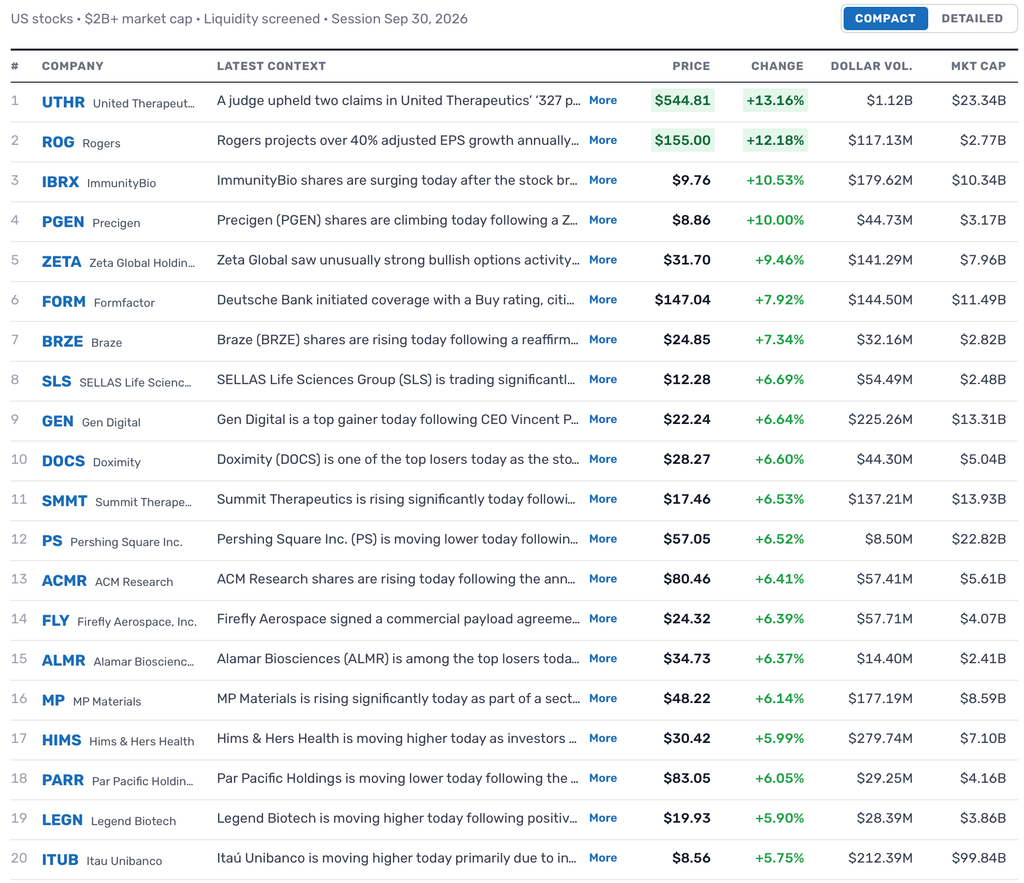
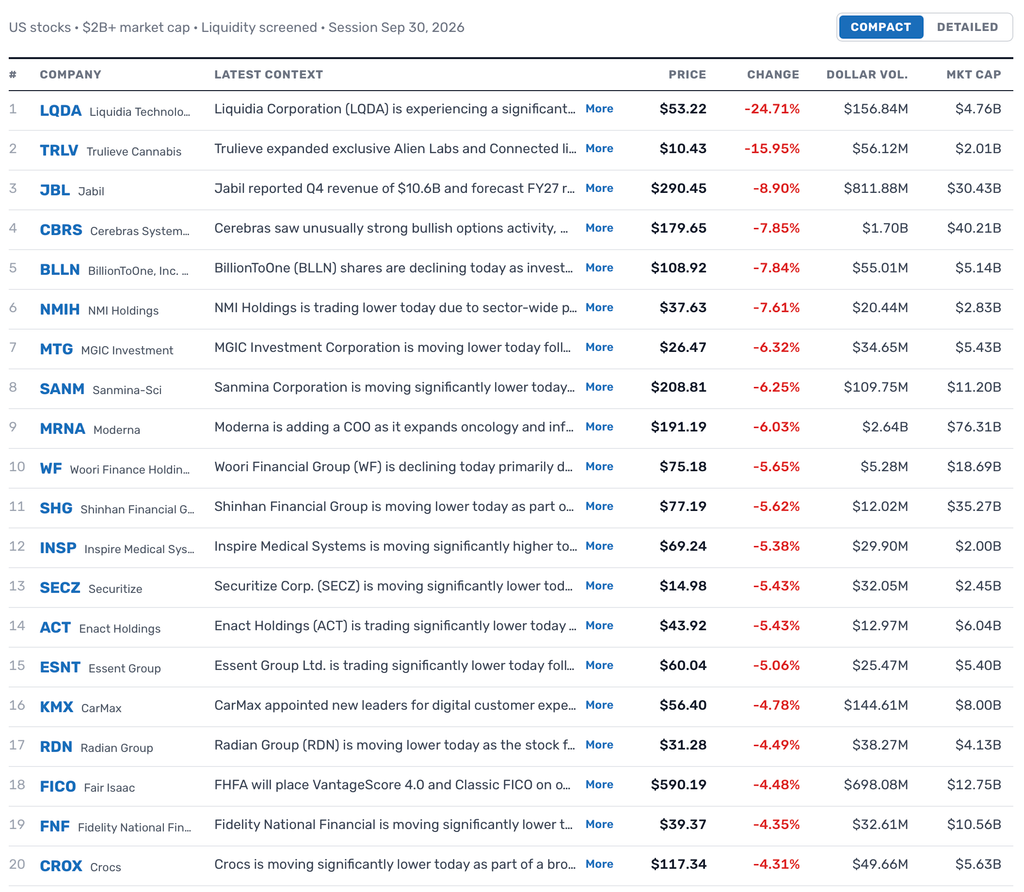
Position: None
BY Doug Kass · Sep 30, 2026, 2:04 PM EDT
 Doug KassDoug Kass
As of 1:45 PM:
Position: None
BY Doug Kass · Sep 30, 2026, 2:04 PM EDT
From The Credit Strategist:
When the Federal Reserve sets its baseline interest rate (the Federal Funds rate) well below the real-world rate of inflation (and below understated government-measured inflation), it leaves the door open for above-trend inflation. It also creates incentives for economic actors to borrow and spend money on speculative and unproductive activities – those that don’t add to the productive capacity of the economy. And that is precisely what happened for years, certainly since the 2008-9 Great Financial Crisis. Kevin Warsh has been pointing this out for years. Now he’s in a position to do something about this long-term monetary policy error. Despite the institutional and political resistance to raising interest rates to positive real territory, investors betting against Warsh are likely underestimating his determination to raise real rates. His criticism of the Fed’s policy errors is longstanding, principled, and evidence based. He is moving deliberately to correct these errors by organizing five “task forces” to reconsider different aspects of Fed policymaking in an effort to return to “first principles” of monetary policy from which the Fed has diverged. He wants to establish a more intellectually robust regime that reflects economic reality rather than the politically distorted process (including misleading government data) that led to years of monetary policy errors. If he succeeds, it will be a sea-change in monetary policy. Many Fed watchers on Wall Street initially argued that Warsh would not challenge the status quo and instead conform to politicized calls for lower rates that have no basis in the data; they are now coming to realize that Warsh meant what he said when he criticized Fed policy in the past and has the intellectual and intestinal fortitude to back up his words regardless of resistance. Investing on that basis will prove to be the better course in the period ahead.
The massive growth of debt creates the illusion that economic growth is strong and healthy by flattering corporate earnings and stock prices. But without $2 trillion annual U.S. deficits and huge government borrowing in Europe, China and Japan, economic growth would be much lower as would corporate earnings and stock prices. Economies are growing in nominal terms, but real (inflation-adjusted) growth is much lower – and most of the growth we see is dependent on a concomitant build-up in debt that can never realistically be repaid in constant dollars. That consigns the world to future inflation. Accordingly, the wealth created by this process is less than it seems and wholly dependent on the Ponzi-like structure of public and private sector financing where debt is incessantly refinanced and extended into the future. Any breakdown in that process will materially reduce if not destroy wealth, but even before that happens, the value of the fiat currencies in which that wealth is denominated keeps eroding steadily under the pressure of rising inflation.
Rising global interest rates, especially those at the long end of the curve, are signaling that we are above the levels where current levels of borrowing can be maintained without moving us toward crisis. Yields are reacting to strong economic growth, but that growth would not be happening without epic government and private sector borrowing. As such, arguments that higher yields are a purely positive reflection of a healthy economy are incomplete at best and misleading at worst. At the end of the day, the growing economy is going to have to deal with the debt that made it look so healthy. Readings like the ISM Services Index hitting 58.7, its highest level in 59 months, and the ISM Manufacturing Index hitting 56.7, its highest in 33 months, reflect economic strength. But those figures have to be read in the context of all the debt employed to reach those levels that are rarely mentioned in any analysis. Growth is not organic because it is debt dependent. Absent massive borrowing, it would be much lower.
Position: None
BY Doug Kass · Sep 30, 2026, 1:15 PM EDT
Wolf Street howls about changes to methodology of the calculus of inflation.
Not Even the Massive Changes of Methodology Can Get PCE Inflation Back into the Bottle | Wolf Street
Position: None
BY Doug Kass · Sep 30, 2026, 12:45 PM EDT
The attached pdf below is a thorough briefing of the ALJ stay and the GAO Drug Scheduling Report.
Most importantly this is a procedural issue.
Go to page six for the possible outcomes.
I continue to add to the space.
Position: None
BY Doug Kass · Sep 30, 2026, 12:15 PM EDT
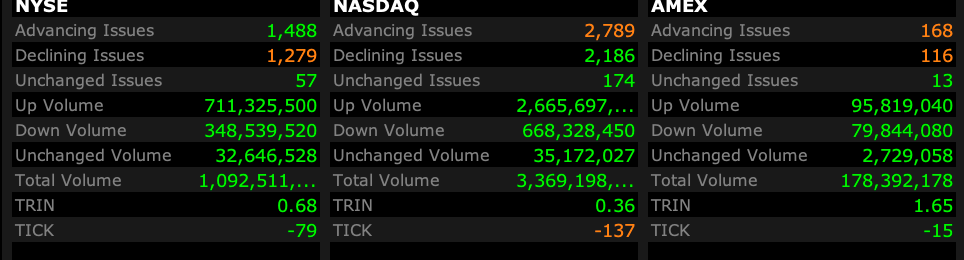
– NYSE volume 145M shares, flat to its one-month average;
– Nasdaq volume 33% above its one-month average;
– VIX Index: down 1.06% to 15.87
SOURCE: Interactive Brokers
SOURCE: Barchart
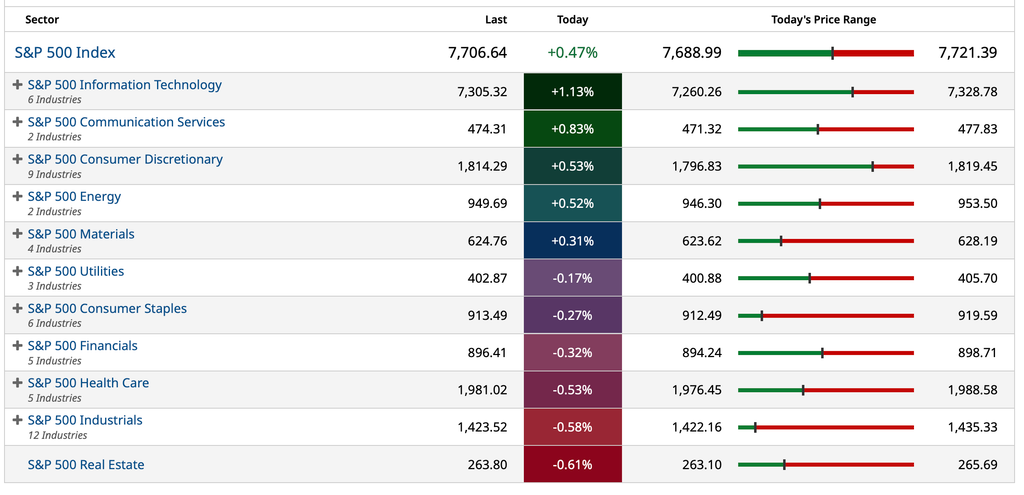
SOURCE: TheStreet Pro
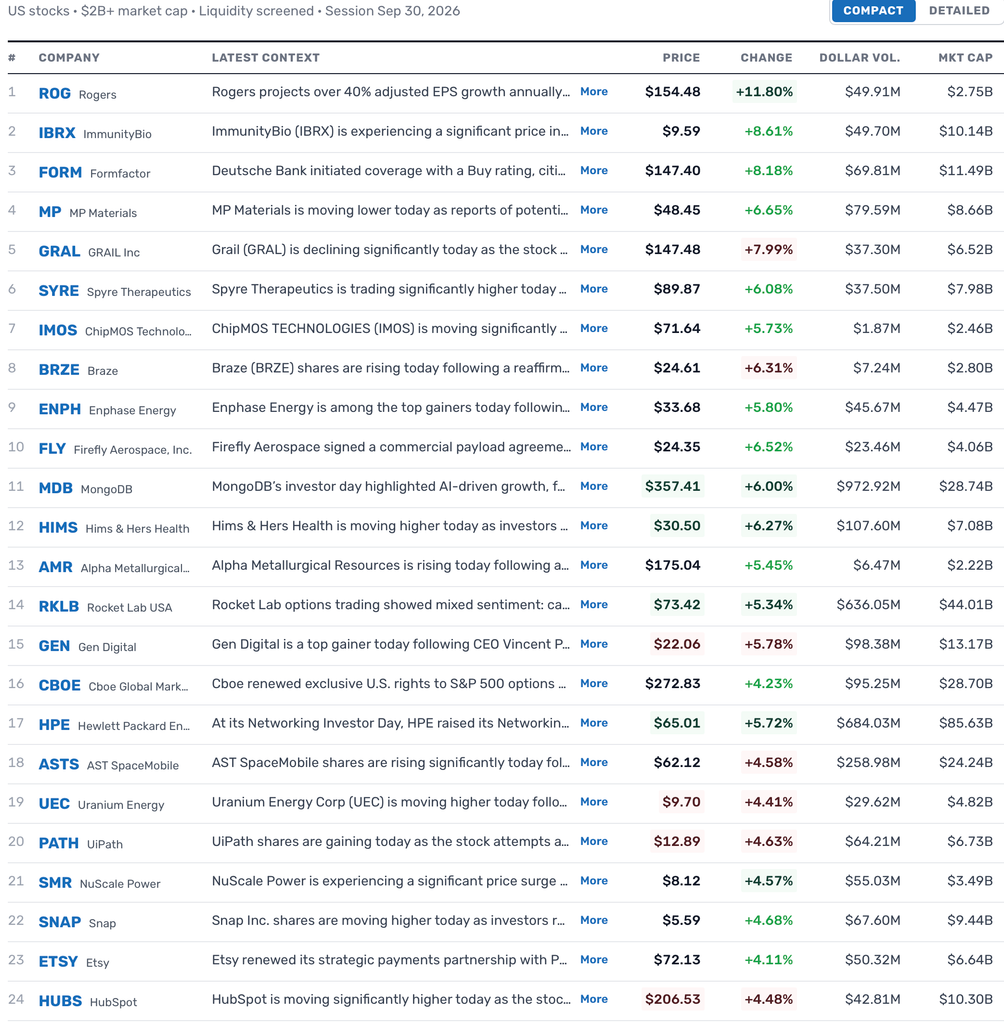
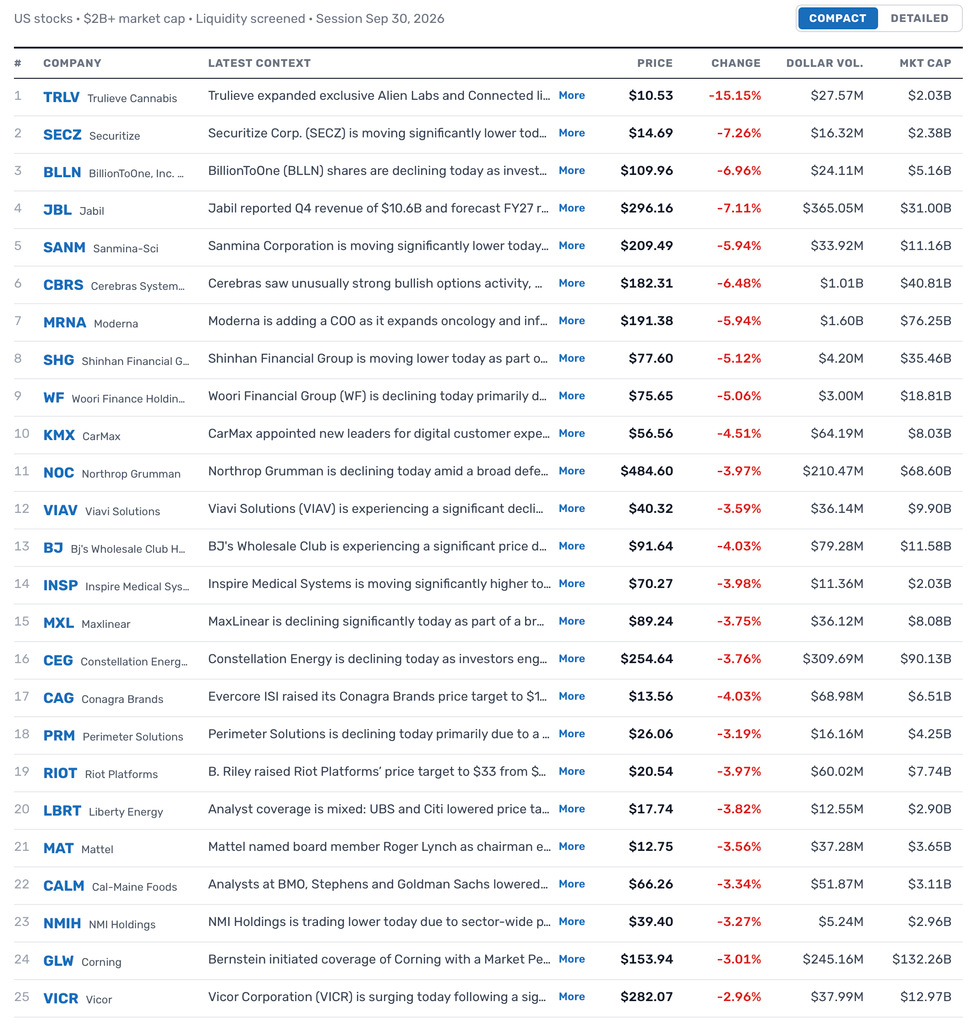
SOURCE TheFly
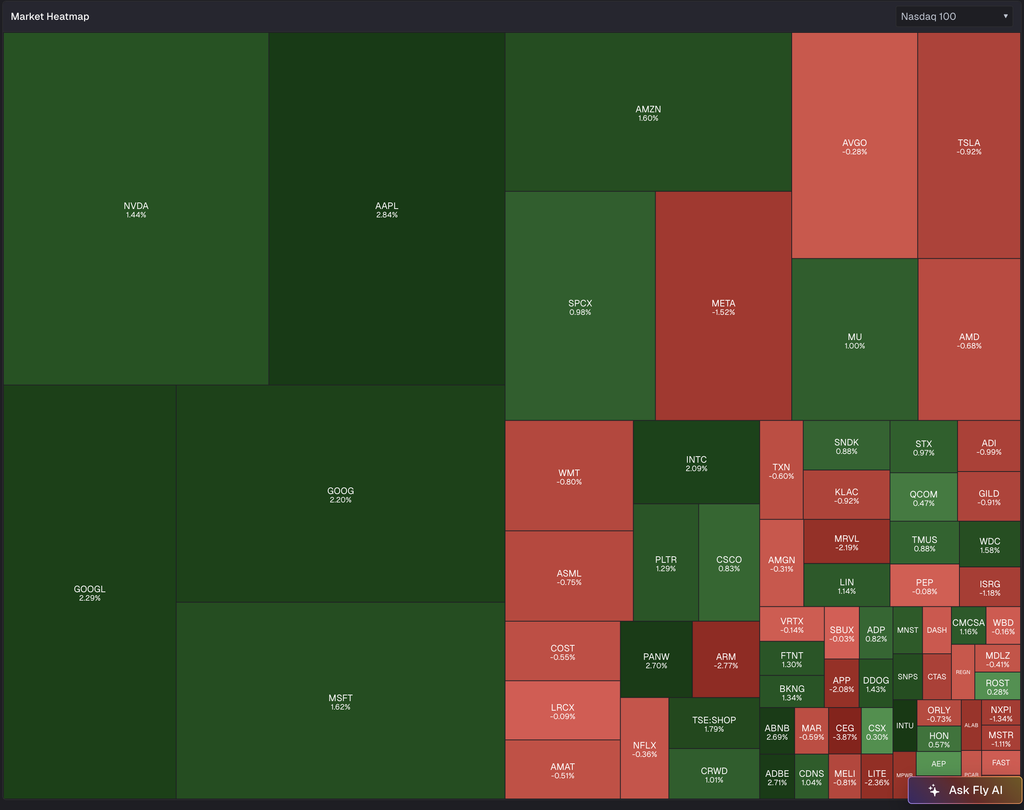
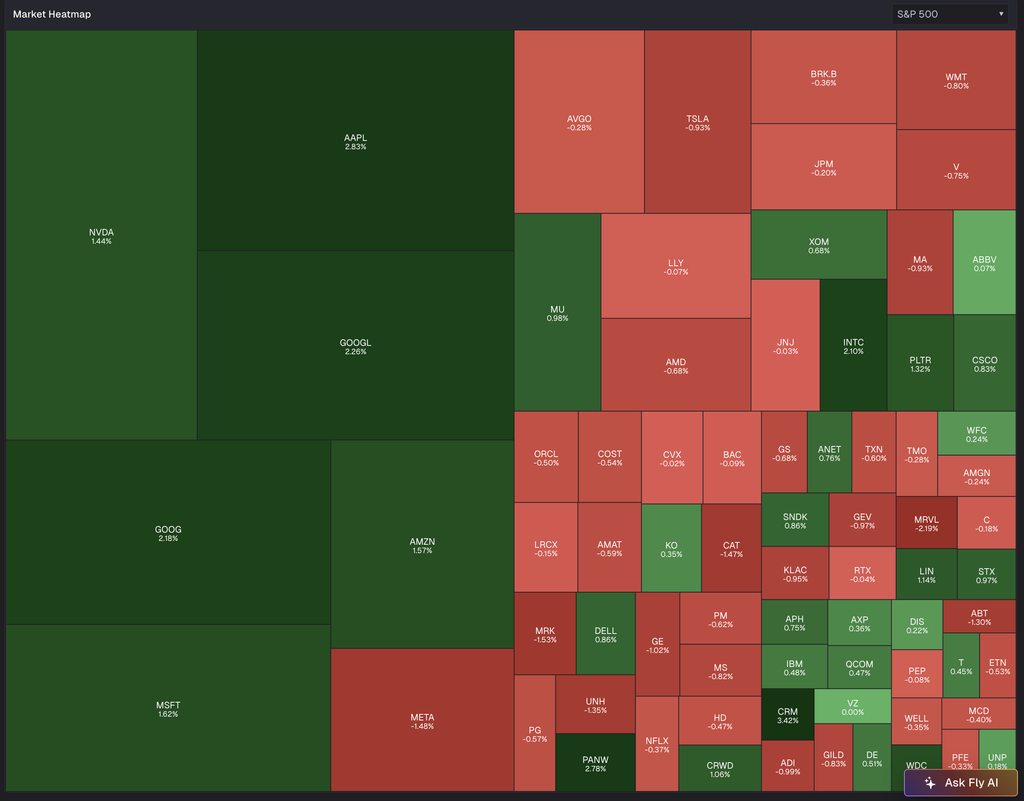
BY Doug Kass · Sep 30, 2026, 11:55 AM EDT
The all-time leaders in the playoffs of pitchers striking out 10 with no runs allowed:
Justin Verlander 3
Sandy Koufax 2
Randy Johnson 2
Cam Schlittler 2
Positions: None
BY Doug Kass · Sep 30, 2026, 11:25 AM EDT
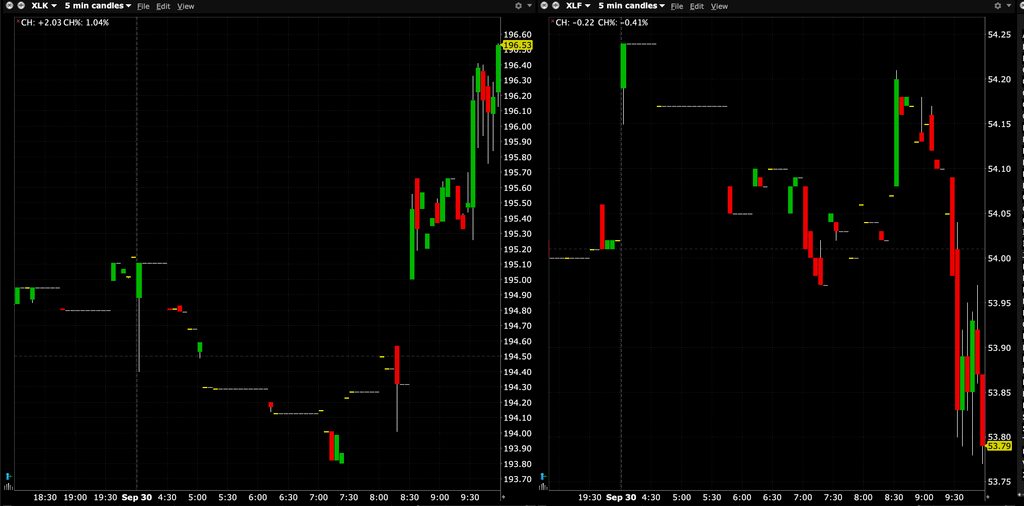
Chart from 10 a.m. ET
BY Doug Kass · Sep 30, 2026, 11:15 AM EDT
The following is from Peter Boockvar:
I think the John Williams comments, the president of the NY Fed, yesterday really matters and assuming no data surprises from now until the October 28th meeting, I don’t think they raise rates again at that gathering, especially right before the midterm elections. If they do hike again by year end, it would be more likely December. The 2 yr yield is down 6 bps since he spoke, and this is what it responded to from him, “With the policy action we took at our September meeting, there is no need for urgency, and we have time to gather more information.” Certainly doesn’t sound like a guy who is for a rapid rate hike cycle.
But he still kept another rate increase on the table by saying “If the economy evolves in a manner broadly consistent with my forecast, one further upward adjustment of the federal funds target range may be appropriate late this year to support a timelier return of inflation to target.”
I’ll argue again that the market is already doing the Fed’s work, among reacting to other things too, and it is not all on the Fed here to respond. A rate tweaking cycle we are under I’ll say again, I believe. And this is what Kevin Warsh wants and told us so, he wants to give room for the market to express itself, and it certaintly is doing so.
The most interest rate sensitive sector in the economy we know is housing. The MBA said the average 30 yr mortgage rate rose to 7.3% from 7.12% in the week before and vs 6.79% one month ago. In response, purchase applications fell 4.3% w/o/w and down 14% y/o/y. Refi’s were lower for a 6th straight week, down 8.7% w/o/w and by 56% y/o/y. I guess no surprise, however difficult the current rate environment is for the housing industry which remains hugely challenged.
These were earnings call comments of note from CarMax in the other highly interest rate sensitive business of selling used cars. With a relatively new CEO, there is some self help here that drove the stock up almost 5% yesterday.
“Used unit comps grew 13%, driven largely by improved price competitiveness.”
Still, the average selling price was up 6.3% y/o/y.
With respect to its CarMax Auto Finance business, “The observed credit performance in this space continues to be in line with our original expectations.” They did though see a reduction in Tier 1 lending (those with the best credit) as “Increased funding costs driven by the interest rate environment resulted in CAF increasing rates in Tier 1 where customers have more funding alternatives, including cash or financing through credit unions. We view this as a normal response to the higher interest rate environment versus a structural change in behavior from CarMax customers.” They saw continued growth in Tier 2 lending.
On their consumer, “affordability is on everyone’s mind. If you look at every single discussion around that…and our focus on having incredibly competitive pricing. And the other word I would say about the consumer is resilient, at the end of the day. Across all the different spectrums, at the lower end consumer to the higher end consumer, we’re definitely seeing resiliency there. I mean, the broader industry is down 1% or flat to 1%, and we posted comps at 13%. So I think having great cars, great vehicles, at great pricing and making it easy to work with will drive continued growth and performance in the business.”
Carnival had a good quarter as cruising continues to be the travel of choice for some. Its stock rallied by 13.4% yesterday. From them:
“The improvement in booking trends we highlighted on our last call continued to build throughout the quarter, with better close-in demand translating into higher revenues. That momentum also enabled us to raise our yield expectations for the fourth quarter.”
They don’t hedge their fuel costs but seemingly managed the cost increases well “as our teams continued to find ways to use less.”
With guidance, “For full year 2027, we are already half booked, with both occupancy and pricing at record levels. Bookings taken over our third quarter solidified this position, as we saw very healthy increases compared to last year’s levels.”
“Demand remains broad-based, including very healthy demand for our peak summer European deployments. 2028 is also off to an excellent start at higher occupancy and even higher prices y/o/y. And our booking curve is further out than it has ever been at this point in the year.”
Shifting gears to the overseas data. The August 3.6% gain in Australia’s trimmed mean CPI validated the rate hike seen yesterday to 4.6% by the RBA.
China’s more private sector weighted PMI improved in September with manufacturing at 52.1 from 51.5 and services up a touch to 51.6 from 51.4. With the former, Rating Dog said “Growth in manufacturing production accelerated amid rising demand from both domestic and overseas customers.” And, “rising cost pressures led to a renewed increase in output prices in September.”
Helping services was a lift in new orders “supported by successful business development efforts among firms and a broad improvement in demand conditions. The survey data also pointed to stronger external demand, as growth of new export business accelerated for the first time in 3 months.”
Separate from this data, China took a step yesterday to improve the demand for housing with the announced subsidies for mortgage payments. I think ending the decline in home prices is crucial to stabilizing household wealth and consumer spending.
On the heels of seeing yesterday’s higher than expected Spanish CPI for September, France today said its headline CPI rose 3.4% y/o/y, up from 2.6% in August and 2 tenths above the estimate. They also said that in August, PPI was higher by 4.8% y/o/y. Italy’s CPI was higher by 4.1% y/o/y vs 3.2% last month and above the forecast of 3.7%.
Expect more ECB rate increases as their deposit rate is still at only 2.5%.
BY Doug Kass · Sep 30, 2026, 10:25 AM EDT
* I have meetings at 10:30 a.m., 2:30 p.m. and 3:30 p.m. so I am keeping you up early…
Here are today’s things:
* I sold my GLD at $386.34
* I added to GLAS $6.15, GTBIF $7.14 and MSOS $4.65.
Positions: MSOS common VL calls M GTBIF S GLAS S
BY Doug Kass · Sep 30, 2026, 9:53 AM EDT
I Asked Claude on Cannabis
To Claude: When has the Drug Enforcement Agency requested a Government Accountability Office report in the past that resulted in rescheduling of a drug?
Researching DEA-requested GAO reports on drug rescheduling.
I’m not aware of any case like that, and the question rests on a premise that doesn’t match how the process works.
GAO doesn’t work for DEA. The Government Accountability Office is a legislative-branch agency that works for Congress. GAO reports are typically requested by congressional committees or members, or mandated by statute, not by executive agencies like DEA.
Rescheduling doesn’t run through GAO. Under the Controlled Substances Act, rescheduling is initiated by DEA, HHS, or a petition. HHS (through FDA and NIDA) then does a scientific and medical evaluation and makes a binding recommendation on the scientific and medical findings. DEA then decides and, if it acts, does so through notice-and-comment rulemaking. GAO has no formal role.
Where GAO has mattered. GAO has published reports touching on DEA’s scheduling and related work, such as drug shortages and the quota system for Schedule I and II substances, DEA’s diversion control, and marijuana research barriers. Those reports fed congressional oversight, but I’m not aware of any that directly triggered a rescheduling. Well-known rescheduling actions, like moving hydrocodone combination products from Schedule III to II in 2014, were driven by the HHS/FDA review process and DEA rulemaking.
If you saw this claim somewhere specific, such as a particular drug or a news article, tell me and I can dig into it. I can also search for GAO reports on DEA scheduling if you want the actual list, since my recollection of specific report titles may be incomplete.
Positions: None.
BY Doug Kass · Sep 30, 2026, 9:30 AM EDT
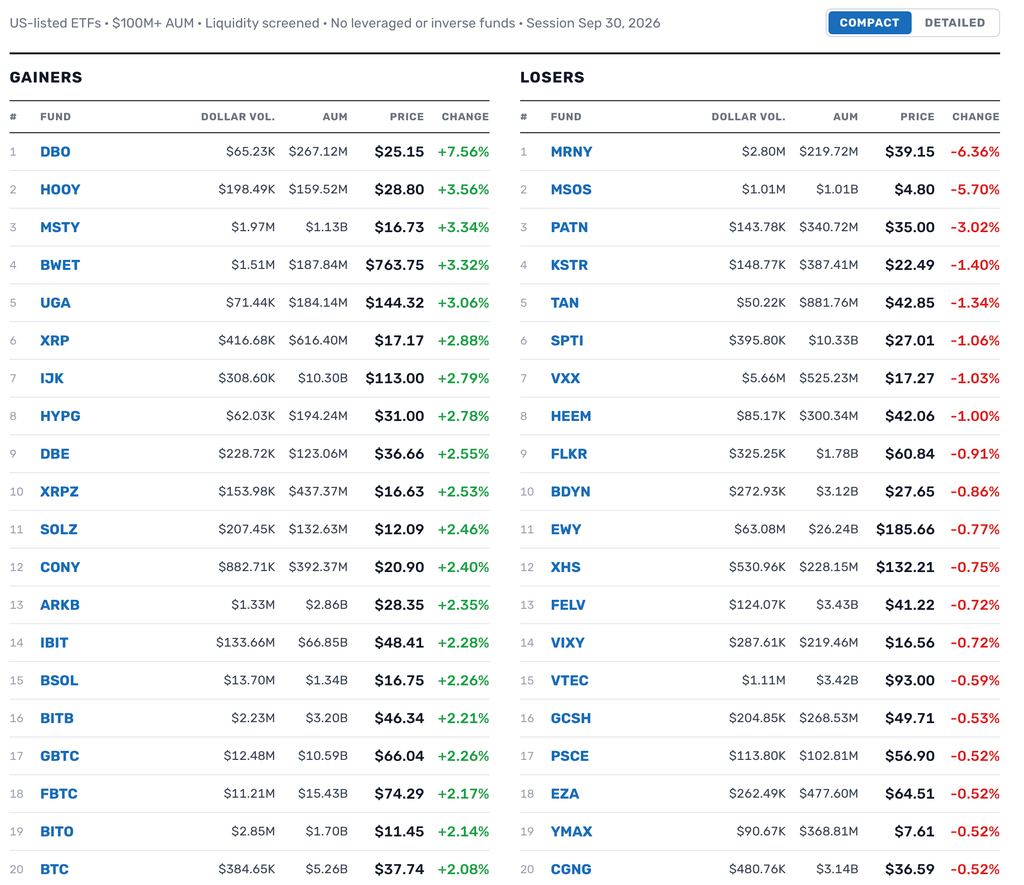
Source: The Street Pro
BY Doug Kass · Sep 30, 2026, 9:12 AM EDT
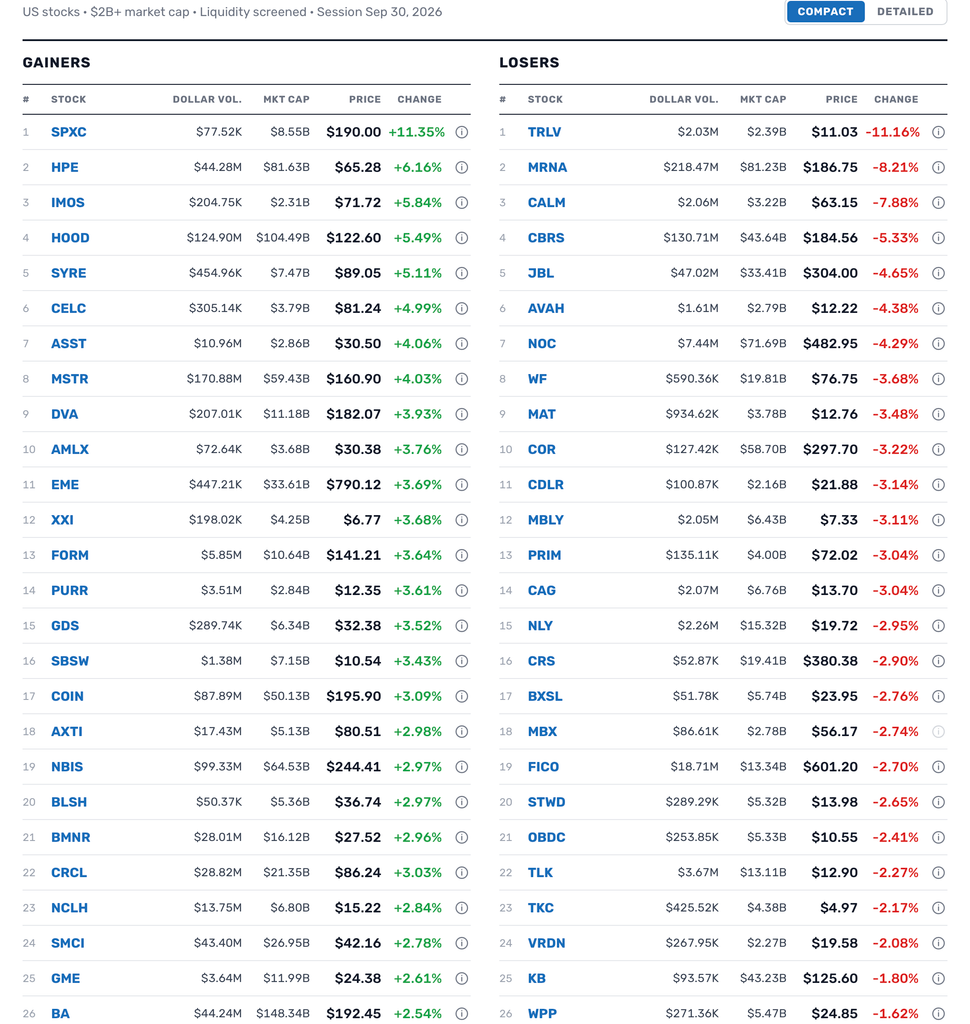
Source: The Street Pro
BY Doug Kass · Sep 30, 2026, 9:07 AM EDT
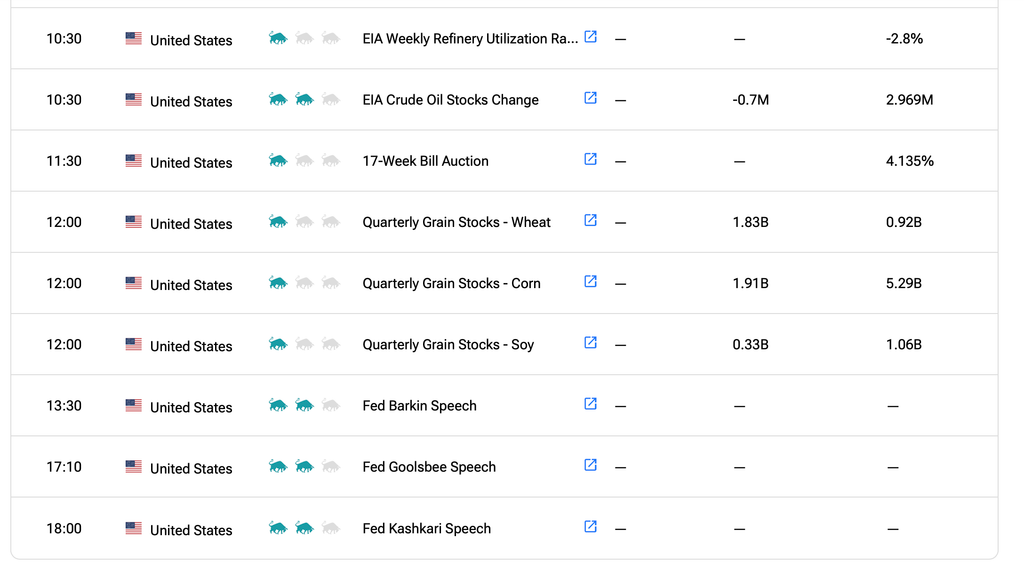
1:30 p.m.: Fed Bank of Richmond President Barkin (Non-Voter) delivers opening remarks at the Federal Reserve Bank of Richmond Investing in Rural America Conference, Asheville, NC (No livestream);
3:25 p.m.: Fed Bank of Richmond President Barkin (Non-Voter) and Federal Reserve Governor Lisa Cook (Voter) give afternoon remarks before the “2026 Investing in Rural America Conference: The Strength of Rural Places” hosted by the Federal Reserve Bank of Richmond in partnership with the Federal Reserve System and Rural LISC (Local Initiatives Support Corporation), Asheville, NC (Other details TBA) https://web.cvent.com/event/0476f20a-ab02-4ae0-83bf65f87e4823a7/websitePage:35859a7c-28ec-4eb5-b8b3-8a1931b9adc3;
5:10 p.m.: Fed Bank of Chicago President Goolsbee (Non-Voter) gives remarks before the “Why Consumers and Economists See Different Economies” event, a collaboration between the Chicago Fed and the research organization NORC at the University of Chicago, Chicago, IL (Embargoed text TBD. Livestream at https://www.chicagofed.org/publications/speeches/2026/sept-30-norc);
6:00 p.m.: Fed Bank of Minneapolis President Kashkari (Voter) participates in fireside chat before the Council on Foreign Relations C. Peter McColough Series on International Economics event, NYC (Audience Q&A expected. No media Q&A. No prepared/embargoed text. Livestream at minneapolisfed.org)
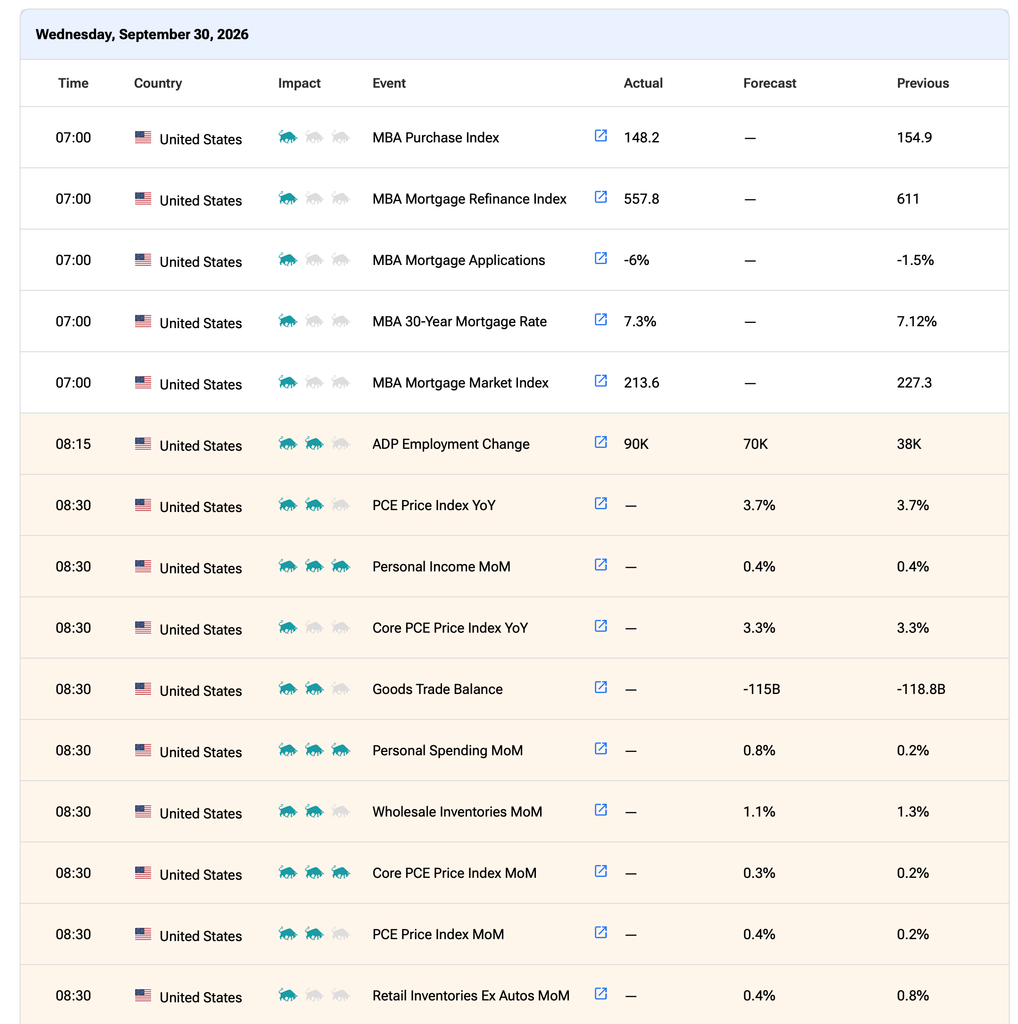
SOURCE: TipRanks
BY Doug Kass · Sep 30, 2026, 8:54 AM EDT
I sold my GLD long at $386.34 (+$3.50).
Positions: None
BY Doug Kass · Sep 30, 2026, 8:47 AM EDT
– CNTB +83% (Phase 2 COPD trial met its primary endpoint, reducing treatment failures by 81% and new moderate-to-severe exacerbations by 85%)
– NAUT +16% (no clear fresh catalyst identified; unusually large, liquid premarket move)
– CAPR +14% (new deramiocel analyses showed slower upper-limb decline in the HOPE-3 open-label extension and versus natural history)
– BIYA +13% (first-half results showed new continuing-operations revenue and a narrower net loss)
– SGMT +9.0% (rises ahead of today’s KOL event on 52-week Phase 3 extension data and the planned US AURORA Phase 3 trial)
– KALA +5.3% (signs a non-binding agreement to acquire a nationwide telehealth platform for approximately $15M)
– HPE +4.2% (no clear fresh catalyst identified; unusually large premarket move in a major liquid stock)
– PYXS -16% (prices a public offering of up to $282.6M, adding substantial dilution and stock supply)
– SDEV -15% (pulls back after the prior session’s outsized speculative surge)
– CNXC -8.7% (quarterly profitability topped guidance, but Q4 sales and profit guidance came in light and the FY revenue outlook missed expectations)
BY Doug Kass · Sep 30, 2026, 8:41 AM EDT
Positions: None.
BY Doug Kass · Sep 30, 2026, 8:29 AM EDT
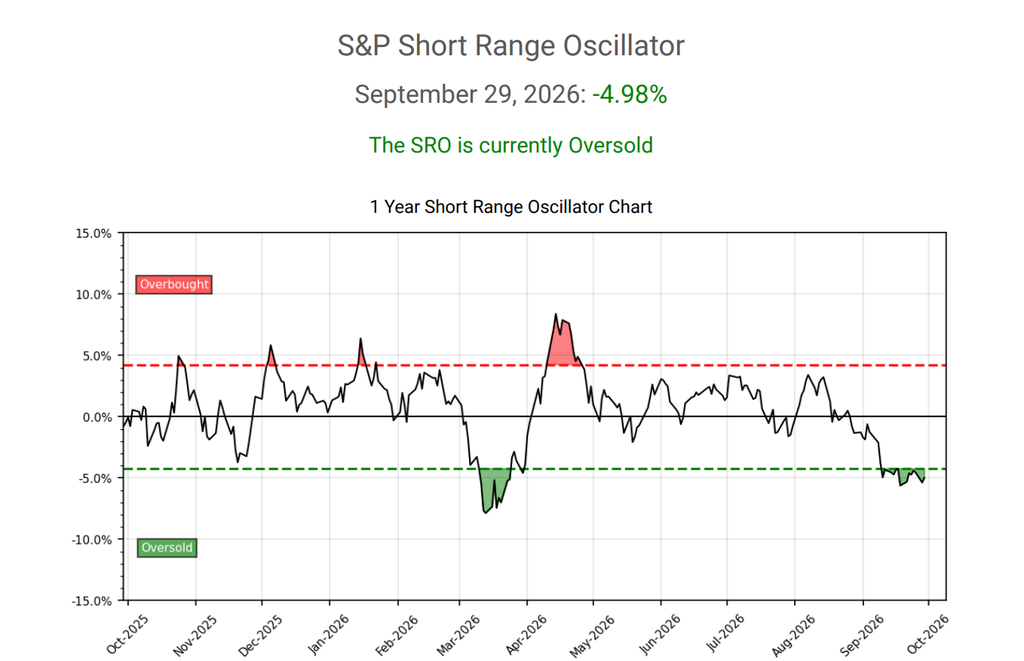
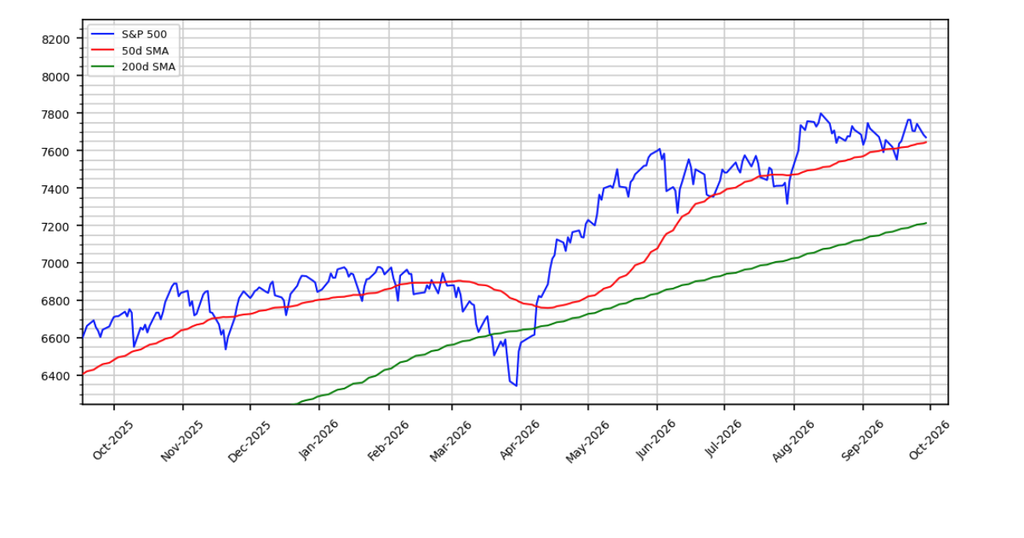
A subscriber – ww33 – asked (in The Comments Section) for a chart on the S&P Oscillator.
Here is a one year chart, from MarketEdge!
I will work on finding a longer term chart, as requested.
Positions: None
BY Doug Kass · Sep 30, 2026, 8:20 AM EDT
I want to pretend I am Sarge this morning!
After last night’s thrilling Yankee win over the hated Red Sox, I have a trivia question…
Who are the all-time leaders in playoffs — pitchers that have struck out at least 10 batters and have allowed no runs?
Position: None
BY Doug Kass · Sep 30, 2026, 8:00 AM EDT
This is an interesting tweet.
Although it is AI specific with regard to OpenAI, I view it more broadly regarding the investment world these days.
Open AI’s valuation should be going down, not up. The fundamental picture keeps getting worse. The prior round valuations were grossly elevated to begin with. There is seemingly nothing but massive losses on the horizon. Executives are leaving in droves. They have all sorts of issues with the product, and its related risks. The CEO is a clown. The industry overall has real issues.
We are likely looking at midterms where Democrats may gain some power (which I have stated can be viewed as a market headwind — more corporate and individual taxes, etc.), which will not be good for AI either.
Yet no matter how much worse things look, they can somehow attempt to keep raising money at a higher valuation than the prior elevated round.
One of their biggest investors (SoftBank) needs to keep borrowing money at elevated rates to keep funding them. It is almost as though there is an expectation that because the prior round was done at X, the next round will be done at almost 2X.
Who is doing this, and why? It makes no sense. The fundamental answer is the next round of financing should be done in bankruptcy court, in my view.
Anthropic is no different with regard to how the IPO is theoretically being priced and how their business is valued. The equity markets in total seem no different now.
It really makes no sense. It is almost like there is some sort of magical force elevating everything. I have never seen anything like this.
Position: None
BY Doug Kass · Sep 30, 2026, 7:30 AM EDT
As I mentioned late yesterday afternoon, the stay is procedural and I fully expect rescheduling to occur:
According to another source, President Trump is growing impatient about the slow pace of rescheduling progress:
Position: Long MSOS common (VL) and calls (M)
BY Doug Kass · Sep 30, 2026, 6:41 AM EDT
Position: None
BY Doug Kass · Sep 30, 2026, 5:55 AM EDT
The S&P Short Range Oscillator remains in a deep oversold at -4.98% vs. -5.37%.
I have no index shorts on currently.
Position: None
BY Doug Kass · Sep 30, 2026, 5:45 AM EDT
U.S. 30-year mortgage rates climb for a sixth straight week

🦔OpenAI wants another $30 billion. The company is seeking a new funding round at a $1.4 trillion valuation, per Bloomberg. This is a bridge round because OpenAI delayed its IPO, with Altman citing safety concerns. OpenAI raised $122 billion in March at an $852 billion valuation. Show more

More than 58% of S&P 500 stocks were trading below their 200-day moving average today, the worst market breadth since May 2025 🚨 🚨


