The following is from Peter Boockvar:
Stop always staring at me/Amazingly good earnings intel/Europe
‘Stop always staring at me’ is essentially what Kevin Warsh said again to the markets and over the past six weeks, the markets took heed. I’ll repeat what I said yesterday: ‘understandably a lot of angst over what the Fed would do today but the bond market has already tightened policy for them whether one thought they would move today or not.’ I loved his line yesterday, “Play the ball, not the referee” and a reason why he’s saying it is because his crystal ball is not any clearer than the markets and he wants to end the Fed playing god over the level of interest rates.
What complicates the job of Warsh & Co though is the near 6% budget deficit as a percent of GDP as it is both fiscal driven inflationary that he has no control over and if I’m right that debts and deficits now matter, long end rates are going to reflect that.
Now what will happen by year end I believe, if inflation is still in the range of 3-4%, which I think to be the case, they will hike rates at some point in the coming meetings “as delivering price stability” is the appropriate key message Warsh keeps sending. And if they don’t, the bond market will continue to do it for them.
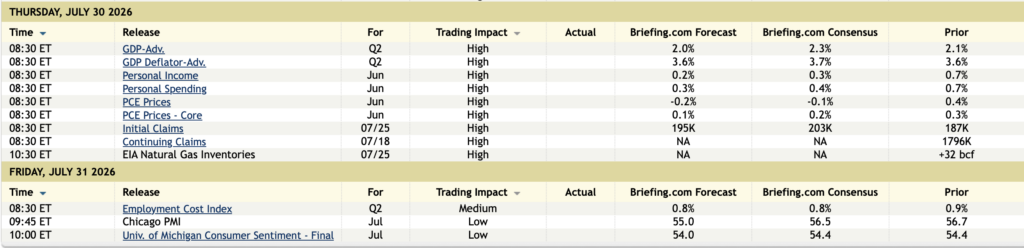
Ahead of the June PCE, thus old news with the moves in oil prices since and after we’ve already seen CPI and PPI, I want to make a quick comment here on the changes being made to the calculation to PCE as of the August print which will be seen in September. The BLS is tweaking how they calculate portfolio management fees, software and legal services, which I have no problem with. What I do have a problem with is they are not changing how they calculate healthcare which is the BIGGEST component of PCE by far. As it currently calculates what 3rd parties pay for healthcare as opposed to consumers, it mostly captures Medicare and Medicaid reimbursements which are artificially set below market. That would be real change to the PCE measurement because it suppresses this inflation metric.
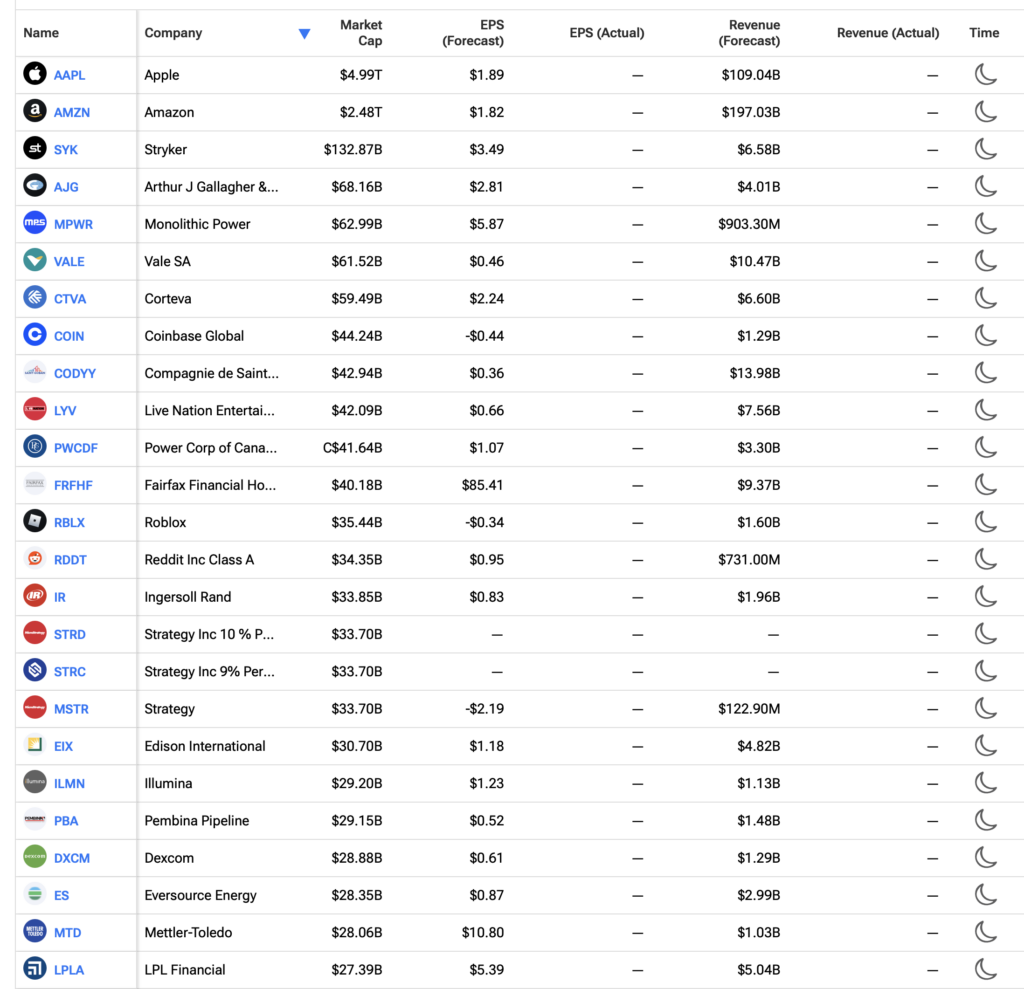
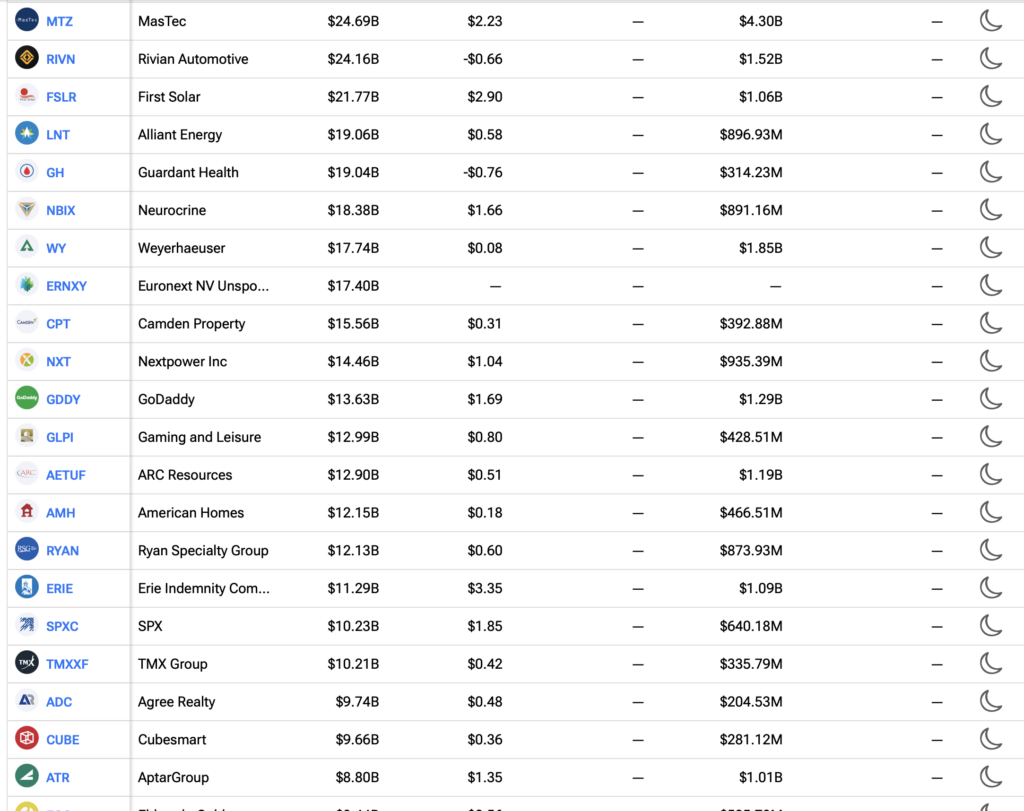
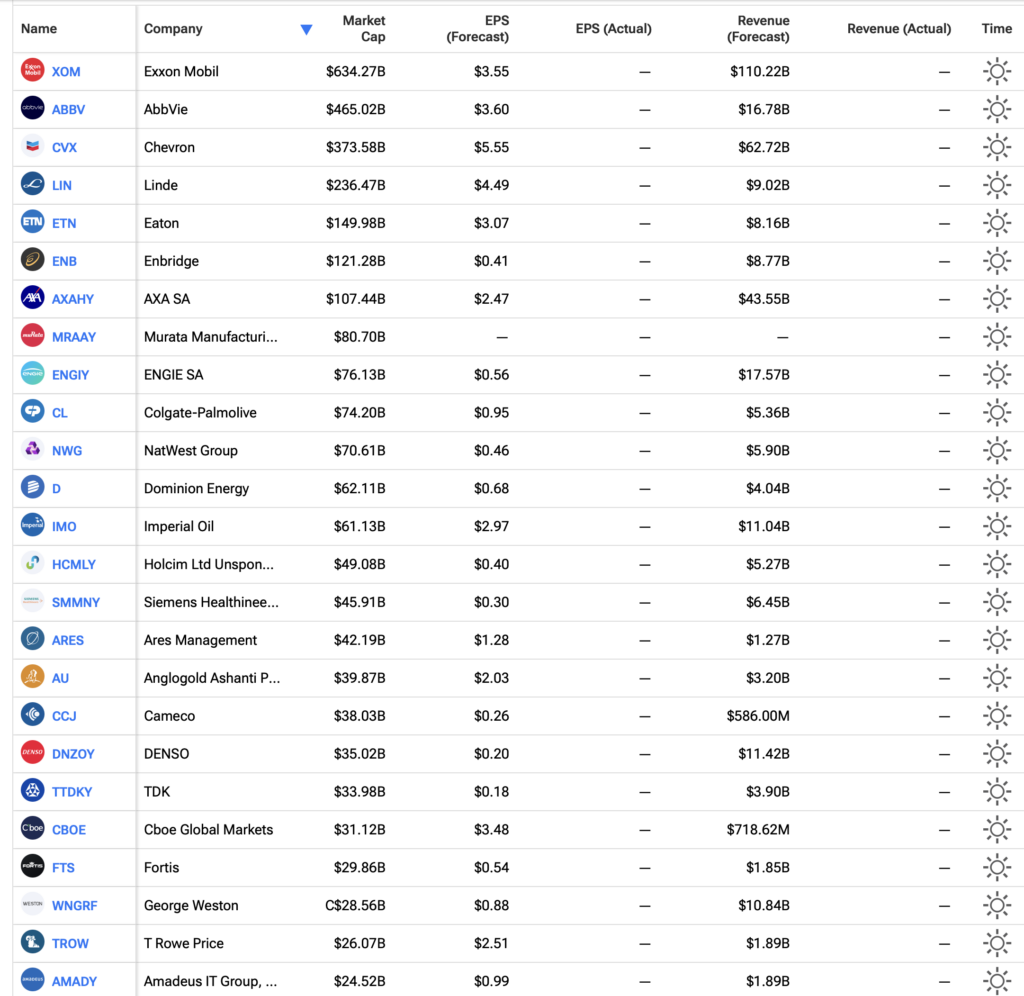
Flooded with earnings and I’ll try to be as succinct as possible with the direction of business the best for those touching the data center construction.
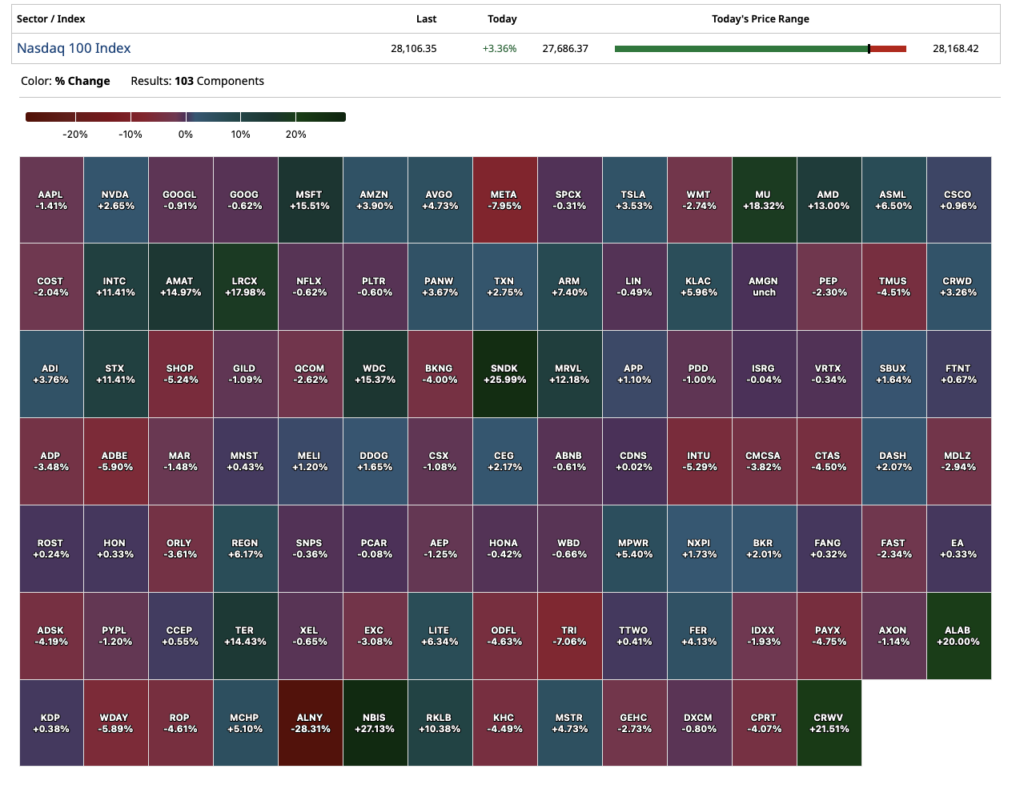
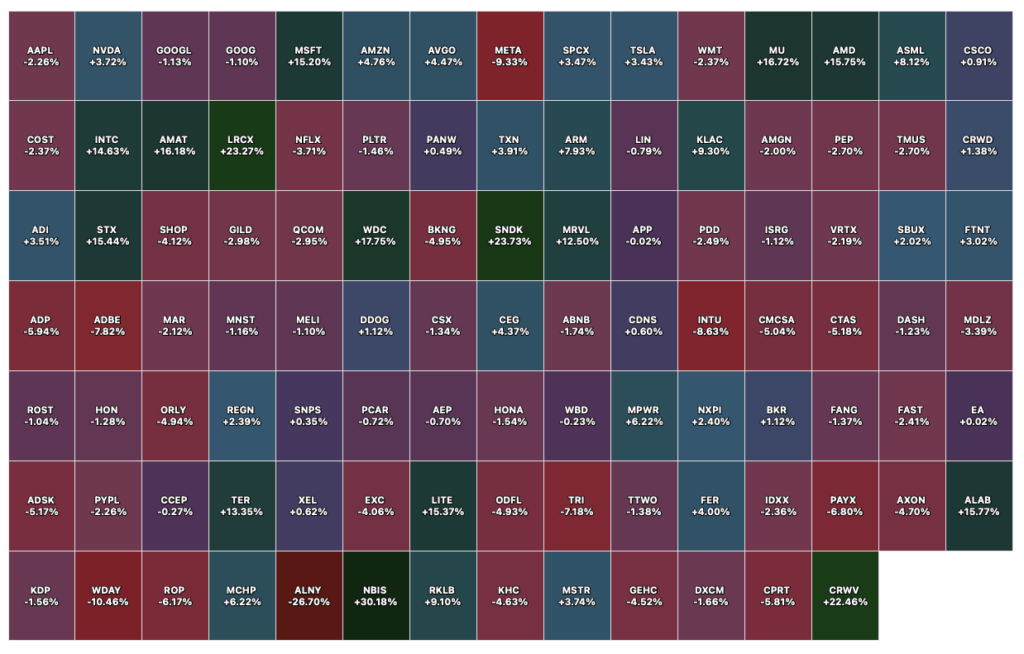
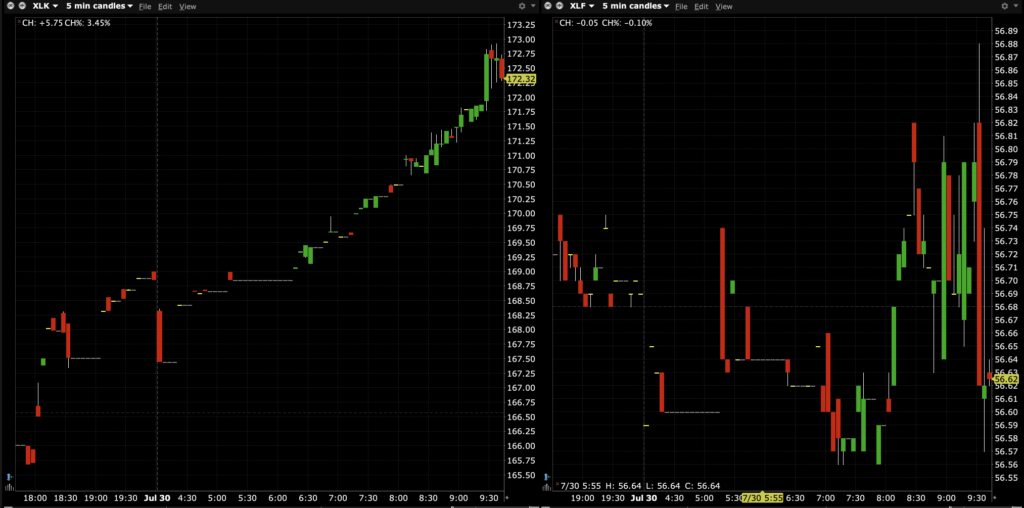
From Microsoft, lifting pre-market:
“Microsoft Cloud surpassed $214 billion, up 27% and Azure surpassed $100 billion, up 41%.”
“Company gross margin percentage was 67%, down y/o/y, driven by sales mix shift to Azure as well as continued investments in AI infrastructure and growing product usage, partially offset by ongoing efficiency gains, particularly in Azure and M365 Commercial cloud.”
In cloud, “Customer demand continues to exceed available capacity. Revenue growth was ahead of expectations driven by efficiency gains across our CPU and GPU fleet as well as process improvements to enable earlier delivery of new capacity. That additional in-quarter capacity for Azure was quickly monetized.”
Unlike the massive $99 billion ‘other income’ gain seen from Alphabet/Google, Microsoft’s was $2.8 billion, “When adjusted for the impact of our investments in OpenAI” and it was “driven by the gain on investment in Anthropic.”
“Capital expenditures were $41 billion including the impact from higher component pricing as noted in our guide. Roughly two-thirds of our CapEx was for short lived assets, primarily CPUs and GPUs as customers increasingly build solutions that leverage both AI and non-AI infrastructure. The remaining spend was for long lived assets.”
Guiding to the next quarter, “We expect CapEx spend will be over $50 billion.”
I’ll add this, in terms of expected free cash flow for Microsoft, for their current 6/27 fiscal year it’s estimated by the Street to be $28.4 billion vs $67 billion for 6/26 fiscal year.
From Meta, down pre-market as still robust revenue growth (up 28%), though with more muted guidance, is again offset by the massive spending concerns:
“The global average price per ad increased 12% y/o/y, driven by ad performance gains, improvements in macro conditions relative to Q2 of last year (which included ‘Liberation Day), and currency tailwinds.”
“Capital expenditures, including principal payments on finance leases, were $31.1 billion, driven by investments in servers, data centers, and network infrastructure…We anticipate 2026 capital expenditures, including principal payments on finance leases, to be in the range of $130 billion to $145 billion, narrowed from our prior outlook of $125 billion to $145 billion.” There was no specific guidance as to what it might be in 2027.
To quantify, at the mid-point of that guide, that is 54% of 2026 expected revenue vs 27% in 2022 before the spend ramp started. Their free cash flow is expected to go from $46 billion in 2026 to an estimated -$1.2 billion in 2026.
And this is one of the reasons why Mark Zuckerberg is spending all this money as he doesn’t think GenAI will just be an enhanced search tool and it won’t be just for coders and software developers:
“one of the bets here that we’re making is that we think that consumer personal agents is going to end up being an extremely important and massive market. I think that it’s extremely unlikely if you look out five years from now, for example, that whatever period of time you want, that you don’t have billions of people with a personal agent that understands your goals and that is just working on your behalf 24/7 to achieve your goals in whatever the domain is that you care about, whether it’s helping you with your health or your hobbies or your personal finances or your productivity in running your home better or improving and enhancing your relationships, helping with your career.”
From Proctor & Gamble, down 2% yesterday:
“We managed through a very volatile environment and delivered organic sales, core EPS and cash return to shareowners within our initial guidance ranges…We also saw improvement in market share in the second half despite some softening in underlying market growth as inflation increased.” And “results were impacted by trade dynamics in the US and the spike in input costs.”
“As we enter fiscal ’27, we continue to expect the environment around us to remain volatile and challenging from cost to currencies to consumer competitor, retailer and geopolitical dynamics.”
“On the consumer, I can’t point or we can’t point to gas as a specific impact. I think it’s a general impact where you see the consumers that are well off continue to behave as they behaved before with larger pack sizes to find value. The more pressured consumer that will be more impacted by gas prices or incremental $100 of gas cost per week. They continue to look for smaller pack sizes. They continue to be very affected by promotion patterns. So none of that has changed.”
From Starbucks and trading higher pre-market as comps exceeded expectations and they raised guidance:
“North America continues to lead our performance in the quarter…Sales growth in Q3 was broad based across generations and income groups, and across both Starbucks rewards members and non-members, even with the continued pressure on US consumer sentiment. Marketing innovation helped drive that resilience.”
US comps were up 7.9%, “led by transactions up 4.2%, and average ticket up 3.6%…Pricing contributed less than a point of ticket growth in the quarter.”
“International company operated comp sales grew 5.7%, driven by continued strength in Japan and the UK.”
From Chipotle, also up pre-market with slightly better comps:
Comps grew 2.2%, “including a transaction comp of 1%.”
“We were pleased to see this momentum carry into early July, though trends have been softer in recent weeks, amid heightened consumer caution around the broader restaurant industry.”
“On pricing, the impact in Q2 was around 1.6% and we anticipate it will increase to the mid 2% range in Q3. For the full year, we expect to land near the high end of the 1% to 2% range we communicated earlier this year.”
From MGM Resorts, in the process of maybe getting bought by Barry Diller:
“Revenue for Las Vegas was bolstered by a solid underlying base of group and convention business at MGM Resorts and aided by strong attendance at events around town ranging from BTS and UFC to a deep playoff running at the Stanley Cup by our very own Vegas Golden Knights.”
With their convention business, “We drove demand from a diverse customer mix that included technology and hospitality corporate groups as well as top B2B trade shows and professional association meetings, leading to the highest 2nd quarter convention ADR and catering and banquet revenue in our history.”
To the two lane economy, “I think we continue to see really strong strength in the luxury segment. As we’ve noted, the lower ends of the segment, particularly Luxor and Excalibur, those do remain challenged, but we’ve been deploying offers such as the all-inclusive. We’ve seen a positive reaction to that.” They are also seeing “real health in the Group segment.”
“At MGM China, we continued to outperform the market in the 2nd quarter, while maintaining solid market share of 16.4%, a sequential increase of a full percentage point. While the World Cup temporarily impacted June volumes in Macau, this was a transitory event rather than a secular shift. Our confidence is reinforced by the immediate and encouraging rebound in volumes observed post-tournament throughout the month of July.”
From Old Dominion Freight Line, down 1.5%:
“The domestic economic environment remains relatively stable and we are encouraged by the continued improvement in demand that began late last year.”
From Vulcan Materials, also down 1.5%:
“Shipments increased 1% compared to the prior year and varied widely across geographies depending upon weather conditions. Aggregates freight adjusted selling prices moved higher both sequentially and y/o/y. On a mix adjusted basis, average selling prices in the quarter improved 5% compared to the prior year with improvements widespread across geographies.”
“We still expect strong public activity in our markets and improving private large project opportunities to drive y/o/y shipments growth in 2026…With the August recess upon us, as expected, there will likely be a continuing resolution to fund federal highway spending while Congress completes this work.”
“On the private side, large project opportunities continue to drive non-residential activity, particularly data centers.”
“Residential construction continues to struggle due to the ongoing lack of affordability.”
From Masco, which fell 11% yesterday as sales missed the estimate:
“Looking at our North American plumbing performance in the first half of the year, sales increased low single digits.”
“Our strong PRO paint performance continues, with sales increasing mid single digits in the quarter. DIY paint sales decreased high single digits in the second quarter, reflecting ongoing weakness in the DIY paint market” among other things.
From Eagle Materials, down 5% yesterday:
“On the heavy side, our cement and aggregate volumes continue to be supported by elevated infrastructure spending driven by federal IIJA bill and elevated state budgets.”
“Similarly, our customers across all of our regions are seeing growth in data center construction. We are still quantifying the impact on our volumes of rapid data center growth. What we do know is our customers are seeing an increased number of projects, building footprint sizes, and visibility from project announcement to actual construction. They are also seeing this growth spill over into other categories such as utilities, warehousing, and community build out.”
From ADP talking about the AI influence or not on the jobs market and who rallied 3.5%:
“While some job displacement can occur during times of transition, our data shows that AI is not eliminating jobs at scale. Instead, it’s reshaping how work gets done, what roles look like, and how teams are organized.”
From Stanley Black & Decker, down 1.2%:
Revenue was up 3%, “slightly ahead of our expectations, driven primarily by volume strength in the US across both retail and commercial & industrial channels within tools & outdoor.”
“we maintain our view that the new Section 301 tariffs, including those implemented just last week, are likely to be introduced during the next few months at the same level as the old IEEPA tariffs, which means our underlying run rate tariff costs are expected to return back to the prior IEEPA levels within a few months.”
They did get some IEEPA refunds but “This temporary tariff tailwind, however, is still being offset by persistent inflationary pressures from battery metals, tungsten, oil and oil derivatives…Given inflationary pressures remain persistent, it appears more likely than not a price increase will be necessary by 2027.”
I’ll finish with some data out of Europe. France’s economy grew by .2% q/o/q or .7% y/o/y about as expected. Spain’s economy was up by .7% q/o/q and 2.7% y/o/y, above expectations.
For the Eurozone as a whole, growth was .4% q/o/q, twice the estimate and up 1% y/o/y. That is something Europe needs to improve but could have said that for a long time now.
Spain’s July CPI fell one tenth m/o/m but off a .6% gain in June and up 3.8% y/o/y.
The Economic Confidence index for the region in July was 96.9, up from 95.4 in June with gains in both services and manufacturing. Retail and consumer confidence both rose but weakened for construction.
Positions: None.