You Can Bet on Nike to Re-Energize, But at What Price?
The footwear and apparel giant has been fading, but new leadership has the chance to turn things around.
You've reached your free article limit
You've read 0 of 1 free Pro articles.
The was a time where Nike NKE was a prestigious brand name in athletic equipment. But now, run a local 5K and you won't see nearly as many runners wearing a pair of Nikes as you used to. That's just a fact of life.
Has Nike apparel or athleisure clothing lost its "cool" factor? I haven't been cool in a very long time (I never was), but I suspect it has.
Nike released the firm's fiscal first quarter financial results on Tuesday evening. Those results were not good. CEO John Donahue is being shown the door, and retired executive Elliott Hill is being brought back to replace him. Hill, who will start in a little less than two weeks, may not have huge shoes to fill, but he certainly does have a huge and probably difficult job ahead of him.
For the three-month period ended August 31, Nike posted a GAAP EPS of $0.70 on revenue of $11.589 billion. The top-line print missed expectations, while reflecting a year-over-year contraction of 10.6%. That bottom-line number did beat Wall Street quite decisively, but was still down 25.5% from the year-ago comp of $0.94.
The poor performance was across the board. Direct revenues were down 13%, while wholesale revenues were down 8%. Perhaps most distressing, but understandable was the firm's decision to postpone its "Investor Day" as it goes through the transition from one CEO to the next.
Operations
As revenues contracted 10.4% to $11.589 billion, the cost of sales contracted 12% to $6.332 billion. This left a gross profit of $5.257 billion (-8%) on a gross margin of 45.4%, which was a bright spot, up from 44.2%.
As for operating expenses, demand creation expenses increased 15%, while overhead as an expense dropped 7% and administrative expenses dropped 2%. This left an operating margin of 34.9%, up from 31.8%. After accounting for interest, other income and expenses, and taxes, net income printed at $1.051 billion, which was down 28% from the year-ago comparison. This worked to the $0.70 per diluted share mentioned above, which was down 25.5%.
Divisional Performance
- North America sales decreased 11% to $4.826 billion, producing earnings of $1.216 billion (-15%)
- Europe, ME and Africa sales decreased 13% to $3.143 billion, producing earnings of $792 million (-15%)
- Greater China sales decreased 4% to $1.666 billion, producing earnings of $502 million (-4%)
- Asia Pac and Lat Am and sales decreased 7% to $1.462 billion, producing earnings of $402 million (-3%).
Brand Performance
- Nike sales decreased 10% to $11.111 billion, producing earnings of $1.685 billion (-20%)
- Converse sales decreased 15% to $501 million, producing earnings of $121 million (-28%).
Nike Brand Sales Performance
- Footwear sales decreased 11% to $7.426 billion
- Apparel sales decreased 11% to $3.032 billion
- Equipment sales increased 14% to $603 million
Fundamentals
The firm has not released its statement of cash flows for the quarter as of yet. You all know how much I love it when reporting firms play "hide and seek" with important financial information. The firm did tell us that it returned a rough $1.8B to shareholders during the quarter that included $1.2B in repurchased common stock and cash dividends or $558M. All that said, I'll get right to the balance sheet, which was published along with the firm's earnings.
Nike's cash position at the end of the quarter stood at $10.294 billion while inventories stood at $8.253 billion. This puts current assets at $25.04 billion. Current liabilities add up to $10.628 billion, which does not put the firm in trouble, but is up 26% from the year-ago comparison. This does include $1 billion worth of short-term debt. The firm's current and quick ratios are now 2.36 and 1.58, respectively. Both ratios are considered to be quite healthy.
Total assets amount to $37.867 billion, including a very small total for intangibles that is no problem at all. Total liabilities less equity comes to $23.923 billion, including $7.998 billion in long-term debt. That's down about $1 billion from a year ago. That simply means the $1 billion in debt entered as a current liability is simply long-term debt that comes due in less than 12 months. This is a strong balance sheet.
Guidance
Given the firm is in transition, full-year guidance was withdrawn. There was no CEO on the call last night, but CFO Matt Friend did provide some guidance for the current quarter during that call. Fiscal second quarter revenues are expected to be down 8% to 10%. Q2 gross margins are expected to be down roughly 150 basis points. No highly detailed guidance on profitability or obviously cash flow was issued. There has been no timeline set and probably will not be, at least until Hill is settled in his new job.
Wall Street
Since these earnings were released last night, I have come across 14 highly-rated (four-plus stars at TipRanks, which left out a few household names) analysts who have opined on NKE. Among the 14, there are nine "buy" or buy-equivalent ratings and five "hold" or hold-equivalent ratings. One of the "holds" did not set a target price, so we are working with 13 of those.
Across the 13 remaining analysts, after allowing for changes, the average target price is $95.46 with a high of $120 (Brian Nagel of Oppenheimer) and a low of $78 (John Kernan of TD Cowen). Once omitting those two as potential outliers, the average of the final 11 analysts drops to $94.82. Because you were going to ask anyway, the average "buy" target is $102.33, while the average "hold" target is an even $80.
My Thoughts
We have no idea what operating and free cash flows were for the quarter, but even if they were below average, Nike has been a cash flow generating beast even in lousy quarters. I don't expect any jaw-dropping information when that statement is released. The balance sheet is still in very good shape. The problem is that the business is in fairly steep decline, across all regions, across both brands and across both footwear and apparel. Incoming CEO Hill will have his hands full. Let's take a look at the chart.
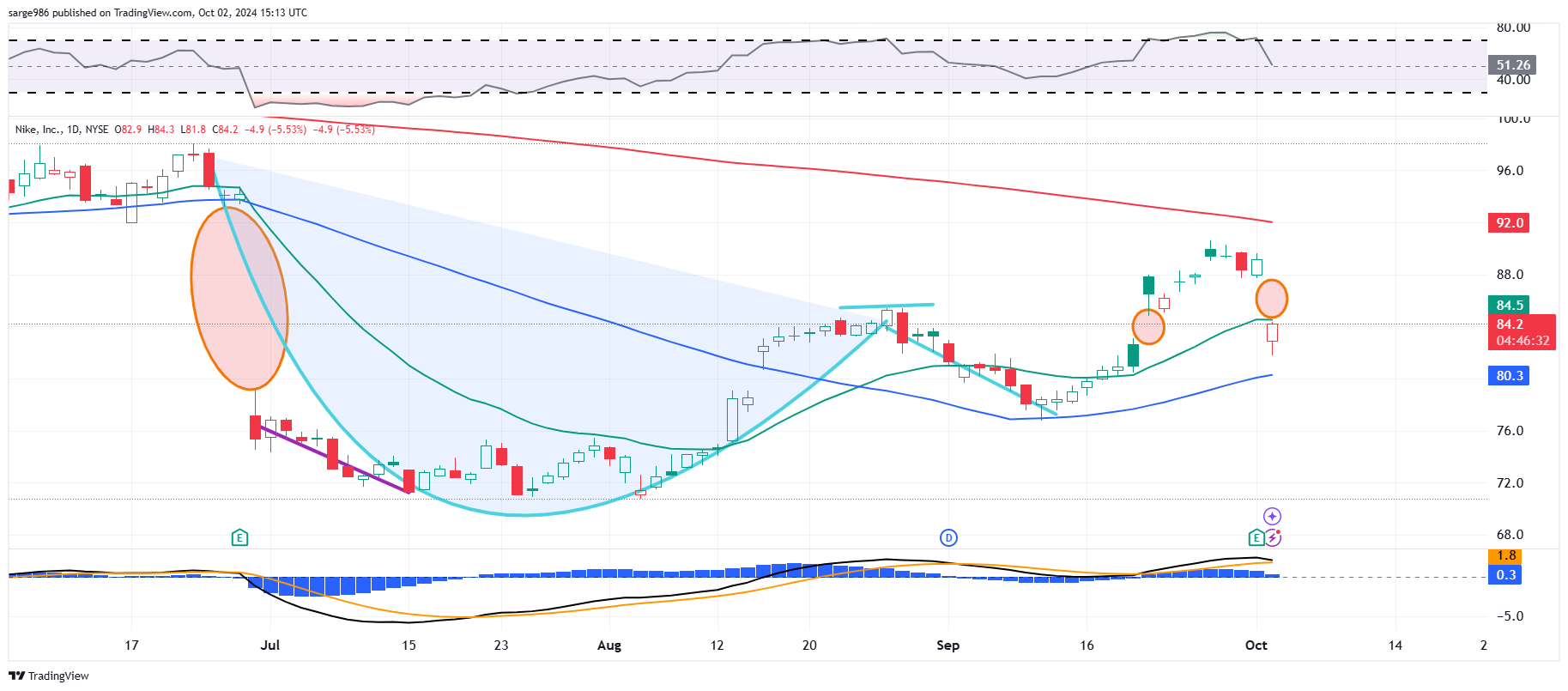
Readers will see that the huge gap down last June for Q4 earnings was the start of a cup-with-handle pattern with an $85 pivot that had seemed to be working its magic, until last week when the change in the C-suite was announced. This morning, the stock gapped lower again, surrendering its 21-day EMA. Relative strength is not yet weak but is weakening quickly. The stock's daily MACD is still slightly positive, but once that 12-day EMA crosses below the 26-day EMA, that will send a sell-signal to the algorithms that price stocks in 2024.
What now? I have no problem betting on a Nike stock re-energized by the leadership of Hill. At what price? That's a good question.
The technical pattern is broken, so forget the cup with handle. The 50-day SMA stands at $80.30 right now. I don't think I dip my toes in the water until I see that line tested. If I miss it because of that, so be it. Something tells me (actually, the CFO told us) that Nike is going to post another tough quarter in three months' time.
Prospective bulls can take their time. There is no need to act quickly. The stock still trades at an expensive 28-times forward-looking earnings. Prospective bears? I'd rather short the stock after a failure to hold that 50-day line than short it just above that line.
At the time of publication, Guilfoyle had no positions in any securities mentioned.