Why Bitcoin Is Central to This Top Investment Pick for 2025
Bitcoin is rapidly gaining acceptance as an asset class that should be held in a diversified portfolio.
You've reached your free article limit
You've read 0 of 1 free Pro articles.
Stock market investors have had a love/hate relationship with Bitcoin for many years. In its early days, Bitcoin was often dismissed as a fringe instrument used as a tool primarily for criminal enterprises. While it has gained some acceptance as a form of payment, it is still not widely used for routine transactions due to its high level of volatility.
Since Bitcoin doesn’t reflect ownership in a business enterprise, it has no clear intrinsic value. There is no way to use traditional investment metrics such as discounted cash flow, balance sheets or enterprise value to arrive at an approximate valuation.
The best way to think of the value of Bitcoin is pure supply and demand. New Bitcoins are created by Bitcoin miners using massive computing power to solve extremely complicated math problems that verify Bitcoin transactions. Successfully solving these problems releases new Bitcoin rewards while assuring ownership in a decentralized manner. The supply of Bitcoin is carefully controlled, and ultimately, there will be a finite supply of 21 million Bitcoins.
Since the supply of Bitcoin is predetermined to some degree, the value of Bitcoin will be largely determined by demand. If demand is greater than supply, then the price of Bitcoin is sure to rise.
Several recent events suggest that market demand for Bitcoin will stay very strong and even accelerate in 2025. The main factors driving recent demand for Bitcoin are:
- Federal regulations and ETFs. The SEC has been harshly criticized for its opposition to Bitcoin and crypto in general. After a long battle, Bitcoin ETFs were finally approved in early 2024. This has increased volume, made it easier for investors to buy and sell it and made the market more liquid.
- Politics. Donald Trump made it very clear that his administration would be supportive of Bitcoin, and by naming Elon Musk as a key advisor, he has helped to move Bitcoin to the mainstream as an alternative investment vehicle.
- Jerome Powell. In a recent interview, Powell compared Bitcoin to digital gold. He did not view it as a threat to the dollar and appeared to be supportive of it as an asset class.
- BlackRock. In a recent note to customers, BlackRock Institutions stated that it viewed a 1% to 2% allocation to Bitcoin as a reasonable range of exposure.
The main takeaway from these developments is that Bitcoin is now an asset class that is increasingly likely to be found in most diversified portfolios. There is still very limited exposure to Bitcoin in most major portfolios, so the potential for growth is strong in demand.
There are a number of pundits out there who are forecasting that Bitcoin will increase by many fold in the years ahead. While that is possible, there is no way to rationalize targeting a price because it is unknown how much demand there will be in the future.
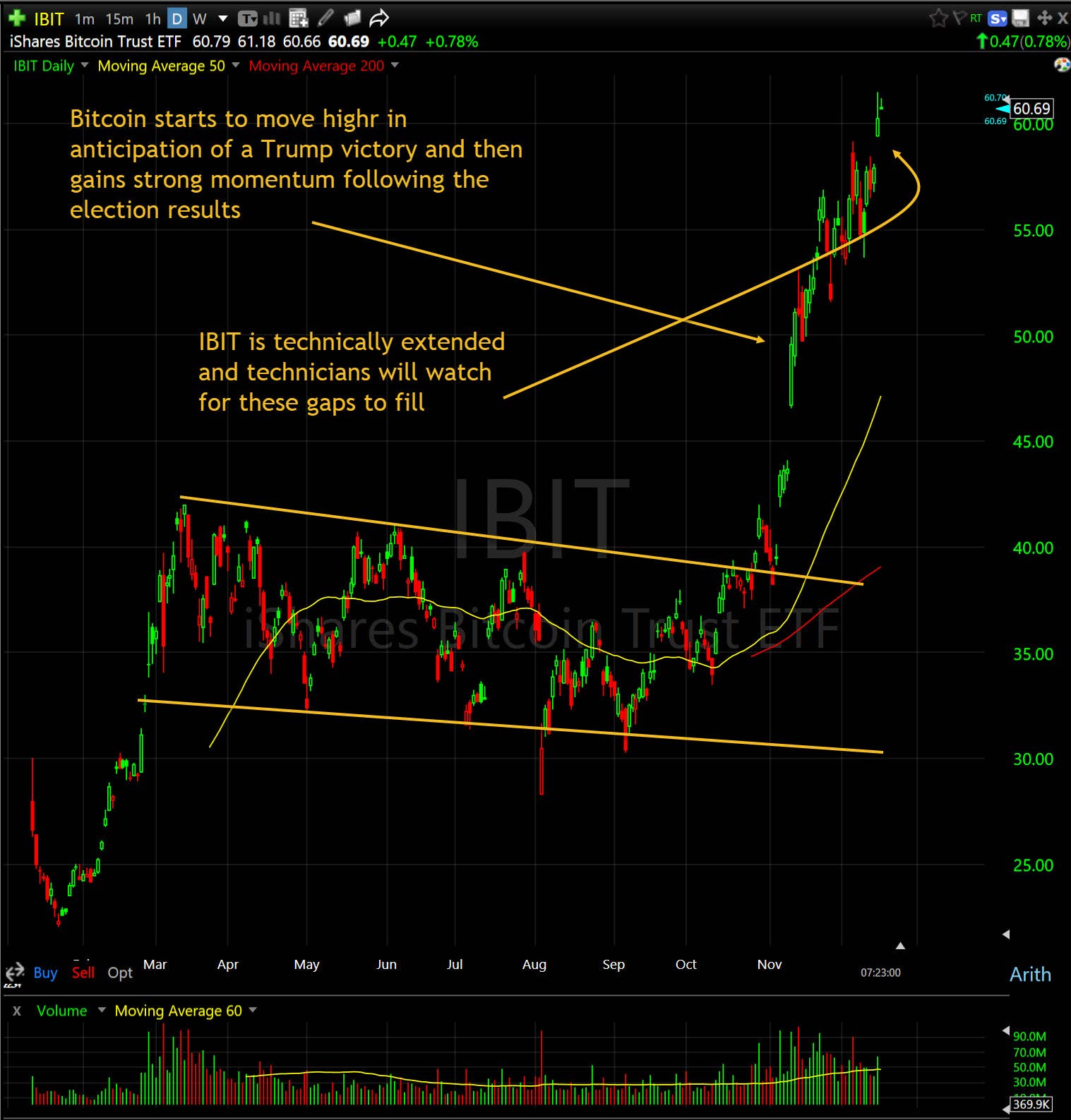
The way to trade and invest in Bitcoin is based purely on the charts. Determine your time frames and then apply standard technical analysis to move in and out of a position.
Bitcoin is very likely to be highly volatile in the years ahead, and holders need to be emotionally prepared for that if they are holding it for the longer term. Traders will have many opportunities to trade Bitcoin, but it will require constant vigilance and good trade management.
My vehicle of choice for Bitcoin is the iShares Bitcoin Trust ETF IBIT. Some brokers now allow this ETF to be traded 24 hours a day, so it is not much different from holding actual Bitcoin.
At the time of publication, DePorre was long IBIT.